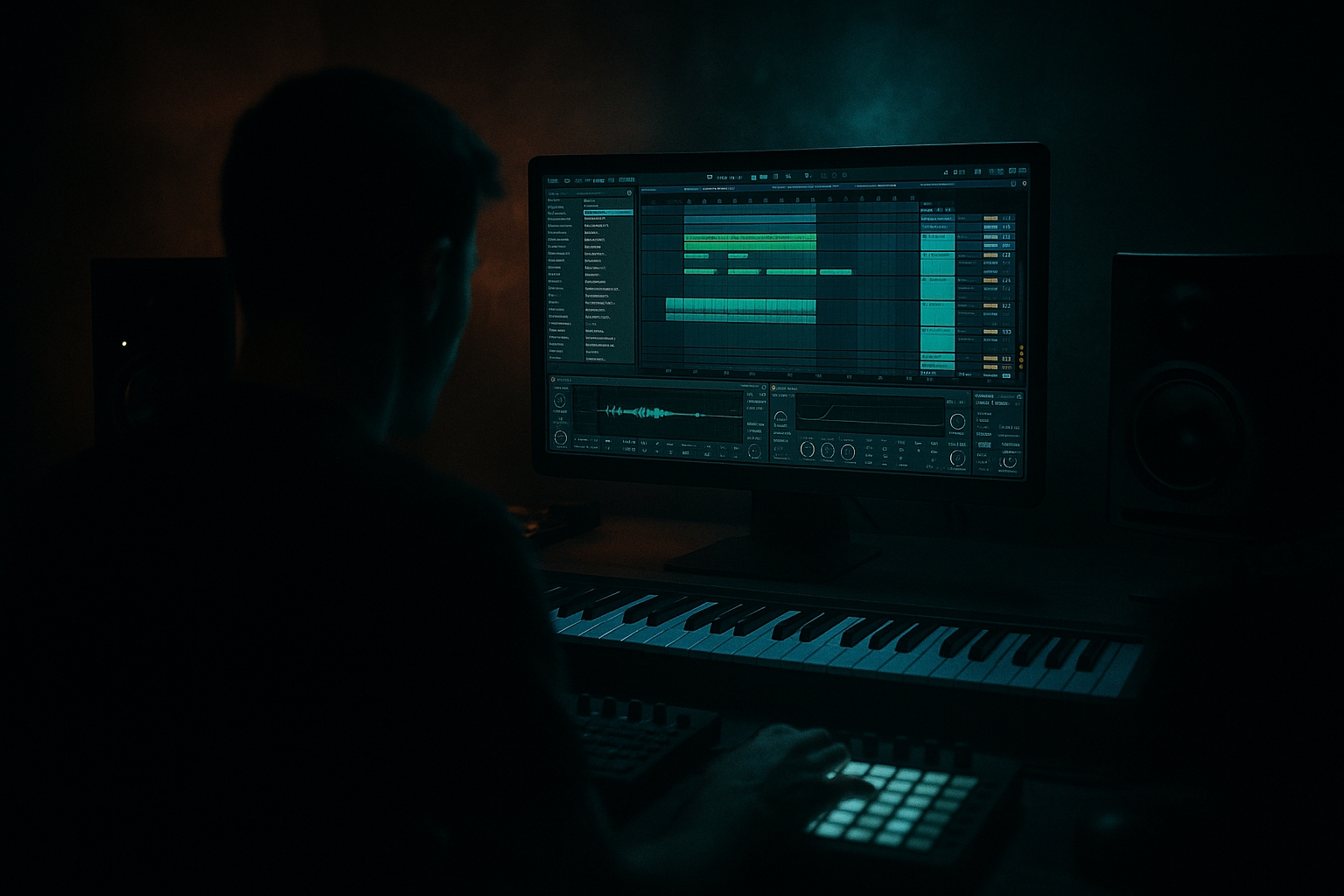
Main tutorial
Lesson Overview
A DJ intro in DnB is not just “the beginning” — it’s a functional mix-in zone. For jungle, oldskool, rollers, neuro-leaning darker bass music, and anything built for DJs, the intro has to do three jobs at once: give the DJ clean phrase alignment, establish the sonic identity of the tune, and create enough grit and tension that the drop feels earned.
In this lesson, you’ll learn how to saturate a DJ intro using only stock Ableton Live 12 devices, with a specific focus on jungle / oldskool DnB character. The goal is not to “make it louder” in a generic way. The goal is to create that worn-tape, driven-console, slightly crushed, dancefloor-ready intro energy while keeping your low end controlled and your mix DJ-friendly.
Why this matters in DnB: intros often carry break fragments, bass teases, FX atmospheres, and filtered drum loops that need to feel alive before the drop. Saturation helps unify those elements, adds perceived energy at low volume, and makes a sparse intro feel like it already has weight. Done right, it gives you the classic urgency of jungle and early DnB without destroying the transients that make the drums hit.
What You Will Build
You’ll build a 16-bar DJ intro that can sit before a drop in a jungle or oldskool DnB tune, using only Ableton stock devices. The intro will have:
- A filtered break-led opening with controlled saturation
- A midrange reese tease or bass stab that feels gritty but not fully exposed
- Gentle bus saturation that glues drums, atmospheres, and FX together
- Automation that gradually increases density, harmonic bite, and perceived tension
- A clean handoff into the drop, with a final 1–2 bar push that feels mix-ready for DJs
- dusty break intro with tape-like edge
- slightly overdriven rims, hats, and ghost notes
- dark atmospheric bed with subtle movement
- bass hint that gets rougher as the phrase builds
- enough headroom to avoid clipping the master while still feeling aggressive
- Bars 1–4: sparse, DJ-friendly opening
- Bars 5–8: more break detail, first harmonic saturation move
- Bars 9–12: introduce bass hint / reese texture / impact FX
- Bars 13–16: push tension with more drive, then hand off to the drop
- EQ Eight: high-pass around 25–35 Hz to remove sub rumble
- Gate or transient-friendly editing: clean any noise tails you don’t want
- Drum Buss: Drive around 5–15%, Crunch 10–25%, Boom mostly off or very subtle
- Mode: Analog Clip or Soft Sine
- Drive: 3–8 dB
- Output reduced to match level
- Utility
- EQ Eight
- Saturator
- Drum Buss
- Glue Compressor
- Limiter only for safety, not loudness
- Width: 70–100% depending on the layer
- Bass-related layers: 0–60% width if needed
- Atmosphere/FX: wider is fine, but don’t let them swamp the center
- Gentle cut around 200–400 Hz if the break and atmosphere cloud each other
- Small dip around 2.5–5 kHz if saturation makes hats too sharp
- Optional high shelf reduction if the intro gets brittle
- Drive: 2–6 dB for subtle glue
- Soft Clip: on
- Curve: keep it moderate; don’t chase extreme flattening yet
- Drive: 5–20%
- Crunch: 5–15%
- Transients: slightly positive if the break loses impact
- Damp: if the top end gets harsh
- Ratio: 2:1 or 4:1
- Attack: 10–30 ms
- Release: Auto or 0.1–0.3 s
- Aim for 1–3 dB gain reduction
- Saturator Drive rises gradually from 1–2 dB in bars 1–4 to 5–7 dB by bars 13–16
- EQ Eight low-pass or high-shelf opens gradually as the intro progresses, revealing more harmonics toward the drop
- Drum Buss Crunch from 5% to 15%
- Glue Compressor threshold for slightly more glue in the final 4 bars
- Utility width on atmospheres from narrower at the start to wider near the drop
- It commits the crunch
- It lets you chop the tail, reverse bits, and create extra micro-edits
- It adds the “worked on” feel that classic jungle intros often have
- Re-chop ghost notes and snares
- Reverse a few 1/16 or 1/8 fragments
- Add tiny stutters before transitions
- Layer the resampled texture under the original for density
- 1–2 notes per bar
- short rhythmic answers to the break
- maybe one note held across a bar transition for tension
- Auto Filter
- Saturator
- EQ Eight
- Utility
- Auto Filter low-pass around 150–400 Hz, with moderate resonance
- Saturator Drive: 2–5 dB
- EQ Eight: cut muddy low mids if the bass smear fights the break
- Operator or Wavetable for tonal risers
- Analog or Noise-based devices if you want simple noise sweeps
- Auto Filter for movement
- Reverb on a return track for space
- Saturator on FX returns if they need more presence
- Reverb: long decay, low dry/wet, high cut to avoid fizz
- Saturator after the reverb: 1–3 dB Drive
- EQ Eight after saturation: tame harsh peaks around 6–10 kHz if needed
- Mono your low end with Utility on bass and sub layers
- Keep sub below about 120 Hz centered
- Use EQ Eight to remove unnecessary low-end from atmospheres and FX
- Watch the Master: leave headroom, don’t crush the intro just because it feels cool soloed
- Use the Spectrum device if you need to see whether saturation is overloading the 2–5 kHz band
- a brief dropout for impact
- a final stab or break fill
- a tension FX tail that clears space for the drop’s first transient
- Over-saturating the entire intro from bar 1
- Crushing the break transients
- Letting the low end get fuzzy
- Making the intro too busy
- Saturating atmospheres until they hiss
- Ignoring gain staging
- Put Saturator before Glue Compressor on the intro bus if you want the compressor to “grab” the harmonics and glue the intro harder.
- Use Drum Buss on the break only, and keep the bus saturation subtler. This gives you bite without turning the whole intro into mush.
- For neuro-leaning darkness, automate tiny cutoff changes on Auto Filter in sync with saturation ramps. Movement matters more than brute force.
- Add a very small amount of clip-style saturation to ghost notes and percussion, not just the kick/snare. That creates the “rusty machine” texture common in darker rollers.
- If your intro needs more menace, bias the midrange around 700 Hz–2 kHz with subtle saturation rather than boosting sub. Midrange drive reads louder on club systems and translates better in dense mixes.
- Use Utility to narrow the intro slightly in the first 8 bars, then widen atmospheres toward the drop. That makes the arrangement feel like it’s expanding.
- If a reese tease feels too clean, resample it and process the bounce again. Two light passes often sound more organic than one extreme pass.
- A DJ intro in DnB needs tension, phrase clarity, and mixability.
- Saturation works best when it evolves across the arrangement instead of staying static.
- Use parallel saturation to preserve break transients while adding grit.
- Group intro elements to a bus and shape them with EQ Eight, Saturator, Drum Buss, and Glue Compressor.
- Resample dirty layers for authentic jungle texture and better arrangement control.
- Keep the sub mono, manage headroom, and let the final 2 bars create space for the drop.
Sonically, expect a result in the lane of:
Step-by-Step Walkthrough
1. Set up the intro as a dedicated arrangement section
Start in Arrangement View and carve out a 16-bar intro region before the drop. For advanced DnB writing, think in 4-bar phrases with a clear escalation curve:
Create a few tracks only: Breaks, Top Loop, Atmosphere, Bass Tease, FX. Keep this intro lean. In DnB, clarity is part of the tension. A DJ intro that’s too busy loses its function.
For oldskool jungle vibes, use a chopped break on one audio track and a separate top-layer loop on another. If you’re using MIDI, bounce/resample your break first so you can process it more aggressively and commit to arrangement decisions early.
2. Build your drum foundation before saturating it
Put your break on an audio track and use Ableton’s stock tools to shape it before adding distortion. Start with:
For a jungle/oldskool intro, the break should already feel a little worn. You want the kick/snare transient to remain intact, but the ghost notes and hat debris should get denser when saturated.
A useful move: duplicate the break track and make one version “cleaner” and the other “dirty.” On the dirty duplicate, add Saturator with:
Then blend that track quietly under the cleaner break. This parallel approach preserves punch while adding grit.
Why this works in DnB: break-based intros need transient snap to stay danceable, but the vibe comes from the in-between details. Parallel saturation thickens the break without flattening the whole groove.
3. Create a saturation chain for the intro bus
Route all intro elements — breaks, atmospheres, bass tease, FX — to a dedicated Intro Bus Group. This is where the glue happens.
Suggested stock device chain on the Intro Bus:
Start with Utility to check stereo width. Keep low-end elements mono or narrow:
On EQ Eight, trim anything muddy before saturation:
Now add Saturator:
Then Drum Buss:
Glue Compressor:
This bus chain gives you a cohesive intro texture. It’s especially effective in rollers and darker DnB because the saturation makes multiple layers feel like one intentional soundscape rather than separate clips.
4. Use saturator automation to evolve the intro over 16 bars
Here’s where the arrangement becomes musical rather than static. Don’t set one saturation amount and leave it. Automate the drive and filter interaction so the intro “opens up.”
Two strong automation moves:
For extra oldskool pressure, automate Saturator’s Output down slightly as Drive goes up so the perceived loudness stays controlled. That way you increase density without accidentally clipping your mix bus.
You can also automate:
Keep the automation phrase-based. In DnB, 4-bar phrasing is king. A subtle automation every 4 bars feels intentional and mix-friendly.
5. Resample a saturated intro layer for authentic jungle texture
One of the strongest advanced moves is to resample part of your intro. In Ableton, record your intro bus or break subgroup to a new audio track once the saturation is sounding right.
Why resample?
Take the resampled audio and drop it into Simpler or Slice to New MIDI Track if you want more control. Then:
If you want a really authentic vibe, resample only the dirty parallel break layer, not the clean core. That keeps the snap while letting the noise floor and harmonic smear become part of the character.
This is especially useful for oldskool-style DJ intros because the audience hears the wear and tear before the drop. That sonic imperfection is part of the genre language.
6. Add a bass tease with controlled saturation, not full power
For a DJ intro, you usually don’t want the full bassline revealed. You want a tease — a note, a phrase fragment, or a reese texture that hints at the drop.
Use Operator, Wavetable, or even a sampled bass hit through Simplers. Keep it minimal:
On the bass tease channel, try this stock chain:
Settings to start:
If you want a reese-like tease, use Wavetable or Operator with detuning, then saturate it lightly and keep it narrow. The trick is to let the distortion create movement, not just volume. A small automation on filter cutoff or wavetable position can make the bass feel like it’s waking up under the intro.
Arrangement idea: place the bass tease in bars 9–12 only, then let it disappear for a bar before the drop. That contrast makes the final drop entry feel larger.
7. Shape transitions with filtered noise, impacts, and saturation ramps
For DnB intros, transition design is part of the saturation story. If every element gets more harmonically dense, your transitions need to support that movement.
Use stock devices for FX layers:
Try this on an FX return:
This gives your risers and downlifters more density without making them feel polished or glossy. In darker DnB, a slightly gritty riser is often better than a clean EDM-style one.
A useful arrangement move: in the final 2 bars, automate a short filter drop or a reverse crash into the downbeat. If the whole intro has been getting more saturated, that final FX hit becomes a natural release point.
8. Final mix discipline: keep the intro aggressive but DJ-friendly
Advanced DnB intros need to be hard enough to excite but clean enough for DJs to blend. This is where many productions lose their usefulness.
Check these points:
A practical target: the intro should feel loud and dense, but the peak levels should remain controlled enough that the drop can hit harder. If your intro already sounds “finished” at the same intensity as the drop, you’ve likely over-saturated the build.
For arrangement, make sure the last bar before the drop has either:
That space is what makes the drop land.
Common Mistakes
Fix: automate drive in stages. Start cleaner, then intensify over 8–16 bars.
Fix: use parallel saturation, not only serial distortion. Preserve one clean drum layer.
Fix: keep sub mono, use EQ Eight before and after saturation, and avoid boosting saturated bass below 120 Hz.
Fix: remember the DJ function. Sparse arrangement with strong phrasing beats random detail.
Fix: low-pass or high-cut your ambience before or after the saturator, and blend it lower.
Fix: match the output level after each saturation stage so you judge tone, not loudness.
Pro Tips for Darker / Heavier DnB
Mini Practice Exercise
Spend 10–20 minutes building a 16-bar DJ intro from an existing DnB project or loop pack.
1. Choose one break loop, one atmosphere, and one bass tease.
2. Group them into an Intro Bus.
3. Add EQ Eight, Saturator, Drum Buss, and Glue Compressor on the bus.
4. Automate Saturator Drive from low to moderate across the 16 bars.
5. Duplicate the break track and create a parallel dirty layer.
6. Resample 4 bars of the intro bus and chop one or two fragments back into the arrangement.
7. Check the intro in mono for low-end cleanliness.
8. Export or bounce the 16 bars and compare it against a reference jungle intro.
Goal: make the intro feel like it gets heavier and more dangerous over time without losing mix clarity.
Recap
If you can make the intro feel worn, weighty, and purposeful using only stock Ableton devices, you’re already working in real DnB arrangement language.

