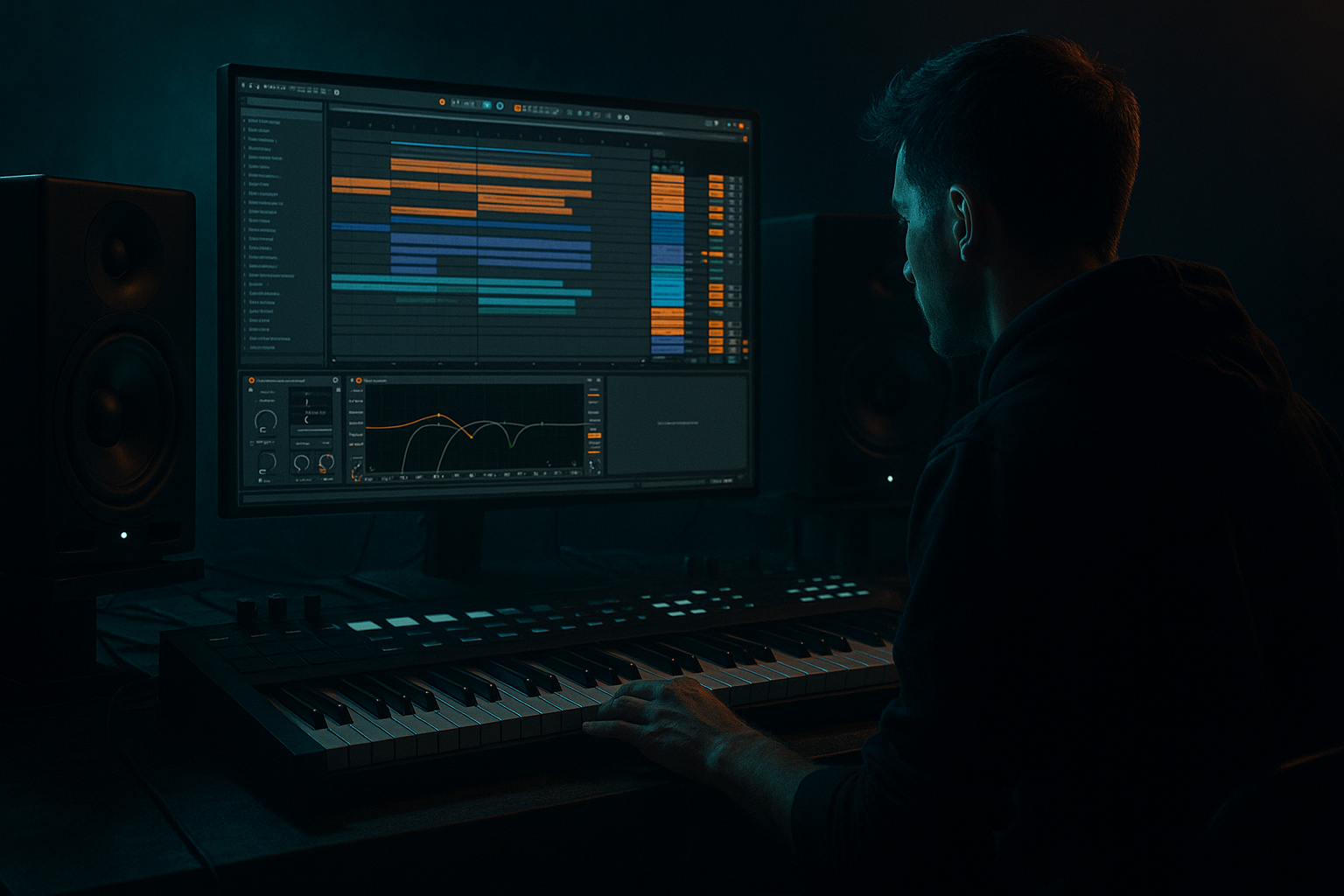
Main tutorial
Lesson Overview
A filtered breakdown is one of the strongest tension tools in jungle and oldskool DnB. You take your bassline, pad, stab, or break-driven texture, filter out the weight, then slowly saturate and resample the signal until it starts to feel like it’s fighting its way back into the tune. That “coming alive” moment is pure dancefloor energy.
In this lesson, you’ll build a breakdown that starts slim, dusty, and restrained, then gets progressively dirtier through resampling inside Ableton Live 12. The goal is not just distortion for its own sake — it’s controlled harmonic buildup that gives your drop more impact, more attitude, and more history. Think: rave tension, jungle grime, broken-up tape energy, and the kind of saturation that makes a bassline sound like it’s been played through a warehouse PA 🌑
This fits especially well in the 8, 16, or 32 bars before a drop, or as a mid-track switch-up in a roller or darker jungle tune. The technique matters because DnB arrangement lives and dies by contrast: clean vs dirty, narrow vs wide, filtered vs full-range, restrained vs explosive. Resampling lets you commit to a sound, then reshape it like audio — which is ideal for edits, transitions, and that “sampled-from-the-session” feel that oldskool records and modern neuro-adjacent rollers both benefit from.
What You Will Build
You’ll create a breakdown section where:
- A bassline or reese is filtered down into a smoky, mid-focused texture
- Saturation and harmonics are introduced in stages using Ableton stock devices
- The evolving sound is resampled to audio so you can edit it like a break or chopped sample
- The resampled audio is then layered, reversed, gated, or sliced for a more dangerous jungle-style transition
- The final result feels like a living breakdown that can lead into a heavy drop, a half-time switch, or a rewind-style edit
- Saturating before filtering too much
- Printing a breakdown that is already too busy
- Letting the low end get messy
- Overdoing saturation so the sound becomes flat
- No edit point before the drop
- Ignoring the context of the drums
- Use a second resample pass
- Try parallel saturation on a return
- Keep the sub out of the edit layer
- Use tiny rhythmic cuts
- Add a ghost break
- Use Utility for mono discipline
- Make the saturation follow the arrangement
- Filter first, then saturate, then resample for the best breakdown evolution.
- Print the movement to audio so you can edit it like a jungle-style sample or break.
- Automate the saturation in stages to create tension across the phrase.
- Keep the low end controlled and the edit readable.
- The strongest DnB breakdowns are not just atmospheric — they are arranged to make the drop feel inevitable.
Musically, this could be a 16-bar breakdown after the first drop: bars 1–4 stripped and filtered, bars 5–8 adding harmonic grit, bars 9–12 becoming more distorted and rhythmic, and bars 13–16 chopped into a suspenseful fill before the drop. The sound should feel like it’s collapsing inward, then snapping back with more weight.
Step-by-Step Walkthrough
1. Choose a strong source sound with enough midrange character
Start with a bassline, reese, or chord stab that already has movement. This works best with something that has rich harmonics: a detuned reese, a wobbling sub-bass with mid layers, or a gritty sampled stab. If you only have a clean sine sub, it won’t resample into much interesting saturation.
Good starting choices in Ableton Live:
- A bass built from Wavetable or Analog
- A sampled bass loop
- A chopped break with a bass note layered underneath
- A synth stab bounced to audio
For oldskool jungle vibes, a bassline with slightly off-grid phrasing works especially well. Don’t make it too tidy. The filter movement and resampling will make the groove feel more organic.
Practical target: make sure the sound has energy between roughly 150 Hz and 2 kHz so saturation has something to chew on.
2. Build a breakdown chain with controlled filtering
On the bass track, insert Ableton stock devices in this order:
- EQ Eight
- Auto Filter
- Saturator
- Utility
Use EQ Eight first to clean the source before filtering:
- High-pass gently around 25–35 Hz to remove useless sub rumble
- If the sound is muddy, dip 200–400 Hz by 2–4 dB
- If it’s too harsh already, lightly tame 3–5 kHz before saturation
Then use Auto Filter as the main breakdown motion:
- Start with a low-pass around 180–400 Hz for a very stripped opening
- Raise resonance modestly, around 0.20–0.45, to give the filter some attitude
- Automate cutoff slowly over 8 or 16 bars
- If the source is rhythmic, try subtle envelope modulation or slight LFO movement for life
Put Saturator after the filter. This is important: if you saturate after filtering, you emphasize the harmonics in the remaining band and make the filtered signal feel denser without immediately opening up the whole spectrum.
3. Set up a resampling route inside Ableton Live 12
Create a new audio track and set its input to Resampling. Arm the track to record the breakdown performance in real time.
This workflow is the heart of the lesson. Instead of endlessly tweaking a MIDI sound, you are printing a performance of the filtered/saturated motion into audio. That gives you:
- More commit-and-move momentum
- Edit-friendly waveforms for chopping
- The ability to reverse, warp, and slice like a break
- A more authentic sampled feel for jungle and oldskool DnB
Start playback and record the breakdown movement for 8 or 16 bars while automating cutoff, drive, and perhaps a utility gain trim. Keep the arrangement playing in context with drums muted or heavily reduced so you hear the tension building on its own.
4. Automate saturation in stages, not all at once
Use the Saturator’s Drive control as a slow-build tool rather than a constant “more” knob. A classic move:
- Bars 1–4: Drive around 1–3 dB
- Bars 5–8: Drive around 4–7 dB
- Bars 9–12: Drive around 7–10 dB
- Bars 13–16: Push harder only if the arrangement can support it
Try Soft Clip on for a smoother, more mix-friendly edge. If you want more obvious grime, experiment with the Color section and move the Frequency slightly upward so the saturation accentuates more upper mids.
The point is to make the breakdown feel like it’s heating up. In DnB, saturation is not just for loudness; it’s for movement and urgency. As the cutoff opens and drive increases, the sound becomes more audible on smaller systems and more threatening on club systems.
5. Resample the hottest part and edit it like a break
Once the audio is recorded, consolidate the best 4–8 bars or a strong 2-bar section. Then duplicate the clip and start editing.
Try:
- Reverse a short phrase before the drop
- Cut the audio on transient points and rearrange 1/2-bar or 1/4-bar pieces
- Use Clip Gain or fades to avoid clicks
- Warp in Beats mode if the phrase needs tighter rhythmic placement
- Use a tiny rhythmic gap before the drop for extra punch
This is where the lesson becomes an Edits workflow. Instead of leaving the breakdown as a static automated synth, you are turning it into a sampled performance. That’s how you get those chopped-up, almost DJ-edit-like transitions that feel rooted in jungle and rave culture.
A strong move is to slice the resampled audio to a Drum Rack:
- Right-click the audio clip
- Choose Slice to New MIDI Track
- Slice by transient if the part is rhythmic
- Trigger fragments like fills, stutters, and reverse pickups
This gives you an edit grid you can perform and rearrange very quickly.
6. Layer the resampled texture with a filtered break for jungle context
To make the breakdown feel more authentic, layer the resampled bass texture with a break or top loop. Keep the break filtered too so the low end doesn’t clutter.
On the break layer:
- Use Auto Filter with a band-pass or high-pass
- Roll off below 120–180 Hz
- Add Drum Buss lightly for transient shaping and grit
- Use Glue Compressor on the drum bus if needed, but keep it subtle
If your breakdown has a sparse kick/snare pulse, the resampled bass energy and the break layer will interact like a classic intro-to-drop ramp. That call-and-response between bass and drums is key in jungle and rollers: the bass answers the break, then the break disappears right before impact.
Musical context example: in a 174 BPM track, you might let the filtered bass and chopped break trade space for 16 bars, with the snare doing a simple 2 and 4, then pull the kick out for the last 2 bars so the drop lands harder.
7. Shape the resampled audio with EQ and transients
Once you have the printed audio, treat it as an edit element rather than a synth. Use EQ Eight to sculpt the tone:
- High-pass at 30–45 Hz if the saturation created sub mud
- Cut 250–500 Hz if the audio feels boxy
- Boost gently around 900 Hz to 2 kHz if you want more “talk”
- Tame 3–6 kHz if the saturation gets fizzy or painful
If you want the breakdown to punch harder as an edit, add Drum Buss or a light Transient control approach via Drum Buss:
- Drive: 5–20% depending on how rough you want it
- Boom: minimal or off for this use case
- Transients: small positive lift for more snap on chopped bits
Use Utility to tighten stereo if the resampled part gets too wide. For darker DnB, keep the low-mids mostly centered. The result should feel powerful but not smeared.
8. Use automation to create a clear phrase arc
Arrange the breakdown with a clear tension curve. In DnB, listeners need to feel the drop coming even if the track gets weird.
A strong 16-bar breakdown shape:
- Bars 1–4: low-pass filtered, minimal drive, wide reverb tail if used
- Bars 5–8: cutoff opens slightly, saturation increases, a few break chops appear
- Bars 9–12: more movement, higher drive, a short reverse slice or fill
- Bars 13–16: final tension move, then a hard stop or snare pickup into the drop
If you’re working on a roller, keep the phrasing smoother and more hypnotic. If you’re going oldskool/jungle, make the edits more obvious and sample-like, with more abrupt chops and reverse snippets. For neuro-leaning darkness, keep the automation tighter and more mechanical, with fast filter rises and a more aggressive harmonic build.
Common Mistakes
- Fix: filter first, then saturate the reduced band so the harmonics feel intentional.
- Fix: simplify the source. Resampling works best when the sound has space to evolve.
- Fix: high-pass the resampled audio around 30–45 Hz, and keep sub information mono and controlled.
- Fix: use staged drive automation. You want contrast, not constant maximum grit.
- Fix: leave a clear gap, reverse tail, or drum pickup. DnB needs impact through arrangement, not just loudness.
- Fix: always hear the breakdown with the break or kick/snare pattern around it. The tension has to work against the rhythm section.
Pro Tips for Darker / Heavier DnB
- Print the first saturated pass, then send that audio through another round of filtering and light Drive. This can create a more “damaged tape” or “sampled cassette” character.
- Create a Return track with Saturator and EQ Eight, then blend it under the dry breakdown for controlled grime. This helps keep clarity while adding edge.
- Let the breakdown texture live in the mids and upper mids while the sub stays muted or very controlled. The drop will hit harder when the sub returns.
- A 1/8 or 1/16 gap before the snare or drop can make the edit feel more dangerous than a giant riser.
- Put a very low-mixed break chop underneath the saturated breakdown to imply motion without crowding the groove.
- If the breakdown widens too much, reduce width on the resampled layer and keep bass-focused material center-heavy. Underground DnB still needs club translation.
- More drive in the final 4 bars, less in the first 4. That progression is what makes the breakdown feel like a scene change, not a loop.
Mini Practice Exercise
Spend 10–20 minutes making a 16-bar filtered breakdown edit using only stock Ableton devices.
1. Pick one bassline, reese, or stab loop.
2. Insert EQ Eight, Auto Filter, Saturator, and Utility.
3. Automate the filter from low-pass heavy to more open over 16 bars.
4. Automate Saturator Drive from light to aggressive in 3 stages.
5. Resample the full performance to a new audio track.
6. Cut out the best 4 bars and reverse one of the last phrases.
7. Add a filtered break underneath for the final 8 bars.
8. Create a 1-bar gap or pickup before the drop.
Aim for a breakdown that feels like it could sit in a 170–174 BPM jungle or rollers arrangement. Don’t chase perfection — focus on tension, grit, and a clean transition.

