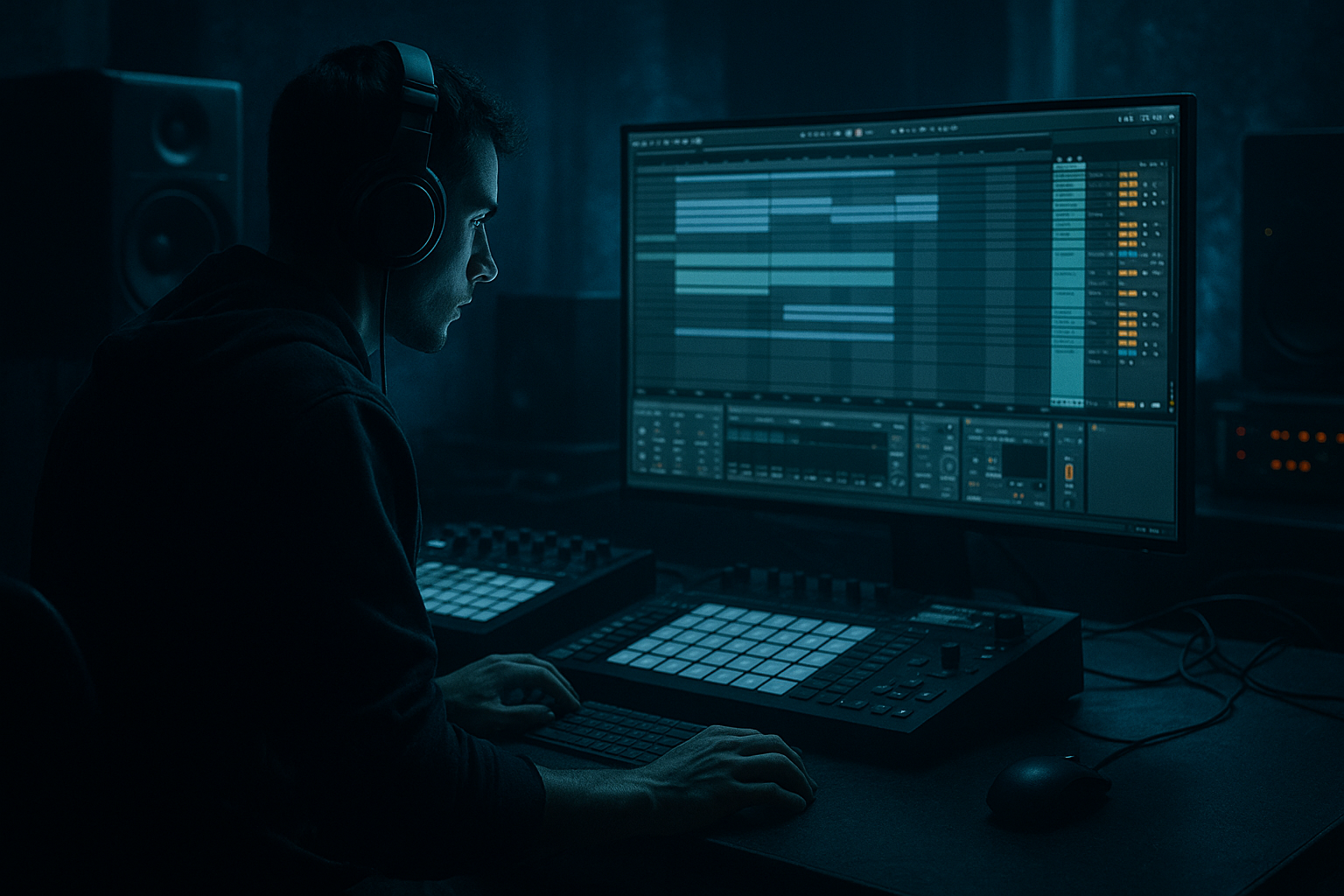
Main tutorial
Lesson Overview
This lesson is about turning an Amen-style vocal texture into a saturated, DJ-friendly arrangement element that feels at home in Drum & Bass — especially in jungle, rollers, darker liquid, and neuro-leaning tracks. The goal is not just to make a vocal sound gritty. It’s to make it behave like a proper arrangement tool: something that can carry tension through the intro, reinforce the first drop, create contrast in the breakdown, and still mix cleanly with fast drums and a heavy bassline.
In DnB, vocals often fail in one of two ways: they’re either too polished and floaty to cut through the density, or they’re too over-processed and destroy the groove. The sweet spot is a texture that feels sampled, rhythmic, damaged, and controlled. Think chopped vocal phrases, short dub-style hits, formant-shifted fragments, and saturated tails that sit between the drums and the bass rather than on top of everything.
Why this matters in arrangement: DnB relies on energy management. A vocal texture can act like a bridge between sections, a hook in the intro, a response to the bass, or a tension layer before a drop. If you structure it properly, it helps the tune feel intentional and DJ-friendly instead of just “packed with ideas.”
---
What You Will Build
You’ll build a gritty Amen-style vocal texture in Ableton Live 12 that:
- starts as a chopped vocal loop or phrase
- gets warped and edited into sync with DnB phrasing
- is saturated and shaped into a textured midrange layer
- sits in a DJ-friendly arrangement with a clean intro, strong 16- or 32-bar phrasing, and a controlled drop
- works as a call-and-response element with drums and bass
- can be automated for tension, filter movement, and breakdown energy
- spoken words
- one-shot phrases
- dark ad-libs
- radio-style lines
- rough mic recordings with character
- Warp mode: Complex Pro or Beats
- Formants: reduce slightly, around -2 to -5 for a darker edge
- Transpose: try -3 to -7 semitones if the phrase can tolerate it
- Right-click the audio clip
- Choose Slice to New MIDI Track
- Slice by Transients or 1/8 notes depending on the source
- Use the default Simpler slicing device for quick auditioning
- Bar 1: one short phrase fragment
- Bar 2: a higher or more urgent fragment
- Bar 3: a gap or reverse tail
- Bar 4: a more saturated response hit
- EQ Eight
- Saturator
- Drum Buss or Roar if you want more aggression
- Compressor or Glue Compressor
- optional Auto Filter
- EQ Eight: high-pass around 120–180 Hz to keep sub out of the vocal texture
- Saturator: Drive around 2–6 dB, Soft Clip on
- Drum Buss: Drive around 5–15%, Crunch low to moderate
- Compressor: 2:1 to 4:1 ratio, slow-ish attack, medium release
- Auto Filter: low-pass automation from 8 kHz down to 2–4 kHz for builds or breakdowns
- Intro, bars 1–16: filtered vocal texture, sparse drums, distant atmosphere
- Bars 17–32: more vocal chops appear, snare build hints, bass tease
- Drop 1, bars 33–64: vocal responds to drums and bass in short calls
- Breakdown, bars 65–80: vocal stretches, filters open, reverb tail expands
- Drop 2, bars 81–112: more aggressive vocal slicing and heavier saturation
- fewer hits in the intro
- more frequent slices entering the pre-drop
- a clear drop moment where the vocal either disappears briefly or hits with maximum impact
- automate Auto Filter cutoff
- automate Saturator drive subtly across phrases
- use Reverb on a return track for selected vocal hits only
- add Echo with short, dubby feedback for end-of-line phrases
- resample the processed vocal texture into a new audio track for extra editing freedom
- bounce the processed vocal texture
- reverse a few sliced tails
- place reverse fragments before snare hits or before a bass re-entry
- use short automation ramps to make the vocal open and close around transitions
- vocal hit on beat 4, snare responds on beat 1
- vocal phrase ends where the bassline begins
- chopped vocal call between kick/snare gaps
- tiny vocal bursts tucked around ghost notes and break edits
- keep the vocal texture mostly in the midrange
- mono-check it if it starts to smear the stereo image
- if using reverb, high-pass the return so the low mids don’t cloud the bass
- Reverb for washed tails into breakdowns
- Echo for last-word repeats
- Frequency Shifter very subtly for unstable tension
- Auto Filter for pre-drop filtering
- Utility for width control or monoing the low mids
- at the end of every 8th or 16th bar, duplicate the last vocal slice
- add a quick reverb throw
- automate filter cutoff down into the transition
- cut the dry signal for half a bar before the drop
- reintroduce the vocal with a hard, saturated hit on the first bar of the new section
- Does the vocal help the tune breathe?
- Is there enough empty space before the drop?
- Do the vocal hits feel intentional every 4, 8, or 16 bars?
- Does the vocal support the bassline instead of fighting it?
- turn the track down low and see if the vocal still reads
- compare the texture against the snare level
- mono-check the vocal group
- make sure the saturation isn’t creating harsh spikes when the drop hits
- Overlong vocal phrases
- Too much low end in the vocal
- Saturation making the vocal harsh
- No arrangement contrast
- Vocal fighting the snare
- Too much stereo width
- Layer a second octave-downed vocal shard very quietly under the main texture. Saturate it lightly and high-pass it so it adds menace without mud.
- Use Drum Buss on the vocal group with a touch of Crunch and Transients to make the texture feel more percussive.
- Automate Saturator Drive only at phrase ends so the vocal blooms before a transition, then backs off in the next section.
- Resample the vocal through reverb and saturation to create a haunted background layer for intros and breakdowns.
- Sidechain the vocal group subtly to the kick/snare bus if the arrangement is dense. Keep it gentle so it breathes, not pumps like a dance-pop mix.
- Use short, repeated vocal stabs as bass call-and-response in a neuro or dark roller context. The vocal becomes another rhythm instrument, not just an effect.
- For jungle energy, degrade the texture slightly with rough warping, tighter slicing, and less polished filtering. Imperfection is part of the aesthetic.
- For heavier rollers, keep the vocal more restrained and use it as a controlled tension layer rather than a constant hook.
- Chop the vocal into rhythmic fragments and treat it like part of the break.
- Saturate with control: add harmonics, but keep the snare and bass clean.
- Use arrangement phrasing to make it DJ-friendly: intro, build, drop, breakdown, reset.
- Automate filters, drive, and reverb to create movement across sections.
- Keep the vocal midrange-focused, rhythmically tight, and supportive of the drums and bass.
Musically, the end result should feel like a dark vocal shard: not a lead vocal, not just background ambience, but a rhythmic texture that helps drive the track forward. Imagine a 174 BPM roller where the vocal fragments appear every four bars in the intro, then get chopped harder in the build, and finally punctuate the drop alongside snare fills and reese movement. That’s the target.
---
Step-by-Step Walkthrough
1. Choose or record a vocal source that can survive heavy processing
Start with a short vocal phrase, spoken line, or even a few syllables that have a strong rhythmic shape. For this style, avoid long, emotional sung vocals unless you plan to chop them aggressively. Better sources are:
Drag the vocal into an audio track and set the project to around 174 BPM if it isn’t already. Use Warp so the timing locks to your DnB grid. For a more sample-based jungle feel, try Complex Pro if the source is tonal and needs preservation, or Repitch if you want a rougher, more old-school sample vibe. For short chopped fragments, Beats can work if transient preservation matters.
Useful starting points:
Why this works in DnB: fast tempos expose sloppy warping instantly. If the vocal doesn’t lock to the grid, the whole arrangement feels rushed or unstable. Tight warp handling gives you a solid rhythmic foundation before you add saturation and movement.
2. Slice the vocal into playable fragments
Instead of leaving the vocal as one continuous clip, turn it into a playable phrase engine.
In Ableton Live:
Now you can trigger individual vocal shards like drum hits. This is where the Amen-style idea comes in: not necessarily a literal Amen break, but the same chopped, percussive logic. Treat the vocal fragments like a break edit — short, syncopated, and conversational.
A good arrangement-friendly pattern is:
For a more controlled workflow, create a MIDI clip and place slices only on offbeats and syncopated positions. Keep some notes empty. Negative space is part of the groove.
3. Build a saturation chain that adds weight without flattening the groove
Route the vocal slice track to an Audio Track or a Group so you can process the texture as a unit. Start with a practical Ableton stock chain:
Suggested settings:
If the vocal is getting harsh, cut a little around 2.5–5 kHz with EQ Eight rather than just reducing the drive. If it’s too thin, add saturation before EQ, not after, so you enhance harmonic density first and then shape the tone.
Keep an eye on gain staging. A saturated vocal texture in DnB should feel loud and present, but it should not steal headroom from the snare or bass. Leave enough space for the drop to hit properly.
4. Shape the texture into a DJ-friendly arrangement role
Now place the vocal texture in the song structure as an arrangement device, not just a looping sound. For DnB, think in 16-bar and 32-bar phrases.
A strong DJ-friendly structure could be:
Use the Arrangement View to automate the vocal’s density:
This makes the tune DJ-friendly because the intro/outro has enough space for mixing, and the drop arrives with a clear energy shift. That’s essential in DnB, where DJs need phrase clarity and low-end predictability.
5. Add movement with modulation, resampling, and reverse tails
Static saturation can sound good for five seconds and boring for five minutes. Add motion.
In Ableton, try these stock workflow moves:
A good move is to resample the saturated vocal group and then chop the bounced audio again. This creates accidental detail and makes the texture feel more like a broken sample than a clean vocal layer. In jungle and rollers, that “already mangled” quality is often what makes the arrangement feel authentic.
Try this:
This is especially effective before drop 2 or a switch-up section.
6. Interlock the vocal with drums and bass instead of letting it float alone
The vocal should not just occupy its own lane. It should answer the rhythm section.
In a DnB context, use it like call-and-response:
If you have an Amen break or Amen-inspired drum edit, place the vocal shards in the spaces between the snare ghosts and kick transients. That way the vocal feels like part of the groove rather than a layer pasted on top.
Mixing tip:
A practical balance point is to let the vocal texture be audible on small speakers without overpowering the snare. If the snare loses authority, reduce vocal level or tame 1.5–3 kHz.
7. Use transitions to make the arrangement feel intentional
Transitions matter a lot in DnB because the energy jumps are dramatic. Use your vocal texture as transition glue.
Useful stock devices:
A strong transition idea:
That small arrangement decision creates a huge impact. It gives the listener a clear sense of structure, which is especially important when the drums and bass are already very busy.
8. Finalize with arrangement edits and mix checks
Once the vocal texture is working musically, zoom out and judge the arrangement as a whole.
Ask:
Do quick mix checks:
If needed, use Clip Gain or Utility on the vocal group to trim the level before hitting the saturation chain. That way you can keep the texture dense without clipping the master bus.
---
Common Mistakes
- Fix: chop them into smaller rhythmic pieces. In DnB, short fragments usually work better than full lines.
- Fix: high-pass with EQ Eight around 120–180 Hz, sometimes higher if the bassline is very dense.
- Fix: reduce drive, cut harsh mids, or use softer clipping rather than brute-force distortion.
- Fix: mute or thin the vocal before the drop, then bring it back with a clear phrase change.
- Fix: move vocal hits away from snare accents or carve a small dip around 2–4 kHz.
- Fix: keep the core vocal texture more centered; use width only on effects and tails.
---
Pro Tips for Darker / Heavier DnB
Why this works in DnB: the genre thrives on contrast between precision and chaos. Saturated vocal textures can add chaos, but the arrangement must provide precision. That tension is what makes the drop feel powerful.
---
Mini Practice Exercise
Spend 10–20 minutes creating a short 16-bar DnB phrase using this method:
1. Find one vocal phrase or spoken sample.
2. Warp it and slice it to a MIDI track.
3. Build a 4-bar pattern of chopped vocal hits.
4. Route the vocal through EQ Eight, Saturator, and Auto Filter.
5. Make the first 8 bars filtered and sparse.
6. Make bars 9–16 denser, with one reverb throw and one reverse tail.
7. Add a drum loop or Amen-style break underneath.
8. Check whether the vocal answers the snare and leaves space for the bass.
Goal: in under 20 minutes, make the vocal feel like it belongs in a real DnB arrangement, not just a random loop.
---
Recap
If you get the structure right, an Amen-style vocal texture becomes more than a sound — it becomes a DnB arrangement weapon 🔥

