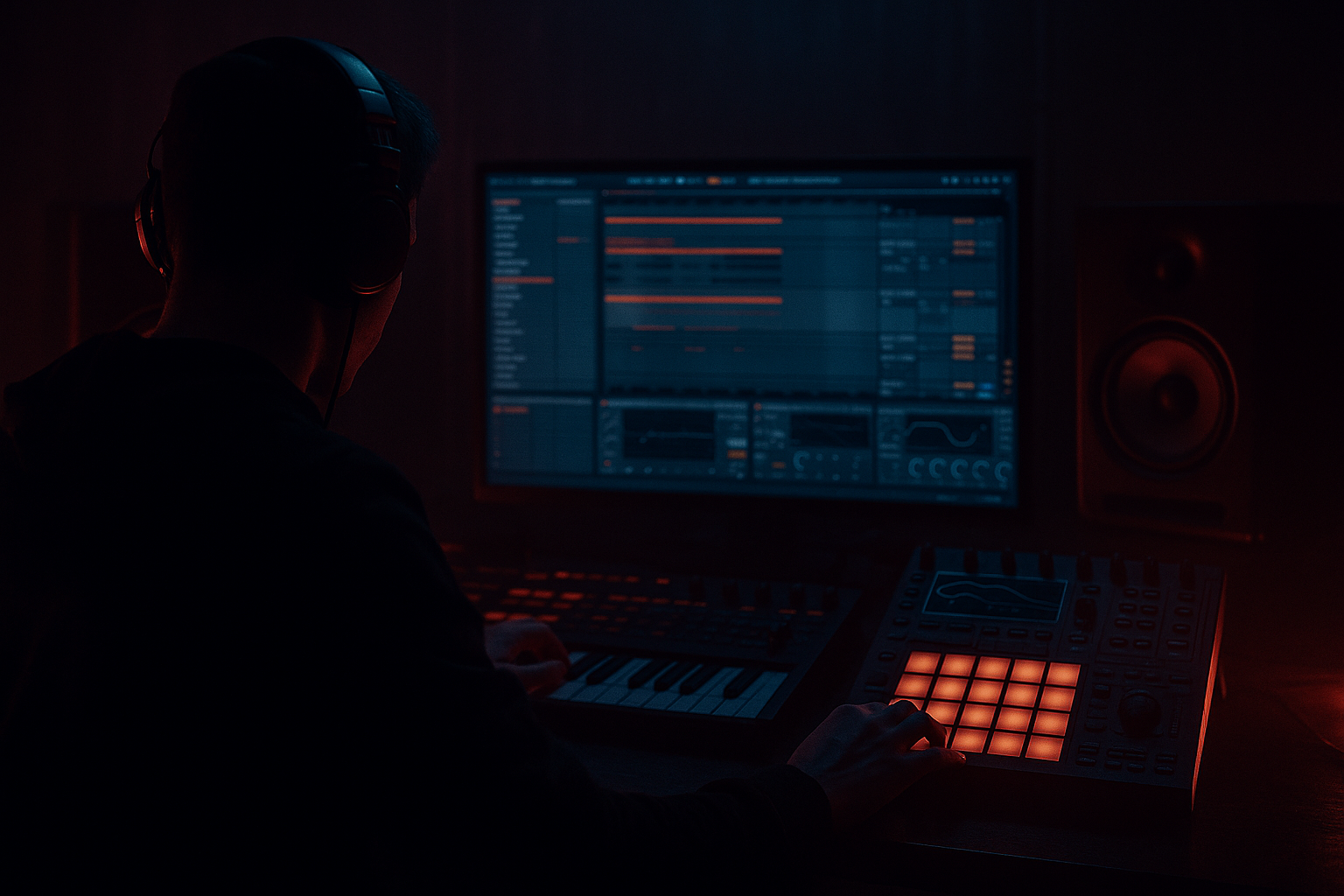
Main tutorial
Lesson Overview
Oldskool DnB ride patterns are one of the fastest ways to make a loop feel like it’s moving, rolling, and pulling energy forward — but if the ride is too clean, it can sound flat or modern in the wrong way. In this lesson, you’ll learn how to saturate an oldskool-style ride groove and then use Ableton Live 12 Groove Pool tricks to give it that slightly human, slightly broken, ravey motion that works in jungle, rollers, and darker DnB.
This is not just “add distortion to cymbals.” The goal is to create a ride that:
- sits on top of break-driven drums without fighting the snare
- has controlled grit and harmonics so it cuts on small speakers
- feels swung and alive, but still tight enough for club playback
- can be arranged into drops, switch-ups, and tension sections without constantly rewriting the pattern
- a 2-bar ride groove with slight timing swing and velocity variation
- a saturated, band-shaped ride tone that sounds crispy but not harsh
- a Groove Pool setup that adds bounce and human push/pull
- a controlled FX chain that lets the ride energize the drop without masking the snare or hats
- an arrangement-ready loop that can evolve into fills, drop transitions, or stripped-back intro versions
- Over-saturating the ride until it becomes white noise
- Applying too much Groove Pool swing
- Letting the ride mask the snare
- Using a ride that is too long and wash-heavy
- Ignoring velocity
- Putting the ride too loud in the mix
- Layer grit, not just volume.
- Use Drum Buss on the ride in small amounts.
- Darken the intro version, open the drop version.
- Try a parallel return for dirt.
- Keep low-end discipline strict.
- Match the groove to the break, not the other way around.
- Use ride motion as a transition tool.
- Build the ride first as a clean rhythmic layer, then saturate it for harmonic bite.
- Use Groove Pool to borrow the timing feel of a real DnB break.
- Keep groove amounts moderate so the ride supports the pocket instead of drifting away from it.
- Shape tone with stock Ableton devices like EQ Eight, Saturator, Drum Buss, Auto Filter, and Utility.
- Use velocity, note length, and automation to make the ride feel like part of the arrangement, not just a loop.
- In DnB, the best ride grooves add motion, tension, and glue without stealing focus from the snare and bass.
Why this matters in DnB: rides are often the glue between kick/snare and hats, especially in older rollers and jungle-influenced patterns. A good ride groove can make a 2-bar drum loop feel like a full section. When you combine subtle saturation with groove extraction and groove pool application, you get motion that feels performed, not drawn in straight 1/16s. That’s a big reason classic DnB drums feel urgent even when the arrangement is simple. 🔥
What You Will Build
By the end of this lesson, you’ll have a saturated oldskool ride loop that sits on top of a break-heavy drum pattern and feels like it belongs in a 170–174 BPM roller or dark jungle track.
Specifically, you’ll build:
Musically, think of a scene like this: a dark 8-bar drop with a Reese bass answering the snare, a chopped Amen or Think break underneath, and the ride entering only after the first 2 bars to widen the groove. The ride should feel like it “opens the room” without becoming a wash.
Step-by-Step Walkthrough
1. Start with a clean 2-bar MIDI clip for the ride
In Ableton Live, create a new MIDI track and load a simple ride sound. You can use:
- Simpler with a ride sample
- Drum Rack with a ride hit mapped to one pad
- or a sampled cymbal from your own drum library
Keep the source clean for now. Choose a bright but not too long ride sample. For oldskool DnB, you want something with enough body to sustain, but not a massive wash like a trance crash.
Program a basic pattern at 174 BPM or whatever your project tempo is. A good starting point:
- hit the ride on every offbeat 8th note, or
- use a 16th-based pattern with gaps so it breathes around the snare
For example, if your snare is on 2 and 4, try ride notes around the spaces between snare accents instead of directly on top of them. That gives you that propulsive, skippy feel classic to jungle and early rollers.
Keep note lengths short at first — around 1/16 to 1/8 — so the groove is defined before processing.
2. Shape the ride tone with stock FX before you saturate
Put the ride track into a cleaner working zone using Ableton stock devices.
Suggested chain:
- EQ Eight
- Drum Buss or Saturator
- Auto Filter if needed
- optional Utility for mono control
Start with EQ Eight:
- high-pass around 300–600 Hz
- if the ride is harsh, dip a narrow band around 6–9 kHz
- if it feels dull, boost gently around 2.5–5 kHz instead of over-brightening the top
Then add Saturator:
- Try Soft Sine or Analog Clip
- Drive range: +2 to +8 dB
- Turn on Soft Clip if the sample is getting spiky
- Keep output trimmed so the ride doesn’t jump above the rest of the drums
If you want more gritty drum-bus energy, try Drum Buss:
- Drive: 5–20%
- Crunch: very light, usually 0–10%
- Boom: usually off for ride work
- Transients: slightly up if the ride loses definition
Why this works in DnB: saturation adds upper harmonics that help the ride read through loud bass movement and dense break layers. DnB arrangements are crowded in the 1–10 kHz zone, so the trick is not just “make it brighter,” but make it harmonically richer and more stable at high volume.
3. Extract or borrow groove from a real drum source
This is where the groove stops sounding programmed and starts feeling like DnB.
Take a loop with a good rhythmic feel — ideally:
- an Amen or similar break
- an oldskool drum loop
- a swung hat/percussion loop from your project
In Ableton Live 12, you can drag the clip into the Groove Pool workflow and use it to influence your ride. If your source loop has the right bounce, it’s worth extracting or reusing its timing feel.
Look for grooves with:
- slight push on some 16ths
- late ghost-note feel
- subtle velocity variation
- uneven swing, not rigid shuffle
Apply that groove to your ride MIDI clip. Start conservatively:
- Groove Amount: 20–40%
- Timing: use the groove’s timing, but don’t max it out
- Velocity: around 15–30% if the groove source has useful accents
The point is not to copy a full break pattern into the ride. It’s to borrow the micro-timing that makes the groove feel like it lives in the same pocket as the drums.
4. Use Groove Pool to lock the ride to the break, not fight it
Open the Groove Pool and audition a few grooves against the kick/snare/break loop. In darker DnB, the ride should usually support the break rather than compete with it.
A good workflow:
- place your break loop and ride loop together
- solo both
- toggle groove application on the ride while listening to snare placement
- keep the ride slightly behind the snare if the track needs weight
- push it slightly ahead if the track needs urgency
Useful starting ranges:
- Timing: 25–35%
- Random: 0–5% unless you want more worn, human variation
- Velocity: 10–25%
If your groove feels too loose, reduce timing amount before changing the actual notes. If it feels too stiff, don’t just add more swing — also adjust note lengths and accents. In DnB, groove is a combination of timing, density, and transient shape.
Pro move: duplicate the ride clip and apply different groove amounts to different sections. For example:
- bars 1–2: 20% groove for tightness
- bars 3–4: 35% groove for more lift
- bars 5–8: add a second layer or automate tonal filtering for variation
5. Build accent movement with velocity and clip-level edits
Ride patterns get boring fast if every hit is the same. In oldskool DnB, accent shapes matter almost as much as timing.
In the MIDI editor:
- make every 2nd or 4th hit slightly louder
- pull a few ghost hits down to create “conversation”
- leave space before snare hits so the transient can breathe
A practical velocity range:
- main hits: around 80–110
- supporting hits: around 50–75
- ghosted or passing hits: around 30–50
Use clip envelopes or MIDI velocity to create little surges into phrase endings. For example, on the last half-bar before a snare fill, raise ride velocity a bit and shorten the note lengths to make the top end feel more urgent.
This is especially effective if the bassline is a reese or growling mid-bass that already has movement. The ride then becomes the high-frequency motion layer that keeps the drop feeling busy without needing more bass notes.
6. Reshape the ride with Auto Filter and automation
Now give it arrangement movement using stock FX automation. Put Auto Filter after saturation and automate:
- filter frequency
- resonance very lightly
- drive if you want extra bite
A classic DnB move:
- start the ride a little darker in the intro or first half of the drop
- open the filter over 4 or 8 bars
- then narrow it slightly before a fill or transition
Starting values:
- Frequency: around 4–8 kHz for a darker intro version
- resonance: low, around 0.20–0.45
- drive: small moves, not huge sweeps
If the ride is too fizzy after saturation, automate a gentle low-pass or notch the harsh band instead of turning it down completely. That keeps the energy while smoothing the top end.
Arrangement idea: in an 8-bar drop, automate the ride so bars 1–2 are restrained, bars 3–6 open up, and bars 7–8 get slightly more aggressive right before the switch-up. That gives the listener a sense of progression without rewriting the drum part.
7. Glue the ride into the drum bus for a cohesive oldskool feel
If your drums are already grouped, route the ride into the same drum bus or a parallel drum return. That helps it feel like part of the kit, not pasted on top.
On the drum group, you can use:
- Glue Compressor for light cohesion
- Drum Buss for subtle density
- EQ Eight to keep top-end buildup under control
Suggested drum bus approach:
- Glue Compressor: very light, around 1–2 dB of gain reduction
- Attack: slower side to preserve transient bite
- Release: auto or medium-fast depending on the break
- Drum Buss Drive: gentle, not crushing
If the ride is fighting the snare transient, try sidechaining a small amount of the ride to the snare using Compressor or a simple utility automation dip. Even a 1–2 dB dip on snare hits can clean up the groove dramatically.
Why this works in DnB: oldskool and roller drums often sound convincing because the top end is not isolated — it’s glued into the break ecosystem. The ride becomes part of the percussion narrative, not just decoration.
8. Create variation with resampling and clip duplication
For final polish, resample your processed ride groove into audio. This lets you edit the actual waveform, cut tails, and create one-shot variations that feel intentional.
Try this:
- freeze/flatten or resample the ride track
- cut out a few hits for call-and-response
- reverse one hit into a fill
- shorten the tail before a drop impact
- make a filtered “intro ride” version and a full “drop ride” version
You can also layer a second ride with different saturation settings:
- one layer brighter and shorter
- one layer darker and dirtier
Blend them carefully so the second layer adds attitude without muddying the top end.
A useful arrangement choice: keep the ride out for the first 8 bars of the intro, then bring it in on the second phrase. That makes the drop feel like it’s opening up, which is a very DnB-friendly tension/release move.
Common Mistakes
Fix: back off Drive, use Soft Clip, and EQ out harsh bands around 6–9 kHz.
Fix: start around 20–30% and increase only if the break still feels too rigid.
Fix: leave space around snare hits, shorten note lengths, or automate small dips on snare accents.
Fix: choose a shorter sample or use EQ Eight and clip shaping to tighten it.
Fix: vary accents. A flat ride line sounds programmed and can flatten the whole drop.
Fix: if you notice the ride first, it’s probably too loud. It should enhance motion, not dominate.
Pro Tips for Darker / Heavier DnB
A lightly saturated ride often cuts better than a loud clean one.
Even subtle Drive can make the top end feel more “broken in” and less sterile.
Automating Auto Filter gives you arrangement movement without adding extra parts.
Send a small amount of the ride to a return with Saturator + EQ Eight, then blend it back in for extra edge.
Even though it’s a ride, any weird low rumble should be cut. Your sub and kick need room.
If your break is late and loose, a tight ride can feel disconnected. If your break is punchy and direct, a looser ride can create the right contrast.
A filtered, slightly more saturated ride can signal a chorus/drop lift better than a riser in some DnB arrangements.
Mini Practice Exercise
Spend 10–20 minutes building two ride variations for the same 2-bar loop.
1. Program a basic ride pattern at your project tempo.
2. Process it with EQ Eight and Saturator.
3. Extract a groove from a break or percussion loop and apply it at 25–35%.
4. Duplicate the clip and make a second version with:
- slightly different velocities
- a different Groove Pool amount
- a darker Auto Filter setting
5. Arrange the two versions across 8 bars:
- Version A for the first 4 bars
- Version B for bars 5–8
6. Listen in context with drums and bass:
- does the ride support the snare?
- does it add energy without clutter?
- does the groove feel oldskool rather than robotic?
If you have time, resample both versions and make a 1-bar fill version by cutting the last two hits.

