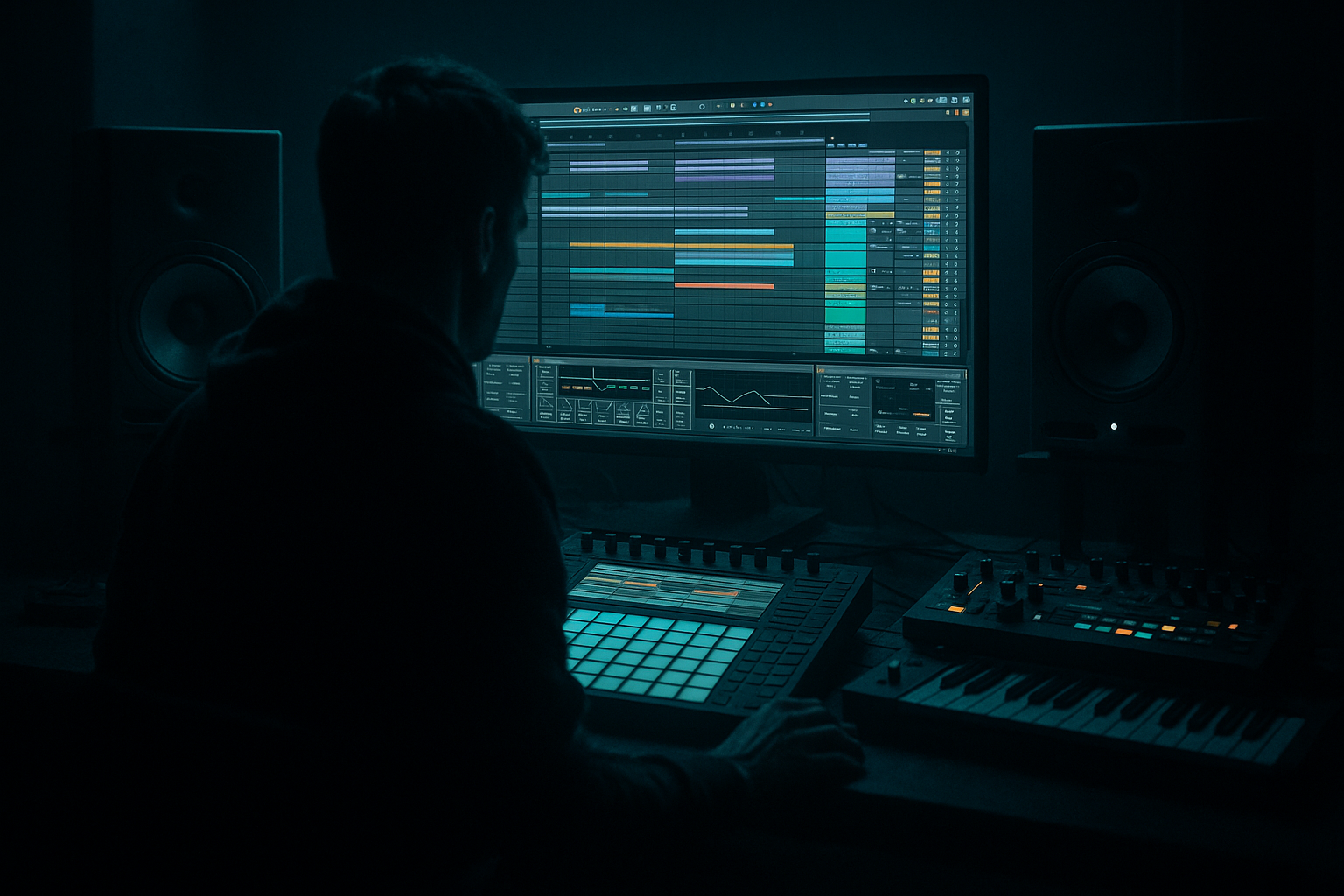
Main tutorial
```markdown
Saturation Rides on Drums (From Scratch) in Session View — Ableton Live (DnB) 🔥🥁
1) Lesson overview
In drum & bass, drums aren’t just loud—they’re alive. One of the fastest ways to get that “rolling, pushing, breathing” feel is a saturation ride: you automate how hard your drums hit a saturator so different sections feel tighter, dirtier, wider, more urgent.
This lesson teaches you (as a beginner) how to build saturation rides from scratch using Session View in Ableton Live—perfect for DnB/jungle workflows where you audition variations with clips.
You’ll learn:
- A clean drum rack → bus saturation workflow
- How to use clip automation in Session View
- How to make A/B drum intensity clips (clean → pushed → smashed)
- How to keep drums punchy while adding grit (no mush) ✅
- A DnB drum loop (kick/snare/hats) in a Drum Rack
- A Drum Bus group with a saturator chain
- Multiple Scene variations:
- Kick: beat 1, and a second kick around 1.3–1.4 (optional ghost)
- Snare: beat 2 and 4
- Hats: 1/8 notes or 1/16 with some velocity variation
- Low: +1 to +2 dB (intro/clean)
- Mid: +3 to +5 dB (rolling groove)
- High: +6 to +8 dB (drop pressure)
- Insane: +9 to +12 dB (fills/impact only)
- Low: 5%
- Mid: 10–20%
- High: 25–35%
- Extreme: 40%+ (careful—can flatten your snare)
- Drive stays steady around +1.5 to +2 dB
- Keep it consistent—this is your reference.
- Drive ramps slightly across the bar:
- This makes a subtle “lean forward” feel.
- Use a pumping curve:
- Example (per beat):
- Drive: +8 to +10 dB for the first half
- Then drop quickly to +4 dB at the end
- Why: the fill explodes, then hands back headroom for the next section.
- Limiter
- Toggle the Saturator device on/off and adjust Output so volume stays similar.
- Parallel dirt lane (for neuro/techy weight):
- Automate saturation more on the “offbeats”
- Use Auto Filter pre-saturation for darker tone
- Transient preservation trick
- Does the drop feel more urgent without just being “louder”?
- Does the snare still crack?
- Do hats get harsh?
- You built a DnB drum bus and used Session View clip automation to create saturation rides you can launch like performance variations.
- The core move: automate Saturator Drive (and optionally Drum Buss Drive) per clip.
- You learned how to keep it controlled with EQ Eight, Glue, and Limiter, and how to expand into jungle-style break layering.
---
2) What you will build
You’ll create a small Session View performance system:
- Scene 1: Clean (intro)
- Scene 2: Slight drive (groove)
- Scene 3: Heavy drive (drop)
- Scene 4: “Overcooked” (fills / impact)
Each variation will be made by automating saturation parameters inside clips—so you can launch them like building blocks while writing.
---
3) Step-by-step walkthrough
Step 0 — Set the project up (DnB baseline)
1. Set tempo to 174 BPM (classic rolling DnB range: 172–176).
2. In Session View, create:
- 1 MIDI track named `DRUMS`
- 1 Audio track (optional) named `DRUM BUS PRINT` (for resampling later)
---
Step 1 — Build a simple DnB drum pattern (fast + functional)
1. On `DRUMS`, load Drum Rack (Browser → Instruments → Drum Rack).
2. Load stock-ish sounds quickly:
- Kick: any tight kick (short tail)
- Snare: punchy snare (DnB snare usually strong at 2 and 4)
- Hats: closed hat + ride/shuffle hat
MIDI clip (1 bar loop):
Beginner-friendly: keep it simple first. You can jungle it up later.
✅ Tip: Add groove later—first get the saturation ride system working.
---
Step 2 — Route drums into a “Drum Bus” group
We want a single place to saturate the entire kit like it’s hitting a mixer/processor.
1. Right-click the `DRUMS` track → Group Tracks.
2. Rename the group track `DRUM BUS`.
3. Keep `DRUMS` inside it.
Now, any devices on `DRUM BUS` affect the whole kit—perfect for drum bus saturation rides.
---
Step 3 — Build a stock saturation chain (clean but mean)
On the group track `DRUM BUS`, add this device chain (in this order):
#### Device Chain (stock Ableton)
1. EQ Eight
- HP filter: 30 Hz, 24 dB/oct (clean rumble)
- Optional: tiny dip around 250–400 Hz if boxy later
2. Saturator
- Mode: Analog Clip
- Drive: start at +2.0 dB
- Soft Clip: ON
- Output: adjust so level matches bypass (important!)
3. Drum Buss (Ableton device)
- Drive: 5%–15%
- Crunch: 0%–10% (optional)
- Boom: 0% (for DnB, Boom can mess with sub/kick clarity—use carefully)
- Damp: around 10–30% if hats get crispy
4. Glue Compressor
- Attack: 3 ms
- Release: Auto
- Ratio: 2:1
- Threshold: aim for 1–3 dB gain reduction on peaks
🎯 Goal: A chain that can go from clean → gritty without destroying transients.
---
Step 4 — Create “Saturation Ride” controls (two easy options)
#### Option A (Beginner-friendly): Automate Saturator Drive
This is the classic saturation ride.
We will automate `Saturator → Drive` per clip.
Set a safe range first:
> If you go high, you’ll likely need to lower Output to keep levels controlled.
---
#### Option B (Also useful): Automate Drum Buss Drive (adds “hit”)
This can feel more “console drum bus” and less like obvious distortion.
Safe range:
---
Step 5 — Build Session View clip variations (this is the magic) ✨
We’ll duplicate the same MIDI clip into multiple slots, then give each clip its own automation.
1. In Session View on the `DRUMS` track:
- Create a clip called “Clean”
2. Duplicate it 3 times:
- “Warm”
- “Push”
- “Smash Fill”
Now we’ll automate saturation from each clip.
---
Step 6 — Clip automation in Session View (Saturation rides)
Ableton clip automation is accessed in the clip view:
1. Click the clip “Warm”
2. At the bottom Clip View, click the Envelopes box (small “E” / Envelopes tab)
3. Set:
- Device: `DRUM BUS` (or the group track device)
- Control: `Saturator → Drive`
Now draw automation.
#### “Clean” (Intro)
#### “Warm” (Groove)
- Start: +2.5 dB
- End: +4 dB
#### “Push” (Drop Energy)
- Drive rises after the snare hits and backs off slightly before the next transient.
- Just before beat 2 snare: +4 dB
- Right after snare: +6 dB
- Ease down before beat 3: +5 dB
- Repeat around beat 4: peak around +7 dB
This mimics analog “push” without needing heavy compression.
#### “Smash Fill” (1 bar impact / fill)
✅ Workflow tip: Turn on Loop in the clip and keep it 1 bar so you can hear the ride immediately.
---
Step 7 — Create Scenes like a DnB DJ arrangement
1. Name scenes (right side):
- Scene 1: `INTRO (Clean)`
- Scene 2: `ROLL (Warm)`
- Scene 3: `DROP (Push)`
- Scene 4: `FILL (Smash)`
Now you can launch scenes and instantly audition drum intensity changes—very DnB-friendly for writing drops and transitions. 🎛️
---
Step 8 — Make it musical: add a “break layer” and saturate together
To make this feel rooted in jungle/DnB:
1. Add an Audio track named `BREAK`.
2. Drop in a classic-style break (or any break loop).
3. Warp it:
- Warp Mode: Beats
- Preserve: Transient
4. Group `BREAK` + `DRUMS` into a bigger group called `ALL DRUMS`.
5. Move the saturation chain to `ALL DRUMS` (or duplicate it).
Now your saturation rides drive both the punchy one-shots and break texture—instant “rolling” glue.
---
Step 9 — Control peaks so saturation doesn’t “fake loud” you
Saturation adds harmonics and often increases perceived loudness.
Add at the end of the drum bus:
- Ceiling: -0.8 dB
- Use it to catch occasional spikes, not crush everything.
And always level-match:
If it’s louder, you’ll think it’s better—even if it’s worse.
---
4) Common mistakes
1. Driving saturation without level-matching
Louder = sounds better bias. Match output when you increase Drive.
2. Saturating sub-heavy kick tails
This can blur low-end and fight the bassline. Use EQ Eight HP at 30 Hz and keep kick tails tight.
3. Over-saturating hats
Too much Drive makes hats fizzy and fatiguing. Use Drum Buss Damp or EQ a little 8–12 kHz if needed.
4. Flattening your snare transient
If the snare stops cracking, reduce Drive, or slow down compression, or try saturation earlier with less Glue gain reduction.
5. Automating too many parameters at once
Start with one knob (Saturator Drive). Get musical results first.
---
5) Pro tips for darker/heavier DnB 🖤
- Create a Return track `DRUM DIRT`.
- On it: Saturator (Analog Clip, Drive +8 dB) → EQ Eight (HP 120 Hz) → Redux (very subtle).
- Send snare/break to it lightly (-18 to -10 dB send).
- This keeps low-end clean while adding nastiness up top.
DnB rolls from syncopation. Let drive peak slightly on hat/offbeat moments, not only on downbeats.
- Add Auto Filter before Saturator:
- Lowpass 12 dB, cutoff around 14–18 kHz
- Automate cutoff slightly down in the drop for a darker, denser tone.
- Put Saturator after a very light Glue Compressor (1 dB GR), not before, if your transients are too spiky.
- Put Saturator before Glue if you want more glue and “printed” feel.
---
6) Mini practice exercise (10–15 minutes) ⏱️
1. Make a 1-bar DnB drum loop (kick/snare/hats).
2. Create 4 clip versions: Clean / Warm / Push / Fill.
3. Automate only Saturator Drive:
- Clean: +2 dB flat
- Warm: +3 → +4 dB ramp
- Push: +5 to +7 dB shaped around snares
- Fill: +9 dB for 1/2 bar then back to +4 dB
4. Launch scenes in this order:
- Intro (Clean) for 8 bars
- Roll (Warm) for 16 bars
- Drop (Push) for 32 bars
- Fill (Smash) for 1 bar, then back to Push
Listen for:
---
7) Recap
If you want, tell me what style you’re aiming for (liquid, jungle, jump-up, neuro, minimal rollers), and I’ll suggest a saturation ride curve and drum bus chain that fits that lane.
```

