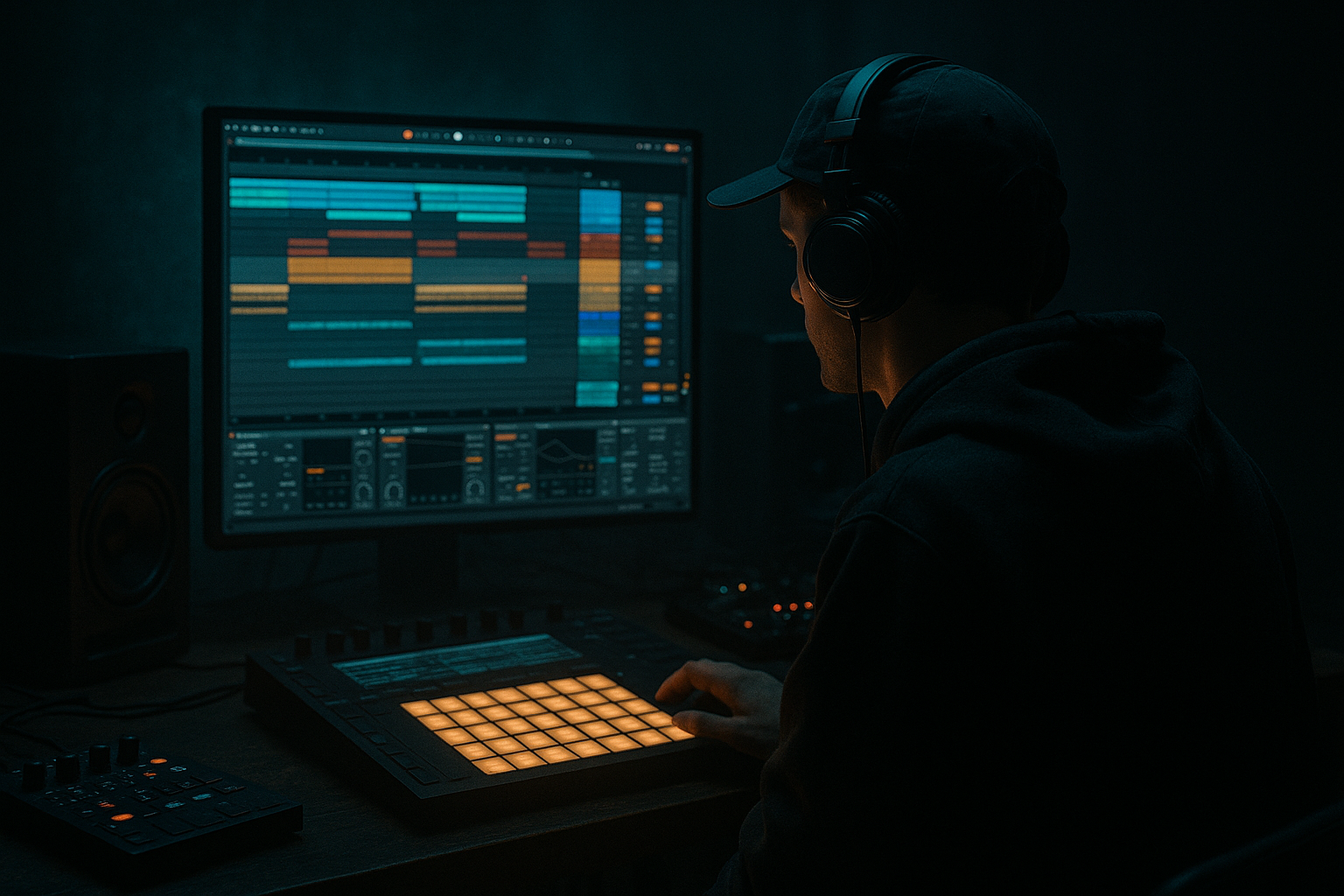
Main tutorial
```markdown
Saving Break Racks (at 170 BPM) — Ableton Live Workflow (Beginner) 🥁⚡
1) Lesson overview
In drum & bass and jungle, breaks are everything—but constantly rebuilding the same chop/processing chain kills momentum. In this lesson you’ll learn a clean, repeatable Ableton Live workflow to turn a breakbeat into a Break Rack you can recall instantly, already tuned for 170 BPM rolling DnB.
You’ll build:
- A Drum Rack that plays chopped slices cleanly at 170
- A processing chain that sounds “record-like” (punchy, controlled, gluey)
- A saved preset (your personal break rack library)
- Sliced break samples mapped across pads (kick/snare/ghosts available fast)
- Macros for fast movement (Drive, Crunch, Tone, Glue, Room, Duck)
- A simple arrangement-ready pattern: 2-step + ghost notes + fills
- Optional: resampling workflow to print processed breaks for fast arranging
- Simpler → Classic mode
- Turn on Snap (helps avoid clicks)
- Adjust Start slightly if a slice is late/early
- Fade In: tiny (like 1–5 ms) if you hear clicks
- Decay: shorten overly long slices so hats don’t smear into the next hit
- Voices: set to 1 for hats/ghosts if they’re stacking too much
- High-pass around 25–35 Hz (remove rumble)
- Small cut if boxy: 200–400 Hz (depends on break)
- Optional tiny lift: 8–10 kHz for air (careful—DnB gets harsh fast)
- Drive: start around 5–15%
- Boom: Off at first (Boom can fight your sub)
- Crunch: 5–20% for grit
- Damp: adjust to tame harshness
- Attack: 3 ms
- Release: Auto
- Ratio: 4:1
- Aim for 1–3 dB gain reduction on the loudest hits
- Optional: Soft Clip ON for controlled smack
- Mode: Analog Clip or Soft Sine
- Drive: small, like 1–4 dB
- Turn Soft Clip ON if you want a harder ceiling
- Ableton stock option: use Drum Buss (it’s your main transient shaper here)
- Or subtle Compressor with slow attack (adds punch)
- Intro: filtered break (low-passed) + light hats
- Drop: full break + extra kick layer + bass
- Mid-16: remove some slices for space, bring back with a fill
- End of phrase: 1-bar or half-bar break edit (stutter or reverse)
- Go to File → Collect All and Save
- Check at least Samples.
- Create a folder tag/category like “Break Racks – 170”
- Save versions:
- Reverse hits
- Add tape stops
- Time-stretch tiny fills
- Chop audio in Arrangement super fast
- Warp is wrong → your slices won’t groove at 170. Always confirm downbeat + bar length.
- Too much saturation/compression → breaks get fizzy and small. Aim for controlled punch, not constant clipping.
- No gain staging → if you slam every device, you lose transient clarity. Keep levels sensible.
- Slices clicking → add tiny fades, enable Snap, adjust Start/Decay.
- Boom fighting your sub (Drum Buss) → turn Boom off unless you know it works with your bassline.
- Darken the top without killing movement:
- Parallel dirt for weight (simple method):
- Make breaks feel “heavier” without more volume:
- Jungle-style edits:
- Space control:
- You warped a break so it locks at 170 BPM ✅
- You sliced it to a Drum Rack for playable chops ✅
- You built a stock-device break bus (EQ → Drum Buss → Glue → Saturator) ✅
- You created Macros so it’s fast to shape ✅
- You saved it as a reusable Break Rack preset (and learned to Collect All and Save) ✅
---
2) What you will build
A reusable “170 BPM Break Rack” that includes:
---
3) Step-by-step walkthrough
Step 0 — Set the project for DnB speed
1. Set tempo to 170 BPM (top left).
2. In Preferences → Record/Warp/Launch:
- Auto-Warp Long Samples: Off (optional, but prevents weird guesses)
- Default Warp Mode: Beats (good starting point for drums)
---
Step 1 — Choose and warp a break properly (the foundation)
Pick a classic break (Amen, Think, Hot Pants, etc.) or any drum loop.
1. Drag your break into an Audio Track.
2. Double-click the clip to open Clip View.
3. Enable Warp.
4. Set Seg. BPM correctly:
- If it’s a known break at ~136–140 or ~160–175, Live might guess wrong.
- Right-click the sample in the browser → Warp From Here (Straight) can help.
5. Make sure 1 bar of the break actually equals 1 bar at 170:
- Find the real downbeat transient (usually the kick).
- Right-click that transient → Set 1.1.1 Here
6. Warp mode:
- Start with Beats
- Settings: Preserve: Transients, and try Envelope 10–30 (tighter = punchier)
✅ Goal: When you loop 1 bar, it stays tight and doesn’t flam against the grid.
---
Step 2 — Slice the break to a Drum Rack (fast chops)
1. Right-click the warped audio clip → Slice to New MIDI Track
2. In the dialog:
- Slicing preset: start with Built-in → Slice to Drum Rack
- Slice by:
- For DnB, choose Transient (most musical)
- Or 1/16 for grid-chop jungle vibes
- Create one slice per: leave default
3. Ableton creates:
- A MIDI Track with a Drum Rack
- Each slice loaded into Simpler on its own pad
🎯 Now your break is playable like a kit.
---
Step 3 — Clean up slices (so it plays like a real break, not a messy loop)
Click a few pads and quickly check the worst offenders: double hits, long tails, clicks.
On the slices (Simpler settings):
Workflow tip:
Open the Drum Rack’s Chain List, then click different pads while watching each Simpler.
---
Step 4 — Add a “DnB break bus” processing chain (stock devices)
This is where the rack becomes your sound.
On the Drum Rack track (NOT inside each pad yet), add:
1) EQ Eight
2) Drum Buss
3) Glue Compressor
4) Saturator
5) (Optional) Transient shaping
✅ You now have a classic “break bus” that’s fast and reliable.
---
Step 5 — Add Macros for quick control (so it’s a real rack you’ll reuse) 🎛️
Group your devices into an Audio Effect Rack on the Drum Rack track:
1. Select EQ Eight + Drum Buss + Glue + Saturator
2. Cmd/Ctrl + G to group into an Audio Effect Rack
3. Map key parameters to Macros:
- Macro 1: Drive → Drum Buss Drive
- Macro 2: Crunch → Drum Buss Crunch
- Macro 3: Glue → Glue Compressor Threshold
- Macro 4: Tone → EQ Eight high shelf gain (or low-pass frequency for darkening)
- Macro 5: Air → EQ Eight high shelf (small range)
- Macro 6: Clip → Saturator Drive (or Output for level match)
- Macro 7: Room (optional) → Reverb Dry/Wet (keep low)
- Macro 8: Duck (if you use sidechain) → Compressor threshold on a sidechain comp
Keep macro ranges tight so everything stays musical (no “one twist ruins it” behavior).
---
Step 6 — Create a go-to 170 BPM MIDI break pattern (rolling, jungle-ready)
On the MIDI clip that triggers the Drum Rack:
1. Make a 2-bar loop
2. Start simple:
- Put your main kick slice on 1.1
- Put your main snare slice on 1.2 and 1.4 (classic DnB backbeat)
3. Add ghost/hat energy:
- Use hat/ghost slices on 1/16 offbeats
- Add a ghost snare just before the main snare (common DnB push)
4. Add variation:
- Bar 2: add a little fill on the last 1/8 or 1/16
- Swap a snare slice for a different one for “call and response”
Arrangement idea (super common in DnB):
---
Step 7 — Save it properly (so it shows up forever in your browser)
You want two things saved: the rack and the source samples organized.
A) Save the rack preset
1. Click the Drum Rack title bar (or the whole track device area).
2. Press the disk icon (top-right of device) to save as a preset.
3. Name it like:
- `BRK_170_Amen_TightBus_v1`
- `BRK_170_Think_DarkGlue_v1`
B) Collect all samples (important!)
If you move projects between drives, missing samples are pain.
C) Build a Break Rack Library
In the Browser:
- Clean
- Crunchy
- Dark
- Overcompressed (special FX)
---
Step 8 (Optional but huge) — Resample a “printed” break loop for instant arranging
Sometimes you want audio, not MIDI, for quick edits.
1. Create a new Audio Track called `PRINT_BREAK`
2. Set Audio From: your Break Rack track
3. Arm `PRINT_BREAK`, record 4 or 8 bars
4. Consolidate (Cmd/Ctrl + J) and save as:
- `Amen_170_DarkBus_8bar.wav`
Now you can:
---
4) Common mistakes
---
5) Pro tips for darker/heavier DnB 🖤
Use EQ Eight with a gentle high-shelf cut (or low-pass at ~12–16 kHz), then add controlled saturation so it still feels alive.
Put an Audio Effect Rack with 2 chains:
- Chain A: Clean
- Chain B: Saturator + Drum Buss (more aggressive) + EQ (roll lows)
Blend B quietly under A.
Shorten hat decays and emphasize the snare transient using Drum Buss + Glue.
Print 8 bars, then in Arrangement:
- reverse a snare tail before the drop
- stutter the last 1/4 bar
- add a single bar of “all ghost notes” for tension
Keep reverb minimal. If you use Reverb, high-pass the reverb (EQ after it) so it doesn’t fog the low-mids.
---
6) Mini practice exercise (15 minutes) ⏱️
1. Pick one break (Amen/Think/etc.) and warp it tight at 170.
2. Slice to Drum Rack by Transient.
3. Build the bus chain: EQ Eight → Drum Buss → Glue → Saturator.
4. Map at least 4 Macros (Drive, Glue, Tone, Crunch).
5. Program a 2-bar rolling pattern:
- snare on 2 and 4
- at least 3 ghost hits
- a small fill at the end of bar 2
6. Save the rack as: `BRK_170_
7. Bonus: print 8 bars to audio and do one reverse-fill.
---
7) Recap
If you want, tell me what break you’re using (Amen/Think/other) and what vibe you’re chasing (roller, jungle, neuro-ish), and I’ll suggest a specific macro setup + an 8-bar arrangement blueprint.
```

