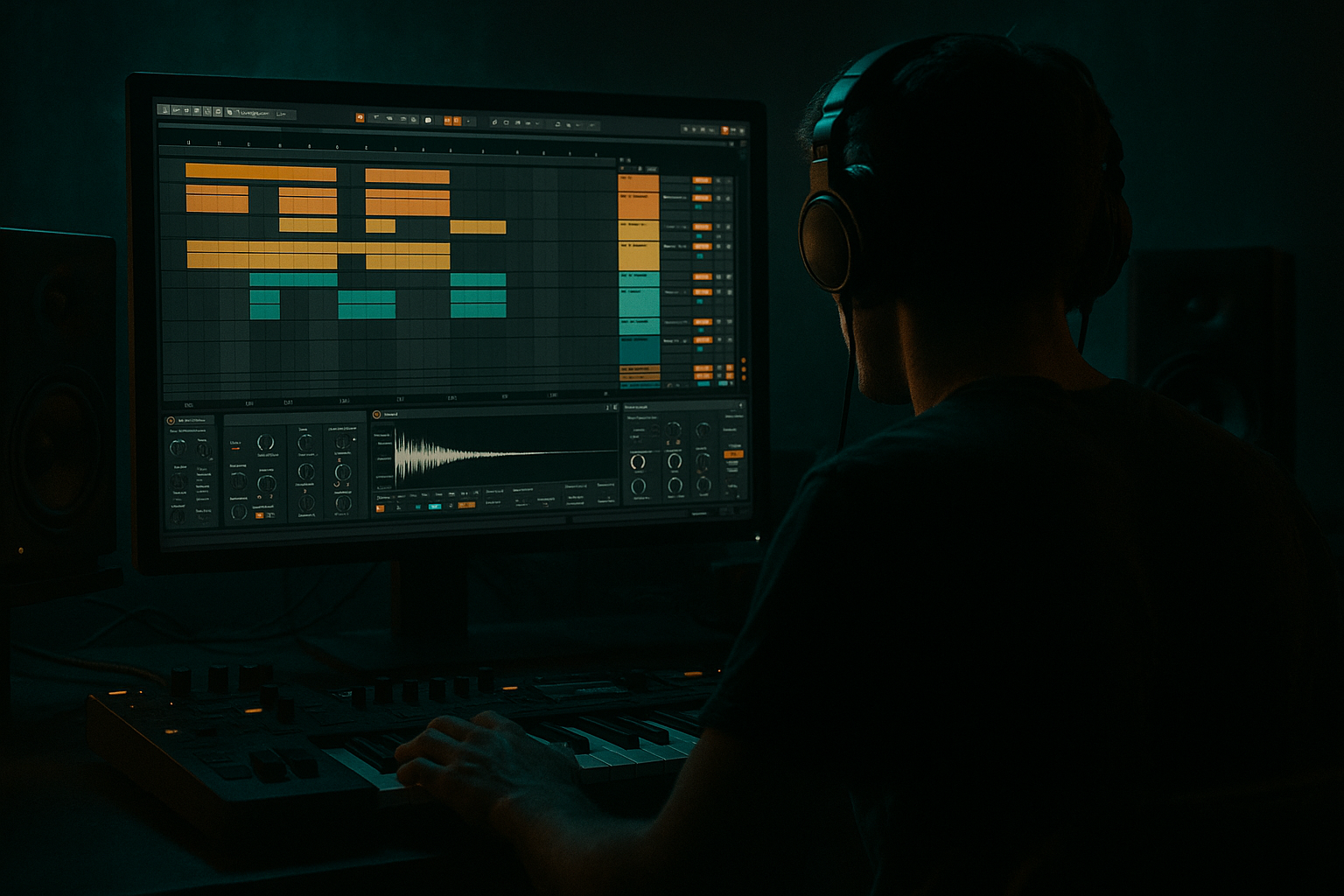
Main tutorial
```markdown
Second-Drop Bass Variations for Jungle Rollers (Ableton Live) 🔥
1. Lesson overview
In jungle rollers, the first drop establishes the groove and bass identity; the second drop is where you level up the impact without changing the whole tune. Today you’ll learn practical, repeatable ways to create second-drop bass variations that feel intentional (not random), while keeping the roller momentum locked.
We’ll focus on Ableton Live workflows that are fast in session or arrangement view: resampling, macro performance, filter/envelope changes, mid/side tricks, and call-and-response with the drums.
---
2. What you will build
By the end, you’ll have:
- A Drop 1 rolling reese/analog-style bass (sub + mid)
- A Drop 2 with 3–5 variations, such as:
- Add Operator:
- Add Saturator (subtle):
- Add EQ Eight:
- Width: 0%
- Bass Mono: ON (if using newer Utility options)
- Wavetable
- Add Auto Filter (for movement):
- Add Saturator:
- Add EQ Eight:
- Width: 80–120% (don’t go crazy)
- If it feels phasey: reduce width
- Create a 16-bar Drop 1 loop.
- Use a classic roller bass rhythm:
- Select clip → Cmd/Ctrl + J (Consolidate)
- Macro 1 Cutoff: slightly higher overall (+5–15% compared to Drop 1)
- Macro 3 Movement: increase LFO or envelope depth
- Macro 4 Drive: +1–3 dB for perceived loudness (watch headroom)
- Bars 1–8: slightly more open + more movement
- Bars 9–16: “pressure mode” (more drive + slightly reduced width for focus)
- Slightly different wavetable position or detune
- More filter drive
- Add Pedal (stock Ableton) after the synth:
- Add Redux very subtly (optional):
- Use Chain Selector automation:
- EQ Eight: high-pass around 100–150 Hz
- Saturator: 2–6 dB
- Auto Filter (band-pass for a bar as a “telephone” moment)
- Optional: Delay (Echo) very low mix just for ear candy
- Width: automate from ~90% (Drop 1) to ~115% (Drop 2)
- 2 bars before Drop 2: remove sub, keep filtered mid + hats building tension
- Drop 2 Bar 1: sub returns + mid more open + extra drive
- Every 8 bars: one bass fill bar
- Final 2 bars: reduce width and open cutoff (makes it feel like it’s pushing forward)
- Extra ghost snare
- Different ride pattern
- One extra break chop layer
- Parallel distortion on mids (clean blend):
- Controlled “metallic” tone (jungle tech vibe):
- Sub consistency trick:
- Make Drop 2 feel louder without clipping:
- Split bass into SUB + MID to vary aggressively without losing weight.
- Build a Macro-driven Variation Rack so Drop 2 is fast to design and easy to control.
- Best second-drop upgrades are usually:
- Arrange Drop 2 with intent: tension before it, and a couple drum changes to sell the lift.
- New movement (LFO/envelope) without losing the bass “character”
- “Answer phrase” fills at the end of 4/8/16 bars
- Mid-layer switch / distortion change
- Additional stereo interest in the mids while keeping sub mono
- A controlled, darker “pressure” mode for the second drop 😈
You’ll also set up a performance Macro system to audition variations quickly.
---
3. Step-by-step walkthrough
Step 0 — Prep: organize your bass into SUB + MID
Why: Second-drop variation is easiest when you can change mids aggressively while keeping the sub consistent and clean.
1. Create a Bass Group with two tracks:
- SUB (pure low fundamental)
- MID (reese/texture)
2. Route both to a Bass Bus (audio track) for glue:
- Set each bass track output to “Sends Only”
- On Bass Bus set Audio From → SUB + MID using two separate inputs, or just group and process at group level (either works).
---
Step 1 — Build a stable Drop 1 bass foundation (quick but solid)
#### SUB track (simple, clean, mono)
- Algorithm: A only
- Wave: Sine
- A Level: 0 dB
- Drive: 1–3 dB
- Soft Clip: ON
- Output: adjust so you’re not clipping
- Low-cut off (don’t cut the sub)
- If needed: gentle dip around 200–300 Hz if it’s boxy
Important: Keep SUB mono. If needed add Utility:
#### MID track (movement + character)
Pick one: Wavetable or Analog. Here’s a Wavetable baseline reese:
- Osc 1: Saw (or “Basic Shapes” Saw), Unison: 2–4
- Osc 2: Saw, Detune slightly different from osc 1
- Voices/Unison Amount: enough to widen but not wash out
- Filter: LP24
- Drive: small (10–20% depending on patch)
- Type: LP
- Envelope amount: start small
- OR use LFO to modulate cutoff slowly (1/2–2 bars)
- Drive: 4–8 dB
- Soft Clip: ON
- High-pass: ~80–120 Hz (leave room for sub)
- Optional: narrow dip where it fights snare body (often 180–220 Hz)
MID Width control: Add Utility after EQ:
---
Step 2 — Lock Drop 1 groove first (arrangement anchor)
In Arrangement View:
- Long notes with occasional 1/8 or 1/16 pushes around kicks/snares
- Leave micro-gaps for drums to breathe (especially before snare hits)
Workflow tip: Consolidate your bass MIDI phrase once it’s right:
Now you have your “identity.” Everything in Drop 2 should feel like a variation of this, not a new song.
---
Step 3 — Build a “Variation Rack” with Macros (fast auditioning) 🎛️
On the MID track, group your devices into an Audio Effect Rack:
1. Select Auto Filter + Saturator + EQ + Utility → Cmd/Ctrl + G
2. Map key parameters to 8 Macros (examples below):
Macro suggestions
1. Cutoff (Auto Filter Freq)
2. Resonance (Auto Filter Res)
3. Movement (LFO amount or Env amount)
4. Drive (Saturator Drive)
5. Width (Utility Width)
6. Mid Bite (EQ Eight bell at ~1–2.5 kHz +2 to +5 dB)
7. Notch (EQ Eight narrow cut around 300–600 Hz)
8. Output Trim (Rack volume or Utility gain)
Now you can “perform” Drop 2 by automating Macros.
---
Step 4 — Second-drop variation method #1: Change movement, not notes (most effective)
This keeps the bassline recognizable while increasing energy.
In Drop 2, automate:
Arrangement idea (classic roller):
---
Step 5 — Second-drop variation method #2: Add a mid-layer “switch” using Instrument Rack chains
On the MID track, convert your synth into an Instrument Rack with two chains:
1. Chain A = Drop 1 Reese
2. Duplicate chain → Chain B = Drop 2 Reese (heavier)
In Chain B:
- Mode: OD or Distortion
- Gain: start low, then bring up
- Tone: adjust to avoid harsh fizz
- Downsample just a touch for grit (don’t destroy transients)
Switching method:
- Drop 1 = Chain A
- Drop 2 = Chain B
This is a pro workflow: fast, recallable, and mix-safe because you can level-match chains.
---
Step 6 — Second-drop variation method #3: Call-and-response bass fills (end of 4/8 bars)
Jungle rollers thrive on small surprises.
1. Duplicate the last 1 bar of your 8-bar phrase.
2. Create a fill by changing only the last 2 beats:
- Add a quick 1/16 roll (tastefully)
- Or jump up an octave briefly in the MID (leave SUB steady)
3. For the fill bar, automate a “special effect”:
- Auto Filter: quick downward sweep
- Saturator: +2 dB just for the fill
- Utility width: slightly narrower for punch (or wider if it’s a “whoosh” moment)
Ableton trick: Consolidate that fill bar into a separate clip so you can re-use it every 8 or 16 bars.
---
Step 7 — Second-drop variation method #4: Resample your MID and do surgical edits ✂️
This is where you get that “produced” feel.
1. Create a new audio track: MID RESAMPLE
2. Set Audio From → MID (Post-FX)
3. Arm and record 8–16 bars of your MID performance
4. Now:
- Slice out the best moments
- Reverse a tiny chunk at the end of a phrase
- Add micro-stutters (grid 1/16 or 1/32)
- Fade clicks with clip fades
Processing on resample (simple chain):
Blend the resampled layer quietly under the main MID in Drop 2.
---
Step 8 — Second-drop variation method #5: M/S control so Drop 2 feels wider (without wrecking the sub)
On the MID track or Bass Bus:
1. Add EQ Eight
2. Switch to M/S mode
3. Do this:
- Side channel: add a gentle shelf +1 to +3 dB from 2–8 kHz (taste)
- Mid channel: keep low-mids controlled (avoid 200–500 Hz buildup)
Then add Utility after it:
Key rule: Sub stays mono; widen mids only.
---
Step 9 — Make it “second drop” in the arrangement (not just sound design)
Your bass variation hits harder when the arrangement supports it.
Try this Drop 2 blueprint:
Add one drum change too (even tiny):
This makes the bass variation feel “earned.”
---
4. Common mistakes
1. Changing the notes too much: If the bassline melody changes drastically, it feels like a new drop, not a second-drop upgrade.
2. Over-widening the low end: Wide subs = weak subs. Keep SUB mono, always.
3. Adding distortion without level-matching: Louder = “better” bias. Match gain when A/B testing.
4. Too many variations too quickly: If every bar is a new trick, the roller loses hypnosis.
5. Ignoring drum/bass relationship: Bass fills that clash with snare or kick timing can kill the roll.
---
5. Pro tips for darker/heavier DnB 😈
- Send MID to a Return track with Pedal + Saturator + EQ Eight
- High-pass the return at 150–250 Hz
- Blend in low (5–20%) for thickness without mud
- Add subtle Frequency Shifter on MID RESAMPLE
- Mode: Ring Mod
- Frequency: very low (try 10–40 Hz) and blend subtly
- Sidechain SUB slightly to kick using Compressor
- Ratio: 2:1–4:1
- Attack: 5–15 ms
- Release: 60–120 ms (tempo dependent)
- Aim for small gain reduction (1–3 dB)
- Slightly more upper-mid presence (1–3 kHz) on MID
- Tiny reduction in competing layers (pads/atmos) during Drop 2
- Automate Bass Bus Saturator Drive +1 dB and pull output down to match
---
6. Mini practice exercise 🧠
Goal: Create 3 second-drop bass variations in 20 minutes.
1. Start with your Drop 1 16-bar loop.
2. Duplicate it to create Drop 2.
3. In Drop 2:
- Variation A (bars 1–8): automate Cutoff + Movement up
- Variation B (bar 8): create a 1-bar bass fill
- Variation C (bars 9–16): switch to Chain B (heavier) using Chain Selector
4. Resample 8 bars of MID in Drop 2 and layer it quietly under the last 4 bars.
Checkpoint: If you mute drums and the bass still “sounds cool,” you’ve probably overdone it. Bring drums back and make the bass serve the roll.
---
7. Recap ✅
- More movement, more bite, slightly different mid character
- Strategic fills every 8/16 bars
- Resampling edits for ear candy
- Wider mids, mono sub for bigger impact
If you want, tell me what style you’re aiming for (deep jungle roller vs. modern jump-up roller vs. techy 1995 vibey), and what bass source you’re using (Wavetable/Operator/Serum), and I’ll give you a specific Drop 2 automation map + 2 fill patterns that fit your groove.
```

