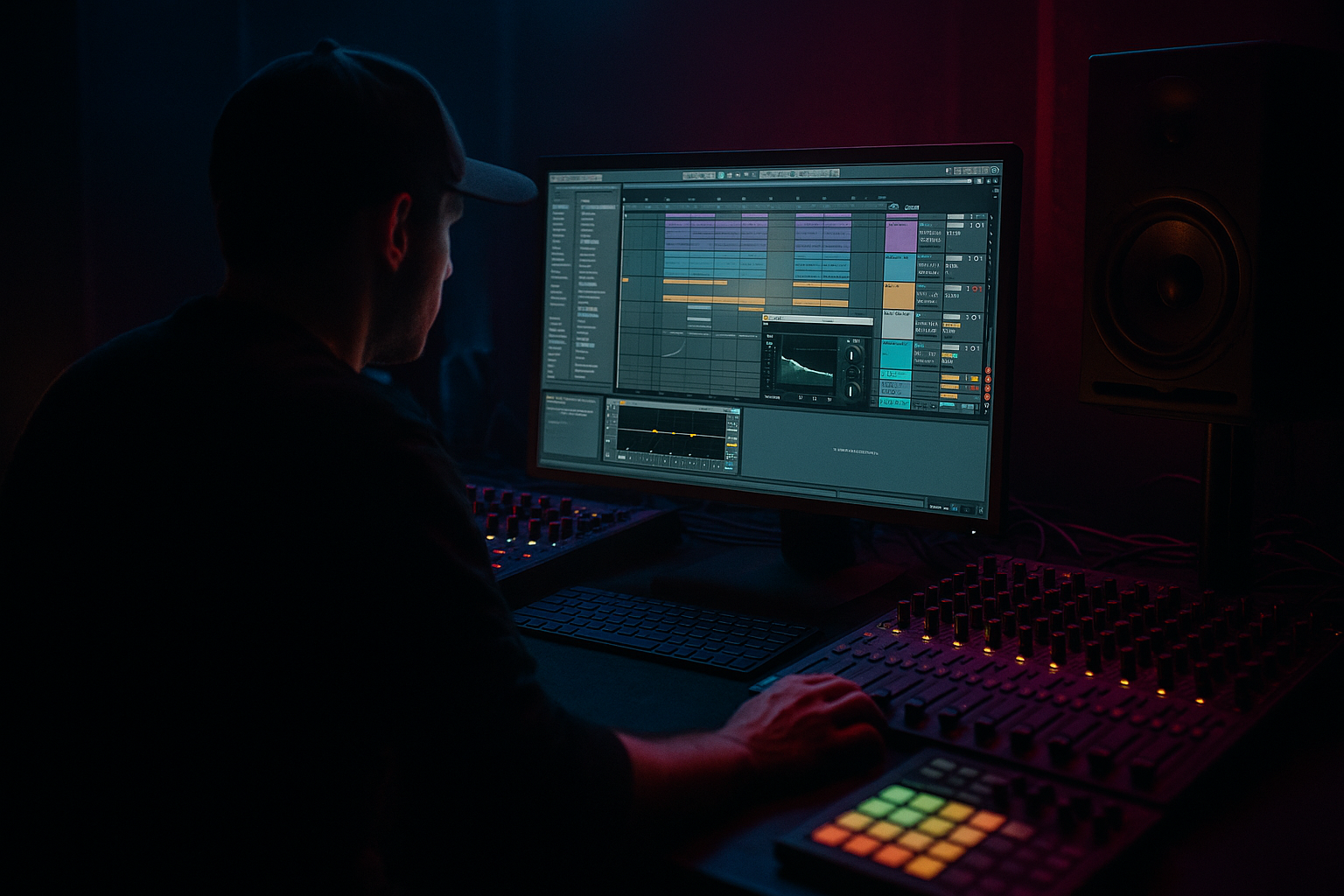
Main tutorial
```markdown
Section Contrast Using Only Mutes (Pirate-Radio Energy) 📻🔥
Advanced Arrangement — Drum & Bass in Ableton Live
---
1. Lesson overview
This lesson is about creating huge section contrast in drum & bass without adding new sounds, new patterns, or new FX hits—only mutes (and the micro-automation needed to make those mutes feel intentional).
The goal: that pirate-radio energy—like someone is riding a dodgy mixer, cutting channels, slamming faders back in, and the tune feels more alive because of it.
We’ll use Ableton Live’s arrangement tools and a few stock devices to make mutes punch hard, stay musical, and translate on loud rigs.
---
2. What you will build
A rolling DnB arrangement where energy and groove evolve using only:
- Track mutes / clip mutes (Arrangement View)
- Mute groups (Drum Rack pads, instrument layers, returns)
- Micro-mute phrases (1/2 bar, 1 bar, 2 bar, 4 bar)
- Pre-planned “mute choreography” across intro → drop → mid-drop → second drop
- A drop that feels heavier even though nothing new is added
- Call-and-response between drums/bass/vocals via mutes
- DJ-friendly phrasing (8/16/32-bar logic) with savage tension releases
- Tempo: 172–176 BPM
- Core drum loop: Kick + snare (tight), hats (rolling), optional break layer
- Bass: 1–2-bar rolling phrase
- On DRUM BUS group:
- On BASS group:
- Bars 1–8: Full power (establish identity)
- Bars 9–16: Remove one element for bounce (e.g., hats or break)
- Bars 17–24: Remove a different element (e.g., bass for 1 bar, then back)
- Bars 25–32: A bigger “DJ tease” cut (2 beats to 1 bar)
- Bars 33–48: Repeat with variation (same mutes but shifted earlier/later)
- Bars 49–64: Pre-second-drop tension (more frequent micro-mutes)
- Use Track Activator automation (the yellow line when you automate) or simply cut time and disable sections.
- I recommend automation, because it’s visually readable and easy to tweak.
- Mute BASS for 1 beat right before a snare hit, then slam it back.
- Best placement: beat 4 of the bar (pre-snare), or the first half of bar 1 of an 8-bar phrase.
- If you layer an amen/think break behind clean drums:
- Alternate every 8 or 16 bars.
- Mute Hats/Top loop for 1/2 bar every 4 bars.
- Keep kick/snare running so the dancefloor doesn’t lose the grid.
- Mute all FX except one hook element for 2 bars (like a single rewind shout, siren, or stab).
- Then bring the full kit back.
- Add tiny fades at cuts:
- Put a subtle room on the drum bus (very low) so the core stays glued.
- Pad A: Clean snare
- Pad B: Snare noise layer
- Pad C: Rim/ghosts
- Pad D: Ride
- Group layers into Instrument Racks inside the Drum Rack pad.
- Map Chain Activator or Chain Selector if you want quick on/off—but since this lesson is “only mutes,” stick to pad mute/track activator.
- Sub intimidation cut: Mute the mid bass layer but keep sub for 1 bar.
- Make the snare feel bigger with silence, not reverb:
- Distorted break “in-out” for brutality:
- Use Gate for controlled “broadcast chop” (still mute-based):
- You can create massive DnB contrast without adding anything—just by removing with taste.
- Build a mute grid based on 8/16-bar phrasing.
- Use classic pirate-radio moves: bass dropouts, hat guillotines, break in/out, vocal/FX teases.
- Make mutes sound pro by managing clicks, FX tails, and bussing stability.
- Dark/heavy DnB loves controlled absence—silence is pressure.
You’ll end up with:
---
3. Step-by-step walkthrough
Step 0 — Set your session up for fast mute performance 🎛️
Ableton View: Arrangement View (this is important—mutes here are arrangement decisions, not improvisations).
1. Group your main elements:
- DRUMS (Kick, Snare, Hats, Break, Perc, Fills)
- BASS
- MUSIC (pads/stabs/atmo)
- VOX/FX
2. Color-code groups (quick readability = better arrangement decisions).
3. Map a few key mutes to keys or a MIDI controller:
- Select a track → CMD/CTRL + M (MIDI Map) → click Track Activator → press a pad/key.
- Map at least: BASS, BREAK, HATS, FX/VOX.
> You’re not performing live for the final render—but mapping mutes helps you “play” arrangement ideas quickly, then you can fine-edit.
---
Step 1 — Define your “anchor groove” (the thing you’ll not change)
Before muting, lock the core loop so all contrast is perceived as arrangement, not pattern edits.
Make sure it already slaps dry. If your loop only works with constant FX and fills, mutes won’t save it.
Quick stock chain checks:
- Drum Buss: Drive 5–15, Boom 0–20 (taste), Crunch 0–10
- Glue Compressor: 2:1, Attack 3–10 ms, Release Auto, 1–3 dB GR
- Saturator (Soft Clip ON), Drive 2–6 dB
- EQ Eight to keep subs clean (HP at 20–30 Hz, gentle)
---
Step 2 — Build “mute lanes” (your arrangement is a grid of removals) 🧩
Think like this: every 8 bars you remove something to create movement.
Create a 64-bar drop section and plan these mute blocks:
In Arrangement View:
Workflow:
1. Press A to show automation lanes.
2. Choose Track Activator for a track.
3. Draw mutes exactly on phrase boundaries (start with 1-bar chunks).
4. Then add micro-mutes (1/2 bar, 1 beat, 1/8) tastefully.
---
Step 3 — The “pirate-radio” mute moves (DnB-specific patterns)
Here are practical mute moves that scream jungle/DnB when done right:
#### Move A — “Bass Dropout Stab” (1 beat to 1 bar)
Why it works: The ear “fills in” the bass; when it returns, it feels louder.
Ableton tip: Put the bass in its own group and automate the group activator so tails don’t overlap weirdly.
#### Move B — “Break Removal = Modern Roll”
- Keep it in for grit.
- Mute it for 4 bars to snap into a clean roller.
Result: Instant contrast between “jungle pressure” and “tech step clean.”
#### Move C — “Hat Guillotine” (half-bar cuts)
Advanced: Offset the mute slightly—e.g., mute the second half of bar 4 instead of bar 4 entirely.
#### Move D — “Vocal/FX Tease Only”
Rule: It must be rhythmic—place it like percussion.
---
Step 4 — Make mutes feel tight (avoid clicks, keep impact) ⚙️
Hard mutes can click or feel like your mix collapses. Fix it with structure, not extra sounds.
#### A) Prevent clicks on audio mutes
If you’re muting audio tracks with waveform edges:
- Select clip → enable Fades (if not visible, right-click and enable fades)
- 1–5 ms is often enough.
#### B) Keep returns from ringing out awkwardly
If you mute a dry track but its reverb/delay return keeps going, that can be cool—or messy.
Two approaches:
1. Put FX inside the group, not on returns, if you want them to mute together.
2. Or automate the Return track activator too for hard cuts.
#### C) “Mute-safe” bussing for consistent weight
To keep the track from feeling like it loses all body when you mute tops/breaks:
- Hybrid Reverb (Room): Size small, Decay 0.3–0.6s, Wet 2–6%
This isn’t adding a new element—just stabilizing the acoustic “space.”
---
Step 5 — Use Drum Rack mutes for surgical contrast 🥁
If your drums are in a Drum Rack, you can mute pads (snare ghost layer, ride layer, extra percussion) for very “mixer-like” energy.
Example:
Mute Pad D (ride) for 4 bars, then bring it in for lift.
Mute Pad B for 1 bar before a phrase change for a “thin → thick” impact.
Pro workflow:
---
Step 6 — Arrange a full drop using a “mute script” (copy/paste template) 🧠
Here’s a proven 32-bar drop mute script you can implement immediately:
Bars 1–8: Full
Bar 9: Mute hats for beats 3–4 (half-bar)
Bar 12: Mute bass for beat 4 only
Bars 13–16: Mute break layer entirely (clean roll)
Bar 17: Full back in
Bar 20: Mute music/pads for 1 bar (drums + bass only)
Bar 24: Mute bass for 1 bar (let drums + FX carry)
Bar 25: Slam bass back, mute hats for 1/2 bar
Bars 29–32: More frequent micro-mutes (one per bar), then a 1-beat “everything but snare” cut right before the next section
> That last move is pure reload bait: “Wait—what—BANG.”
---
4. Common mistakes
1. Muting the wrong anchor
- If you mute kick/snare too often, you lose dancefloor trust.
- Save full-kit mutes for very intentional moments (1 beat max).
2. Random mute timing
- DnB wants phrase logic: 8/16/32 bars.
- Put big mutes on bar 8/16 boundaries; micro-mutes inside.
3. Over-muting
- If every bar has a cut, nothing feels special.
- Use clusters: quiet for 4 bars, then busy for 4 bars.
4. Ignoring tails (reverbs/delays/sub notes)
- If bass stops but sub tail rings, your “cut” isn’t a cut.
- Manage returns and release times.
5. Not checking mono / club translation
- Some mutes reveal phase/width issues (suddenly the mix feels hollow).
- Check Utility (Mono) on the master occasionally.
---
5. Pro tips for darker/heavier DnB 🖤
- Result: the room still shakes, but it feels “empty” in a threatening way.
- Use Audio Effect Rack on bass with two chains (SUB / MID), then mute the MID track (or chain track) only.
Mute hats for 1/2 bar leading into the snare on bar 8/16. The snare appears wider and louder.
Keep a crushed break layer (Erosion / Saturator / Overdrive) muted most of the time, then unmute for 2 bars as a “rage” section.
(Still counts: you’re not adding new material—just revealing it.)
If you want that pirate transmission feel, put Gate on a group and automate the Device Activator (on/off) instead of drawing volume.
- Gate: Fast attack, short release, adjust threshold so it clamps hard.
This keeps cuts aggressive and consistent.
---
6. Mini practice exercise (15 minutes) ⏱️
1. Take a 16-bar loop that already grooves (drums + bass + minimal music).
2. Duplicate it to make 64 bars.
3. You are allowed only:
- Track activator automation
- Clip disabling
- Tiny fades (anti-click)
4. Write a “mute story”:
- 4 big mutes (1–4 bars)
- 8 micro-mutes (1 beat to 1/2 bar)
5. Bounce a quick render and listen on low volume:
- Can you still “hear” the arrangement changes?
- Do the mutes feel like intention, or accidents?
Optional: After you finish, move every big mute 2 bars earlier and see if it improves momentum.
---
7. Recap ✅
If you want, tell me what subgenre you’re aiming for (rollers, jump-up, jungle, neuro, minimal), and what your current track elements are (kick/snare style, break layer, bass type), and I’ll write you a custom 64-bar mute script tailored to your tune.
```

