Main tutorial
Lesson Overview
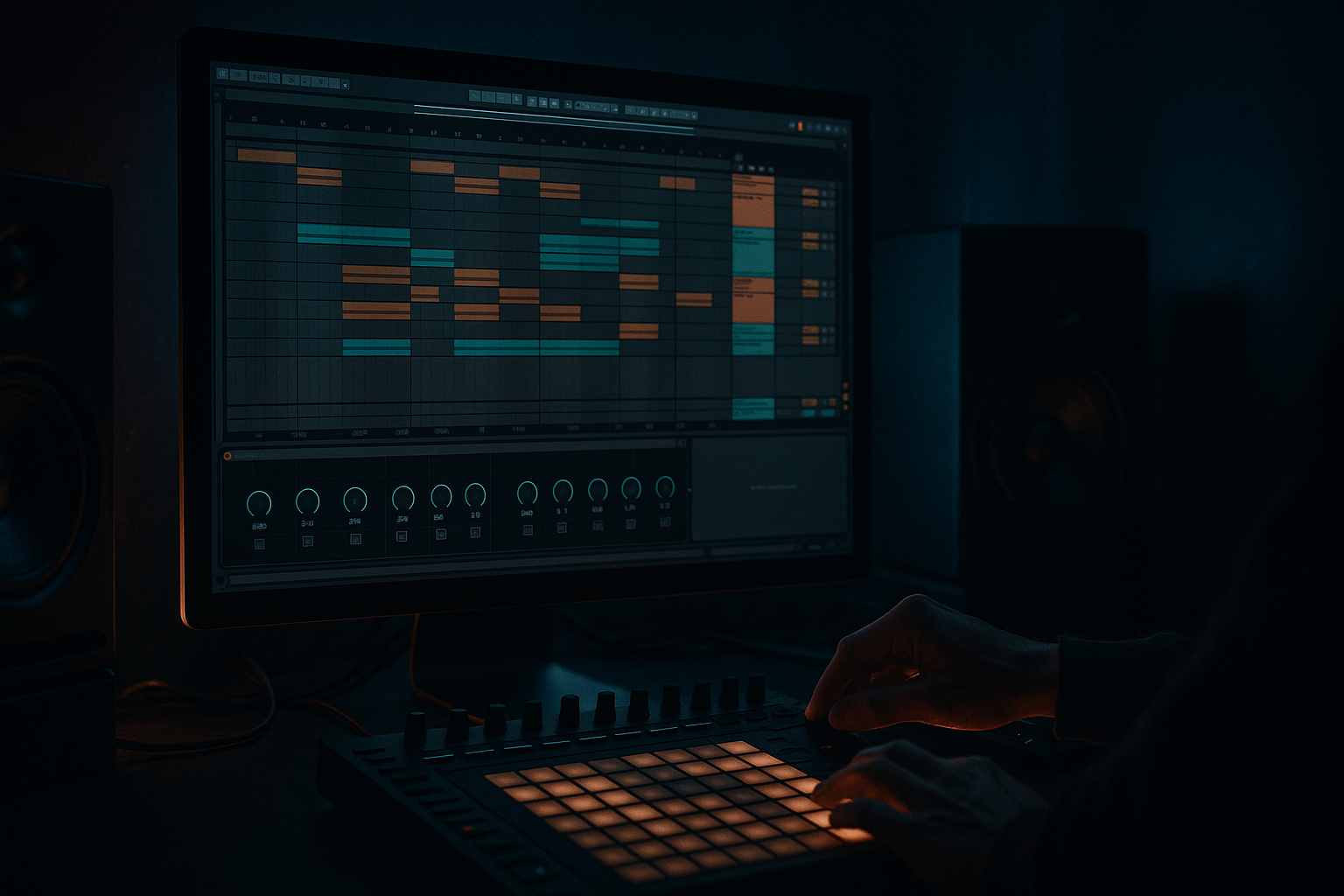
This lesson is about building a Selector Dub-style breakdown blueprint in Ableton Live 12 and using the Groove Pool to give it that oldskool jungle / early DnB swing that feels human, dusty, and dangerous rather than grid-locked. The goal is not to make a full track from scratch here — it’s to build the kind of breakdown that can sit between drops and make the next section hit harder.
In a DnB track, this kind of breakdown usually lives after the first drop, before the second drop, or as a DJ-friendly tension section inside the arrangement. It’s where you remove enough weight to create contrast, but keep enough rhythmic identity that the tune still feels like a record, not an empty interlude. For Selector Dub vibes, that means space, dub pressure, chopped percussion, ghostly samples, skanked offbeats, and a groove that feels swung but still functional for the dancefloor.
Why it matters musically: a good breakdown gives the listener a reset without killing momentum.
Why it matters technically: it lets you shape groove, low-end absence/presence, and texture in a controlled way so the drop feels bigger when it returns. In jungle / oldskool DnB, the groove often comes from micro-shifted drums and sampled swing, so the Groove Pool becomes a fast way to inject that feel without manually nudging every note.
By the end, you should be able to hear a dubby, broken-down section that still moves like DnB, with drums and percussion sitting behind the beat in a deliberate way, samples breathing in the gaps, and a clear path back into the drop. It should feel like a moody, selector-ready breakdown with DJ utility, not a random ambient pause.
What You Will Build
You’ll build a 16-bar breakdown blueprint in Ableton Live 12 that uses:
- a chopped oldskool drum break
- a dub chord stab or skank
- a short bass phrase or sub tease
- atmospheric one-shots and reverse textures
- Groove Pool timing/swing applied to the rhythmic elements
- Keep the sub present in memory, not in constant motion. In darker DnB, the absence of full bass can be more menacing than a busy line. A short sub answer after a gap hits harder than a constant rumble.
- Use one harmonically dirty layer above the sub, not three. A single lightly saturated mid-bass layer gives grit without wrecking mono. Try Saturator before EQ Eight so the harmonics are already part of the tone, then trim what you don’t need.
- Let the break carry menace through ghost-note timing. A tiny delay in the extra snare taps or hat ghosts can make the groove feel like it’s dragging its feet in a dark way. Too much and it just feels sloppy, so keep the movement small.
- Automate filters in narrow, useful arcs. For a breakdown, moving a low-pass from darker to slightly more open over 8 or 16 bars can create a proper lift without needing a huge riser. In DnB, small filter changes are often enough if the drums are already speaking.
- Use a short echo throw on only the last hit of a phrase. One delayed skank or vocal chop can define the end of a 4-bar idea much more effectively than a delay on everything. That creates dub space while preserving punch.
- Make the last 2 bars of the breakdown cleaner than the first 2. This is a classic heavy-DnB move: remove tension sources so the return into the drop feels bigger. More space before impact often reads as heavier than more noise.
- If the break gets harsh, shape it before adding more FX. A gentle EQ Eight dip around the brittle zone — often somewhere in the upper mids — can make room for the stab and FX without flattening the character. Don’t “solve” harshness with more reverb; that usually makes it worse.
- Use only one break loop
- Use only one dub stab sound
- Use only one bass tease
- Use Groove Pool on at least two clips
- No more than one reverb and one delay device in the whole section
- a chopped break
- a sparse skank or chord stab
- a short bass answer
- one transition FX or reverse hit
- a clear ending into the next section
- Can you still feel the kick/snare authority after the groove is applied?
- Does the bass teaser stay supportive instead of taking over?
- When the section loops, does it feel like it wants to move forward rather than sit still?
- Build the breakdown around a break, a skank, a bass tease, and controlled FX.
- Use Groove Pool lightly to create oldskool/jungle human feel without losing drum clarity.
- Keep the sub short, centered, and intentional.
- Shape the section with automation and arrangement, not just sound design.
- Check the breakdown in context with the drop before and after it.
- A good Selector Dub breakdown should feel moody, swinging, spacious, and like it’s setting up real impact.
The finished result should sound dusty, tense, and controlled, with the drums slightly behind the grid, the skanks answering the break, and the bass appearing in short phrases instead of nonstop movement. The rhythmic feel should lean toward jungle bounce and dubwise pull, not straight quantized modern roller stiffness.
Role in the track: this is your middle-section tension builder — ideal before a heavier second drop, a switch-up, or a dubby turnaround. Mix-wise, it should already feel close to usable: no huge low-end mess, no overblown stereo smear, and enough headroom to transition into the next section cleanly.
Success sounds like this: the groove feels lopsided in a musical way, the break has character, the dub hits feel like they’re leaning into space, and when the drop comes back, it feels meaningfully bigger because this section took something away.
Step-by-Step Walkthrough
1. Set up a clean 16-bar breakdown lane before you add anything fancy
In Arrangement View, make a new 16-bar section after your first drop or wherever you want the reset to happen. Start with four lanes of material:
- one audio track for a break loop
- one MIDI track for a dub stab or chord hit
- one audio or MIDI track for sub/bass teases
- one audio track for atmospheres or one-shot FX
Keep it simple at first. The mistake beginners make is loading five ideas before the groove exists. In a Selector Dub breakdown, the “song” is the interaction between a few elements, not a pile of parts.
Why this works in DnB: DnB breakdowns need contrast, but they still need forward motion. A small number of clearly-defined layers makes the groove readable and leaves room for arrangement automation later.
If you already have a bassline and break from the drop, duplicate them into the breakdown section first. Then strip them back rather than starting from nothing. That helps the breakdown feel connected to the track.
2. Choose the break: use a chopped jungle break or a sparse oldskool loop
Drag in a breakbeat that has obvious snare hits and some ghost detail. If you only have one break, that’s enough. Put it on its own audio track and loop 2 or 4 bars.
Now decide between two valid directions:
- A: More jungle / broken feel — keep the break more exposed, with chopped pieces and a few ghost hits
- B: More dub / spacious feel — use a thinner break loop and let the skank and atmosphere carry more of the section
For the beginner workflow, I’d start with A if you want an oldskool rush, or B if your track already has a busy bassline and you need the breakdown to breathe.
Use Clip View and enable Warp if needed. Then try a small amount of groove later, not huge timing correction. If the break is a bit messy in a good way, leave it. You are not trying to sterilize it.
What to listen for: the snare should still land with authority, but the smaller percussion inside the break should feel like it’s dragging the pocket around the beat. If the break sounds too straight, it will lose the jungle character.
3. Open the Groove Pool and give the break a human push
In Ableton’s Groove Pool, choose a swing/groove that feels close to classic sampled drum movement. Start modestly. You want the break to lean, not wobble off the grid.
A practical starting point:
- Timing: around 55–65% if the groove is strong
- Random: very low, around 0–5% at first
- Velocity: subtle, around 5–15%
- Base: test at 1/16 or 1/8 depending on how the break is phrased
Apply the groove to the break clip. If it gets too lazy, reduce Timing or switch to a lighter groove. If it feels too rigid, increase Timing slightly and let the ghost notes sit behind the snare.
The point here is not “swing for swing’s sake.” In jungle and oldskool DnB, groove works because it makes the break feel like it was lifted from a record rather than programmed from scratch.
What to listen for: the snare should still punch, but the hats and tiny percussive notes should feel slightly delayed or leaned. If the break feels like it’s tripping over itself, back off immediately.
4. Edit the break into a breakdown pattern instead of a full loop
Don’t just loop the full break and call it a breakdown. Chop it into musical phrases.
In the Arrangement View or Clip View, make a 4-bar pattern like this:
- bars 1–2: full break, but with some space between hits
- bar 3: remove a few kick hits and leave the snare/ghosts
- bar 4: bring back a fill or a reverse-like pickup into the next section
You can also use Split and duplicate small break fragments so the section evolves. For example, let the first two bars carry the rhythm, then remove the low-end part of the break later so only the top of the kit remains.
A useful stock-device chain for the break track:
- EQ Eight: high-pass gently around 80–120 Hz if the break is fighting the sub
- Drum Buss: light drive and a touch of crunch for grit
- Utility: keep the low end focused and check mono if the break has stereo width
Keep the bass energy out of this lane. The breakdown should suggest the groove, not replace the main low-end role.
5. Add a dub skank or chord stab with controlled timing
On a MIDI track, program a simple offbeat stab — a minor chord, dub chord, or short organ-style hit. Put it on the “and” of the beat or slightly behind it.
This is where Groove Pool gets interesting. Apply a similar groove to the MIDI clip, but don’t copy the break exactly. The break can feel more broken; the skank should feel more intentional and delayed.
Stock-device chain example for the stab:
- Instrument of your choice: keep the tone short and percussive
- Auto Filter: low-pass around 2–6 kHz and automate the cutoff
- Echo: short, dubby repeats with low feedback for space
- Reverb: small to medium room; keep it dark and short so it doesn’t smear the groove
Parameter suggestions:
- filter cutoff: start around 2.5–5 kHz and open only where needed
- Echo feedback: around 15–30%
- Reverb decay: roughly 1.2–2.5 seconds for atmosphere, shorter if the section is dense
- reverb low cut: keep it high enough that the low end stays clean
Decision point:
If you want more Selector Dub mood, keep the stab sparse and let the echo fill the gaps.
If you want more jungle urgency, make the stab more rhythmic and shorten the tail.
The breakdown should now feel like the drums and skank are having a conversation.
6. Place a bass tease, not a full bassline
For beginner-friendly control, use a short bass phrase, one note, or a two-note answer rather than your full drop bassline. In a dub breakdown, the bass is often more about implied pressure than constant motion.
Make it 1 or 2 bars long, then leave space. This is crucial. If the bass runs nonstop, the breakdown loses its function.
Good stock-device chain for a bass tease:
- Operator or Wavetable for the core tone
- Saturator for harmonics and audibility on smaller systems
- EQ Eight to trim useless high end and keep the sub focused
- Utility to check mono and control width
Practical settings:
- Saturator Drive: start around 2–6 dB
- bass low-pass: often around 100–200 Hz depending on the sound
- if adding a mid layer, high-pass that layer around 120–180 Hz so it doesn’t blur the sub
- keep the true sub centered/mono
What to listen for: the bass should be felt as pressure, not heard as a messy note cloud. If the bass line starts fighting the kick/snare memory of the break, shorten the notes or thin the harmonic layer.
Stop here if the bass is getting too busy. A successful Selector Dub breakdown usually leaves the listener wanting the drop, not explaining the drop to them.
7. Use automation to shape the tension curve across 16 bars
Now automate the section so it evolves from open and spacious to tightened and ready to transition.
Useful automation targets:
- Auto Filter cutoff on the stab or atmosphere
- Reverb dry/wet to widen the space at the start and then pull it back
- Echo feedback for one or two dub throw moments
- Volume on the break fragments so certain hits disappear before the turnaround
A strong 16-bar breakdown structure:
- bars 1–4: open space, fewer elements, obvious groove
- bars 5–8: add a little more rhythmic activity or a second stab
- bars 9–12: introduce tension with a filtered noise rise or a bass reply
- bars 13–16: thin out again, then build into the next drop with a fill or reversed texture
In DnB, this works because the listener needs a clear energy map. If everything stays at the same intensity, the second drop has no leverage.
What to listen for: the section should breathe. If every bar feels equally full, your automation is too flat.
8. Add one or two FX elements, but keep them functional
For a Selector Dub breakdown, use FX as punctuation, not decoration. A reverse cymbal, filtered noise swell, or short vocal/dub phrase can do a lot if placed sparingly.
Try this:
- reverse one break hit into bar 9 or bar 13
- add a low-passed noise swell under the transition
- use a short delay throw on the last skank before the drop
Keep FX in a separate track so you can mute them fast if they clutter the section.
Workflow efficiency tip: once the FX path works once, commit it to audio. In a beginner session, printing the best reverse and delay throw saves CPU and helps you stop fiddling with “maybe” versions. The goal is arrangement progress, not infinite auditioning.
If the FX are too loud, they’ll swallow the break’s character. If they’re too subtle, they won’t justify their place. Aim for “felt first, heard second.”
9. Check the breakdown in context with drums, bass, and the next section
This is the moment many beginners skip, and it’s the one that matters most. Loop from the last two bars of the drop into the breakdown and back out again.
Ask three questions:
- Does the groove still feel like DnB when the full bass drops out?
- Does the breakdown create contrast without killing momentum?
- Does the transition back into the next section feel earned?
If the answer is no, the problem is usually one of these:
- too much low-end left in the break
- too many long tails from reverb/delay
- not enough rhythmic anchor from the skank or percussion
Compare the section with and without the bass tease. If the bass tease makes the breakdown feel heavy but the low end turns muddy, shorten the notes or reduce the harmonic layer.
This is the core “in context” check: the breakdown is only successful if it makes the next drum-and-bass section hit harder.
10. Finish with a DJ-friendly transition and a clear second-drop setup
Your breakdown should end with a shape that a DJ or listener can follow. In oldskool/jungle-flavoured DnB, a good arrangement usually gives you:
- a clear 16-bar or 32-bar phrase
- a fill or lift at the end
- enough room for the next section to land clean
A simple arrangement example:
- 4 bars: open break + dub stab
- 4 bars: break gets thinner, bass tease appears
- 4 bars: atmosphere rises, one-shot FX, filter opens
- 4 bars: fill and pre-drop tension, then back into full drums/bass
If you want a more proper DJ tool feel, make the last 2 bars cleaner so a mixer can blend into the next tune or section more easily. If you want a more modern “statement” feel, let the final bar have a stronger fill and a harder handoff.
A versus B decision point:
- A: DJ utility — cleaner ending, fewer surprise elements, better for blending
- B: performance impact — more dramatic fill, more FX, stronger surprise into the drop
Both are valid. Choose based on whether the track is built for mixes or for a bigger standalone arrangement moment.
Common Mistakes
1. Using a full drop bassline inside the breakdown
- Why it hurts: the section loses contrast and the next drop has less impact.
- Fix: keep only a short bass tease or one-note response. In Ableton, mute or split the bass clip so the breakdown uses only selected hits.
2. Applying too much Groove Pool timing
- Why it hurts: the break starts to feel late instead of swung, and the rhythm gets blurry.
- Fix: reduce Timing and Random. Start with subtle swing and test against the snare. If the backbeat loses authority, the groove is too heavy.
3. Letting reverb and delay wash over the low end
- Why it hurts: the breakdown gets cloudy, especially when the bass returns.
- Fix: shorten Reverb decay, lower dry/wet, and use EQ Eight to high-pass the FX return or the source itself. Keep anything below the musical body clean.
4. Putting every element on every bar
- Why it hurts: the section has no shape, so it feels static.
- Fix: remove elements in planned waves. In Arrangement View, leave space in bars 3–4, 7–8, or 15–16 so the listener feels movement.
5. Not checking mono compatibility on the break and bass
- Why it hurts: wide effects can sound impressive in stereo but disappear or get weak in mono, especially in clubs.
- Fix: use Utility to check mono on the break or bass layer. Keep sub frequencies centered, and avoid making the low end depend on stereo spread.
6. Choosing a groove that fights the drum phrase
- Why it hurts: the snare and ghost notes stop feeling like part of the same record.
- Fix: test a different groove base or reduce the groove amount on the MIDI stab while keeping more swing on the break.
7. Leaving the breakdown unedited because it “sounds cool alone”
- Why it hurts: isolated coolness is not the same as track function.
- Fix: always audition the section with the drop before and after it. If it doesn’t improve the transition, simplify it.
Pro Tips for Darker / Heavier DnB
Mini Practice Exercise
Goal: Build a 16-bar Selector Dub breakdown that feels swung, tense, and ready to return into a drop.
Time box: 15 minutes.
Constraints:
Deliverable: A 16-bar arrangement section that contains:
Quick self-check:
If the answer to any of those is no, remove one layer and simplify before adding anything else.

