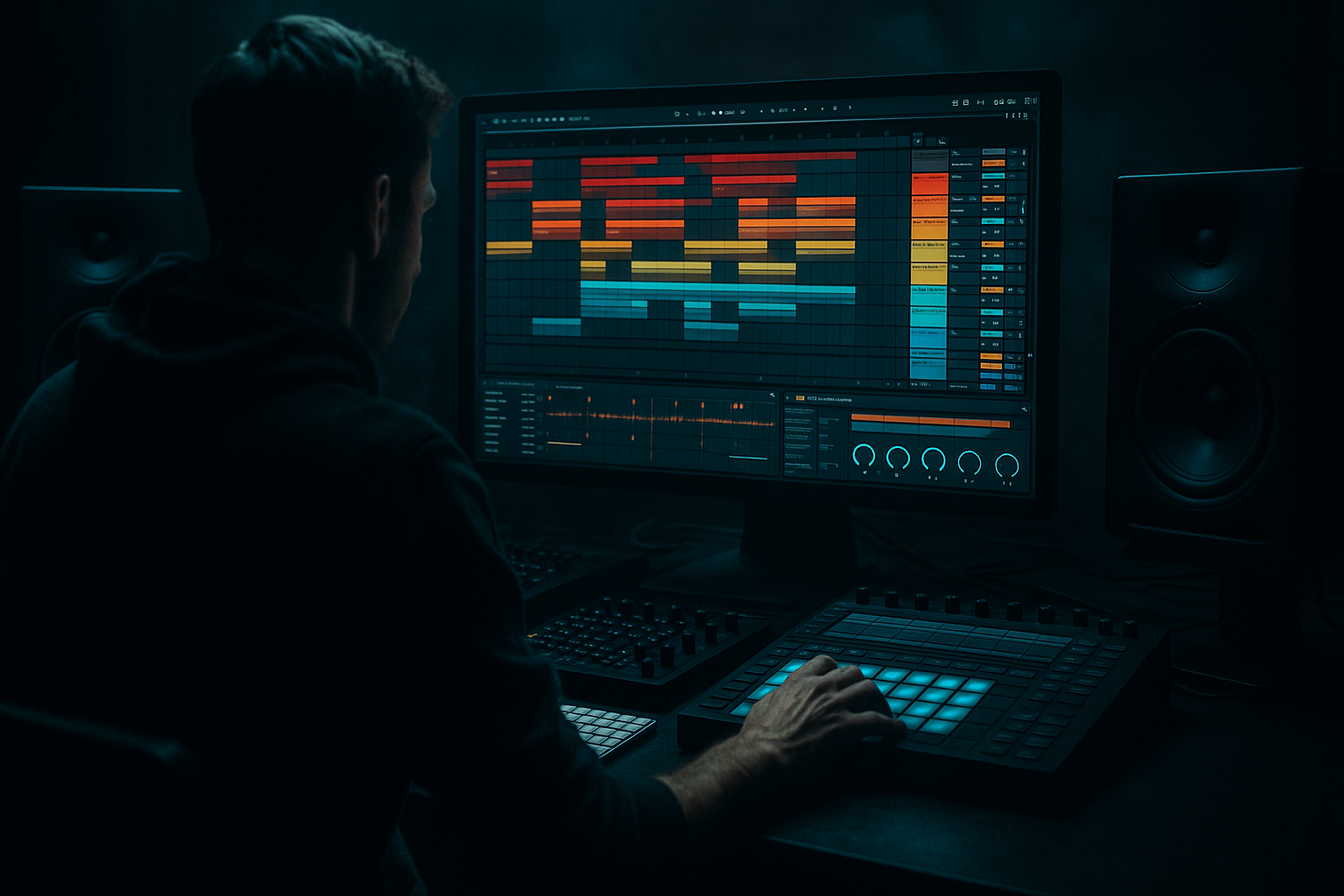
Main tutorial
Lesson Overview
This lesson is about building a Selector Dub-style jungle fill blueprint in Ableton Live 12 using an automation-first workflow. The goal is not just to “add a fill,” but to design a repeatable system for making those oldskool DnB switch-ups that feel like a DJ pulling a tune into the next section with confidence: chopped breaks, sub drop tension, dubwise delay throws, filter sweeps, and a quick burst of controlled chaos before the drop lands.
In advanced DnB production, fills are rarely random. They work best when they’re part of the arrangement language: a two-bar tension build, a one-bar break flip, or a half-bar selector-style reset that signals a new phrase. This matters because jungle and oldskool DnB rely heavily on contrast, momentum, and edit culture. If the fill is too clean, it loses character. If it’s too messy, it eats the groove. The sweet spot is an intentional, automation-driven fill that sits inside the mix like it belongs there.
This approach is especially useful for:
- Jungle rolls with chopped Amen or Think break energy
- Oldskool DnB switch-ups before the drop or second drop
- Dubby “selector” transitions with delays and filter movement
- Dark rollers that need a controlled burst of activity without losing low-end authority
- A main drum break with selective chops and ghost hits
- A fill layer derived from the break or a resampled drum bus
- A dub-style FX lane with delay throws and filter movement
- A bass mute / stutter / re-entry strategy
- A mastering-safe transition shape that preserves punch and low-end clarity
- A selector-style drum pullback into a new phrase
- A jungle fill that nods to oldskool Amen edits
- A tension spike before the drop or breakdown
- A fill that works in a roller context, not just a chaotic “drum solo”
- 16-bar intro turns
- 8-bar pre-drop ramps
- 4-bar drop transitions
- Breakdown re-entry moments
- Final-drop variation with darker energy
- Overfilling the bar
- Letting bass and fill compete
- Using too much reverb
- Quantizing every chop too hard
- Ignoring the drum bus
- Making the fill louder instead of more contrasted
- Use Auto Filter in band-pass mode on the fill for a filthy tunnel-like reset, especially on breaks or atmospheres.
- Add Saturator on the fill layer with soft clip engaged and drive around 2–6 dB for grit without shredding transients.
- For neuro-adjacent tension, modulate a Reese or mid-bass with a short filter sweep while the drums fill the gap, then snap it back into mono.
- Use Utility to narrow the fill’s stereo image briefly, then widen the next phrase slightly for a stronger drop impression.
- Try a one-shot sub hit at the end of the fill, but keep it short and clean. Think impact, not sub rumble.
- If the track is very dark, keep FX tails filtered below the harsh zone. A darker echo return often feels bigger than a bright one.
- Use ghost snares with lower velocity and a slightly different transient character to create “human” pressure in the fill.
- On the master or drum bus, compare the fill section against the drop with Spectrum and your ears: the fill should feel more animated, not necessarily more full.
- Build the fill from your existing break so it sounds native to the tune.
- Automate the transition first: drums, bass, filters, delay throws, and width.
- Keep the bass under control so the fill can breathe.
- Use Ableton stock devices like Auto Filter, Echo, Reverb, Drum Buss, Saturator, Utility, and EQ Eight.
- Think like a mastering engineer: manage headroom, transients, and low-end separation.
- The best jungle fills feel edited, musical, and phrase-aware — not random.
The core idea: build a fillable performance lane around drums, bass, and FX, then automate it as if you’re mixing live. That keeps the vibe organic while giving you precise control over tension and release. 🎛️
What You Will Build
You’ll build a 1- to 2-bar jungle fill blueprint in Ableton Live 12 that can be dropped into multiple parts of a DnB arrangement. It will include:
Musically, the result should feel like:
By the end, you’ll have a blueprint you can reuse for:
Step-by-Step Walkthrough
1. Set up the arrangement context first, not the fill
Start with a clean section in Ableton Live 12: pick an 8- or 16-bar phrase boundary where the fill will live. For oldskool DnB, the most effective fill points are usually the last 1 bar or 2 bars before a new phrase. If your tune is around 174 BPM, aim for the fill to happen over bar 7–8 of an 8-bar cycle or bar 15–16 of a 16-bar cycle.
Put your main elements in place:
- Kick/snare or break-led drum groove
- Bassline with clear phrase logic
- A light atmospheric bed or dub chord stab if relevant
Why this works in DnB: the listener needs to feel the tune “turn the corner.” Jungle and rollers depend on phrase momentum, so the fill must serve the arrangement, not interrupt it.
2. Build the fill from the existing break, not from scratch
Duplicate your main break track to a new lane called something like BREAK FILL. In Live, use the simplest workflow:
- Duplicate the clip
- Consolidate if needed
- Slice or edit only the last 1–2 bars
- Keep the same sample family so the fill feels glued to the groove
Use Slice to New MIDI Track if you want precise chop control, or stay audio-based if the break already has a strong human feel. For jungle, a resampled audio approach often sounds more convincing because the micro-timing and transient smear feel more “real.”
Practical edit idea:
- Keep the core backbeat in place
- Insert one extra snare pickup
- Add a ghost kick just before the final snare
- Use a short break reversal or half-beat stutter in the final half-bar
This gives you a fill that feels like a natural extension of the break rather than a generic fill pack loop.
3. Create a dedicated Fill Group and resample the drum bus
Group your drums and create a DRUM BUS. Add a Resampling audio track or a new track fed from the drum group output. Record a few passes of the groove while performing small changes:
- Short mutes
- Snare emphasis
- Hat dropouts
- One-bar break variations
Then choose the most useful moments and turn them into a fill sample pool.
Inside the Drum Bus, use stock Ableton devices carefully:
- Drum Buss: Drive around 5–15%, Transients slightly up if the break needs bite
- Glue Compressor: light movement, ratio 2:1, attack 10–30 ms, release Auto or moderate tempo-synced release
- EQ Eight: high-pass only if needed on the fill layer, usually not on the main drum bus if the low-end is already right
Advanced tip: the fill should have a little more aggression than the groove, but not more low-end than the main drums. The goal is impact, not bloat.
4. Design the automation lane before adding extra sound design
This is the automation-first part. Create automation on:
- Filter cutoff for the break or drum fill
- Delay send level
- Reverb send level
- Bass mute or low-pass
- Utility width if you want the fill to collapse into mono then explode back out
Useful stock device choices:
- Auto Filter for sweep and band-pass moves
- Echo for dub throws and feedback bursts
- Reverb for short, dark room tails
- Utility for gain and width control
- Envelope Follower if you want movement tied to the break’s dynamics
Good starting ranges:
- Auto Filter cutoff: sweep from about 180 Hz to 12 kHz depending on source
- Resonance: 10–35% for a noticeable but not piercing sweep
- Echo feedback: 15–45% for dub throws, higher only on isolated moments
- Reverb decay: 0.6–1.8 s for tight jungle fill space
The key is to automate the fill as a performance, not just as a static clip. In DnB, automation creates the sense that the track is breathing.
5. Shape the bass so the fill has room to speak
Most jungle fills fail because the bass keeps speaking at full volume while the drums are trying to narrate the transition. Build a clear bass strategy:
- In the last half-bar to one bar, automate a bass duck or mute
- If the bass is a reese, filter it down or narrow it temporarily
- If the bass is sub-heavy, make sure the sub either drops out or becomes very simple during the fill
Stock Ableton workflow:
- Use Utility for a short gain dip of about -2 to -6 dB
- Use Auto Filter on the bass to close the top end slightly during the fill
- If needed, automate a Low-Pass Filter around 120–250 Hz to remove upper motion while preserving sub
A strong option for darker DnB is a call-and-response setup:
- Fill hits in the drums
- Bass answers after the fill with a strong re-entry note
- The bass return lands on the first downbeat of the next phrase
Why this works in DnB: the bass carries authority. If it stays too active through the fill, the listener can’t feel the drop of energy that makes the next section hit harder.
6. Add selector-style FX throws that sound like a live dub system
This is where the “Selector Dub” flavor comes alive. Use Echo and Reverb on return tracks so you can throw individual hits into the space:
- Send the last snare or rimshot into Echo
- Use short delay times synced to 1/8, 1/4, or dotted 1/8
- Automate feedback to spike briefly on the final hit
Good creative moves:
- A dub snare delay throw on the final hit of the fill
- A high-passed echo tail so the low end stays clean
- A brief reverb swell on a chopped break slice
- A reverse crash or downlifter into the next section
Example routing idea:
- Return A: short room reverb
- Return B: Echo with filter driven darker
- Return C: long atmosphere or noise tail, used sparingly
Keep the FX “behind” the drums. In jungle, the FX should feel like smoke and motion around the break, not a giant cinematic wash that buries the groove.
7. Use clip automation and lane editing to make the fill feel edited, not pasted
In Live 12, combine arrangement automation with clip-level shaping. For the fill clip:
- Shorten a snare hit by a few milliseconds if it needs more snap
- Shift a ghost note slightly late for swing
- Add micro-mutes around the kick to create syncopation
- Draw velocity changes in MIDI if using sliced drums
Advanced layering trick:
- Layer a second break only on the final 2 beats
- High-pass it around 200–300 Hz
- Keep the original break as the body
- Let the layer provide texture and urgency
If you’re working with a jungle break, make sure the fill doesn’t flatten the groove by over-quantizing everything. Oldskool DnB lives on slightly unstable timing and intentional edits, not perfect grid conformity.
8. Shape the transition with mastering-safe bus control
Since this lesson sits in the Mastering category, think like a final-stage engineer while building the fill. Your transition should not create uncontrolled peak spikes or low-end pileups.
On the master during the writing stage:
- Keep headroom around -6 dB peak or healthier
- Avoid over-limiting while designing the fill
- Use Spectrum to watch the low-end behavior during the fill
- Check Utility mono summing on the low frequencies if needed
On the drum bus:
- Add subtle saturation with Drum Buss or Saturator
- Keep transient control tight so the fill hits without clipping
- If the fill overdoes the top end, use EQ Eight to tame harsh hats around 6–10 kHz
Mastering mindset: the best fills create perceived loudness through contrast, not just by being physically louder. A brief dip before impact often sounds bigger than a full-force wall of sound.
9. Test the fill in three arrangement modes
Don’t judge the fill only in isolation. Test it in three contexts:
- As a pre-drop fill before the first drop
- As a switch-up in the middle of a roller
- As a breakdown re-entry after a dubby atmospheric section
For each test, ask:
- Does the bass re-entry feel obvious?
- Is the drum fill clear on first listen?
- Does the low end stay controlled?
- Does the fill preserve the track’s identity?
If it works in all three, you’ve built a reusable blueprint. If it only works once, simplify the automation and reduce the number of moving parts.
Common Mistakes
- Too many hits make the transition feel busy instead of powerful.
- Fix: leave at least one clear rhythmic anchor, usually the snare or the downbeat.
- Heavy bass motion during a fill kills clarity.
- Fix: automate a short bass mute, filter dip, or width reduction before the drop.
- DnB fills need space, not wash.
- Fix: shorten decay, high-pass the return, and automate only on select hits.
- Oldskool jungle loses swing when everything is perfectly aligned.
- Fix: move ghost notes slightly late or use groove lightly.
- A fill that sounds good solo can still overload the mix.
- Fix: check the fill with the full drum bus and bass together, not by itself.
- Loud doesn’t always read as impactful.
- Fix: automate a tiny dip before the fill, then restore energy on the downbeat.
Pro Tips for Darker / Heavier DnB
Mini Practice Exercise
Set a timer for 15 minutes and build one reusable jungle fill blueprint.
1. Pick an 8-bar loop at around 170–175 BPM.
2. Duplicate the main break to a fill lane.
3. Edit only the last 1 bar with:
- one extra snare pickup
- one ghost kick
- one chopped or reversed break slice
4. Add Auto Filter automation sweeping from dark to bright across the last bar.
5. Put Echo on a return track and automate one final snare throw.
6. Duck the bass by 2–5 dB for the fill bar.
7. Check the result with the full arrangement, then bounce or consolidate the fill clip.
8. Make one second version: darker, less FX, more drum weight.
Goal: end with two options — one more dubwise, one more aggressive — both reusable in future tracks.

