Main tutorial
Lesson Overview
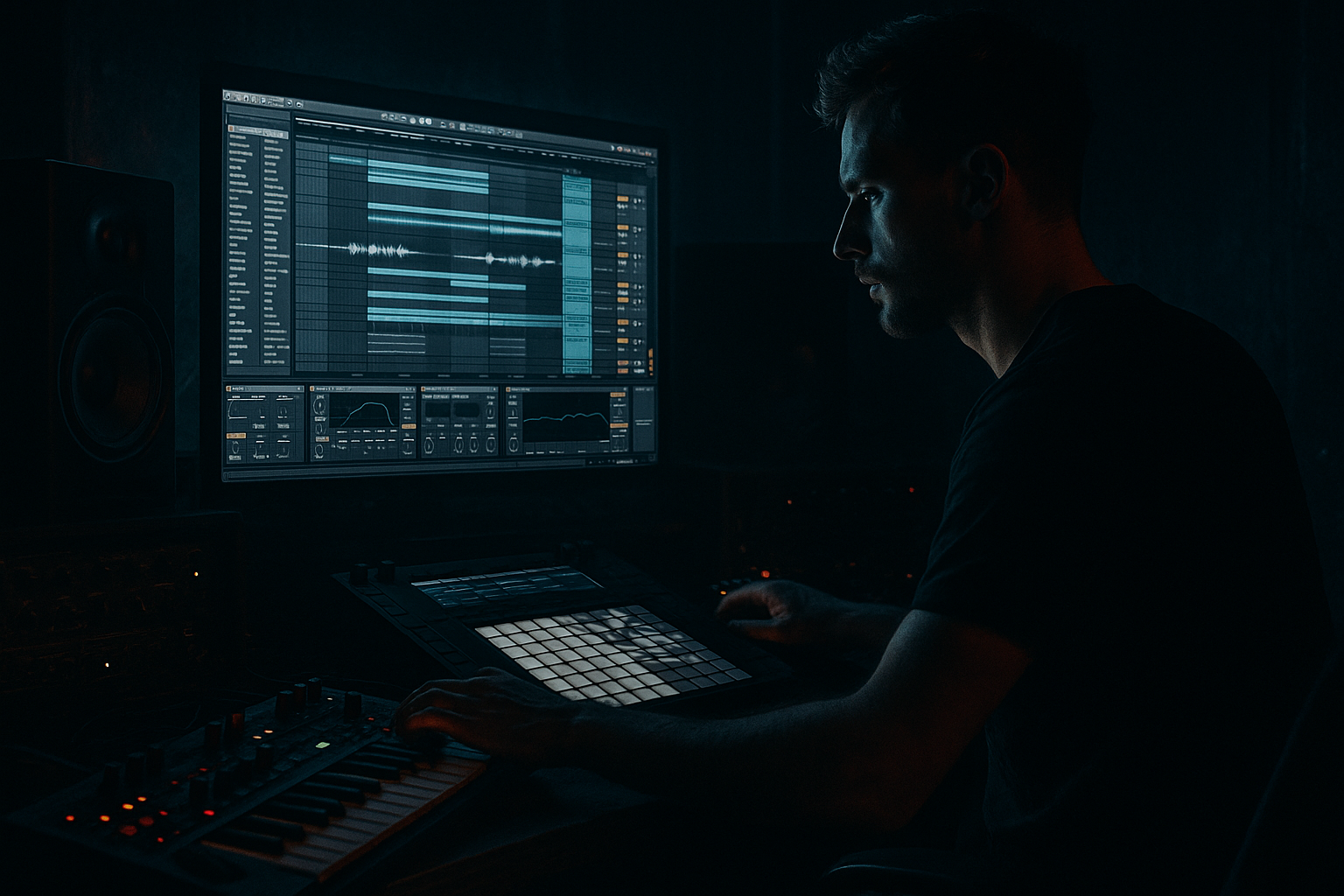
In this lesson you’re building a Selector Dub-style tape-hiss atmosphere blueprint for deep jungle / oldskool DnB inside Ableton Live 12. The goal is not just “adding noise” — it’s creating a living atmospheric bed that feels like an old dub plate, a smoked-out sound system tape loop, and a rainy alleyway rolled into one. 🌫️
This technique matters because in Drum & Bass, especially jungle, rollers, and darker halftime-adjacent material, the atmosphere is often what makes a loop feel scene-specific instead of generic. A great break and sub can carry the energy, but the atmos layer gives the track its memory, age, space, and menace. In a Selector Dub context, you want that half-worn, half-mystical texture: tape hiss, filtered room tone, distant vinyl crackle, spectral chords, and degraded movement that sits behind the drums without smothering them.
This is especially useful for:
- Intro sections before the drop
- Breakdowns between drum edits
- Dubby mid-intros where the bass drops out briefly
- Oldskool jungle tension beds under break chops and amen fills
- Transition glue between 16-bar phrases
- A tape-hiss noise layer
- A dark filtered ambience layer
- A subtle dub chord or tonal smear
- A rhythmic movement layer that pulses around the break
- A resampled texture loop you can arrange across intros, breakdowns, and drop transitions
- a rainy alley tape loop
- the sound of a dubwise jungle intro
- a lo-fi atmospheric cloud hovering above breakbeats
- enough space for a sub-heavy bassline and crisp drums to still hit hard
- Oldskool jungle intros
- Deep rollers
- Dubwise / selector-style arrangements
- Darker DnB atmospheres under Reese bass and chopped breaks
- a Return track if you want the atmosphere to be send-based and reusable
- or a Group track if this is a track-specific atmosphere layer
- Utility
- Auto Filter
- Saturator
- Hybrid Reverb
- Echo or Delay
- Limiter only if needed for safety
- In Operator, select a noise source if you want a pure hiss texture.
- If you want a slightly harsher edge, use a simple oscillator with very high filtering and extra saturation.
- Noise level: low, around -24 to -18 dB
- Auto Filter: Low-pass or band-pass
- Add Saturator
- Downsample only a little
- Bit reduction very subtle
- Keep it tasteful — you want age, not digital destruction
- Wavetable for a soft, detuned pad
- Analog for a darker, warmer tone
- A sampled chord stab stretched and filtered
- A resample of a dub chord from your own session
- Oscillator 1: saw or sine blend
- Oscillator 2: detuned saw slightly lower in level
- Filter: low-pass, cutoff around 300 Hz to 2.5 kHz depending on how dark you want it
- Envelopes: slow attack, long release
- Slight pitch drift or subtle detune for movement
- Reverb size: medium to large
- Decay: 3–8 seconds
- Pre-delay: 10–25 ms
- Use a darker tone if possible
- Keep wet signal controlled, around 10–25% if it’s insert-based
- Cutoff sweeping from around 250 Hz up to 2–4 kHz
- Resonance modest, around 10–25%
- Filter type: low-pass for build-ups, band-pass for telephone-like tension
- LFO in Wavetable/Analog for subtle wavering
- Auto Pan very lightly
- Echo set to very low feedback for ghost tails
- Solo the atmosphere chain
- Record or resample 8–16 bars onto a new audio track
- Chop the best parts into a loop
- Tighten the start so there’s no dead space
- Use clip fades for smooth loops
- Warp carefully if needed; avoid making it too clinical
- Try Complex Pro only if the source needs pitch/time preservation without artifacts
- Trim out dull sections
- Leave in interesting hiss bursts, reverb swells, or chord tails
- Reverse a few short slices for tension before fills
- Keep atmosphere dips on strong kick/snare moments
- Let it swell in the spaces between snare hits
- Use volume automation to duck the atmosphere during key drum phrases
- Utility automation for 1–2 dB dips on drum accents
- Compressor sidechain from the kick or main drum bus
- If the atmosphere is wide, keep its low end mono using Utility or EQ Eight
- High-pass around 120–250 Hz depending on the sound
- Cut harshness around 2.5–5 kHz if the hiss bites too much
- Notch any resonant whine if the noise gets narrow and annoying
- If the pad is muddy, dip 200–500 Hz gently
- The atmosphere should support the sub and snare
- It should not fight the kick transient
- It should not occupy the same “voice” as your Reese or lead bass
- Delay time: 1/4, 1/8 dotted, or 1/2
- Feedback: 15–35%
- Filter the repeats so they’re darker than the dry signal
- Automate send amount on the last hit of an 8-bar or 16-bar phrase
- Put a chord hit or texture stab on bar 8
- Automate a delay send upward only on that hit
- Cut the dry signal slightly after the hit for space
- Intro 1–8 bars: hiss + filtered room tone
- Bars 9–16: add tonal smear and delayed chord echoes
- Pre-drop 17–24: open filter, more movement, less low-mid clutter
- Drop 1: reduce atmosphere to a lighter bed so the drums and bass own the space
- Breakdown: bring back the full selector dub cloud
- Switch-up: reverse slices, automate filter movement, add a few pitched-down tails
- Outro: strip back to hiss and distant reverb
- Too much hiss
- Atmosphere masking the snare
- Too much low-mid mud
- Static loop syndrome
- Stereo clutter
- Overprocessing
- Sidechain the atmosphere lightly from the snare bus, not just the kick, if the break needs more snap and breathing room.
- Layer a very low sine or sub-tonal rumble under the atmosphere for tension, but high-pass it above the actual bass zone if the track is already sub-heavy.
- Use subtle chorus or ensemble-style widening only on the upper atmosphere layer, never on the sub region.
- Print a few versions of the atmosphere: dry, more reverbed, more filtered, more degraded. That gives you arrangement options fast.
- Add a restrained Saturator before reverb so the ambience blooms with more density and old tape feel.
- Use automation to “duck into darkness” before the drop: close the filter, reduce width, then open everything on the first downbeat.
- For neuro-leaning darkness, keep the atmosphere smaller and more controlled, with sharper spectral movement and less wash. Let the bass design carry the aggression.
- For oldskool jungle, embrace more reverb tail and a wider stereo haze, but keep the kick/sub lane clean.
- Build from noise + tonal space
- Use filtering, saturation, reverb, and delay for character
- Resample and chop to make it musical
- Keep it out of the way of the sub, kick, and snare
- Arrange it in phrases, not just loops
The key lesson here is that a proper DnB atmosphere is not static. It needs motion, filtering, saturation, and arrangement logic so it supports the groove rather than just sitting there.
What You Will Build
By the end of this lesson, you’ll have a custom atmosphere rack in Ableton Live that combines:
Musically, the result should feel like:
You’ll end with a sound that works in:
Step-by-Step Walkthrough
1) Set up a dedicated atmosphere return or group
Start by creating a clean place for this sound to live. In Ableton Live 12, make either:
For most DnB workflows, I recommend a Group track for the main atmosphere sound, then a small amount sent to a shared reverb/delay return.
Build this chain order:
Set Utility first so you can control gain staging early. Aim to keep the atmosphere peaking around -12 to -8 dB before heavy send effects. This keeps it present but not blurry.
Why this works in DnB: drums and bass need headroom. If the atmosphere is too loud in the source, your break transients and sub lose impact fast.
2) Create the tape-hiss source
The easiest authentic foundation is white noise shaped like tape hiss.
Use Operator or Analog:
Practical starting settings:
- Low-pass cutoff around 6–10 kHz
- Resonance low, around 5–15%
- Drive: 2–6 dB
- Soft Clip: On
- Output adjusted to match level
If the hiss feels too clean, use Redux lightly:
This hiss should not be loud enough to notice as a “noise effect.” It should feel like air in the room, especially on headphones.
3) Add a dark ambience layer with filtered tonal content
Now create a second layer that feels like space, not just noise. This can be a pad, a sustained chord, or a resampled tonal smear.
Good Ableton-native choices:
Suggested patch direction:
Add Hybrid Reverb:
This layer is what makes the atmosphere feel like “Selector Dub” instead of generic hiss. The noise gives surface texture; the tonal layer gives emotional weight.
4) Shape the atmosphere with movement, not static sustain
A static pad will get boring in 8 bars. In jungle and DnB, the atmosphere has to breathe around the breaks.
Use Auto Filter after your tone layer and automate:
Add movement with one of these:
- Amount: 10–25%
- Rate synced to 1/2, 1 bar, or 2 bars
- Phase: 180° if you want width movement, but keep low end out of it
- Time: 1/8 dotted or 1/4
- Feedback: 10–25%
- Filter the delay so it doesn’t crowd the low mids
For oldskool jungle vibes, think of the atmosphere as a call-and-response bed with the break. It should open up when the drums hit, then bloom in the gaps.
5) Resample a “room tape” loop for character
This is where the sound gets special. Print your atmosphere to audio and edit it like a sample.
In Ableton:
Then use the Simpler or Audio Clip tools to reshape it:
Now edit the resampled texture:
Why this works in DnB: once a texture becomes audio, you can arrange it rhythmically like a break. That makes it much easier to fit into a track structure and helps it sound more intentional.
6) Make it groove with the drums instead of floating above them
Place your atmosphere against your break pattern and listen for masking.
If your track uses an amen or chopped break:
Useful approaches:
- Ratio: 2:1 to 4:1
- Attack: 10–30 ms
- Release: 80–200 ms
- Just enough to create breathing room
A musical context example: in a 16-bar intro, let the hiss and pad sit almost alone for bars 1–4, bring in ghosted breaks at bars 5–8, then open the filter and add more stereo width in bars 9–12 before the drop. That creates tension without needing huge FX.
7) Control frequency space with surgical EQ
Atmospheres can destroy clarity in the low mids if you’re not careful.
Add EQ Eight and do this:
A good rule:
If needed, put Spectrum after EQ Eight to check the balance. In DnB, visual checking helps when the texture is dense and the mix is moving fast.
8) Add dub-style delay throws and phrase endings
Selector Dub vibes thrive on delayed echoes that appear at the end of phrases.
Use Echo or Delay on an automation lane:
Try this:
This creates that smoked-out dub “tail” without making the mix wash out.
9) Arrange the atmosphere like part of the track architecture
Don’t leave it looping unchanged for the whole song. DnB arrangement is about phrasing.
A strong structure might be:
This keeps the atmosphere functional instead of decorative. In DJ-friendly DnB, those intro/outro atmos beds are gold because they help mixes blend naturally.
Common Mistakes
- Fix: lower the noise source and high-pass it more aggressively. Tape hiss should feel like air, not a washing machine.
- Fix: cut 2–5 kHz in the atmosphere or automate volume dips on snare hits.
- Fix: high-pass higher than you think, often 150–250 Hz, and keep reverb darker.
- Fix: automate filter cutoff, delay throws, or resample and chop the atmosphere into phrases.
- Fix: keep low frequencies mono, and avoid wide reverb on everything. Use Utility to narrow the bed if needed.
- Fix: one great texture with movement beats five messy layers. Let the drums and bass lead.
Pro Tips for Darker / Heavier DnB
Mini Practice Exercise
Spend 10–20 minutes making one 8-bar Selector Dub atmosphere loop in Ableton Live.
1. Build a noise layer with Operator or Analog.
2. Add Auto Filter + Saturator + Hybrid Reverb.
3. Add a second tonal layer using Wavetable or a resampled chord.
4. Automate the filter cutoff across 8 bars.
5. Sidechain the atmosphere lightly to your drum bus.
6. Resample 4–8 bars of the result to audio.
7. Chop it into 2–4 useful phrases.
8. Add one delay throw on the final bar.
Goal: by the end, you should have a loop that could sit under an amen break or a deep roller intro without fighting the drums.
Recap
The core idea is simple: a great DnB atmosphere is a controlled, moving texture that supports the groove.
Remember these essentials:
If you get this right, your jungle and oldskool DnB intros will immediately sound more tape-worn, dubwise, and emotionally deep — exactly the kind of atmosphere people replay later 🔥

