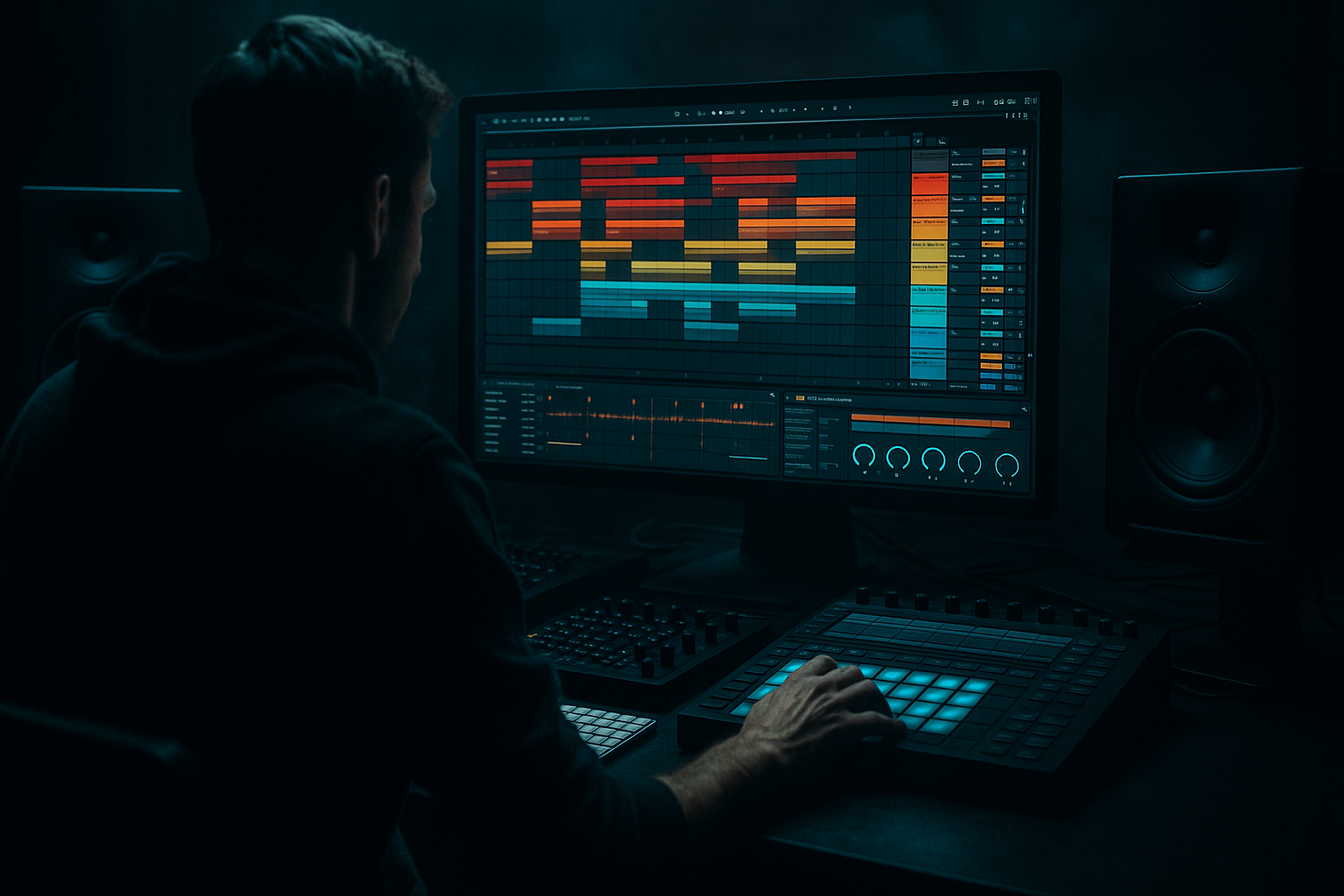
Main tutorial
Separating Writing and Mixing Stages (DnB in Ableton Live) 🎛️⚡
Workflow lesson for intermediate producers
---
1. Lesson overview
In drum & bass, it’s incredibly easy to kill momentum by mixing too early: tweaking EQs for 30 minutes while your drop still has no hook. The goal of this lesson is to separate “writing mode” from “mixing mode” so you can:
- Finish arrangements faster 🏁
- Make stronger musical decisions (groove, call/response, energy)
- Mix with clearer priorities later (because the song is actually a song)
- WRITE stage = speed, vibe, arrangement, sound choice (rough leveling only)
- MIX stage = technical polish, translation, headroom, depth, automation cleanup
- A 32–64 bar arrangement sketch
- A writing-ready routing system:
- A switchable “Write vs Mix” approach
- No soloing for more than 10 seconds (danger zone for micro-fixation)
- No spectrum analyzing every channel
- Only use: Utility, EQ Eight, Auto Filter, Saturator, Glue Compressor (and reverb/delay sends)
- Leveling uses your ears + meters only (simple)
- If a sound doesn’t work in 2 minutes, swap it (don’t rescue it)
- Set tempo 172–176 BPM
- Warp mode defaults:
- Return A (Room): Reverb
- Return B (Delay): Echo
- Return C (Long): Hybrid Reverb
- Kick on 1 and 3 (or a 2-step DnB kick pattern)
- Snare on 2 and 4 (DnB standard)
- Hats: 1/16 with velocity variation + offbeat open hat
- On Snare track:
- On Drum Group:
- Drop a break sample on a track
- Warp: Beats, Preserve: Transients, Envelope: ~40–70
- High-pass it with Auto Filter around 120–200 Hz so it doesn’t fight the kick/sub.
- Instrument: Operator
- Write a rolling bassline that locks to the kick/snare pocket (use syncopation, leave space on snare hits)
- Instrument: Wavetable
- Or use Analog for classic reese weight.
- Phrase A (bars 1–4): simple + heavy
- Phrase B (bars 5–8): add variation (fill, pitch bend, extra note)
- Utility: -3 dB (headroom safety)
- Glue Compressor (optional): 1 dB GR max
- Limiter: OFF during writing (or on but barely touching; don’t chase loud)
- Bars 1–9 (Intro): hats, atmos, filtered break, tease bass
- Bars 9–17 (Build): snare build, riser, bass automation opening up
- Bars 17–33 (Drop): full drums + sub + bass phrase A/B
- Bars 33–41 (Mini break): pull kick, keep break/atmos, add vocal stab throw
- Bars 41–57 (Drop 2): variation (switch bass phrase, add ride/crash, extra fills)
- Use Locator markers: INTRO / BUILD / DROP / BREAK / DROP2
- Group scenes in Session, then record to Arrangement (great for performance-based automation)
- Use Automation lanes early for energy moves only:
- Arrangement is mostly done
- The core sounds are chosen
- The drop works without “mix magic”
- No sound browsing
- No rewriting basslines (unless arrangement demands it)
- Fix problems in priority order: balance → low end → drums → space → details
- Turn OFF any “Write safety” master processing you used for vibe
- Set up proper gain staging:
- Add Reference track:
- Put EQ Eight after Reverb/Echo returns:
- EQ Eight: tiny corrections only
- Glue Compressor: optional, 1–2 dB GR
- Limiter: only to catch overs (0.5–1 dB max), not for loudness wars
- Use contrast, not constant brutality
- Parallel grime on bass (Ableton-only approach)
- Mid/Side control with stock tools
- Make drums feel “forward” without harshness
- Switch drops with micro-edits
- What hits hardest?
- What feels messy?
- What is missing arrangement-wise?
- WRITE mode = speed + decisions: groove, hook, arrangement, sound choice
- MIX mode = clarity + control: balance, low end, depth, translation
- Use Ableton stock devices to keep your workflow tight:
- The moment your 8-bar loop works: arrange immediately
- Save a dedicated MIX version and stop rewriting—finish the tune.
You’ll set up a two-phase workflow inside Ableton Live:
---
2. What you will build
A practical Ableton Live project template + a short rolling DnB idea:
- Intro → build → drop → mini break → 2nd drop (optional)
- Drum Bus, Bass Bus, Music Bus, FX Bus, Master Sketch chain
- Write: minimal processing, quick glue, rough balance
- Mix: proper gain staging, bus processing, surgical EQ, depth, loudness prep
---
3. Step-by-step walkthrough
Step 0 — Project prep: lock your “Write rules” ✅
Before you place a single note, commit to these rules during WRITE:
WRITE rules (non-negotiable):
Ableton setup:
- Drums: Beats
- Melodic samples: Complex Pro (only if needed)
---
Step 1 — Build a DnB routing skeleton (10 minutes) 🧱
Create these groups/busses:
1. DRUMS (Group)
- Kick
- Snare
- Hats/perc
- Break (optional)
2. BASS (Group)
- Sub
- Reese/Neuro bass
3. MUSIC (Group)
- Pads/Stabs
- Atmos/Textures
4. FX (Group)
- Risers/Impacts/Noise
5. Returns (Sends)
- A: Short Room Reverb
- B: Tempo Delay
- C: Long Dark Verb (sparingly)
Recommended Return devices (stock):
- Decay: 0.4–0.8s
- Pre-delay: 5–15ms
- HiCut: 6–10 kHz
- Sync: 1/8 or 1/4
- Feedback: 20–35%
- Filter: HP ~200 Hz, LP ~6–8 kHz
- Decay: 2–5s
- HP: 250–400 Hz
- LP: 6–9 kHz
Why: In WRITE mode, you want space fast without building “mix reverb chains” on every track.
---
Step 2 — Start in Session View: write 8-bar loops fast 🌀
Goal: Make a loop that slaps before you arrange anything.
#### Drums (classic rolling pattern)
Quick drum shaping (WRITE-safe):
- EQ Eight: gentle cut if boxy (250–500 Hz), small lift if needed (3–6 kHz)
- Saturator: Soft Clip ON, Drive 1–3 dB
- Glue Compressor:
- Attack: 10 ms
- Release: Auto
- Ratio: 2:1
- Aim for 1–2 dB GR max in WRITE
- Utility: set group gain so it’s not crushing your master
#### Optional break layer (jungle flavor)
---
Step 3 — Build the bass in two layers (sub + character) 🔊
Sub track (pure + stable):
- Osc A: Sine
- Add tiny saturation later (not now)
WRITE-safe sub chain:
1. EQ Eight:
- Low cut OFF (don’t cut sub unless needed)
- If it’s too thick: small dip ~60–90 Hz (tiny)
2. Utility:
- Width: 0% (mono sub always)
- Gain staging (keep headroom)
Bass character track (reese/neuro):
- Two saws, slight detune
- Filter: low-pass with envelope movement
WRITE-safe movement chain:
1. Auto Filter (for groove)
- Mode: LP24
- Envelope: small amount
- Map cutoff to a macro and perform it
2. Saturator (subtle)
- Drive 1–4 dB, Soft Clip ON
3. EQ Eight
- High-pass ~80–120 Hz so it doesn’t stomp your sub layer
DnB arrangement trick:
Write two bass phrases:
This keeps the loop evolving without mixing.
---
Step 4 — “Sketch Mix” in 3 moves (still WRITE mode) 🎚️
You’re allowed to do only these:
1. Rough levels
- Keep master peaking around -10 to -6 dB (plenty of headroom)
2. One EQ fix per track (if necessary)
- Not 8 bands of surgery
3. One space send per element
- Short room for drums, echo throws for vocals/stabs, long verb for atmos only
Add a Master “Write” chain (very light):
This is about vibe, not final loudness.
---
Step 5 — Move to Arrangement View: build a 32–64 bar structure 🧭
Once the 8-bar loop is exciting, arrange immediately. Don’t “perfect the loop.”
Practical DnB arrangement template (32 bars):
Ableton tools to make this fast:
- Filter opening (Auto Filter cutoff)
- Reverb sends on transitions
- Drum fills (mute last 1/2 bar, add snare rush)
---
Step 6 — Freeze your writing and switch to MIX mode 🧊➡️🎚️
When to switch? When:
Create a “MIX START” snapshot:
1. Save As: `TrackName_WRITE_v1.als`
2. Duplicate project: `TrackName_MIX_v1.als`
Now enforce MIX rules:
Mix preparation inside Ableton:
- Aim for Master peak ~ -6 dB before any mastering chain
- Drop a pro DnB track into Ableton
- Put it on its own channel with Utility gain matched to your track
- Route it directly to Master (no processing)
---
Step 7 — MIX pass: practical device chains (stock-focused) 🧰
#### Drum Bus (clean + punch)
On DRUMS group:
1. EQ Eight
- High-pass around 20–30 Hz (remove rumble)
- Tiny dip if harsh around 6–10 kHz (depends)
2. Glue Compressor
- Attack: 3–10 ms (punch control)
- Release: Auto
- Ratio: 2:1 or 4:1
- GR: 2–4 dB for tightness
3. Drum Buss (stock)
- Drive: 5–15% (taste)
- Crunch: 0–10%
- Boom: off or very low (DnB low end is already busy)
#### Bass Bus (control + mono management)
On BASS group:
1. EQ Eight
- Make room for kick fundamental if needed (small, targeted moves)
2. Saturator (optional)
- Add harmonics for translation
3. Glue Compressor (optional)
- Gentle leveling, GR 1–2 dB
4. Utility
- Consider mono below using Width automation or split processing (see Pro Tips)
#### Space/Depth (keep it dark, keep it controlled)
- High-pass 250–500 Hz
- Low-pass 6–10 kHz
This stops reverbs from clouding the drop.
#### “Mix Master” (NOT mastering)
On Master (mix stage only):
---
4. Common mistakes 🚫
1. Mixing the loop instead of writing the tune
If the drop idea isn’t strong dry, it won’t be saved by EQ.
2. Using a limiter as motivation
It makes everything feel “finished” and hides balance problems.
3. Infinite bass design during arrangement
Commit early. If you need 40% more aggression, do it in MIX mode with saturation/parallel, not a full patch rebuild.
4. Over-EQ’ing the sub
Sub should be stable and simple. Most “sub issues” are actually arrangement conflicts.
5. Too many unique reverbs
DnB needs controlled space. Use returns and automate sends.
---
5. Pro tips for darker/heavier DnB 🖤🔩
Heavy tracks hit harder when the intro/build is lean. Strip elements before the drop.
Create a Return called “Bass Dirt”:
- Saturator (Drive 6–12 dB, Soft Clip ON)
- Auto Filter (HP ~150 Hz so dirt doesn’t muddy sub)
- Redux (tiny amount for texture)
Send only the mid-bass to it, keep sub clean.
Use EQ Eight in M/S mode on Music/FX buses:
- Cut some low mids on the Sides (e.g., 200–400 Hz) to keep the center heavy
- Keep sub/low bass mono with Utility on sub track
Add snap around 3–5 kHz on snare, but tame brittle highs with gentle shelving or dynamic control (light compression, not extreme EQ).
For Drop 2: change one thing:
- Different ride pattern
- New break layer
- Bass phrase inversion
- Half-bar silence + impact
Small edits = big perceived arrangement progression.
---
6. Mini practice exercise 🧪
Timebox: 45 minutes.
Set a timer and do this exactly:
Phase 1 — WRITE (25 minutes)
1. Make an 8-bar loop:
- Kick/snare + hats + (optional) break
- Sub bassline + one mid-bass patch
2. Add only:
- Utility, EQ Eight, Auto Filter, Saturator, Glue
- Returns A/B/C
3. Arrange to 32 bars with locators:
- Intro, Build, Drop, Mini break, Drop 2 (or repeat Drop)
Rule: No more than 2 minutes on any single channel.
Phase 2 — MIX (20 minutes)
1. Save As new version.
2. Set master peaks ~ -6 dB.
3. Do a “top 5 fixes” pass:
- Kick vs sub relationship
- Snare presence
- Bass mid clarity
- Reverb low-cut cleanup
- Drum bus glue
Export a rough mix and write 3 notes:
---
7. Recap 🔁
- Utility (gain/mono), EQ Eight, Auto Filter, Saturator, Glue, Drum Buss, Echo/Hybrid Reverb
If you want, tell me your typical DnB sub style (pure sine, FM, distorted, etc.) and whether you write from breaks or from synth drums—I can suggest a “Write template” tailored to your approach.

