Main tutorial
Lesson Overview
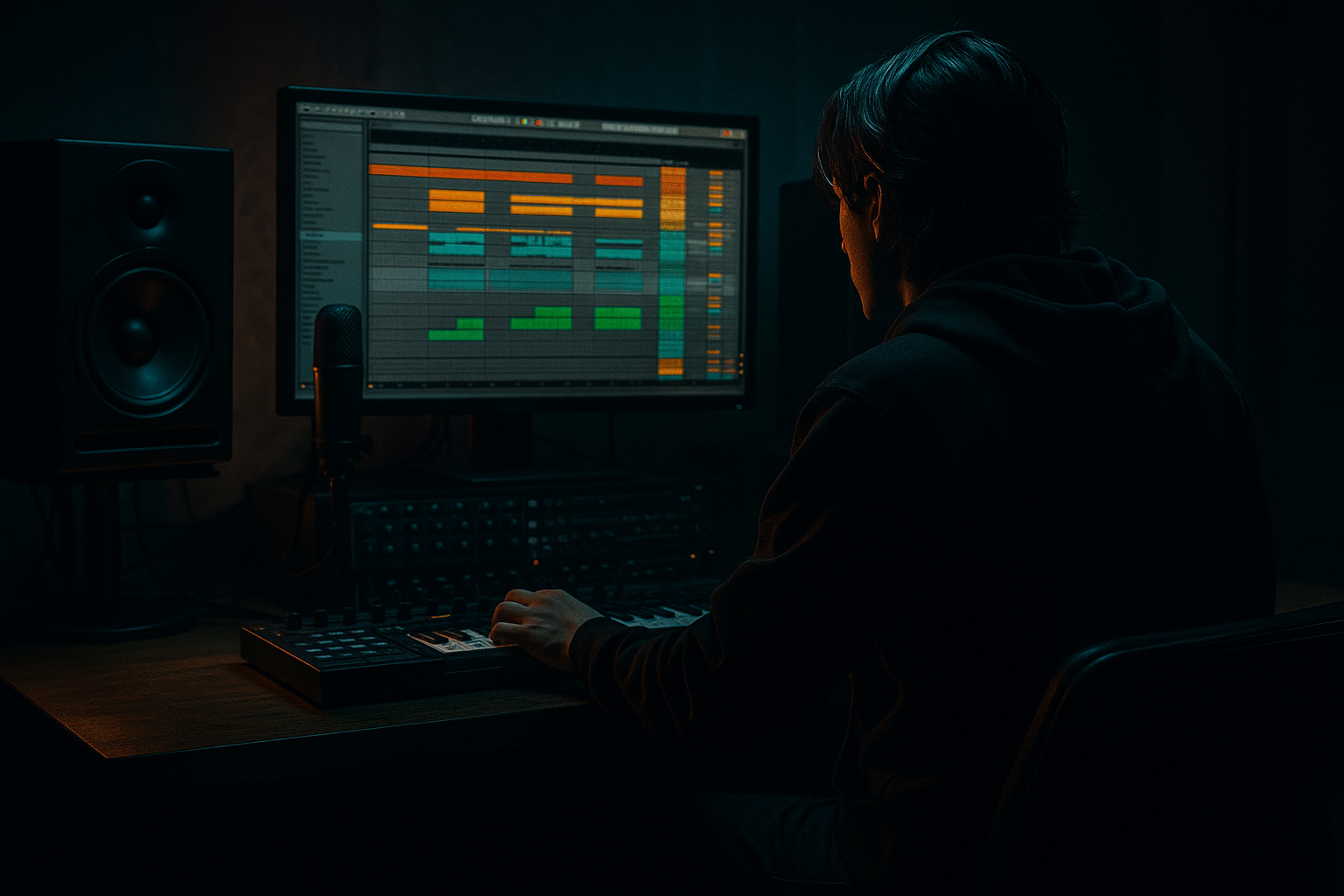
This lesson is about building a darkside intro with modern punch and vintage soul in Ableton Live 12 that actually works as a DJ tool in a Drum & Bass track. The goal is to create an intro that gives DJs enough space to mix, but still sounds alive, classy, and unmistakably DnB from the first bar. Think of it as the opening of a tune that says: “this is deep, serious, and ready to move into a drop.”
This technique lives in the intro section before the first drop, and it matters for two reasons:
1. Musically, it sets the mood: tension, atmosphere, broken rhythm, and character.
2. Technically, it helps the track work in a set: clear intro phrasing, controlled low-end, and enough drum information for mixing without giving away the full drop too early.
This is especially suited to dark rollers, jungle-inflected DnB, deeper neuro intros, and moody club tools where you want old-school soul in the texture, but a clean, modern impact in the drums and transitions.
By the end, you should be able to hear a dark intro that feels like a real record: tight drums, a haunted musical motif, movement without clutter, and enough negative space for DJs to blend. A successful result should feel like it has weight and atmosphere, but still leaves room for the drop to hit harder.
What You Will Build
You will build a 16-bar darkside intro that starts with a vintage-sounding musical phrase, layers in a restrained break or top loop, and develops into a DJ-friendly pre-drop section with tension, grit, and clean phrasing.
The finished result should have:
- Sonic character: smoky, worn, slightly eerie, with a soulful sample-like tone
- Rhythmic feel: broken but controlled, with subtle swing and a steady forward pull
- Role in the track: intro and mix-in tool, not a full hook or drop replacement
- Mix readiness: clean low end, mono-safe core elements, controlled top-end hiss, and no over-wide chaos
- Keep the motif emotionally simple, timbrally rich.
- Use saturation for density, not loudness.
- Make the snare your anchor.
- Use negative space like a musical element.
- Restrain stereo until the music asks for width.
- Let the last 2 bars feel slightly unfinished.
- If the intro feels too modern, dirty it by removing perfection.
- Use only stock Ableton devices
- Use only one main motif and one break/top loop
- No more than two automation lanes
- Keep the core elements mono-compatible
- 4 bars of atmosphere and motif
- 8 bars of developing drum movement
- 4 bars of pre-drop tension
- Does the intro still feel like a real DnB section?
- Can I clearly hear where the last 4 bars begin?
- Does the snare remain the anchor?
- Does the intro feel dark, but not muddy?
In plain terms: it should sound like a dark, classy intro that could sit before a heavy DnB drop in a club set, and still feel polished enough that you would keep it in a finished track.
Step-by-Step Walkthrough
1. Set the project up for an intro-first arrangement
Start by creating a new MIDI track for the musical motif, an audio track for a break or top loop, and a return or group structure you can keep tidy. Set your session thinking around a 16-bar intro, because that gives enough time for DJs to mix and for the atmosphere to evolve without feeling sluggish.
Put a simple marker structure in place:
- Bars 1–4: atmosphere and motif only
- Bars 5–8: introduce drum movement
- Bars 9–12: add tension or variation
- Bars 13–16: pre-drop build or final tease
Why this works in DnB: intros often need to function as mix-in space. If you make the first 8 bars too busy, DJs lose a clean entry point. If you make it too empty, it feels unfinished. This structure gives you control.
Workflow tip: name the tracks immediately, for example Motif / Break Top / FX / Drone / Pre-drop. That saves a surprising amount of time once you start editing and automating.
2. Build the vintage soul motif with a simple instrument chain
On your MIDI track, load Sampler or Simpler if you’re using a chopped melodic sample, or Wavetable if you’re making the line from scratch. For beginner-friendly results, start with a short, moody phrase: 2 to 4 notes, maybe a minor third, fifth, or a small descending figure. Keep it memorable and repeatable.
A strong starting chain is:
- Instrument: Simpler or Wavetable
- EQ Eight: high-pass gently around 120–200 Hz
- Saturator: subtle drive around 2–5 dB
- Echo: short, dark delay for space
- Reverb: small to medium room, low decay
If you want more vintage soul, make the tone a little dusty:
- Filter some top end off with an EQ shelf around 8–12 kHz
- Add a tiny bit of saturation so the note edges don’t feel sterile
- Keep the notes slightly short rather than overly legato
What to listen for: the motif should feel like a memory, not a lead synth trying to dominate the intro. If it sounds too bright or modern, reduce the upper mids a little and soften the attack.
The key decision here is the flavour:
- Option A: sampled soul vibe — use a chopped phrase or a sample-like tone for instant character
- Option B: synthetic noir vibe — use a simple synth line with filtering and subtle detune for a colder, more controlled feel
For beginner DnB, Option A often gets you to a convincing dark intro faster. Option B is better if you want a cleaner, more original sound design path.
3. Shape the motif so it leaves space for the drums
Now edit the MIDI or audio phrase so it breathes. Leave little gaps between notes. If the phrase is too continuous, it will fight the break and the snare. In DnB, the intro often works best when the musical content sits around the drums, not on top of them.
Try these practical settings:
- Shorten note lengths so they don’t smear into the next bar
- Use velocity variation to avoid a looped feel
- Pan nothing extreme yet; keep the core motif centered or only slightly off-center
- If using audio, fade note tails manually so the rhythm stays clean
A good test: mute the drums and hear whether the motif has its own shape. Then unmute the drums and check whether the motif still feels present without masking the kick/snare idea. If it disappears completely, it may be too quiet; if it crowds the beat, it’s too dense.
Stop here if the motif is already carrying the mood. Don’t overbuild it. In darkside DnB, one strong phrase usually beats three competing ideas.
4. Create the drum bed with a break or top loop
Add a breakbeat or a top loop on an audio track. For a beginner-friendly intro, keep it simple: use a clean break slice, or a top loop with minimal low-end. If you are using a full break, high-pass it so the sub stays free for later.
A practical stock-device chain for the break/top loop:
- Warp the loop in Beats mode if needed
- EQ Eight: high-pass around 120–180 Hz for top loops, around 80–120 Hz if the break is fuller
- Drum Buss: drive gently if the break needs bite
- Saturator: small drive to thicken transient edges
Keep the break relatively dry at first. In dark intros, the groove should feel like it’s entering the room, not already exploding. Let the kick/snare pattern imply momentum without filling every gap.
What to listen for:
- The snare should still cut through the motif
- The hats should add motion, not white-noise clutter
- The break should suggest the main groove without stealing the spotlight
If the break sounds too thin, add a touch of Drum Buss drive or layer a very quiet top loop. If it sounds too messy, trim the high mids around 2–5 kHz and reduce reverb.
5. Lock the low end early, even if the intro is sparse
Even in an intro, you need to think about low-end clarity because the DJ will be mixing into or out of a bass-heavy section. If you plan to leave the intro mostly sub-free, that is fine—but be intentional.
Two valid approaches:
- A: no sub until the drop — cleaner for mixing, safer for DJs, more tension
- B: a filtered sub hint — gives the intro more weight, but risks masking incoming bass if overdone
For beginner DJ tools, A is usually the safer choice. Keep the intro low end restrained by high-passing the musical layers and letting the kick or break provide the only real weight.
If you choose to add a sub hint, keep it simple:
- One sustained note under the motif
- Low-pass it heavily so it sits under 100–120 Hz
- Keep it mono
- Make it very quiet, more felt than heard
Mix-clarity note: check the intro in mono. If your atmosphere disappears or the groove collapses, too much of the identity is living in stereo only. The core of the intro should still make sense when folded down.
6. Add a second layer for modern punch
Now introduce a more modern rhythmic layer, but keep it controlled. This can be a tight hat pattern, a short metallic tick, a reversed percussion hit, or a subtle percussion loop. The point is to give the intro enough contemporary energy to feel current, without turning it into a full drum section.
A useful stock-device chain for a punchy texture layer:
- Drum Rack or audio clip
- EQ Eight: trim lows, maybe a narrow cut if something is harsh
- Auto Filter: automate opening over 8 bars
- Redux very subtly if you want a gritty digital edge
- Utility: reduce width if the layer feels too wide
Keep this layer tucked low in the mix. It should sharpen the intro, not become the main event.
What to listen for: the track should start to feel like it is moving forward even before the drop. If the percussion makes the intro feel busy instead of tense, reduce the density or remove every second hit.
This is where the intro starts to feel like a proper DnB DJ tool: enough pulse to hold attention, enough restraint to give the next section room.
7. Automate tension across the 16 bars
Use automation to make the intro feel like it is evolving, not looping. In Ableton Live, this can be very simple and still powerful.
Useful automation moves:
- Open a filter gradually from around 200 Hz to 2–5 kHz on a texture
- Increase reverb send slightly in the last 4 bars, then pull it back before the drop
- Automate Echo feedback lightly for a bar-end throw
- Raise saturation or distortion subtly in the final 2 bars
- Reduce the motif’s low-pass cutoff over time for a darker closing phrase
Keep automation small. Dark intros often fail when they over-announce the drop too early. You want tension, not a trailer.
What to listen for:
- The energy should rise without getting louder in a crude way
- The last 4 bars should feel more charged than bars 1–4
- The final bar should hint at the drop, not fully reveal it
If the automation feels random, simplify to one strong gesture per 4 bars. In DnB, a few clear moves usually sound more confident than constant motion.
8. Check the intro against the drums and future drop energy
Now audition the intro in context with a placeholder kick, snare, and bass arrangement, even if the actual drop is not finished. This is one of the most important checks in the whole process.
Ask:
- Does the intro leave enough room for the drop to feel bigger?
- Does the snare anchor the groove properly?
- Is the motif acting like a hook, a pad, or a distraction?
This is where many beginners lose the plot: they make the intro sound impressive in isolation, but it doesn’t serve the arrangement. A strong DnB intro should set up contrast, not use all of its ideas before the first breakdown.
Arrangement example:
- 4 bars of motif only
- 4 bars with break top and small FX
- 4 bars with more tension and a tiny stop or half-bar drop-out
- 4 bars of pre-drop build with filter opening and a final impact cue
If you have a bass idea already, even a rough one, check whether the intro sounds like it belongs to the same record. If the intro is soulful and the bass is hyper-aggressive, you may need to darken the motif or simplify the transition.
9. Commit the best part to audio and refine the phrasing
Once the intro has a good feel, commit the motif or the break to audio if it helps you edit more decisively. This is especially useful if you want to trim tails, create reverse swells, or make one-shot fills.
Commit this to audio if:
- the phrase is looping well
- you want to cut cleaner gaps
- you need more control over transitions and stabs
- you are spending too long tweaking instead of arranging
After that, use clip edits to create:
- a one-bar stop for tension
- a reversed note into the snare
- a final pickup before the drop
- a tiny fill at the end of bar 8 or bar 16
This is where your intro starts feeling like a real DJ intro, not just a loop. The phrasing should help the mix. A DJ-friendly intro usually gives 8 or 16 bars of usable space, with a clear cue that tells the floor the drop is arriving.
10. Do the final mix pass for punch, mono, and readability
Before you call it done, do a basic mix pass on the intro elements only.
Practical checks:
- EQ Eight on the motif: cut unnecessary low end below roughly 120–200 Hz
- Utility on wide layers: reduce width if they smear in mono
- Saturator: keep drive moderate so the tone gains attitude without flattening transients
- Drum Buss on the break: use lightly; too much drive can blur the snare shape
- Keep headroom so the drop can still feel larger later
What to listen for:
- The snare should feel like the timekeeper
- The motif should sit in its own band of the spectrum
- The intro should feel moody, but not muddy
A good dark intro has a clear hierarchy: snare first, motif second, texture third, sub only if deliberately used. If you can hear each role without effort, you’re close.
Common Mistakes
1. Making the intro too full too early
Why it hurts: if every bar is packed with drums, melody, and FX, the drop has nowhere to go.
Fix: strip the first 4 bars back to one motif and one supporting texture. Let the energy develop gradually over 16 bars.
2. Letting the low end spill across the whole intro
Why it hurts: muddy intros translate badly in clubs and clash with incoming basslines.
Fix: high-pass the motif and top layers with EQ Eight, and keep any sub hint mono and very restrained.
3. Using a wide stereo effect on the core motif
Why it hurts: the intro may sound exciting in headphones but fall apart in mono or on a club system.
Fix: keep the main motif centered; reserve width for secondary textures. Check with Utility by narrowing the image if needed.
4. Over-processing the break until it loses snap
Why it hurts: too much saturation, reverb, or compression can blur the transient that gives the intro its pulse.
Fix: back off Drum Buss drive, shorten reverb decay, and keep the break slightly drier than you think.
5. No clear phrasing or section logic
Why it hurts: a loop that never changes feels amateur and is hard for DJs to mix around.
Fix: plan a 4-bar or 8-bar development pattern and add one meaningful change per section.
6. Harsh upper mids on the motif or texture
Why it hurts: dark intros can become piercing fast, especially with distorted samples or bright hats.
Fix: use EQ Eight to tame a narrow harsh range around 2.5–5 kHz, and reduce the top shelf if needed.
7. Building the intro in isolation and never checking with drums or drop material
Why it hurts: the intro might sound good alone but fail as a track-opening tool.
Fix: audition it against the snare, break, and a rough bass/drop idea before finalizing.
Pro Tips for Darker / Heavier DnB
A small note movement can carry a lot of weight if the tone is dusty, slightly detuned, and filtered well. Dark DnB intros usually fail when the writing gets too busy.
A modest amount of Saturator can make a sample feel older and tougher without making it obviously distorted. That extra density helps the intro survive club playback.
Even in a sparse intro, the snare tells the listener where the bar is. If the snare is too soft, the whole section loses authority. If needed, layer a very quiet transient-heavy hit under it.
The silence before a snare, or the gap after a motif hit, is part of the arrangement. In darker DnB, those gaps create menace. Don’t fill them automatically.
Mono-compatible cores keep the intro solid. Save width for delays, reverb tails, and background texture, not the main rhythm or essential low-mid content.
A tiny drop-out, filter sweep, or reversed tail makes the first drop feel more inevitable. That’s a classic DJ-tool trick because it creates anticipation without needing a huge riser.
Slight timing offset, a little grit, and a less pristine sample often make the piece feel more “record-like” and less loop-pack polished.
Mini Practice Exercise
Goal: Build a 16-bar darkside DnB intro that a DJ could mix into cleanly.
Time box: 15 minutes
Constraints:
Deliverable:
A 16-bar intro with:
Quick self-check:
Mute the bass/drop and ask:
If you can answer yes to most of those, you’ve built a usable DJ tool intro.
Recap
A strong darkside intro in Ableton Live 12 is about control, contrast, and DJ usability. Build around one memorable motif, keep the drums supportive rather than overcrowded, protect the low end, and automate tension in small but deliberate moves. Use stock devices to shape tone, grit, and space, then check everything in context so the intro actually serves the track. The best result should feel moody, punchy, and mix-ready, with enough soul to stand out and enough discipline to launch the drop hard.

