Main tutorial
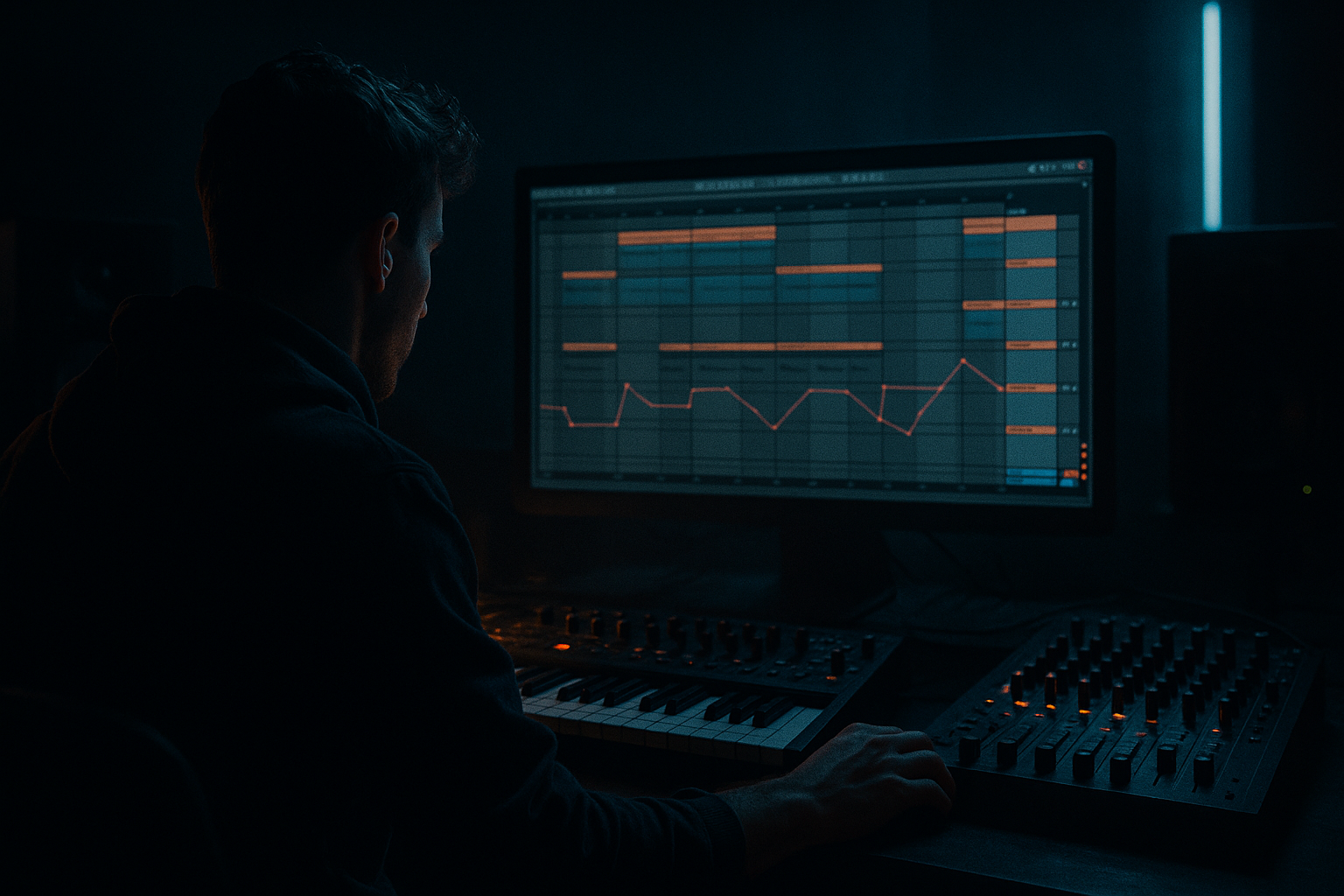
Sequence an Amen-style DJ Intro with an Automation-First Workflow in Ableton Live 12 🥁⚡
1. Lesson overview
In this lesson, you’ll build a DJ-friendly intro for a drum and bass / jungle track using an automation-first workflow in Ableton Live 12.
That means we’ll design the intro mainly by automating filters, reverb, delay, tension FX, and drums processing rather than relying only on lots of extra clips or instruments.
This approach is perfect for DnB because:
- DJs need clean, beatmatched intros
- Amen-style drums create instant energy and identity
- Automation builds tension and momentum before the drop
- You keep the arrangement tight and functional
- A looped Amen-style break
- A DJ-friendly 16-bar intro structure
- Automation on:
- A simple build-up into the main drop
- A clean arrangement that works in DnB / jungle / bass music
- Bars 1–4: filtered intro, minimal drums
- Bars 5–8: more break detail, rising energy
- Bars 9–12: tension FX, snare fills, filter opening
- Bars 13–16: full pre-drop momentum, last bar impact into drop
- Set tempo to 172 BPM or 174 BPM
- Set your project to 4/4
- Create a few tracks:
- Simpler for chopping break samples
- Drum Rack if you want to layer individual hits
- Auto Filter
- Reverb
- Echo
- Saturator
- Drum Buss
- EQ Eight
- Utility
- Limiter on the master if needed
- EQ Eight
- Drum Buss
- Auto Filter
- Utility
- Filter the break heavily
- Add a quiet noise layer
- Keep the low end controlled
- Leave space for the DJ mix
- Bar 1: cutoff very low
- Bar 4: cutoff starts opening
- Bar 8: more top-end presence
- Bar 16: nearly full brightness before drop
- Decay: 1.5–3.5 s
- Pre-delay: 10–25 ms
- Low Cut: 200–400 Hz
- High Cut: 6–10 kHz
- Dry/Wet: 100% on the return track, then use send knobs
- Time: 1/8 or 1/4 dotted
- Feedback: 15–35%
- Filter it so it doesn’t clutter the mix
- Use low cut and high cut inside Echo
- Bars 1–4: very little send
- Bars 5–8: more reverb on snare hits
- Bars 9–12: delay throws on fill hits
- Bars 13–16: increase FX for pre-drop tension
- Increase Drive slightly before the drop
- Automate Crunch upward in the last 4 bars
- Use Boom carefully; DnB intros should stay tight
- Mode: Soft Sine or Analog Clip
- Drive: 2–6 dB
- Output: trim to match level
- Bars 1–8: minimal drive
- Bars 9–12: more grit
- Bars 13–16: strongest intensity
- noise sweep
- vinyl hiss
- dark ambience
- reversed cymbal
- short impact hits
- Operator for simple noise
- Wavetable for a low rumble or sweep
- Simpler for one-shot FX samples
- Low-pass the noise at the start
- Slowly open it by bar 8 or 12
- Add more reverb sends near the transition
- Cut the FX abruptly just before the drop for contrast
- Filtered break only
- Light ambience
- Very subtle reverb
- No bass or only a low filtered hint
- Open the filter a little
- Add ghost hits or rimshot layers
- Increase send to delay on selected snare hits
- More open break
- Add saturation or drum drive
- Bring in a noise sweep
- Short fills at the end of bar 12
- Full break brightness
- Final snare roll or fill
- Reverb throw on last snare
- Reverse crash or impact into the drop
- Press A to show automation
- Use Arrangement View for precise intro shaping
- Automate:
- Keep automation curves smooth unless you want a hard switch
- Auto Filter cutoff
- Reverb send
- Delay send
- Drum Buss Drive
- Saturator Drive
- Utility volume
- Echo feedback
- Device on/off for FX stabs
- Auto Filter on the bass
- Utility to reduce gain
- Maybe a high-pass or band-pass for the intro
- Bars 1–8: bass absent or barely hinted
- Bars 9–12: filtered bass pulses
- Bars 13–16: bass energy hinted, but not fully revealed until drop
- Use Saturator or Drum Buss
- Automate slowly
- Don’t let it become harsh unless that’s the style
- Keep it filtered
- Keep it mono with Utility
- Fade it in only near the end
- Use clip gain
- Use Utility
- Then add saturation and reverb
- 1 Amen break loop
- 1 noise or atmosphere layer
- 1 reverb return
- 1 delay return
- 1 saturation device
- Start with a tight 172–174 BPM project
- Use a breakbeat loop or chopped Amen
- Shape the intro with Auto Filter, Reverb, Echo, Saturator, and Drum Buss
- Build tension over 8 or 16 bars
- Automate send levels, filter cutoff, and drive for movement
- Keep the intro DJ-friendly, dark, and controlled
- a bar-by-bar Ableton arrangement template
- a device chain preset suggestion
- or a companion lesson on the drop section
We’ll focus on a rolling, dark, Amen-inspired intro that feels like it could sit before a heavy bass drop. 🔥
---
2. What you will build
By the end, you’ll have a short intro section that includes:
- filters
- reverb send
- delay send
- drum saturation / drive
- riser noise or FX
Example intro shape
A practical 16-bar structure:
---
3. Step-by-step walkthrough
Step 1: Set up your project
Open Ableton Live 12 and do the following:
- 172 = a little smoother
- 174 = classic drum and bass energy
1. Drum Break
2. Kick/Snare Layer or Drum Reinforcement
3. FX / Noise
4. Bass Intro if needed
5. Return A – Reverb
6. Return B – Delay
Good stock devices to use
---
Step 2: Load an Amen-style break
You have two beginner-friendly options:
Option A: Use a loop
Drag a breakbeat loop into an audio track and warp it to match tempo.
Option B: Chop it in Simpler
For more control:
1. Drop the Amen break sample onto an audio track
2. Right-click and choose Slice to New MIDI Track
3. Use slicing by transient
4. Play the slices on a MIDI clip
For this lesson, a looped audio clip is the fastest way to build the intro.
Basic Amen-style processing chain
On the break track, try:
EQ Eight → Drum Buss → Auto Filter → Utility
#### Starting settings
- High-pass gently at 30–40 Hz
- Slight cut around 250–400 Hz if muddy
- Drive: 5–15%
- Boom: 0–10% if the low end gets too thick
- Crunch: subtle, around 5–20%
- Low-pass or band-pass for intro filtering
- Use to control gain if the break gets too loud after processing
---
Step 3: Build the intro with automation-first thinking
Instead of adding lots of new elements, let the intro evolve by automating the break and FX.
Start with the first 4 bars
Keep it restrained and DJ-friendly.
#### In bars 1–4:
Automate the break filter
On the break track:
1. Add Auto Filter
2. Choose Low-Pass
3. Set cutoff low at the start, around 200–600 Hz
4. Draw automation so the filter gradually opens over 8 or 16 bars
This gives the intro a classic “coming alive” feel.
#### Automation idea:
---
Step 4: Add reverb and delay movement
For jungle and DnB intros, space matters. But you want it controlled, not washed out.
Return A: Reverb
Add Reverb to a Return track.
#### Suggested settings:
Return B: Delay
Add Echo to another Return track.
#### Suggested settings:
Automation workflow
Automate the send amounts from the drum break to the reverb and delay returns.
#### Practical approach:
This is where the “automation-first” mindset shines. The same loop feels like it’s evolving without needing a totally new beat.
---
Step 5: Create tension with drum automation
Now we add movement to the drums themselves.
Use Drum Buss for controlled aggression
On the break track or drum group:
Use Saturator for extra bite
Add Saturator after Drum Buss or instead of it.
#### Starting settings:
Automate the drive to rise subtly over the intro:
This works especially well for darker jungle and rollers.
---
Step 6: Add a tension FX layer
A good DJ intro often needs an atmospheric layer to glue the drums together.
Create a new audio track or MIDI track
Add:
You can use stock devices like:
Simple FX chain
EQ Eight → Auto Filter → Reverb → Utility
#### Example FX automation:
Common jungle-style FX idea
Add a short reverse crash into the last bar of the intro.
This is a classic way to signal the drop without overdoing it.
---
Step 7: Arrange the intro in 16 bars
Here’s a practical arrangement plan.
Bars 1–4: DJ start zone
Bars 5–8: Groove reveals itself
Bars 9–12: Tension rises
Bars 13–16: Pre-drop pressure
---
Step 8: Use automation lanes efficiently in Live 12
Ableton Live 12 makes automation easy and clean, especially if you stay organized.
Best workflow tips
- filter cutoff
- send levels
- device on/off
- saturation drive
- utility gain
Useful automation targets
A clean automation-first intro often sounds more professional than a crowded one.
---
Step 9: Add a bass tease if needed
If your tune has a dark Reese, sub, or rolling bassline, you can tease it in the intro.
Keep it filtered
Use:
Arrangement idea
This builds anticipation without stealing the drop’s impact.
---
4. Common mistakes
1) Making the intro too busy
A beginner mistake is adding too many FX, fills, and extra percussion layers.
Fix: Keep the intro functional. Let automation create motion.
2) Using too much reverb
Huge reverb can smear the Amen break and destroy punch.
Fix: High-pass the reverb return and keep the decay controlled.
3) Overprocessing the break
Too much saturation, compression, and EQ can kill the character of the break.
Fix: Use light processing and compare with bypass often.
4) No low-end discipline
If sub or boom frequencies creep into the intro, the DJ mix gets messy.
Fix: Filter the low end early. Use EQ Eight and Utility carefully.
5) Static arrangement
A loop that repeats unchanged for 16 bars gets boring fast.
Fix: Automate something in almost every 4-bar section.
6) Too many full-impact elements before the drop
If you reveal everything too early, the drop loses power.
Fix: Save the biggest impact for the final 1–2 bars before the drop.
---
5. Pro tips for darker/heavier DnB
Tip 1: Automate distortion subtly
For dark rollers and heavier jungle, tiny increases in saturation across the intro can make the break feel more aggressive.
Tip 2: Use band-pass filtering for tension
Instead of just low-pass filtering, try a band-pass on the break or FX layer.
This creates a more claustrophobic, underground feel — very useful in darker DnB. 😈
Tip 3: Add a controlled sub rumble
Use Operator or a sampled low hit very quietly under the intro.
Tip 4: Make snare hits echo into space
A snare with a quick delay throw can sound massive without cluttering the whole arrangement.
Use Echo on a return track and automate send only on selected hits.
Tip 5: Contrast is everything
A dark intro feels heavier when the drop is sudden and clean.
If the intro is all-out from bar 1, the drop won’t smash as hard.
Tip 6: Use clip gain and utility before heavy processing
Before adding more devices, make sure the break level is balanced.
This keeps the chain clean and manageable.
---
6. Mini practice exercise
Try this quick 8-bar exercise:
Goal
Build a short Amen-style intro that evolves using automation only.
What to use
Task
1. Put the break in an audio track
2. Add Auto Filter
3. Automate the cutoff from dark to brighter over 8 bars
4. Add Reverb and automate the send higher in bars 5–8
5. Add Saturator and automate Drive slightly upward near the end
6. Add one reverse crash in bar 8
Challenge
Do not add any extra drum clips.
Make the whole intro interesting using only automation and smart FX movement.
If it works, you’re already thinking like a DnB arranger.
---
7. Recap
You now have a solid method for creating an Amen-style DJ intro in Ableton Live 12 using an automation-first workflow.
Key points to remember
The main idea
In drum and bass, a great intro is not just about adding sounds — it’s about revealing energy over time.
Automation gives you that power. Use it to make your Amen intro feel alive, heavy, and ready to explode into the drop. 💥
If you want, I can also turn this into:

