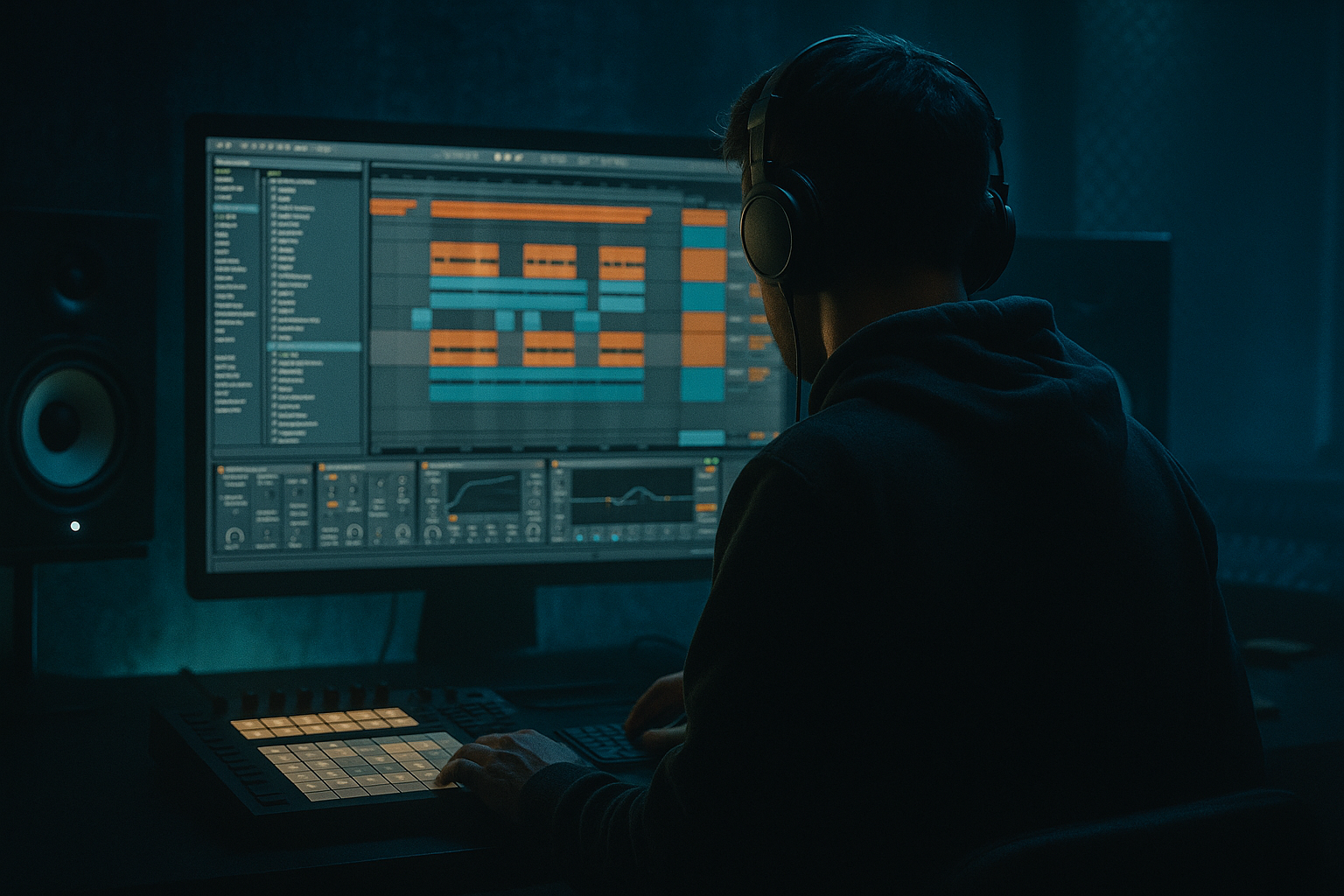
Main tutorial
Sequence a Jungle Bass Wobble From Scratch in Ableton Live 12 (Advanced • DJ Tools)
1) Lesson overview
This lesson is about building a classic jungle / early DnB wobble bass and then sequencing it like a DJ tool: tight, repeatable, easy to re-arrange, and designed to lock with breakbeats. We’ll focus on groove, sub management, and modulation timing—the stuff that makes a wobble feel rolling rather than random. ⚙️
We’ll do it 100% with Ableton Live 12 stock devices (plus Live’s modulation workflow).
---
2) What you will build
By the end you’ll have:
- A two-layer bass:
- A MIDI sequence that “talks” like jungle:
- A wobble modulation system:
- A DJ-tool arrangement:
- A performance-ready macro setup for quick edits (wobble rate, filter, drive, tone)
- Key: F minor or G minor often hits right.
- Rhythm: syncopated, with gaps for breaks to breathe.
- Notes: F1 (main), occasional Ab1 / Eb1 as movement
- Bar 1:
- Bar 2:
- Use Groove Pool with a breakbeat groove (e.g., a swung 16th feel).
- Apply lightly: Groove Amount 10–25% on the bass, not 100%.
- Bars 1–4: Base wobble at 1/8
- Bars 5–8: Introduce faster bursts (automate to 1/16 for 1 bar)
- Bar 8: “Turnaround” (drop filter base down + reduce wobble depth)
- Bars 9–12: Bring back full power + add a note variation
- Bars 13–16: Add aggressive tone (more Drive, slightly higher filter base), then cut at bar 16 for the drop
- Auto Filter:
- Saturator Drive: push +2–4 dB in “hype” bars
- Utility Width: narrow during dense drum fills, widen on open sections
- Letting the wobble layer carry sub frequencies → mud + weak master.
- One wobble rate for the entire phrase → instantly repetitive.
- Too much unison/stereo below 150 Hz → collapses in clubs.
- Overdriving without level-matching → you think it’s better, it’s just louder.
- No gaps in the MIDI → breaks can’t breathe, groove feels flat.
- Sidechain release wrong → pumping that fights the rhythm instead of rolling with it.
- Parallel dirt bus: Send WOBBLE MID to a return with Overdrive → Saturator → EQ Eight. Blend lightly for aggression without wrecking dynamics.
- Triplet wobble shots: Automate one bar to 1/8T near the end of a phrase for that tense jungle lurch.
- Band-split processing (stock-friendly):
- Resample micro-edits: Record 8 bars of bass to audio, then chop one-bar “fills” (reverse, stutter, pitch nudge) to create DJ-tool variations fast. ✂️
- Darker tone trick: Lower filter base, increase resonance slightly, and add subtle Redux downsample—instant ‘95 warehouse edge.
- You built a split bass system: mono sub + high-passed wobble mids.
- You created wobble movement using Auto Filter LFO, then made it musical by automating rate changes.
- You sequenced a jungle-style MIDI groove with gaps, note-length variation, and tasteful glide.
- You arranged it like a DJ tool: predictable phrase structure with controlled variations.
- You kept it club-safe with sidechain, mono checks, and frequency discipline. ✅
- Sub layer (clean, mono, consistent)
- Mid wobble layer (movement, character, stereo-safe)
- syncopated notes, ghost notes, tasteful slides
- tempo-synced movement with deliberate rate changes
- 8/16/32-bar sections with variations + fills
---
3) Step-by-step walkthrough
Step 0 — Session setup (DnB-friendly defaults)
1. Tempo: 165–174 BPM (try 172 BPM).
2. Clip Grid: 1/16 for detailed programming.
3. Create a group: BASS (Group) with two MIDI tracks:
- `SUB`
- `WOBBLE MID`
Why: You want the sub to stay stable while the mids do the talking. That’s the foundation of heavy rolling bass. 🔥
---
Step 1 — Build the SUB (clean and unshakeable)
On `SUB` track:
1. Add Operator (stock).
2. Operator settings:
- Algorithm: A only (single oscillator)
- Osc A Wave: Sine
- Envelope (Amp):
- Attack: 0.0 ms
- Decay: ~250 ms
- Sustain: -inf (or very low) if you want plucks
- Release: 60–120 ms
- If you want held subs: Sustain 0 dB, Release 80 ms
3. Add Saturator:
- Type: Soft Sine or Analog Clip
- Drive: 2–6 dB
- Output: adjust so level matches before/after
4. Add EQ Eight:
- HP filter off (don’t kill the sub)
- Optional: tiny dip around 200–300 Hz if it muddies later
5. Add Utility:
- Mono: 100%
- Gain: set for headroom (don’t slam)
Goal: A sub that is stable, consistent, and mono—so the wobble can be wild without collapsing the low-end.
---
Step 2 — Build the WOBBLE MID (character + movement)
On `WOBBLE MID` track:
1. Add Wavetable (or Operator if you prefer FM grit).
2. Wavetable settings (starting point):
- Osc 1: Basic Shapes → Saw
- Osc 2: Basic Shapes → Square (level lower than Osc 1)
- Unison: 2–4 voices, Amount low (don’t over-widen)
- Glide: enable Portamento (Time: 40–90 ms) for slinky movement
3. Add Auto Filter (this is the wobble “mouth”):
- Filter type: LP24
- Frequency: start around 200–500 Hz
- Resonance: 10–25%
- Drive: 2–6 dB (subtle bite)
4. Add Saturator (yes, again):
- Drive: 4–10 dB
- Soft Clip: On
5. Add Redux (optional for jungle grit):
- Downsample: 2–6
- Bit Reduction: 0–3 (light touch)
6. Add EQ Eight:
- High-pass at ~100–140 Hz (keep sub separate)
- Shape mids: small boosts around 700 Hz–1.5 kHz if needed
7. Add Utility:
- Bass Mono: set 120–160 Hz
- Width: 80–110% (keep it controlled)
Why high-pass the wobble layer: Your sub track owns the true low end. This avoids phase wars and gives you loudness without mush.
---
Step 3 — Create wobble modulation that feels like jungle (rate switching!)
Instead of one wobble rate for 8 bars (boring), jungle often uses rate call-and-response: 1/8 → 1/16 → triplet bursts → rests.
Modulate Auto Filter Frequency:
1. On the `WOBBLE MID` track, open Auto Filter.
2. Turn on its LFO.
3. Set:
- Amount: start 20–40%
- Wave: Sine or Triangle (smooth), or Square for aggressive gating
- Sync: ON
- Rate: start at 1/8
4. Now the crucial part: automate the LFO Rate (or map it to a Macro).
Macro setup (recommended DJ tool workflow):
1. Group devices on the `WOBBLE MID` track (select them → Cmd/Ctrl+G).
2. Map to 4–6 Macros:
- Macro 1: Wobble Rate (Auto Filter LFO Rate)
- Macro 2: Wobble Depth (Auto Filter LFO Amount)
- Macro 3: Filter Base (Auto Filter Frequency)
- Macro 4: Drive (Saturator Drive)
- Macro 5: Tone (EQ Eight mid band gain)
- Macro 6: Stereo Width (Utility Width)
Now you can perform wobble variations like a DJ—quick moves, repeatable results. 🎛️
Advanced feel tip: automate rate changes on phrase boundaries (every 2 or 4 bars), then add one “stutter bar” at bar 8/16.
---
Step 4 — Program the MIDI like a rolling jungle bassline
Create a 2-bar MIDI clip on both `SUB` and `WOBBLE MID` (they should share the same notes).
Typical jungle vibe:
Example pattern (2 bars, 172 BPM, 1/16 grid):
- Beat 1: F1 (1/4 long)
- “And” of 2: F1 (1/8)
- Beat 3: rest
- Beat 4: Eb1 (short 1/16 → ghosty)
- Beat 1: F1 (1/8)
- Beat 2: Ab1 (1/8)
- Beat 3: F1 (1/4)
- Last 1/8: F1 (short)
Key detail: Use note length variation. Wobbles sound more musical when the filter movement has moments to reset.
Add groove intentionally:
---
Step 5 — Make it a DJ tool: variations, fills, and call-backs
DnB tools live on 8/16/32 bar logic.
Build a 16-bar bass arrangement:
Practical automation moves (in Arrangement View):
- LFO Rate: 1/8 → 1/16 → 1/8T for one-bar spice 🎚️
- Frequency: small phrase lifts (e.g., +100–200 Hz at end of 4-bar)
---
Step 6 — Sidechain it to the drums (rolling clarity)
To keep breaks punching while the bass stays loud:
On the BASS group (or just WOBBLE MID):
1. Add Compressor.
2. Enable Sidechain → select your Kick (or a “ghost kick” MIDI track).
3. Settings:
- Ratio: 3:1–6:1
- Attack: 1–10 ms
- Release: 50–120 ms (tune to tempo; should “breathe”)
- Aim for 2–5 dB gain reduction on hits
If you want cleaner control: sidechain SUB a bit less than mids (sub dipping too hard can feel weak).
---
Step 7 — Check phase + mono compatibility (don’t skip this)
1. Put Utility on the Master temporarily:
- Width: automate to 0% to mono-check
2. Listen for:
- Sub disappearing? Phase conflict between sub and mid—raise HP on mid or reduce unison.
3. Use Spectrum on SUB:
- You want a strong fundamental and controlled harmonics.
---
4) Common mistakes
---
5) Pro tips for darker/heavier DnB
- Duplicate WOBBLE MID into “MID LOW” and “MID HIGH”
- EQ Eight split:
- MID LOW: 150–700 Hz (more drive)
- MID HIGH: 700 Hz+ (more movement/stereo)
---
6) Mini practice exercise
Build three 8-bar versions of the same bassline:
1. Version A (Classic Roll):
- LFO Rate mostly 1/8
- One bar at 1/16 (bar 8)
2. Version B (Steppy):
- More rests in MIDI
- Shorter notes + slightly longer portamento (80–110 ms)
3. Version C (Heavier):
- +3 dB Saturator drive
- Add Redux lightly
- Wobble depth reduced but filter base lower (darker)
Export each as an 8-bar loop and label them like DJ tools:
`BASS_A_172_Fm`, `BASS_B_172_Fm`, etc.
---
7) Recap
If you want, tell me your target style (’94 jungle, techstep, modern roller, halftime) and I’ll give you a matching wobble-rate automation map + MIDI pattern template.

