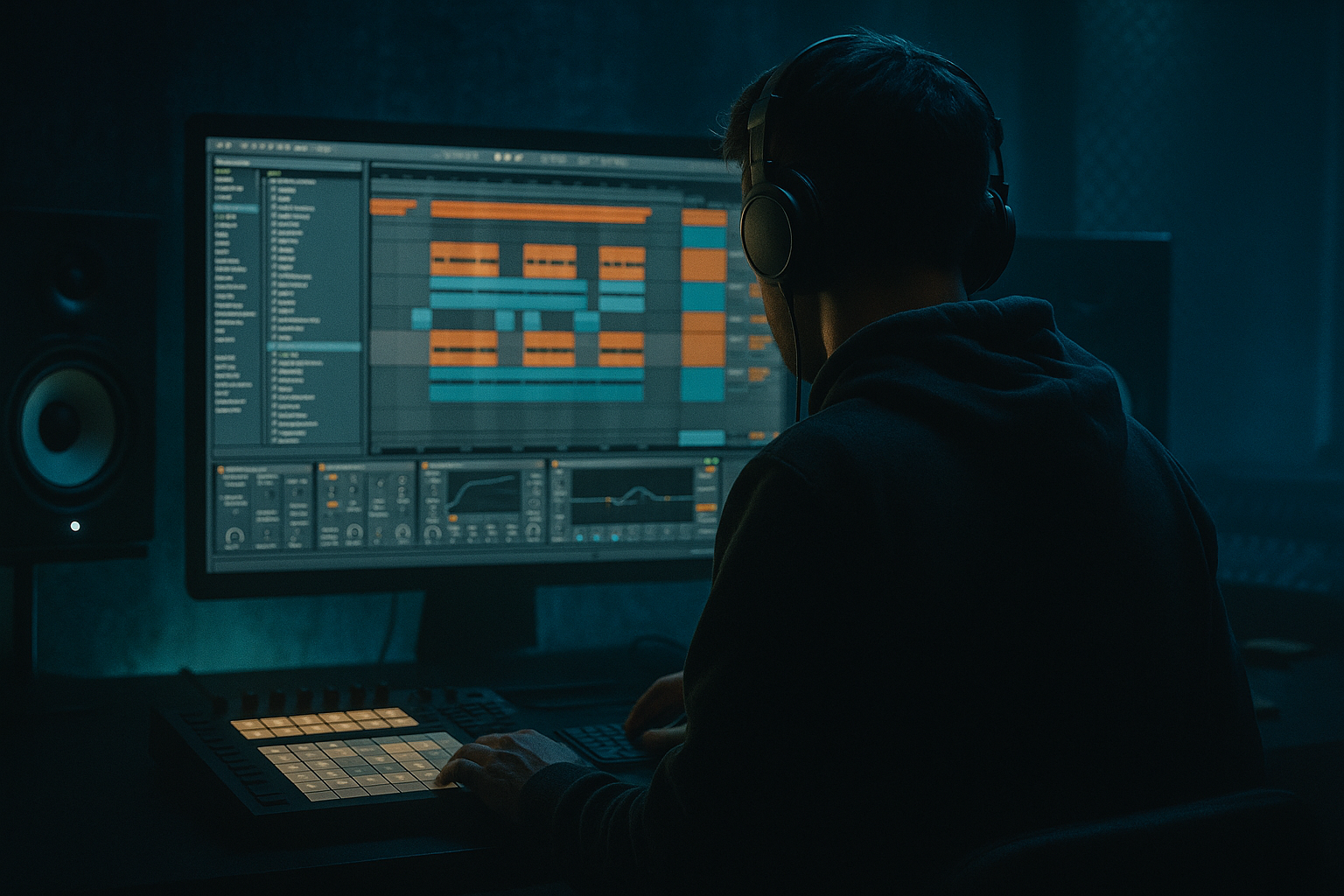
Main tutorial
```markdown
Sequence Oldskool DnB Kick Weight with DJ‑Friendly Structure in Ableton Live 12 🥁⚡
1. Lesson overview
Oldskool DnB/jungle kicks feel heavier not because they’re louder, but because they’re placed, layered, and supported by arrangement. In this lesson you’ll build a kick pattern that punches like classic 90s records and sits properly with a rolling bassline—then wrap it in a DJ-friendly structure (clean intros/outros, cue points, 16/32-bar phrasing) inside Ableton Live 12.
You’ll focus on:
- Kick sequencing that creates weight + swing
- Layering + processing using stock Ableton devices
- Arrangement choices that make your track easy to mix for DJs 🎛️
- A 2-step / oldskool DnB kick foundation (with ghost kicks + variations)
- A kick bus chain for weight and consistency
- A DJ-ready arrangement skeleton:
- Pad 1: Kick Punch (tight, mid-heavy; think 100–200 Hz + click)
- Pad 2: Kick Sub/Thump (short low tail, clean 45–70 Hz focus)
- Your own jungle/DnB pack, 90s breaks one-shots, or resampled vinyl hits.
- If using Ableton stock: start with any kick in Core Library → Samples and shape it.
- Add Simpler (already inside Drum Rack pad) and set:
- Put main kicks on:
- Add a quiet kick just before beat 3 occasionally:
- Add a pickup into bar 2:
- Main kicks: 110–127
- Ghost kicks: 45–80
- Pickups: 70–100
- Put Kick Punch on the main notes
- Put Kick Sub/Thump on the same notes but control it with velocity (or separate notes)
- Copy the MIDI to both pads and adjust:
- Put both samples on the same pad using a Drum Rack chain.
- Use Velocity Zone so:
- Bars 1–16: drums + hats + minimal FX, no big bass yet
- Bars 17–32: tease bass stabs, atmos, or filtered reese
- Add snare/clap layers, rides, tension FX
- Start automation:
- Full kick weight + bassline locked
- Add subtle kick variations every 8 or 16 bars
- Strip kick back (or high-pass the drum bus)
- Bring back pads, vox, or jungle atmos
- Slightly harder: extra ride, extra ghost kick pattern, or alternate bass patch
- Return to drum-focused, reduce melodic info
- Keep kick pattern DJ-stable again
- Slowly remove layers so another track can blend in cleanly
- Every 8 bars: tiny change (ghost kick on/off)
- Every 16 bars: bigger change (pickup + fill)
- Every 32 bars: significant shift (new break layer, new bass phrase)
- Variation A (default): steady 2-step + 1 ghost before beat 3
- Variation B (end of 8): add pickup on 1.4.4
- Variation C (end of 16): remove kick on 2.3.1 once and replace with tom hit or reverb tail (tasteful—don’t derail the mix)
- Over-swinging the kick: makes blends feel lumpy. Swing hats/snares more than the kick.
- Too much sub tail on the kick: fights the bassline and kills headroom.
- Random fills in the intro/outro: DJs want clean, predictable drums to lock onto.
- Boosting 50 Hz blindly: if your kick fundamental is higher/lower, you’ll add mud instead of weight—identify the fundamental first.
- Over-compressing the drum bus: you’ll flatten transient punch (especially at 172 BPM).
- Pitch the sub-kick layer to the key (or root note) of your bassline. Even 1–2 semitones can tighten the low-end massively.
- Add a parallel “crunch” bus:
- Use Roar (if available in your Live edition) subtly on the drum bus:
- Add a short room reverb only on the punch layer (send):
- For serious weight: keep the kick fundamental around 45–70 Hz and let the bass occupy slightly above/below depending on your style (rolling reese often lives strong in 80–150 Hz too—manage overlap with EQ).
- Oldskool DnB kick weight comes from layering + placement + controlled dynamics, not just volume.
- Keep the kick pattern stable for DJs in intros/outros and make variations at 8/16/32-bar boundaries.
- Use stock devices to lock the low end:
- Build a DJ-friendly structure with clean phrasing, clear locators, and predictable energy ramps.
---
2. What you will build
By the end you’ll have:
- 16–32 bar intro (drum-focused, bass teased later)
- 32–64 bar main drop
- breakdown / second drop
- 16–32 bar outro for mixing
---
3. Step-by-step walkthrough
Step 0 — Session setup (fast + correct)
1. Set tempo to 170–175 BPM (start at 172).
2. In Preferences → Record/Warp/Launch:
- Warp mode for drums: Beats
3. Turn on the Groove Pool (hotkey: `Cmd/Ctrl + Alt + G`).
DnB mindset: you’re building loops that feel stable for a DJ, but alive from bar to bar.
---
Step 1 — Pick kick sources that behave like oldskool 🧱
Oldskool weight is often a short punch + low thump combo.
Create a Drum Rack on a MIDI track called DRUMS:
Where to get sounds:
Quick shaping (per kick pad):
- One-Shot
- Warp: Off
- Decay: keep it fairly short (oldskool kicks are rarely boomy-long)
---
Step 2 — Program the core 2-step kick pattern (DJ-stable)
Make a 2-bar loop. In DnB, 2 bars gives you enough space for variation without losing the grid.
In MIDI (Grid: 1/16):
- Bar 1: Beat 1 (1.1.1)
- Bar 1: Beat 3 (1.3.1)
- Bar 2: Beat 1 (2.1.1)
- Bar 2: Beat 3 (2.3.1)
This is your anchor—it’s mix-friendly and instantly “DnB.”
Now add weight moves (ghost/support kicks):
- Example: 1.2.4 (16th before 1.3.1)
- Example: 1.4.4 leading into 2.1.1
Velocity guidance (important):
This creates momentum without messing up DJ stability.
---
Step 3 — Layer punch + sub properly (so it hits big but stays clean)
Inside the Drum Rack:
Method A (simple): Stack both on same hits
- Sub layer: slightly lower velocity
- Sub sample: shorter Decay to avoid bassline conflicts
Method B (pro control): Use Drum Rack “Chains”
- At high velocity = more punch
- At medium velocity = more thump
This makes ghost kicks automatically lighter.
---
Step 4 — Make it swing like jungle (without going sloppy) 🌀
Oldskool drums feel late/rolled because of micro-timing + groove.
1. Open Groove Pool
2. Try grooves like:
- Swing 16-57
- MPC 16 Swing variants (if available)
3. Apply to your drum clip at:
- Timing: 10–25%
- Velocity: 0–10%
- Random: 0–5% (tiny!)
Then Commit only once you like it, or keep it live-adjustable.
Pro move: Keep the main kicks more straight than hats/snares. If the kick swings too much, DJs feel it as unstable in blends.
---
Step 5 — Kick bus processing chain (stock devices) 🔧
Create a DRUM BUS (Audio track) and route Drum Rack to it, or group your drum tracks (`Cmd/Ctrl + G`) and process the group.
Suggested kick-weight chain on the DRUM BUS:
1. EQ Eight
- HPF everything below 25–30 Hz (steep)
- Gentle boost (if needed) around 55–70 Hz (1–2 dB, wide Q)
- Cut a little boxiness around 200–350 Hz if it’s muddy
2. Drum Buss
- Drive: 5–15%
- Boom: 20–40%
- Boom Freq: start around 55 Hz
- Transient: +5 to +20 (adds smack)
- Damp: to tame harshness if needed
3. Saturator
- Mode: Soft Sine or Analog Clip
- Drive: 1–4 dB
- Turn on Soft Clip
This adds density so the kick reads on smaller speakers.
4. Glue Compressor (gentle)
- Ratio 2:1
- Attack 10 ms
- Release Auto (or ~0.2s)
- Aim for 1–2 dB gain reduction
Keeps kicks consistent across phrases.
If the kick fights the bassline: don’t just sidechain harder—shorten the kick sub layer and carve EQ space first.
---
Step 6 — Build DJ-friendly structure (the arrangement blueprint) 🧭
Open Arrangement View and set locators every 16 bars. DJs love predictable phrasing.
Here’s a classic DnB layout (adjust to taste):
#### Intro (0:00 – 0:45 / 16–32 bars)
Goal: easy beatmatch + hint of vibe.
Intro kick tip: keep it clean and consistent—avoid heavy fills in the first 16 bars.
#### Build (next 16 bars)
- Auto Filter on a drum break layer (LP → opening)
- Reverb send rising into the drop
#### Drop 1 (32 or 64 bars)
- Example: remove a ghost kick before a fill
- Add a pickup kick into a new phrase
#### Breakdown / Switch (16–32 bars)
#### Drop 2 (32–64 bars)
#### Outro (16–32 bars)
---
Step 7 — Phrase-based kick variations (keep DJs happy, keep listeners hooked)
Use variations at predictable boundaries:
Example variations (2-bar loop edits):
---
4. Common mistakes 🚫
---
5. Pro tips for darker/heavier DnB 🖤
- Duplicate drum group → on the duplicate use Saturator (harder) + EQ (high-pass ~150 Hz)
- Blend quietly for aggression without ruining sub clarity.
- Gentle drive + tone shaping can add modern darkness while keeping oldskool punch.
- Reverb: Decay 0.3–0.6s, low cut 200 Hz, high cut 6–9 kHz
Gives “warehouse” vibe without washing the sub.
---
6. Mini practice exercise 🎯
Goal: Create a 32-bar DJ intro with evolving kick weight but mixable stability.
1. Start with your 2-bar kick loop.
2. Duplicate it to 32 bars in Arrangement.
3. Bars 1–16: only Variation A (super stable).
4. Bars 17–24: introduce ghost kick every other bar.
5. Bars 25–32: add a pickup kick into bar 33 (the drop) and automate:
- Drum Bus Drum Buss Drive from 6% → 12%
- Slight Auto Filter opening on a break layer (not the kick)
Check: Can you imagine a DJ mixing this intro for 16 bars without surprises?
---
7. Recap ✅
- EQ Eight (clean + carve), Drum Buss (thump + transient), Saturator (density), Glue Compressor (control).
If you want, tell me your target subgenre (jungle, rollers, techstep, jump-up) and whether you’re using breaks, and I’ll suggest a kick pattern + 64-bar arrangement template that matches it.
```

