Main tutorial
Lesson Overview
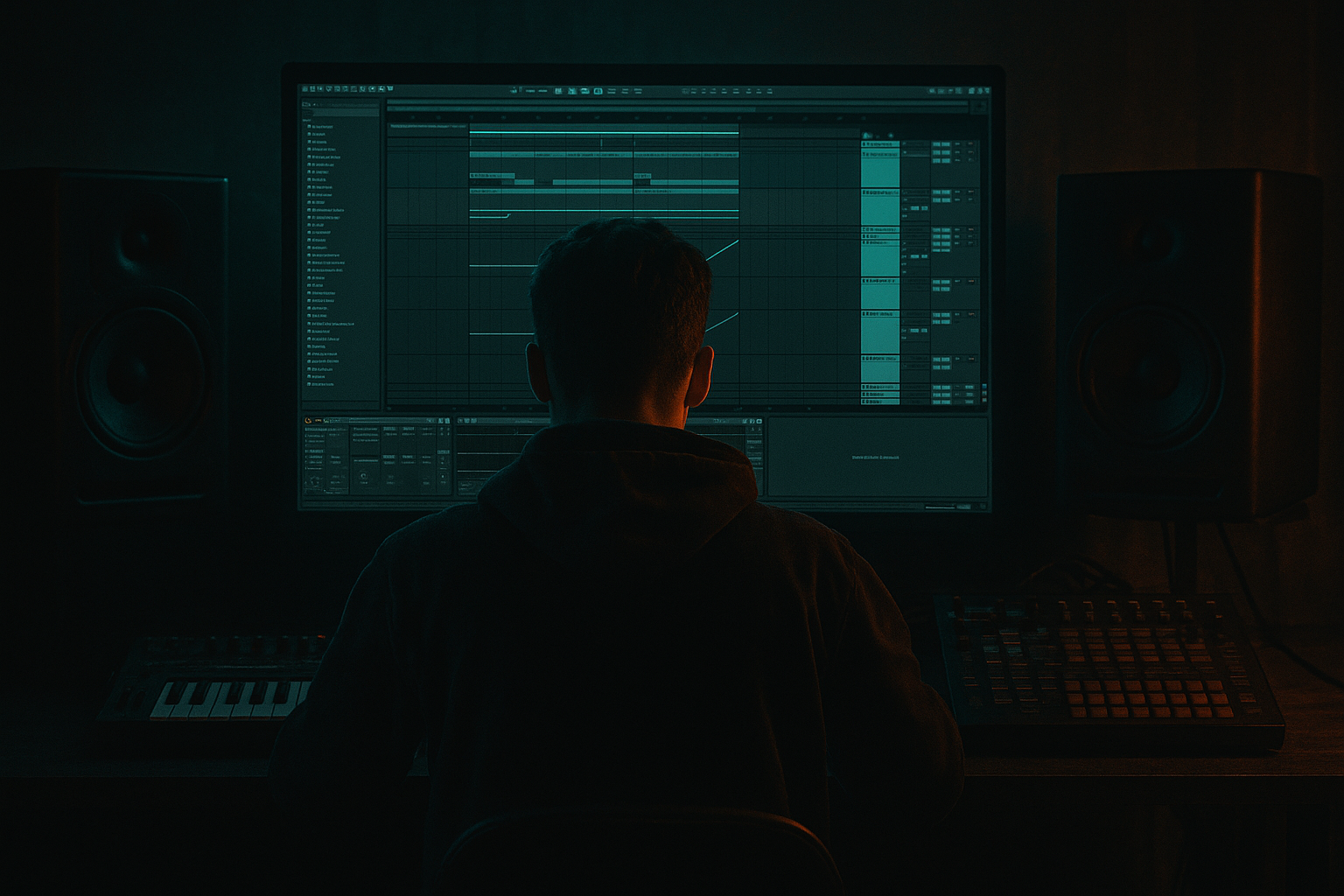
This lesson is about building a Session View sketch for swing-heavy, DJ-friendly jungle / oldskool DnB in Ableton Live 12, then shaping it so it can be performed, looped, and eventually arranged into a full track. The focus is not just on making a loop sound good — it’s about making it mixable like a DJ tool: clean intros, controlled breakdown space, strong 8/16-bar phrasing, and enough swing and call-and-response motion to keep the groove alive.
In DnB, especially jungle and older-style rollers, the difference between a loop and a usable track often comes down to how the energy is organized. A club-ready Session setup lets you test different drum edits, bass phrases, and atmosphere changes quickly. It’s a fast way to answer questions like:
- Does the break breathe properly with swing?
- Is the intro long enough for a mix?
- Can the drop loop work for 16 bars without getting stale?
- Does the bass leave enough space for the kick/snare and the DJ transition?
- A swinged breakbeat lane with ghost notes, fills, and break edits
- A sub-and-reese bass system that can be switched between sparse and busy phrasing
- A DJ intro scene with filtered drums and atmosphere
- A drop scene with full drums and bass
- A switch-up scene for tension, fills, or half-bar edits
- A DJ outro scene with stripped elements for mixing out cleanly
- oldskool break energy
- a heavy mono sub
- a gritty midrange reese or bass stab
- 8- and 16-bar phrasing that DJs can mix into
- enough swing to make the groove feel human, but not so much that the drums lose impact
- jungle rollers
- darker oldskool DnB
- amen-based cuts
- stripped DJ tools for your own sets
- performance-ready sketches that can later become full arrangements
- Drums Break
- Drums Top
- Sub
- Reese / Mid Bass
- Atmos
- FX
- Return A: Reverb
- Return B: Delay
- In the Groove Pool, try MPC 16 Swing 57 or MPC 16 Swing 58
- Apply groove lightly to the break clip, starting around 20–40% timing and 10–20% random
- Use the clip’s Quantize only if the break is too loose; don’t fully rigidize it
- one or two ghost hits before the snare
- a small kick pickup into bar 1
- a variation in bar 4 or bar 8 with a fill or reversed slice
- EQ Eight: high-pass very gently only if the break has low rumble; don’t gut the body
- Drum Buss: try Drive 5–15%, Crunch low to medium, and add a touch of Boom only if the kick lane is too thin
- Glue Compressor: mild bus glue, around 1–2 dB gain reduction
- Oscillator: Sine
- Filter: very light low-pass if needed
- Amp envelope: fast attack, short decay if you want stabs; longer release if you want a sustained roller
- Volume: low enough to leave headroom; aim for a solid but not aggressive foundation
- Use simple roots and fifths at first
- Leave rests on busy break moments
- Let the sub answer the drums rather than run constantly
- Bars 1–2: long sub notes
- Bars 3–4: short pickup notes or a stop before the snare fill
- Bars 5–8: repeat with one altered note on the last bar
- Start with two detuned saws or a saw + square blend
- Use a low-pass filter with moderate resonance
- Modulate filter cutoff slightly with an LFO or envelope
- Add Saturator or Roar if you want more edge
- Use EQ Eight to high-pass the bass around 80–120 Hz so the sub owns the bottom
- Filter cutoff: start around 200–600 Hz for a dark reese, depending on the patch
- LFO rate: very slow, around 1/2 bar to 2 bars for movement
- Saturator drive: 3–8 dB
- Width: keep low-end mono; if you use stereo expansion, do it only above the low mids
- bar 1: two hits
- bar 2: one long tail
- bar 3: a syncopated stab
- bar 4: silence or a filtered fill
- Intro 1
- Build
- Drop
- Switch
- Outro
- Keep the drums filtered or stripped
- Use only atmospheric texture, vinyl noise, or a distant break
- Add a delayed stab or reverse hit every 4 or 8 bars
- Keep the sub out until the last phrase or reduce it to a teaser note
- Bring in full break
- Full sub
- Bass phrase
- Possibly a second percussion layer or ride
- Remove bass first
- Leave drums and ambience
- Strip the break down to top percussion or a filtered loop
- Make it mix-friendly for a DJ to blend out
- Duplicate clips across scenes
- Use clip launch quantization set to 1 Bar so scene changes stay musical
- If needed, set the intro clips to launch with legato behavior for smooth bass continuity when switching ideas
- Auto Filter cutoff
- Reverb send
- Delay send
- Utility gain
- Reverb dry/wet only on transitional hits
- Filter cutoff sweeps from 300 Hz to 10 kHz for intro tension
- Delay send moments at 5–15% on fills
- Reverb send used sparingly on snare throws or vocal chops
- Utility gain dips of -2 to -4 dB before a drop for contrast
- In the last 1 bar before the drop, automate a band-pass or low-pass filter on the whole drum bus
- Then snap it open on the first bar of the drop
- EQ Eight: tame harshness around 3–6 kHz if the hats bite too hard
- Drum Buss: use lightly, not as a destroyer
- Glue Compressor: 1–2 dB of reduction for cohesion
- Saturator: a little extra density if needed
- whether your transient is softened too much
- whether the groove timing is too extreme
- whether your kick/snare layer is being masked by the top break
- mute the bass for 1 bar before the drop
- remove the top break and leave only the snare lane
- bring in the reese after 4 bars rather than immediately
- use scene launch to jump from Intro to Drop to Switch
- Can a mix happen over the intro?
- Does the drop feel big enough after a sparse section?
- Is the switch-up clear without needing a full breakdown?
- Over-swung breaks that lose the snare pocket
- Sub bass that fights the break
- Too much bass in the intro
- Every scene feels identical
- Break processing gets harsh fast
- No clear phrasing
- Use a filtered reese answer phrase after the main bass line. A short muted response can feel heavier than constant movement.
- Resample your break bus into audio and chop a few custom fills. A custom fill gives the track its own identity.
- Put a very subtle Auto Filter on the drum bus and automate cutoff just before drops for tension.
- Keep the sub note length slightly shorter than the bass phrase to avoid low-end smear.
- Add grit with Saturator before EQ shaping so the harmonics remain audible on small speakers.
- For darker character, layer a low noise or vinyl texture very quietly under the intro and outro scenes.
- Use Utility on bass returns to check mono compatibility. Heavy DnB falls apart quickly if the low mids are too wide.
- Try a call-and-response between break fills and bass stabs. That interplay is very oldskool and still hits in modern systems.
This technique matters because oldskool-inspired DnB is all about movement inside repetition. A static loop can feel dead fast. A smart Session setup gives you a way to perform variation live: mute and unmute layers, trigger fills, filter the bass, and switch drums without breaking the groove. That makes it ideal for DJ tools, live sketches, and building arrangement ideas that still feel club-functional.
What You Will Build
By the end, you’ll have a Session View mini-rack of scenes that behaves like a DJ-friendly DnB performance tool:
Musically, the result should feel like a 98–174 BPM jungle/DnB idea depending on your tempo choice, with:
This is especially useful if you’re making:
Step-by-Step Walkthrough
1. Set up a Session template built for DJ utility
Open a new Live Set and set your tempo to 170 BPM if you want true jungle energy, or 174 BPM if you want that classic forward push. If your reference is more roller-like, 172 BPM is a great middle ground.
Create these tracks:
For the drum tracks, load Drum Rack or simple audio tracks with break samples. For the bass tracks, use Operator, Wavetable, or Analog from stock devices. Keep the whole template ready for rapid scene building.
Why this works in DnB: Session View lets you test mix-ready structure without committing to a linear arrangement too early. Jungle and oldskool DnB rely on variation, but DJs still need clear sections. Session makes it easy to design those sections as performance blocks.
2. Build a breakbeat lane with swing and ghost-note movement
On Drums Break, drop in a classic break sample or chopped amen-style loop. Use Simpler in Slice mode if you want the chop workflow, or keep the audio clip if you prefer waveform editing.
Now add groove:
Then edit the break to include:
Good stock devices here:
If you’re using an amen, keep the main snare hits strong but let the ghost notes live slightly behind the grid. That human push is part of the jungle identity.
3. Lock in a mono sub that leaves room for the break
Create your Sub track with Operator. Use a sine wave or a very clean triangle-like source. Keep it monophonic and focused.
Suggested settings:
Programming advice:
Try this phrasing idea:
Add Saturator after Operator with Drive 2–5 dB and Soft Clip on if the sub needs presence on smaller systems. Keep the sub mono. If necessary, use Utility to reduce width to 0%.
Why this works in DnB: the break already carries a lot of midrange movement. A disciplined sub gives you weight without cluttering the groove. In dark DnB, the sub is often less about complexity and more about timed pressure.
4. Design a reese or mid bass that phrases like a DJ tool
On Reese / Mid Bass, use Wavetable or Analog to make a gritty bass patch. The goal is a bass that can be played in short phrases and can also be filtered or muted for transitions.
A strong stock workflow:
Parameter suggestions:
Programming tip: write the bass in short call-and-response phrases. For example:
This creates DJ-friendly tension because the groove has spaces where the drums can breathe. DnB basslines often work best when they don’t run continuously.
5. Create three core scenes: intro, drop, and outro
Now use Session Scenes to make the track DJ-friendly.
Create these scenes:
For Intro 1:
For Drop:
For Outro:
Ableton workflow move:
This is the real DJ tool move: you are not just making sections, you are making mixable states of the track.
6. Automate filters and transitions for tension without losing groove
Use clip automation or track automation to control energy. Keep it subtle and functional.
On the Drums Break and Reese / Mid Bass tracks, automate:
Practical ranges:
Try a classic oldskool move:
That gives you the feel of a DJ-friendly pressure release. In jungle and darker DnB, this kind of simple automation often hits harder than overdesigned FX.
7. Shape the drum bus so the swing stays punchy
Route your break and percussion to a Drum Bus group. Put shaping devices there rather than over-processing each channel individually.
Suggested chain:
If your break loses impact after swing is added, check:
A good rule: the swing should make the groove feel more human, not more sloppy. The snare still needs to land with authority.
8. Perform a few live mute moves to test DJ-friendliness
Now test the Session like a real performance tool.
Try these performance actions:
This is where Session View shines. You’ll hear whether the structure works as a DJ tool:
If you’re making a darker roller, keep the changes smaller and more sinister. If you’re making jungle, you can use more dramatic break edits and more obvious scene differences.
Common Mistakes
Fix: reduce groove amount and keep the snare closer to the grid than the ghost notes.
Fix: simplify the bass rhythm, add rests, and keep the sub mono with Utility or careful device routing.
Fix: strip the low end until the final phrase so DJs have room to mix in.
Fix: make each scene function differently — intro, tension, drop, switch, outro.
Fix: use EQ Eight to control top-end bite and keep Drum Buss settings moderate.
Fix: think in 4-, 8-, and 16-bar blocks. DnB needs repetition, but it also needs release points.
Pro Tips for Darker / Heavier DnB
Mini Practice Exercise
Set a timer for 15 minutes and do this:
1. Choose one break loop and one sub sound.
2. Create three Session scenes: Intro, Drop, Outro.
3. Apply a groove to the break around 30% timing.
4. Program a bass phrase that leaves at least one full beat of space every 2 bars.
5. Add one automation move: filter the drums or bass in the last bar before the drop.
6. Make the outro mixable by stripping out the sub first.
7. Perform the scene changes and listen for whether the drop feels like a DJ can come in or out cleanly.
Goal: in 15 minutes, build something that could realistically be used as a mixable DnB idea rather than just a loop.
Recap
The key idea is to use Session View as a DJ tool for jungle and oldskool DnB, not just as a sketchpad. Build swinged breaks, mono sub weight, a controlled reese, and clear scenes that create intro, drop, switch, and outro functionality. Keep the groove human, the low end disciplined, and the arrangement phrased for mixing. If it works as a performance-ready Session layout, it will usually translate well into a full DnB arrangement too.

