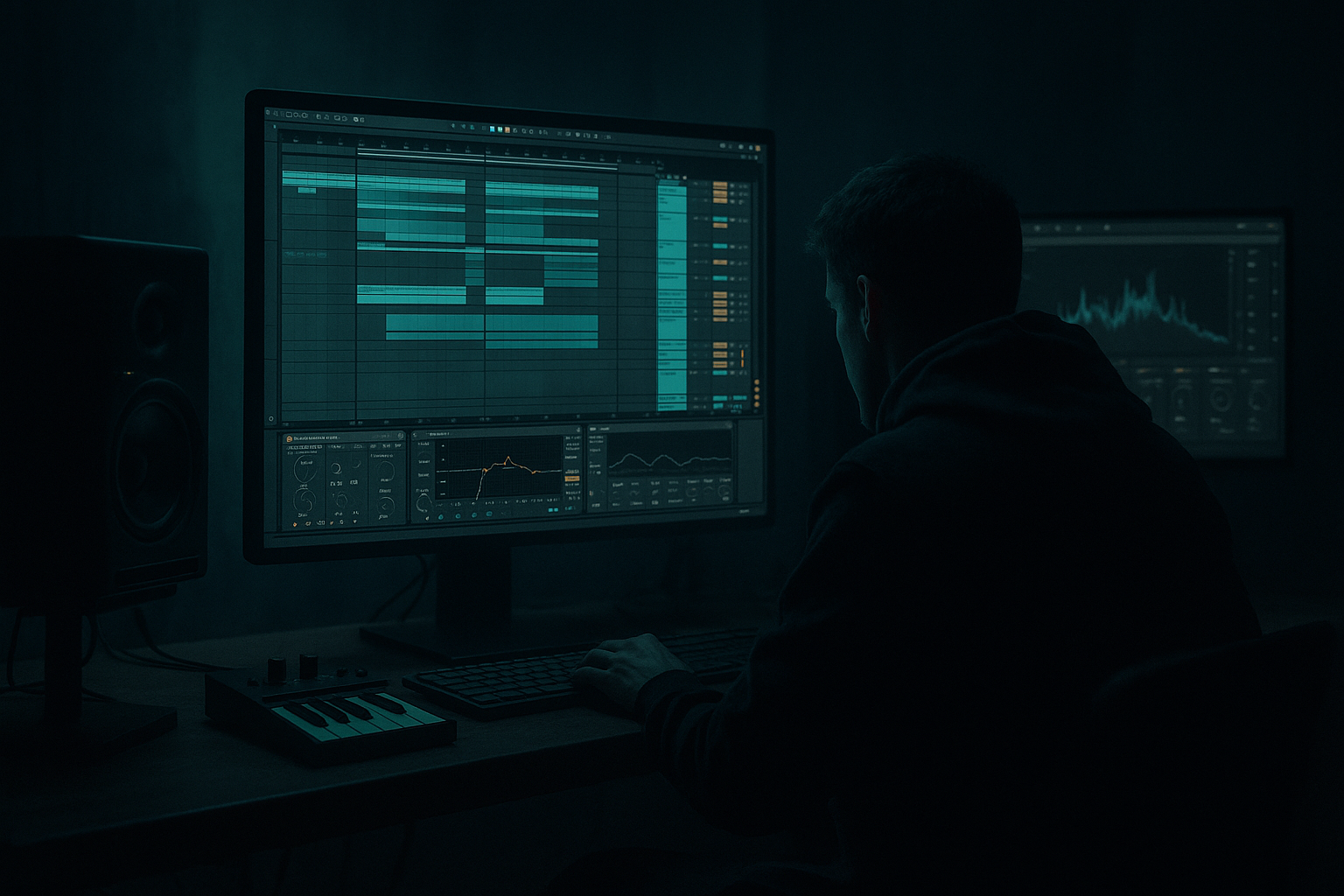
Main tutorial
```markdown
Session View Jam → Arrangement View (Pirate-Radio Energy) in Ableton Live (DnB Workflow) 📻⚡
1) Lesson overview
This lesson is about building drum & bass like a pirate radio set: you start in Session View with loopable “tunes,” jam transitions live, and then print the performance into Arrangement View with energy, movement, and that “hands-on fader” vibe.
You’ll learn:
- How to set up Session View so jamming feels musical (not chaotic)
- How to build DnB scene architecture (intro → drop → breakdown → reload → outro)
- How to use Follow Actions, dummy clips, and return FX for that pirate-station feel
- How to record your jam into Arrangement, then tighten it like a proper release
- 170–174 BPM
- Punchy break + tight kick/snare combo
- Rolling Reese/sub bass with movement
- Pirate-radio transitions: airhorns, sirens, mic drops, tape stops, dubby echoes
- A recorded Arrangement performance with realistic DJ-style structure
- Kick
- Snare
- Break (Amen / think / classic loop)
- Hats / Perc
- Drum FX (fills, impacts)
- Sub (clean sine/triangle)
- Reese/Mid (wider, modulated)
- Bass FX (one-shots, growls, resamples)
- EQ Eight: HP @ `25–30 Hz`, gentle dip around `200–350 Hz` if muddy
- Utility: Bass Mono ON (below ~120 Hz using width control is external; but Utility helps keep it centered)
- Optional: Glue Compressor lightly (1–2 dB GR)
- Pads, stabs, rave chords, vocals, noise beds.
- Put one-shots and short loops in Session clips.
- Echo
- EQ Eight after Echo (tame lows)
- Optional: Saturator (Drive `2–4 dB`)
- Hybrid Reverb
- Compressor (optional) to keep it controlled
- Drum Buss
- Glue Compressor
- Keep Return level low; use sends like a DJ slamming a channel 🔧
- Use Drum Rack on a MIDI track.
- Pattern: classic DnB: snare on 2 and 4.
- Kick: try hits around 1, plus ghosts depending on vibe.
- EQ Eight: small cut around `250 Hz` if papery; boost `50–70 Hz` only if it’s not muddy.
- Saturator: Drive `1–3 dB` for density.
- EQ Eight: HP around `120 Hz`, presence boost `2–5 kHz`, snap `8–10 kHz` if needed.
- Drum Buss: very light (Drive `5–10%`) for smack.
- Add an audio track with an Amen/think-style break.
- Warp mode: Beats
- Make 3–5 different break clips:
- EQ Eight: HP `120–200 Hz` (leave lows for kick/sub)
- Saturator: Drive `2–6 dB` (breaks love it)
- Transient shaping (stock alternative): Drum Buss “Transient” knob slightly up
- Keep it rolling: off-beat hats, 16th shuffles, ride loops.
- Use Auto Pan at phase 0° for tremolo-style movement:
- Instrument: Operator (stock)
- Add Compressor sidechained from kick (light 1–3 dB GR).
- EQ Eight: low-pass around `120–150 Hz` if you want strict separation.
- Use Wavetable (stock) or Operator with detune.
- Wavetable idea:
- Add:
- Make 2–3 MIDI clips:
- Set Launch Quantization per clip if needed: `1 Bar` for main, `1/4` for quick fills.
- Easiest: put these FX on Master (not recommended for mixing later), or better:
- Create a “PREMASTER” group/bus:
- In a break clip, set:
- Use this on fill clips so every 4 bars it does something slightly different—like a lively DJ mix.
- Consolidate sections: select a clean 16/32-bar drop → Cmd/Ctrl + J.
- Fix obvious timing: move clip edges to bar lines (keep the human feel though).
- Add arrangement details:
- Intro: 8–16 bars of atmosphere + filtered drums (HP filter opening).
- Drop A: 32 bars (introduce main bass + break variations).
- Switch: change one major element (new bass rhythm, different break, new stab).
- Breakdown: 8–16 bars, heavy echo throws, vocal tag, tension.
- Drop B: 32 bars, add extra ride or reese automation for intensity.
- Outro: strip to break + bass tail, dub echo out.
- Return send spikes (snare throws)
- Filter cutoffs (Auto Filter)
- Utility gain dips for “DJ cuts”
- Everything changes at once.
- Sub isn’t mono/controlled.
- Break is fighting kick/snare.
- Overdoing Echo feedback.
- Recording without rehearsal.
- Make the room feel nasty, not roomy:
- Parallel smash on drums (Return C) = instant weight:
- Reese movement without mud:
- Dark tension beds:
- Clip-based bass variations:
- Session View is your DJ booth: scenes = moments, clips = variations.
- Use returns + dummy clips to get pirate-radio transitions fast (filters, stutters, throws).
- Record the jam into Arrangement, then edit like a producer: structure, clean transitions, small ear candy.
- DnB thrives on phrase-based variation: every 8/16 bars, switch something—keep the roll alive. 📻
Assumption: You know Ableton basics (clips, scenes, routing). You want a repeatable workflow that still feels alive.
---
2) What you will build
A 2–3 minute rolling DnB sketch that sounds like it was mixed live:
---
3) Step-by-step walkthrough
Step 0 — Global setup (so Session View behaves)
1. Tempo: `172 BPM` (start here; adjust later).
2. Time Signature: `4/4`.
3. Global Quantization: `1 Bar`
- This keeps scene launches tight like DJ cue points.
4. Preferences → Record/Warp/Launch:
- Warp Long Samples: ON
- Auto-Warp: OFF (recommended for drums so you choose warp mode)
5. Set a headroom-friendly mix start:
- Master peak target while building: -6 dB (you’ll thank yourself later).
---
Step 1 — Build your “radio desk”: groups, returns, and routing 📡
Create these tracks/groups:
#### A) Drum Group (Group Track)
On Drum Group insert chain (stock):
1. Glue Compressor
- Attack: `3 ms`
- Release: `Auto`
- Ratio: `2:1`
- Soft Clip: ON (if you’re hitting it)
- Aim: 1–3 dB GR on peaks
2. EQ Eight
- HP @ `25–30 Hz` (24 dB/oct)
- Tiny dip if boxy around `250–400 Hz` (optional)
3. Saturator
- Mode: Soft Sine or Analog Clip
- Drive: `2–5 dB`
- Output: trim to unity
#### B) Bass Group
On Bass Group (stock):
#### C) Music / Atmos
#### D) “Radio Tools” track (Audio)
This is your pirate radio control channel: drops, tags, sirens, airhorns, mic FX.
---
Step 2 — Return tracks for pirate-radio transitions (crucial) 🔥
Create 3 return tracks:
#### Return A — “Dub Echo”
- Time: `1/8` or `1/4` (try dotted `3/16` for jungle spice)
- Feedback: `35–55%`
- Filter: HP `200–400 Hz`, LP `6–10 kHz`
- Mod: subtle
#### Return B — “Rave Verb”
- Algorithmic plate or hall
- Decay: `2.5–5 s`
- Pre-delay: `10–25 ms`
- HP: `250–500 Hz`, LP: `8–12 kHz`
#### Return C — “Smash / Parallel”
- Drive: `10–25%`
- Crunch: `5–15%`
- Boom: OFF or very low (Boom can wreck low end fast)
- Ratio: `4:1`
- Attack: `0.3–1 ms`
- Release: `Auto`
- Push until it’s clearly crushed
---
Step 3 — Clip design: make Session View feel like a set (scenes + variations)
In Session View, think columns = channels, rows = moments.
#### Create 6–8 scenes like this:
1. SC01 – Intro (Atmos + filtered break)
2. SC02 – Roll-up (add hats + bass tease)
3. SC03 – DROP A (full drums + bass)
4. SC04 – Switch (new break slice / bass variation)
5. SC05 – Breakdown (pads + vocal tag + FX)
6. SC06 – DROP B / Reload energy
7. SC07 – Outro (strip back + echoes)
Scene tempo? Leave global tempo the same (classic DnB stability), but you can set scene BPM for halftime sections if desired.
---
Step 4 — Drums: build “tight + broken” at the same time 🥁
#### Kick + Snare (clean)
Kick processing chain (stock):
Snare chain:
#### Break layer (the movement)
- Preserve: `Transients`
- Envelope: `20–40` (tight)
- Clip 1: clean loop
- Clip 2: transient envelope higher (tighter)
- Clip 3: HP filtered (for intros)
- Clip 4: Slice feel: duplicate clip, then in Clip view adjust start slightly or use Beat Repeat inserts briefly
Break track chain:
#### Hats/percs
- Rate: `1/8` or `1/16`
- Amount: subtle (10–25%)
---
Step 5 — Bass: build a rolling engine with two layers 🎛️
#### Sub (simple, stable)
- Osc A: Sine
- Add a touch of triangle if needed
- Amp Envelope: short-ish release so it doesn’t smear
#### Reese/Mid (movement + attitude)
- Unison: 2–4 voices
- Detune: low/moderate
- Filter: LP24 with envelope movement
- Auto Filter: slow movement (0.05–0.2 Hz) or map to Macro
- Chorus-Ensemble (wide)
- Saturator (drive for growl)
- EQ Eight: high-pass at `120–200 Hz` so mids don’t fight sub
Bass “rolling” clip strategy:
- Clip A: standard rolling 1-bar pattern
- Clip B: variation (different syncopation)
- Clip C: “switch” with a different note or rhythm
---
Step 6 — Dummy clips: your secret weapon for pirate-radio hype 🎚️😈
Create an Audio track called “DUMMY FX” (no input, no audio clips needed—use empty clips).
1. Add these devices on DUMMY FX track:
- Auto Filter
- Beat Repeat
- Echo
- Utility
2. Create empty clips named like:
- `HP Sweep Up`
- `Tape Stop`
- `8th Stutter`
- `Dub Throw`
- `Kill Low`
3. In each dummy clip, automate device knobs using Clip Envelopes:
- Auto Filter cutoff sweeping up/down over 1–4 bars
- Utility Gain dips for “duck” moments
- Beat Repeat: Interval `1/8`, Grid `1/16`, Chance `30–60%` for glitch fills
- Echo feedback spikes for throws (be careful!)
Route it properly:
- Route all music groups to a single Audio track via Audio To: Premaster
- Put DUMMY FX devices on that Premaster (clean and controllable)
---
Step 7 — Follow Actions: controlled chaos (optional but powerful) 🎲
For break variations or fills:
- Follow Action Time: `1 bar`
- Actions: `Next` / `Other` with probabilities (e.g., 3:1)
---
Step 8 — Jam like a pirate radio host (Session performance plan) 🎙️
Before recording, rehearse a simple launch routine:
1. Start SC01 Intro (filtered break + atmos).
2. Ride Dub Echo send on vocal tag or snare hits.
3. Launch SC02 Roll-up (add hats, bass tease).
4. 1 bar before drop: trigger a dummy clip `HP Sweep Up`.
5. Launch SC03 Drop A on the bar.
6. Every 8 or 16 bars:
- swap break clip
- switch bass clip
- do one tasteful “dub throw” (Echo send spike on a snare)
7. Create a “Reload moment”:
- cut drums for 1 beat (dummy Utility dip)
- airhorn/siren one-shot on Radio Tools track
- slam back into Drop B
Keep it musical: changes every 8/16 bars feels authentic for DnB.
---
Step 9 — Record Session → Arrangement (the clean method) 🎬
1. Hit Global Record (top transport).
2. Launch scenes/clips as you perform.
3. When done, hit Stop.
4. Press Tab to go to Arrangement View.
5. You’ll see your performance laid out: clips, automation, scene changes captured.
Now tighten it:
- risers into drops
- crash/impact at scene changes
- 1-bar drum fills every 16 bars
---
Step 10 — Arrangement polish for pirate energy (fast checklist) ✅
Use Automation Lanes for:
---
4) Common mistakes
In DnB, change one headline element per phrase (every 8/16 bars) to keep the groove rolling.
Keep sub centered; avoid widening devices on the sub track.
HP the break, or use EQ Eight notch where kick/snare live.
One runaway feedback spike can ruin a take—keep Return levels sane and automate carefully.
Do a 60-second practice run so your hands know the “launch order.”
---
5) Pro tips for darker/heavier DnB 🖤
Use short, filtered verbs (Hybrid Reverb HP high) + Echo throws instead of long reverb washes.
Send snare + break more than kick. Keep kick clean to preserve punch.
HP reese at `150–250 Hz`, then distort/saturate. Let sub carry the actual low end.
Use Operator noise or a vinyl/crowd bed, filtered and sidechained slightly—gives “broadcast” grit.
Instead of endless automation, make 3 bass clips and perform them like a DJ.
---
6) Mini practice exercise (20 minutes) 🧪
1. Set tempo to 172 and create 4 scenes: Intro / Drop / Switch / Outro.
2. Build:
- Kick+snare loop (1 bar)
- Break loop (1 bar) with 2 variations
- Sub + reese (2 MIDI clips)
3. Create one Return: Dub Echo.
4. Create one dummy clip: HP sweep up over 1 bar.
5. Record a 90-second jam into Arrangement:
- Intro 8 bars
- Drop 16 bars
- Switch 16 bars
- Outro 8 bars
6. Listen back and fix only:
- one messy transition
- one echo throw timing
- one element that’s too loud
---
7) Recap
If you want, tell me your preferred substyle (rollers, jungle, neuro, jump-up, halftime), and I’ll give you a scene blueprint + exact clip list tailored to it.
```

