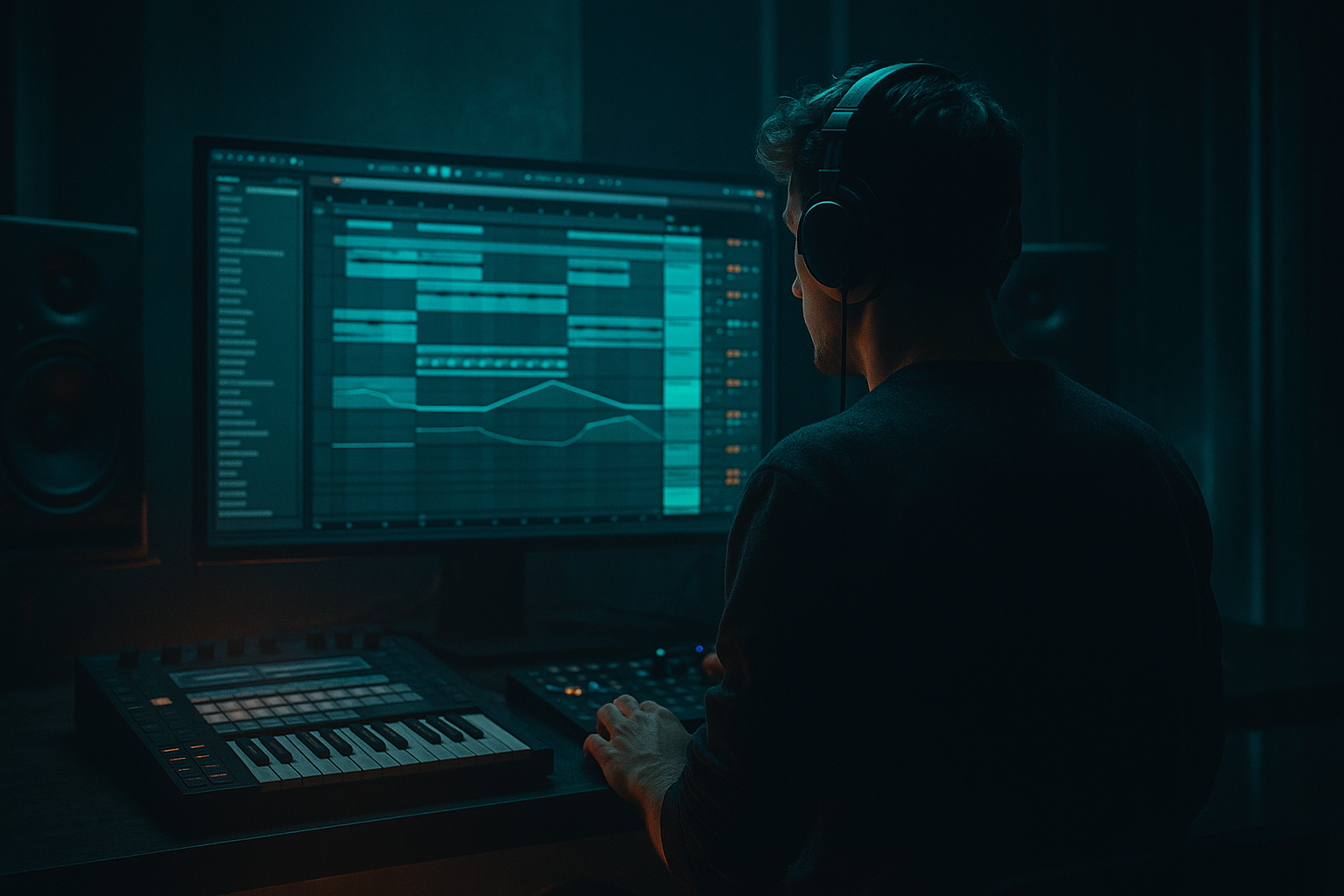
Main tutorial
```markdown
Shaker Groove Foundations for Faster Workflow (DnB in Ableton Live) 🥁✨
1) Lesson overview
Shakers in drum & bass aren’t “extra percussion” — they’re the engine oil that makes a beat roll smoothly at 170–176 BPM. In this lesson you’ll build a reusable shaker workflow in Ableton Live that gives you:
- Instant forward momentum (without cluttering your mix)
- Control over swing, push/pull, and energy
- A fast method to create variations across an 8–16 bar loop
- A 2-layer shaker groove (main + ghost/texture layer)
- A simple device chain for tone shaping, movement, and mix control
- An 8-bar arrangement with variation, fills, and transitions — perfect for rolling DnB
- Accents: 85–105
- Medium: 55–75
- Ghost: 25–45
- Duplicate the clip into 4 x 2-bar clips or 2 x 4-bar clips
- Edit density:
- Automate one macro (easy mode):
- Too loud: Shakers should support the groove, not lead it. If you notice them immediately, turn them down 2–4 dB.
- No velocity shaping: Flat 16ths sound like a typewriter at 174 BPM.
- Too much swing/random: A little human feel is great; too much makes the beat feel late.
- Harsh top end: Cheap samples + no EQ = brittle fatigue. Use EQ Eight and Drum Buss damp.
- Stereo too wide: Wide shakers can smear your mix. Keep width controlled (Utility 80–120% is plenty).
- Shorten the shaker tail for aggression:
- Pitch down slightly for grit:
- Saturate for density (but don’t fizz):
- Use band-pass movement for “industrial air”:
- Micro-dropouts for menace:
- Jungle nod: Add a very quiet 8th-note tambourine layer, but filtered and tucked — it adds that old-school propulsion without sounding retro-cheesy.
- Start with a reliable 16th-note foundation at 174 BPM.
- Use velocity + subtle swing to create groove fast.
- Layer a quiet ghost shaker for perceived speed and air.
- Use a repeatable stock device chain (EQ Eight → Drum Buss → Auto Filter → Utility).
- Add arrangement variations every 2–4 bars so the loop stays alive.
- Use sidechain to snare for clean space and professional movement.
We’ll keep it beginner-friendly but very practical, using Ableton stock devices and DnB/jungle timing concepts. ⚡
---
2) What you will build
By the end you’ll have:
---
3) Step-by-step walkthrough
Step 0 — Set up the context (tempo + drums)
1. Set tempo to 174 BPM (classic modern DnB).
2. Make sure you have a basic drum groove:
- Kick on 1
- Snare on 2 and 4 (standard DnB backbeat)
3. Loop 8 bars.
This is the perfect length to build movement without getting lost.
Ableton tip: Turn on Loop and set the loop brace to 8 bars.
---
Step 1 — Create your shaker track (fast + clean)
1. Create a MIDI Track: `Cmd/Ctrl + Shift + T`
2. Drop in a Drum Rack (from Instruments).
3. Load 2 shaker-ish samples (any of these work):
- Shaker (short/tight) for the main pulse
- Tamb/shaker/noise hat for texture
Where to find samples:
If you don’t have a pack, use Ableton’s Core Library (search “shaker”, “tamb”, “hat”, “noise”).
DnB guideline: Your shaker should usually sit above the snare in frequency and behind it in perceived loudness.
---
Step 2 — Program the “DnB rolling shaker skeleton”
We’ll start with a super reliable pattern: 16th-note grid with accents.
1. Create a MIDI clip (8 bars) on the shaker track.
2. Set grid to 1/16.
3. Place hits on every 1/16 for now (yes—full machine-gun).
4. Now shape it into a groove using velocity:
- Accents on the off-16ths tend to roll nicely in DnB.
- Use this simple velocity idea:
- Strong: 1.2, 1.4, 2.2, 2.4 (etc.)
- Weaker: the other steps
Quick velocity recipe (starting point):
This creates motion without needing complicated rhythms.
Why this works: DnB relies on consistent subdivision energy, but the accent pattern creates the feeling of swing and drive.
---
Step 3 — Add swing the “DnB way” (without wobbling the whole beat)
In Live, your global groove can mess with your kick/snare if you’re not careful. So we’ll apply groove only to the shaker clip.
1. Open the Groove Pool (`Cmd/Ctrl + Alt + G`)
2. Drag in a groove like:
- `Swing 16-57` (subtle)
- `Swing 16-63` (more obvious)
3. Apply it to the shaker MIDI clip:
- Click the clip → in the Groove chooser select your groove
4. Set:
- Timing: 15–30%
- Velocity: 0–15% (optional if you already did velocity)
- Random: 3–10% (tiny human feel)
✅ DnB rule: Keep swing subtle. Too much and the groove feels late/sloppy at 174 BPM.
---
Step 4 — Layer a “ghost shaker” for air + speed perception
Now we create a second layer that adds texture without being “heard” as a rhythm line.
Option A (fastest): Duplicate within Drum Rack
1. Add a second pad sample (a lighter shaker/noisy hat).
2. Copy your MIDI notes from layer 1.
3. Change the second layer pattern:
- Remove some hits (leave only offbeats or every other 16th)
- Lower velocities heavily (mostly 15–40)
Option B (audio texture): Use Simpler + noise
1. Add a separate audio track with a noisy hat loop or shaker loop.
2. Warp it, then high-pass and tuck it in.
Goal: You feel the top-end motion more than you notice it.
---
Step 5 — Build a stock Ableton device chain (clean, controlled, repeatable)
Put this on your shaker group (or shaker track). Here’s a great “default chain” for DnB:
#### Recommended chain (all stock)
1. EQ Eight
- High-pass around 200–400 Hz (shakers rarely need low-end)
- If harsh: dip 7–10 kHz by 1–3 dB (Q ~2)
2. Drum Buss (subtle!)
- Drive: 2–6
- Crunch: 0–10%
- Damp: adjust until less fizzy
- Boom: OFF (usually not needed for shakers)
3. Auto Filter (movement)
- Mode: HP or BP
- Frequency: start around 6–10 kHz (for gentle tone shifts)
- LFO: Rate 1/8 or 1/16, Amount 5–15%
- Keep it subtle so it doesn’t sound like EDM wobble
4. Utility
- Gain: adjust so shakers sit behind snare
- Width: 80–120%
- Optional: Bass Mono ON (if you kept any low content)
Workflow tip: Save this as an Audio Effect Rack preset called:
> “DnB Shaker Clean + Movement”
Then you can drop it onto any project in seconds. 🚀
---
Step 6 — Make it “arrangement-ready” (8-bar variation plan)
A loop that never changes becomes tiring fast in DnB. Here’s an easy variation structure:
Bars 1–2: Full groove (establish roll)
Bars 3–4: Remove 20–30% of hits (make room for drums/bass)
Bars 5–6: Bring it back + slight filter open
Bars 7–8: Add a mini fill or push into the next section
#### How to do this quickly in Ableton:
- Select notes → `Delete` a few hits
- Group your shaker track and map Auto Filter Frequency to a Macro
- Automate it to open slightly into bar 8
Classic DnB move: In bar 8, mute shakers for the last 1/4 or 1/2 bar to create a drop-in vacuum before the loop repeats. 😈
---
Step 7 — Lock shakers to the drum groove (sidechain + dynamics)
If your shakers fight the snare, your mix will feel messy.
Quick fix (stock): Compressor sidechain
1. Add Compressor on the shaker group
2. Enable Sidechain
3. Input: your Snare track (or drum group)
4. Settings (starting point):
- Ratio: 2:1 to 4:1
- Attack: 1–10 ms
- Release: 60–120 ms
- Threshold: adjust for 1–3 dB gain reduction on snare hits
This subtly “bows” the shakers around the snare. Super clean for rolling DnB.
---
4) Common mistakes
---
5) Pro tips for darker/heavier DnB 🖤
- In Simpler: reduce Decay/Release
- Or use a Gate to tighten
- In Simpler: Transpose -1 to -3 semitones (tiny move, big vibe)
- Try Saturator (Soft Clip ON)
- Drive 1–4 dB, then compensate gain
- Auto Filter in BP mode around 6–9 kHz, tiny LFO amount
- Mute the shaker for 1/8 right before a snare or fill to create tension
---
6) Mini practice exercise (15 minutes) ⏱️
1. Make an 8-bar DnB loop at 174 BPM with kick + snare.
2. Program a 16th shaker on one sample.
3. Do velocity shaping:
- Accents ~95
- Medium ~65
- Ghost ~35
4. Apply Groove Pool:
- `Swing 16-57`
- Timing 20%, Random 6%
5. Add a ghost layer (second sample) with only off-16ths.
6. Add the chain:
- EQ Eight (HP at 300 Hz)
- Drum Buss (Drive 4)
- Auto Filter (LFO 1/16, small amount)
- Utility (Width 110%)
7. Create two variations:
- One with reduced density (bars 3–4)
- One with a bar 8 dropout
Export a quick bounce and listen on headphones: does it roll without sounding harsh?
---
7) Recap
If you want, tell me your current drum pattern (straight 2&4, break-based, or halftime sections), and I’ll suggest a shaker groove that matches that specific vibe. 🎛️
```

