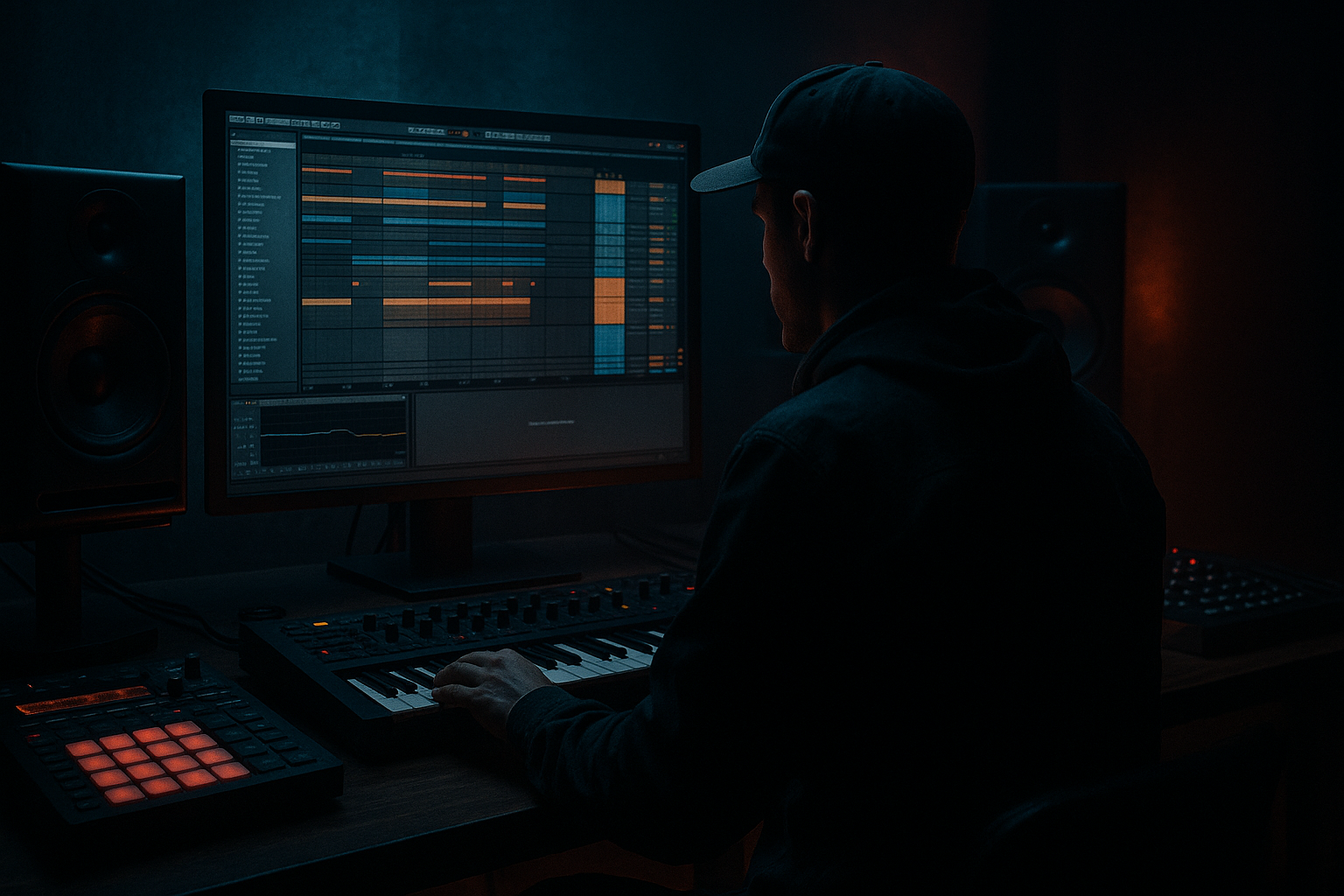
Main tutorial
Lesson Overview
A filtered breakdown is one of the most effective tension tools in Drum & Bass, especially when you want that jungle / oldskool energy before a drop. In Ableton Live 12, the goal is to take your full-spectrum loop and gradually strip it back into a focused, musical breakdown that still feels alive: drums become ghostly, the bass loses weight and returns in fragments, and the track breathes without losing momentum.
This matters in DnB because the genre lives on contrast. Your drop hits harder when the breakdown creates space, and your breakdown feels more exciting when it still hints at the groove underneath. For jungle and oldskool-style DnB, that usually means filtered breaks, dubby atmospheres, a teased bassline, and automation that feels intentional rather than random. A good filtered breakdown should sound like the track is “opening up” and then “sucking back in” before the drop.
We’ll build a breakdown that works for:
- jungle-inflected DnB
- rollers with retro swing
- darker bass music and neuro-adjacent tension sections
- DJ-friendly arrangement where the energy can reset cleanly
- a looped breakbeat reduced to a narrow, filtered texture
- a reese or sub bass teased in short call-and-response phrases
- atmospheres and delay tails filling the gaps
- a rising sense of tension created mostly through automation, not overused risers
- a clean path into the drop with enough contrast to make the impact feel bigger
- Filtering the whole mix instead of separate elements
- Removing all low end too early
- Over-resonant filters
- Too much reverb on drums
- Breakdown that feels static
- Uncontrolled stereo widening
- Weak transition back into the drop
- Use saturation before the filter on bass
- Try two filters in series for finer control
- Automate send amounts, not just effect parameters
- Keep the sub out of the breakdown until the final tension hit
- Use break edits to imply momentum
- Reference oldskool jungle phrasing
- Check mono at low volume
The focus is not just on throwing a filter on the master. We’ll shape the drums, bass, atmos, and FX separately so the breakdown has movement, depth, and mix clarity.
What You Will Build
By the end of this lesson, you’ll have a breakdown section in Ableton Live that sounds like:
Musically, think of a 16-bar or 8-bar breakdown that starts from a full roller or jungle drop and transitions into a more stripped, haunted section. For example: after 32 bars of full drums and bass, the track drops into 16 bars of filtered drums, the bass disappears except for a few chopped notes, and a dubby pad or vocal stab carries the harmonic identity. The last 4 bars tighten up with filter movement, reverb swell, and a snare pickup before the drop returns.
Step-by-Step Walkthrough
1. Duplicate your main drop section and prepare the breakdown lane
Start with your existing DnB arrangement in Session or Arrangement View and duplicate the 16 or 32 bars that contain your main groove. Then create a breakdown region directly after the drop or after a phrase boundary. For jungle and oldskool DnB, clean phrasing matters a lot: 8, 16, or 32 bars is usually the sweet spot.
In Arrangement View, label the section so you can work fast:
- “DROP 1”
- “BREAKDOWN”
- “BUILD”
- “DROP 2”
Make sure you leave enough room for the transition. A breakdown feels stronger when it has a clear beginning, middle, and end. If you’re working at 174 BPM, an 8-bar breakdown can still feel substantial if the automation evolves every 1–2 bars.
2. Separate your core elements before filtering anything
Don’t put one giant filter on the whole mix and call it done. Split the groove into at least three lanes:
- drums / break loop
- bass
- atmos / musical layers
If your break is on one audio track, group it with any layered kick or snare reinforcement. If your bass is a MIDI instrument or resampled audio, keep it on its own track. This lets you automate each layer differently.
Useful stock Ableton devices:
- Auto Filter for sweeping and narrowing frequency range
- EQ Eight for surgical low-end and harshness control
- Utility for mono control and gain trimming
- Saturator for grit and density
- Echo or Delay for space and rhythmic tails
- Reverb for depth and wash
- Drum Buss for break glue and controlled impact
Why this works in DnB: jungle and roller arrangements rely on drum/bass interplay. If you automate the full mix as one block, the low end collapses and the groove turns muddy. Separate automation keeps the tension strong while preserving clarity.
3. Shape the drums with a band-pass style breakdown move
On your break/drum group, place Auto Filter first in the chain. Set it to a low-pass or band-pass-style movement depending on how hollow you want the breakdown to feel.
Starting point suggestions:
- Filter type: Low-Pass 24 for a smoother oldskool taper
- Cutoff: start around 14–18 kHz in the drop, then automate down to 300–900 Hz in the breakdown
- Resonance: 10–25% for a bit of bite without whistling
- Drive: use lightly if the break needs more attitude
For a more authentic jungle feel, don’t fully remove the drums. Leave some transient identity:
- keep the snare crack visible around 2–5 kHz
- roll off the top-end cymbal fizz
- let the break feel “underwater” rather than dead
Add EQ Eight after Auto Filter if needed:
- cut a touch at 250–400 Hz if the filtered break gets boxy
- shave harshness around 6–8 kHz if the filtered snare gets brittle
- use a gentle low shelf if the break still fights the bass return later
Then automate a subtle volume drop on the drum group during the first half of the breakdown, maybe -1 to -3 dB, so the filter movement reads more clearly.
4. Automate the bass into fragments instead of full sustain
In DnB, the bassline often carries the most emotional tension. For a filtered breakdown, don’t just mute it instantly. Instead, turn it into a teasing motif.
If your bass is a reese, sub, or layered bass patch:
- automate Auto Filter cutoff from full open down to around 150–500 Hz
- reduce resonance if the filter gets too obvious
- use Utility to keep the low-end centered in mono
- automate the bass volume so it appears in short phrases rather than constant movement
A strong pattern is:
- bars 1–4: bass drops out entirely except atmosphere
- bars 5–8: 1–2 note teaser phrase every 2 bars
- bars 9–12: more frequent bass hits, still filtered
- bars 13–16: cutoff opens and bass tension returns before the drop
Concrete parameter ideas:
- reese cutoff: 200–800 Hz during the breakdown
- sub level: keep it 6–12 dB lower than the drop version, or remove it until the final build
- saturation: mild drive only, enough to make small bass notes audible on smaller speakers
If your bassline is MIDI, try automating note length too. Shorter notes with more space can feel more oldskool than a sustained wash.
5. Add ghost FX and atmospheres to keep the breakdown alive
A filtered breakdown in DnB needs movement between hits. This is where atmospheres, reverses, dub echoes, and noise layers come in.
Add one or two simple layers:
- a vinyl/noise texture
- a reverbed stab or chord
- a vocal chop, amen hit, or metallic one-shot
- a reverse cymbal or reversed break hit leading into phrase changes
Use stock Ableton devices:
- Reverb with decay around 2.5–6 seconds for distant space
- Echo with time synced to 1/4 or 1/8 dotted for jungle-style trails
- Auto Pan at low depth for subtle motion
- Grain Delay only if you want more experimental, gritty texture
- Utility to keep low frequencies out of atmospheric layers
Practical routing move: send your chopped stab or vocal hit to a reverb return, then automate the send amount up at the end of each 4-bar phrase. That creates a nice tail that doesn’t clutter the main signal.
Keep the atmos mostly high-passed:
- High-pass around 150–300 Hz
- Dip 2–4 kHz if they fight the snare presence
- Let the reverb tail fill the upper mids, not the sub area
6. Use automation lanes to create phrase-level tension
This is where the breakdown becomes musical instead of just filtered. In Arrangement View, write automation for at least three different elements:
- drum filter cutoff
- bass filter cutoff or bass mute/return
- reverb/delay send amount or return level
Strong DnB breakdown automation often moves in layers:
- bar-by-bar: gradual filter narrowing
- every 2 bars: small bass phrase change
- end of each 4 bars: extra FX hit or delay swell
- final 1–2 bars: open the filter slightly to imply the return
A good arrangement example:
- Bars 1–4: break filtered, bass absent, atmosphere present
- Bars 5–8: bass teaser enters, delay throws on snare
- Bars 9–12: drums get a touch brighter, snare becomes more defined
- Bars 13–16: filter opens, riser or noise sweep increases, snare pickup leads the drop
This works in DnB because the listener is always tracking the groove, even when it’s reduced. Automation replaces constant density with progression.
7. Shape the breakdown bus for glue without killing dynamics
Put your filtered breakdown elements into a group bus and process gently. You want cohesion, not overcompression.
On the breakdown group, try:
- Compressor with low ratio, around 1.5:1 to 2:1
- Attack around 10–30 ms to keep transients alive
- Release around 80–200 ms, tempo-dependent
- Gain reduction usually just 1–3 dB
If the break needs more grit, add Drum Buss lightly:
- Drive low to moderate
- Boom only if the low end is controlled
- Crunch subtly for texture
Then check the group with Utility:
- switch Bass Mono on if you need low-end discipline
- reduce width if the atmospheres are too wide and wash out the center
The goal is to make the breakdown feel like a single scene rather than disconnected layers.
8. Build the final 2-bar lift into the drop
The last two bars should make the listener feel the drop coming back, not guess it. Open the filter slightly, automate the reverb and delay into a tail, and let one element return with more energy.
A classic jungle / oldskool trick:
- bring the snare back a bit brighter
- add a short reverse break leading into bar 1 of the drop
- automate the bass filter to open just before the drop hits
- stop the reverb tail from masking the first kick/snare impact
Useful final transition choices:
- a small pitch-rise noise sweep
- a snare roll with increasing reverb send
- a half-bar drum fill using chopped break slices
- a downlifter that gets filtered instead of full-range
Keep the transition DJ-friendly if you want this to work in mixes. Don’t overstuff the last bar with too many effects. One or two clear signals are stronger than five competing ones.
Common Mistakes
- Fix: automate drums, bass, and atmos independently so the breakdown stays clear.
- Fix: leave a hint of sub or filtered bass movement until the final bars, especially in rollers or jungle styles.
- Fix: reduce resonance and compensate with movement in automation, not squealing peaks.
- Fix: keep reverb on sends or returns, high-pass the return, and automate it only where needed.
- Fix: change at least one parameter every 2 bars: cutoff, send level, bass phrase, or drum density.
- Fix: keep bass mono, and avoid widening the low-mids of the filtered drums.
- Fix: use a final snare fill, reverse hit, or filter-open moment to set up the impact.
Pro Tips for Darker / Heavier DnB
- A subtle Saturator or Soft Clip effect can make the filtered bass audible even when it’s narrowed down. This is especially useful for gritty reese fragments and dark roller basses.
- One Auto Filter can handle broad movement, while EQ Eight or a second Auto Filter can shape the lower mids. This gives you more control over the oldskool “muffled but alive” character.
- Raising delay or reverb sends at phrase ends often sounds more musical than cranking the return track itself.
- For darker DnB, the absence of the true sub for most of the breakdown can make the drop feel much heavier when it returns.
- Even a filtered breakdown can feel fast if you chop the break into ghost notes, snare pickups, or small call-and-response slices.
- The best breakdowns often feel like they’re borrowing from dub and reggae: space, echo, fragment, answer, repeat.
- If the breakdown still reads in mono, your bass and core break balance are probably solid.
Mini Practice Exercise
Set a timer for 15 minutes and build a filtered breakdown from one of your own DnB projects.
1. Duplicate an 8-bar section from your drop.
2. Create a breakdown after it.
3. Put Auto Filter on your drum group and automate the cutoff from open to narrow over 8 bars.
4. Put Auto Filter on your bass and make it disappear for the first 4 bars, then return with 2 short teaser notes.
5. Add one atmosphere layer or vocal chop and send it to Reverb and Echo.
6. Automate the reverb send up on the last hit of every 2 bars.
7. Add a final 2-bar lift with a snare fill, reverse hit, or opening filter.
8. Play the section from start to finish and ask:
- Does the groove still feel present?
- Is the low end controlled?
- Does the drop return feel bigger?
Optional challenge: make one version more jungle/oldskool and another more dark/modern, using the same source material.
Recap
The best filtered breakdowns in DnB are built with separation, automation, and phrase awareness. Filter the drums, tease the bass, and use atmospheres and delay tails to keep movement alive. Keep the low end disciplined, automate in musical chunks, and shape the final 2 bars so the drop lands with real force.
If it feels empty, add phrasing. If it feels muddy, separate the layers. If it doesn’t hit hard enough, make the breakdown more focused so the drop has something to explode out of.

