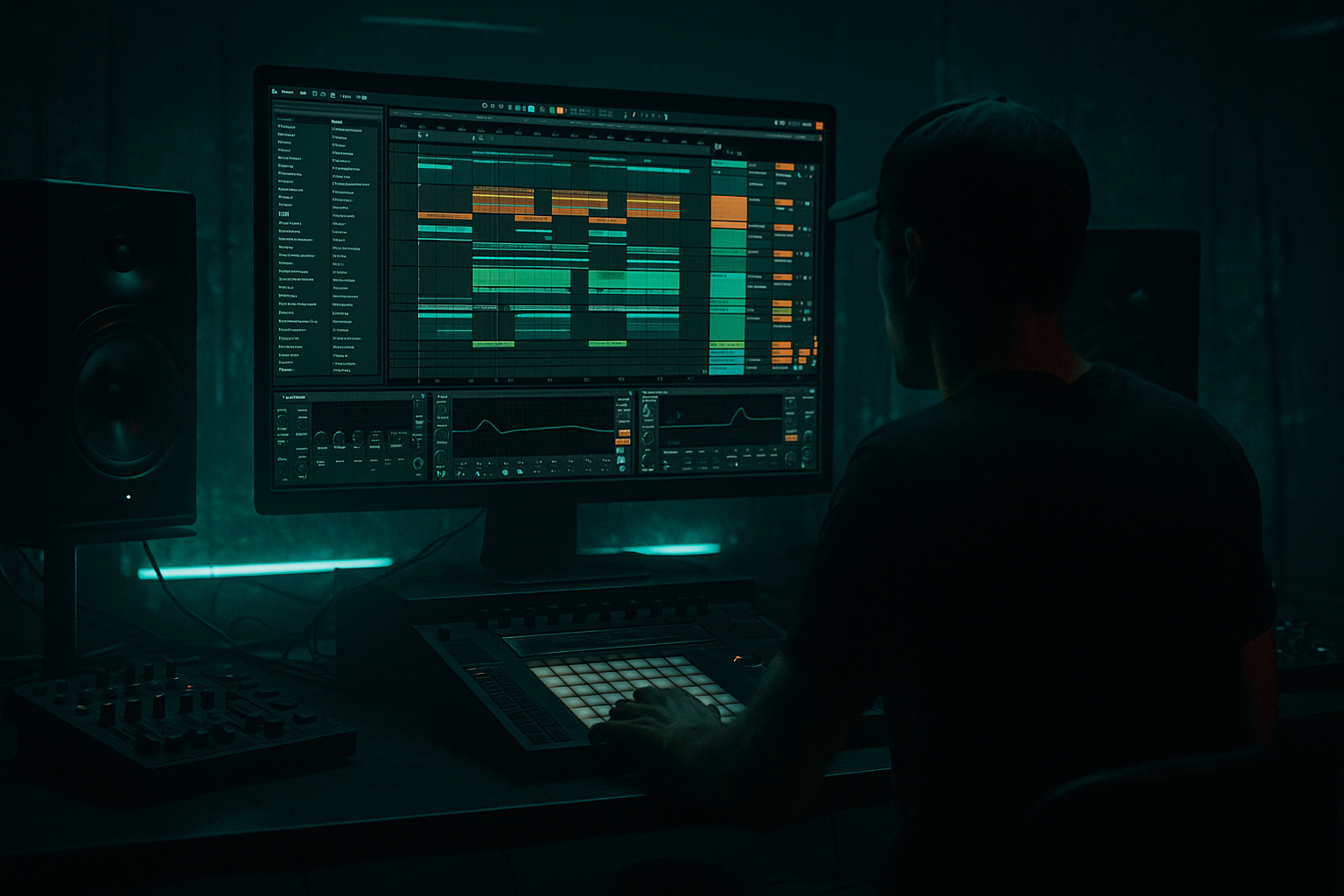
Main tutorial
Lesson Overview
This lesson is about building a reese patch that feels like a DJ tool, not just a sound design exercise: a bass line that can sit under jungle or oldskool DnB drums, move with the groove, and keep enough structure that a DJ can mix into and out of it cleanly.
In a real DnB track, this lives in the drop, the switch, and the outro. It’s the kind of bass that can hold a main phrase for 8 or 16 bars, then mutate just enough for the second half of the drop so the arrangement doesn’t feel looped. For jungle and oldskool-leaning DnB, the reese has to do two jobs at once: it needs midrange character and motion for attitude, while staying disciplined in the low end so the kick, snare, and break can still breathe.
Why this matters musically and technically:
- Musically, a reese gives you pressure, weight, and tension without needing busy note writing.
- Technically, it forces you to manage stereo width, sub clarity, distortion, and phrasing so the bass stays club-safe.
- For DJ use, it needs to be readable in a mix: clear intro/outro options, no random low-end chaos, and enough space around the downbeat so it doesn’t fight the snare.
- a solid mono sub foundation
- a moving mid-bass layer with detune and harmonic motion
- controlled saturation and filtering
- DJ-friendly phrasing that leaves room for breaks and snare accents
- an arrangement shape that works as a 16-bar drop core with an 8-bar variation
- sonic character: dark, gritty, slightly haunted, with a controlled stereo smear above the low end
- rhythmic feel: short, punchy notes with some held notes for tension; it should groove against the drums, not smear them
- role in the track: main bass identity for a jungle/DnB drop, with enough flexibility to serve as the A-section of a two-part arrangement
- mix-readiness: clean mono sub, restrained width, and enough headroom to survive drum processing and arrangement automation
- Use note length as arrangement, not just MIDI data. A one-bar bass note can feel huge if it opens slowly, while an overly long note can kill a snare-led groove. Shape note lengths to leave pockets for ghost hits and break slices.
- Print different versions of the same reese. One version should be slightly cleaner, one slightly nastier. In the arrangement, use the dirtier print for the second eight bars or the second drop so the track evolves without needing a whole new sound.
- Add movement with tiny automation, not giant sweeps. In darker DnB, subtle filter motion over 4 or 8 bars often feels more dangerous than a dramatic wobble. A slow opening cutoff on the reese layer can create tension without destroying club readability.
- Treat the snare as a bass reference point. If the snare disappears when the bass comes in, the patch is too wide, too loud, or too low-mid heavy. Fix that before adding more distortion.
- Use controlled grit in the 700 Hz to 2 kHz area. That range helps the reese speak on systems that don’t reproduce sub well, but too much there makes the bass shouty. Balance it with EQ and saturation, not just more volume.
- For menace, leave a little emptiness before the downbeat. A tiny gap before a bass hit can feel heavier than constant notes, especially under jungle drums. The absence makes the next hit land harder.
- If the track needs more underground character, degrade the mid layer rather than the sub. You can add a rougher saturation profile, a little bit of clipping, or a more unstable filter tone on the reese layer while keeping the foundation clean and mono.
- Use only stock Ableton devices
- Use two layers: one sub, one reese
- Write an 8-bar phrase with at least one variation
- Keep the sub mono
- No more than one distortion device on the reese layer
- A short 8-bar loop with:
- In mono, does the bass still feel stable?
- With drums playing, can you still hear the snare clearly?
- Does the second half of the phrase feel like an evolution, not a copy?
- Split the bass into mono sub + moving reese layer.
- Build the reese from simple oscillators, not oversized unison.
- Keep distortion and filtering focused on the mid layer.
- Shape the bass as a phrase so it works for DJ mixing and drop evolution.
- Always check the bass with drums, especially the snare and break.
- If the low end gets vague, fix stereo, timing, and layer roles before adding more processing.
Best fit: jungle, oldskool DnB, rollers with a gritty edge, darker half-time sections, and break-heavy arrangements. By the end, you should be able to hear a bass that feels thick, slightly nasty, rhythmically locked, and easy to place against a drum loop—something you could confidently build a drop around.
What You Will Build
You’ll build a two-layer Ableton Live reese patch with:
The finished sound should be:
Success sounds like this: the bass hits with authority, has movement when sustained, does not blur the kick/snare relationship, and still feels usable when a DJ blends in the next track.
Step-by-Step Walkthrough
1. Start with the drum context first, not the synth
In Ableton, place a minimal drum loop on the grid before sound design: kick, snare on 2 and 4, and a break or ghosted break pattern around it. You want the bass to answer a real groove, not a metronome.
Set up a 2-bar loop and leave the bass empty for a moment. Put a reference point in the arrangement where the snare is clearly dominant. For jungle and oldskool DnB, that snare is often the anchor that tells the bass where to sit.
Why this works in DnB: the reese only feels authentic when it locks to the drum hierarchy. If it’s designed in isolation, you’ll often overbuild the motion and end up with a bass that fights the break.
What to listen for:
- Does the drum loop already feel like a phrase?
- Is there a clear “hole” after the snare where the bass can answer?
2. Build the core oscillator stack in Wavetable or Operator
Use a stock synth as your main source. Two good Ableton-only paths:
Option A: Wavetable
- Osc 1: saw
- Osc 2: saw or square
- Detune modestly, not wildly
- Keep unison low at first, because the width can get messy fast in DnB
Option B: Operator
- Use two oscillators, both saw-like or square-ish where available
- Slight detune between the oscillators
- Keep the patch simple and let processing create the body
For a classic reese feel, the point is not “huge unison.” It’s beating and instability in the midrange. Try:
- Detune: very small to moderate
- Oscillator blend: one oscillator slightly louder than the other
- Octave: keep the core around bass range, then add a sub separately
Decision point — A versus B:
- A: cleaner, more modern reese if you want the patch to stay tighter and more mixable
- B: dirtier, older, more unstable reese if you want a more jungle-authentic, slightly ragged vibe
For oldskool jungle vibes, B usually wins. For a polished roller, A can be the safer call.
3. Separate the sub from the movement immediately
Add a second chain or a second instrument path for the sub. Keep this part simple:
- a sine or very pure low tone
- mono
- no wide effects
- no heavy distortion
In Ableton, you can do this with an Instrument Rack and two chains:
- Chain 1: sub layer
- Chain 2: reese layer
On the sub chain:
- low-pass around 80–120 Hz if needed
- keep it centered
- keep notes shorter than the mid layer if the groove needs more punch
On the reese layer:
- high-pass around 80–120 Hz so it doesn’t double the sub too much
- this lets the movement live in the mids and low-mids, where the character is actually heard
Why this works: DnB low end collapses when sub movement and stereo movement occupy the same space. Split the roles and the bass becomes easier to mix, louder, and more reliable.
Stop here if the sub is already getting vague in mono. Fix that before adding any more motion.
4. Shape the envelope for a DJ-friendly bass phrase
In the synth envelope, keep the bass envelope fairly quick so the groove stays readable. A useful starting point:
- attack: very short
- decay: short to medium
- sustain: moderate if you want a held reese, lower if you want a more percussive stab
- release: short enough that notes don’t overlap unless you want legato tension
For jungle/oldskool DnB, a strong move is to make the bass speak quickly and then wobble under sustain. That gives you punch at the note onset and instability in the tail.
Good starting feel:
- short notes for call-and-response with the snare
- longer notes in the second half of the phrase to create pressure
What to listen for:
- Does the note attack arrive before the drum transient disappears?
- Do held notes still feel rhythmic, or do they just smear?
5. Add controlled movement with a stock filter and modulation
Insert Auto Filter on the reese layer, not the sub. Start with a low-pass or band-pass feel depending on the sound:
- low-pass if you want the bass to open up like a growl
- band-pass if you want a more nasal, vintage jungle edge
Use envelope or LFO movement sparingly:
- filter cutoff movement: subtle, not dramatic
- resonance: low to moderate; too much makes the bass whistle instead of growl
- cutoff range: move within a useful band, often somewhere around the low-mid to mid zone rather than sweeping the full spectrum
A practical range:
- cutoff sitting in a midrange region where the reese speaks, then opening slightly on accented notes
- filter movement should feel like the bass is breathing, not wobbling like dubstep
This is where the reese starts to feel alive without destroying the low end.
6. Distort the mid layer, not the whole bass blindly
Add Saturator or Drum Buss to the reese chain after the filter. Keep the sub chain clean.
Two workable stock-device chains:
Chain 1: Clean-heavy classic
- Wavetable/Operator
- Auto Filter
- Saturator
- EQ Eight
- Compressor if needed for control
Chain 2: Dirtier jungle edge
- Wavetable/Operator
- Overdrive or Saturator
- Auto Filter
- EQ Eight
- Utility for mono/width discipline if needed
For Saturator, try:
- Drive: modest to moderate
- Soft Clip: on if the transients are poking too hard
- Output trimmed back so the level doesn’t fool you into thinking it sounds bigger just because it’s louder
Why this works in DnB: the reese’s identity comes from harmonics in the low-mid and midrange. Distorting the mid layer gives you audible attitude on smaller systems without wrecking sub clarity.
What to listen for:
- Does the bass get more present, or just more harsh?
- Can you still hear pitch movement after saturation?
7. Carve the bass around the drums with EQ and timing
Use EQ Eight on the reese layer to make room for the kick and snare. Common moves:
- high-pass the reese layer around 80–120 Hz depending on the sub crossover
- tame boxy build-up somewhere around 200–400 Hz if the break gets cloudy
- control harshness around 2–5 kHz if the distortion bites too hard
Then check timing against the drum loop:
- If the bass hits too early, it can blur the kick impact.
- If it arrives too late, the groove feels lazy.
Try nudging MIDI notes slightly:
- a few milliseconds early for urgency
- a few milliseconds late for a heavier, laid-back pocket
In DnB, that tiny timing choice can be the difference between “urgent and dangerous” and “soft and vague.”
Check this in context with the drums, not solo. A bass that sounds perfect alone can still sit wrong under a snare-led break.
8. Program a DJ-friendly 8-bar phrase with call-and-response
Build a phrase that feels mixable and intentional:
- Bars 1–2: establish the main bass motif
- Bars 3–4: repeat with a small variation or note drop-out
- Bars 5–6: add a filter opening or a rhythmic answer to the snare
- Bars 7–8: strip a little away to create space for a mix transition or next section
A useful jungle move is to let the bass answer the break rather than continuously fill space. That gives the drop room to breathe and makes later switch-ups feel earned.
Arrangement example:
- 8 bars of main drop
- 8 bars with a slightly opened filter and a different last note
- 8 bars of stripped version for second-drop tease or DJ exit
This is what makes the bass useful in a real track: it can support a DJ blend instead of trapping the arrangement in one static loop.
9. Commit the sound if the movement is right
Once the bass character is working, freeze and flatten or resample the reese layer into audio so you can edit it like a phrase. This is especially useful if the filter and saturation interaction is the whole identity.
Commit this to audio if:
- the sound is already “the one”
- you want to chop specific hits
- you need cleaner arrangement control for the second drop
After printing, you can:
- cut gaps for snare space
- reverse tiny slices into transitions
- duplicate one bar and mutate only the ending for variation
Workflow efficiency tip: name the printed audio by function, not just sound. For example: “reese_dropA_print” or “reese_intro_tension_print.” That speeds up later arrangement decisions.
10. Test the bass against the full groove and make an A/B choice
Now loop the bass with your drums and compare two versions:
- Version A: more sustained
- better for ominous rollers
- stronger sense of pressure
- risk: can blur the break if overlong
- Version B: more choppy and gated
- better for jungle bounce
- clearer drum detail
- risk: can feel too fragmented if every note is short
Choose based on the track’s job:
- If the drums are already busy, go slightly more sustained.
- If the break is the star, go tighter and more percussive.
What to listen for:
- Can the snare still punch through?
- Does the bass groove feel like it’s pushing the drums forward instead of sitting on top of them?
Common Mistakes
1. Making the whole reese stereo
- Why it hurts: the low end becomes unstable and the kick loses authority.
- Fix: keep the sub mono with Utility, and high-pass the stereo reese layer so width lives above the low end.
2. Using too much detune too early
- Why it hurts: the bass turns into a blurry pad instead of a focused DnB reese.
- Fix: back off oscillator spread and let saturation create density instead of relying on huge detune.
3. Letting distortion hit the sub
- Why it hurts: the bass loses pitch clarity and can distort unpredictably on club systems.
- Fix: split sub and mid layers, and keep drive processing on the mid layer only.
4. Over-filtering the bass so it disappears on smaller systems
- Why it hurts: you get nice movement in solo but lose impact in the drop.
- Fix: make sure the reese still has enough harmonics around the low-mid region to read on a modest system.
5. Ignoring drum/bass timing
- Why it hurts: the groove feels either late and sleepy or rushed and awkward.
- Fix: nudge MIDI or audio a few milliseconds and compare against the snare-led break in context.
6. Leaving too much 200–400 Hz buildup
- Why it hurts: the mix gets boxy and the bass masks the break texture.
- Fix: use EQ Eight to trim the muddy zone, but do it gently and only where the arrangement actually clumps.
7. Not arranging the bass like a phrase
- Why it hurts: the drop feels looped and DJ transitions get clumsy.
- Fix: design 8-bar and 16-bar variations with drop-outs, filter moves, and a small second-half shift.
Pro Tips for Darker / Heavier DnB
Mini Practice Exercise
Goal: Build a DJ-friendly reese drop core that works with jungle drums and survives a mono check.
Time box: 15 minutes
Constraints:
Deliverable:
- a clean sub foundation
- a moving reese mid layer
- one bar of drop-out or variation for DJ phrasing
Quick self-check:

