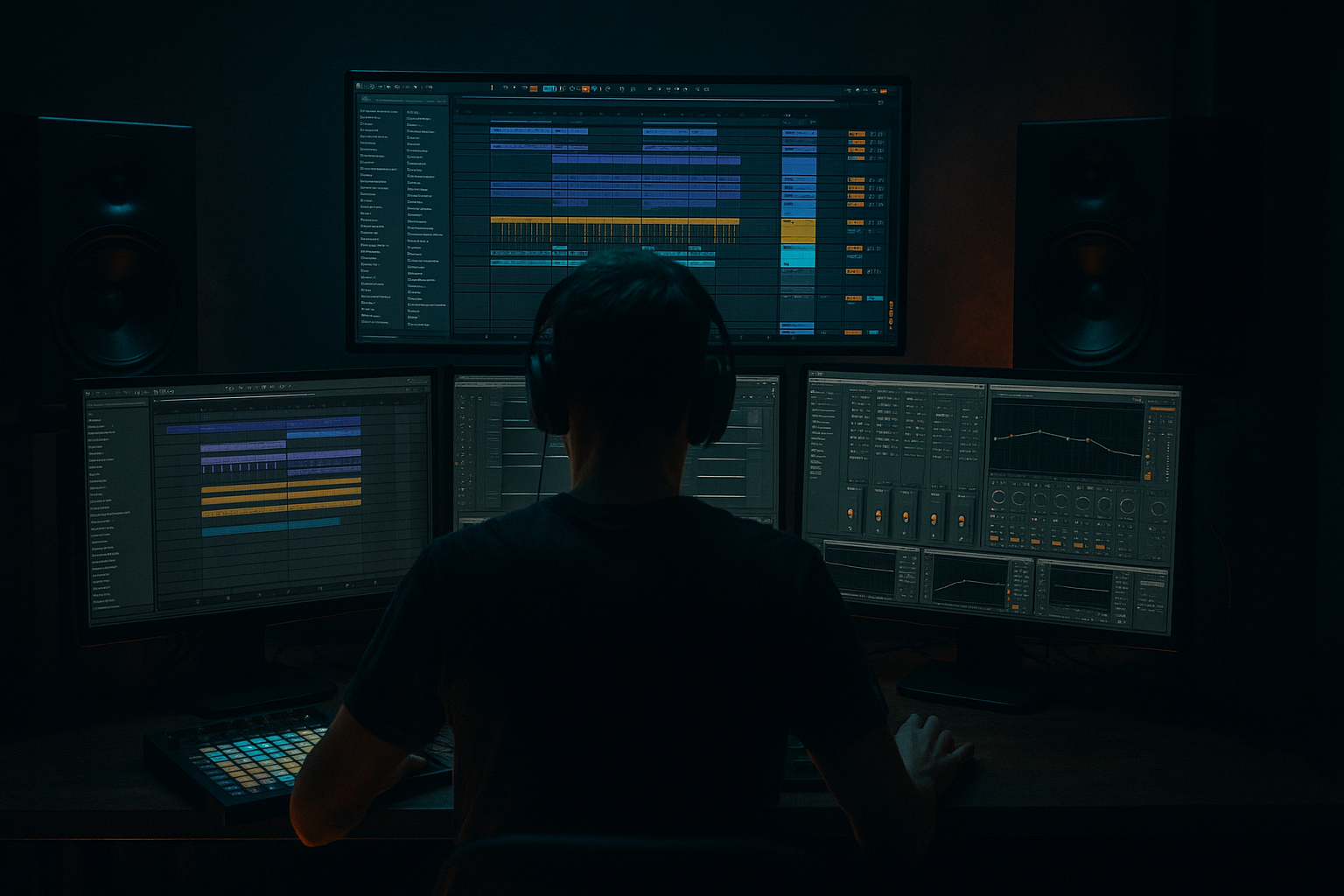
Main tutorial
Lesson Overview
This lesson is about turning a simple Amen-inspired jungle arp into a moving, groove-pool-driven edit inside Ableton Live 12. The goal is not just to “make it swing,” but to shape a pattern that feels like it was cut from old-school jungle tape edits while still hitting like a modern DnB loop. You’ll use groove pool timing, velocity, and note placement tricks to make an arp feel less quantized, more human, and more alive in the pocket.
In DnB, this matters because a strong arp can do a lot of work in a track: it can glue the drums to the bassline, create tension in an intro or breakdown, and add motion under an Amen chop without overcrowding the kick/snare relationship. In darker rollers or jungle hybrids, an arp often becomes the “middle frequency engine” that keeps momentum between the sub and the top-end percussion. The trick is making it dance around the break rather than sit on top of it.
We’ll build this as an edit-focused workflow: clip construction, groove extraction, micro-timing, resampling, and arrangement shaping. This is the kind of process that helps you move fast when you’re working on a full track and need that “finished” feeling before you overcook the idea.
What You Will Build
By the end, you’ll have a tight 1-bar or 2-bar Amen-style arp loop that:
- Feels like it’s cut from a jungle edit rather than drawn mechanically
- Uses Groove Pool swing and timing offsets to push notes around the pocket
- Sits in the midrange with controlled stereo motion, leaving room for sub and break
- Has enough variation to work in a drop, intro build, or switch-up
- Can be resampled into a new audio clip for further editing, chopping, and arrangement
- Over-quantizing the arp
- Letting the arp fight the snare
- Using too much low end
- Too much stereo width in the drop
- Overdoing Echo or Reverb
- Ignoring velocity
- Use a darker oscillator tone first, then brighten with automation
- Resample and distort in stages
- Add ghost notes strategically
- Keep bass and arp in complementary register zones
- Use call-and-response with the break
- Automate subtle pitch or wavetable movement
- Check it in mono
Musically, think of a sequence that rides over an Amen break in the style of early jungle phrasing, but with modern precision: a syncopated arp pattern that dodges the snare accents, answers the kick movement, and can be filtered or gated into a heavier drop. It’s not meant to sound like a generic trance arp — it should feel like a jungle-era melodic fragment re-edited into a DnB weapon.
Step-by-Step Walkthrough
1. Start with a short, functional MIDI phrase
Create a MIDI track and load Wavetable, Analog, or Operator. For a classic jungle-like arp, use a saw-based or slightly hollow tone:
- Wavetable: start with a basic saw or square-saw blend
- Analog: two oscillators, slightly detuned
- Operator: simple sine or saw-harmonic core for cleaner resampling later
Program a 1-bar phrase in a minor key, but keep the note set simple: 3–5 notes maximum. An advanced DnB arp works best when the movement comes from rhythm and voicing, not from overly dense harmony.
Good starting notes: root, minor third, fifth, and optionally the seventh or ninth. If your track is in A minor, try A–C–E–G.
Keep the MIDI clip short enough that repetition becomes part of the identity. In jungle and rollers, repetition is not a weakness — it’s what lets groove processing do the heavy lifting.
2. Set the arp rhythm to feel like an edit, not a plugin preset
Use Ableton’s Arpeggiator MIDI effect before the instrument. Set it as your rhythmic generator, then shape it like a chopped edit:
- Rate: try 1/16 or 1/32 depending on density
- Gate: around 45–70% for a tighter, more percussive feel
- Style: UpDown or Converge for a more fluid jungle contour
- Distance: keep it moderate if you want a more open, rolling phrase
If you want a more break-edit feel, manually place a few notes instead of relying on a perfectly steady arp. The best Amen-style lines often feel like they were edited by hand, with tiny gaps and overlaps.
Try accenting certain notes by changing note lengths rather than adding more notes. A longer note landing just before the snare can create a “pull” that feels very DnB.
Why this works in DnB: the genre thrives on forward motion plus syncopation. A strict, uniform arp can sound too clean, but a rhythm that “leans” around the break gives you the same feeling as sliced Amen hits or chopped bass stabs.
3. Extract a groove from the Amen break and apply it to the arp clip
Load or program an Amen break on an audio track. It can be a full loop or a chopped sequence, but you want something with a strong swing identity. In Live 12, use the clip’s timing feel as the reference:
- Right-click the Amen clip and extract groove from it
- Open the Groove Pool
- Apply that groove to your MIDI arp clip
Start with these groove parameters as a practical range:
- Timing: 20–55%
- Random: 0–10%
- Velocity: 10–35%
- Base: usually leave default unless the pocket feels too late or too early
Don’t max out Timing. You want the arp to borrow the swing, not become a copy of the break’s exact push-pull. If the break is heavy on the snare drag, a moderate timing setting can make the arp feel like it was cut from the same rhythm family.
Compare the arp against the Amen loop with drums soloed. The arp should nest around the kick/snare, not fight them. If it feels too lazy, reduce Timing or tighten the note lengths. If it feels too robotic, increase Timing slightly and add velocity variation.
4. Shape note placement against the snare, not just the grid
This is where the edit mindset matters. In DnB, the snare is often the anchor. Your arp should either answer the snare or leave space for it.
Try shifting one or two notes slightly:
- Move a note a few ticks earlier before the snare for tension
- Leave a gap right on the snare hit so the break punches through
- Push a note just after the snare to create a call-and-response feel
In a 2-step or jungle context, the best arps often avoid landing on every main drum accent. That little gap is what makes the groove breathe.
Use MIDI note velocities to reinforce phrasing:
- Strong notes: 95–110
- Supporting notes: 70–90
- Passing notes: 55–70
If you’re working in a dark roller, keep the arp more restrained and let velocity differences create the motion rather than a flashy melodic line.
5. Use stock sound design to make the arp feel like a jungle edit
Add Auto Filter, Saturator, and optionally Echo after the instrument.
A strong starting chain:
- Auto Filter: low-pass with cutoff around 400 Hz–4 kHz depending on brightness
- Saturator: Drive 2–6 dB, Soft Clip on if needed
- Echo: very light, short feedback, filtered repeats
For the arp to feel like an edit rather than a clean synth line, add a bit of harmonic dirt and movement:
- Auto Filter envelope or manual automation to open the arp into transitions
- Saturator for edge and midrange density
- Utility for mono control if the patch gets too wide
If the arp is too polite, resample it through Resonators, Pedal, or Roar if you’re using Live 12’s newer distortion/color options in your setup. But keep the tone controlled — this is about edit texture, not turning it into a lead synth.
For a classic dark jungle angle, consider a band-pass vibe with a narrow resonant peak. That helps the arp read like a sliced sample fragment rather than a polished pad.
6. Resample the groove-shifted arp and edit it like audio
Once the MIDI groove feels right, record it to a new audio track. This is the real “edits” step. Resampling lets you:
- Slice the arp into micro-chops
- Reverse specific notes
- Shift transients manually
- Create fills without rewriting MIDI
After recording, turn on warp and use:
- Complex Pro for smoother melodic material
- Beats if you want more chopped, rhythmic edges
Slice the audio clip at transient points and rearrange 2–4 hits. A tiny reverse note before a snare or a doubled hit after a kick can make the arp feel much more like an Amen edit.
This is especially powerful if your arp has reverb or delay tails. You can cut the tails strategically so the pattern feels like it’s breathing with the break.
7. Automate movement across the arrangement
Now place the arp in context. In a DnB arrangement, this kind of part often lives in:
- 8-bar intro with filtered tension
- First 16 bars of a drop as a supporting hook
- Breakdown lift before a re-entry
- Switch-up section with more aggressive groove
Automate these parameters over 8 or 16 bars:
- Auto Filter cutoff: open from 200 Hz to 8 kHz
- Saturator Drive: increase by 1–3 dB into drop sections
- Echo feedback: automate up briefly before the switch
- Stereo width via Utility: wider in breakdowns, tighter in drops
A strong arrangement move: start the arp as a muffled, midrange loop under the intro drums, then automate it brighter and slightly louder just before the drop. Once the full break and bass arrive, cut the arp back or thin it out so it doesn’t step on the sub.
If the track is darker/neuro-leaning, use the arp as a tension device, not a constant feature. Let it appear in phrases, then disappear. That contrast is what keeps the drop heavy.
8. Glue it to the drums and bass with bus discipline
Route the arp to its own group or return path so you can manage it against the rest of the track. Keep your low end clean:
- High-pass the arp if needed, often around 120–250 Hz
- Use Utility to keep the low end mono-safe
- Check phase and stereo width in mono regularly
If the arp clashes with the bass, carve space with EQ Eight:
- Small dip around 200–400 Hz if it clouds the snare/bass area
- Gentle notch around the harshest resonance if it gets brittle
- High-pass enough that the sub stays dominant
For a jungle track, the arp often lives as a “high-mid glue” element. It should support the break and bass, not replace them. If the drums are doing the conversation, the arp should be the texture that connects the sentences.
Common Mistakes
- Fix: apply less groove timing, or manually offset just a few notes. Too-perfect timing kills the jungle feel.
- Fix: create space on snare hits or push the arp to answer after the snare instead of landing on top of it.
- Fix: high-pass the arp and keep the sub lane clean. The arp should live in the midrange.
- Fix: narrow the arp with Utility or use wider settings only in breakdowns. Wide mids can blur the kick/snare impact.
- Fix: keep delays short and filtered. In DnB, ambience should add tension, not wash out the break.
- Fix: vary velocities so the groove feels edited and human. Velocity is one of the fastest ways to fake a “chopped” feel.
Pro Tips for Darker / Heavier DnB
- Start with a muted saw or square-saw tone, then open the filter into the drop. That gives you tension and release without changing the core pattern.
- Render the arp, then run it through Saturator, EQ Eight, and maybe a subtle second stage of color. Layered processing often sounds more authentic than one heavy effect.
- Tiny extra notes before or after main arp hits can create the illusion of a chopped sample loop. Keep them quiet: around 20–50 velocity.
- If the bass is aggressive in the 100–400 Hz area, let the arp sit above that. If the arp needs body, carve a pocket in the bass midrange instead of boosting the arp too much.
- Let the arp phrase answer the Amen’s snare or hat pattern. This makes the edit feel intentional and very “cut to the rhythm.”
- A small movement on a synth parameter can keep a repeated arp from sounding static, especially in long intros or rolling sections.
- Darker DnB often hits hardest when the arrangement is disciplined. If the arp collapses too much, reduce width and simplify the patch.
Mini Practice Exercise
Spend 10–20 minutes building a single 8-bar jungle arp phrase:
1. Make a 1-bar MIDI clip using only 4 notes in a minor key.
2. Put Arpeggiator before your synth and set it to 1/16.
3. Extract groove from an Amen break and apply it to the arp clip.
4. Adjust groove timing until the arp feels like it sits with the break, not on top of it.
5. Add Auto Filter and automate the cutoff across 8 bars.
6. Resample the arp to audio and make 2 manual edits: one reverse hit and one tiny gap.
7. Check the result with drums and sub in mono.
Goal: make one loop that feels like it could sit in an intro, a build, or a switch-up without sounding generic.
Recap
The key to an Amen-style jungle arp in Ableton Live 12 is to treat groove as an editing tool, not just a swing preset. Build a simple melodic phrase, extract and apply groove from the break, then refine the pocket with note placement, velocity, and audio edits. Keep the arp in its lane: midrange, controlled stereo, and rhythmically supportive of the snare-led drum pattern. When you resample and edit it like jungle source material, the arp stops sounding programmed and starts sounding like part of the record.

