Main tutorial
Lesson Overview
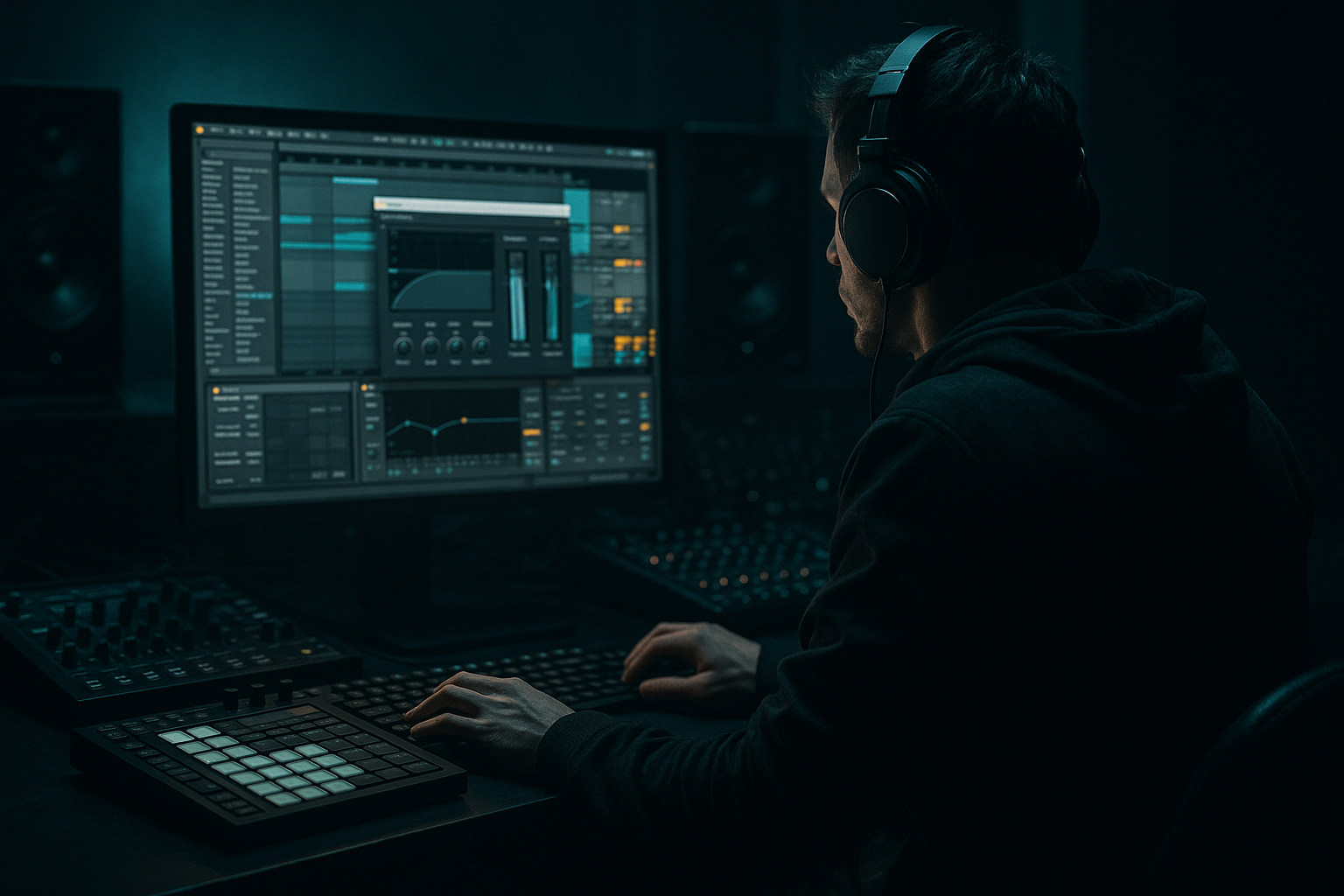
In this lesson, you’ll learn how to shape a jungle bassline for a deep jungle atmosphere in Ableton Live 12 using a sampling-first workflow. The goal is not just to make a bass sound “heavy” — it’s to make it feel like it belongs under chopped breaks, smoky pads, and that classic dark, damp, late-night DnB mood.
In jungle and deeper DnB, the bassline usually does a few jobs at once:
- Holds the low-end foundation under the drums
- Adds movement and tension between kick/snare hits
- Creates a hypnotic groove that loops cleanly
- Leaves enough space for break edits, FX, and atmosphere
- A solid sub layer in mono
- A mid-bass layer with a reese-style edge
- A sampled, chopped rhythm that feels musical instead of random
- Short note phrases that leave room for the breakbeat
- Saturation and filtering for darker texture
- Automation for movement and tension
- A simple arrangement-ready loop that can sit under a jungle drum pattern
- 1 MIDI track for your bass source
- 1 audio track for resampling
- 1 drum track or drum rack for your breakbeat
- 1 return or audio track for a simple reverb or delay if needed later
- A clean 808-style sub hit
- A reese-ish bass stab
- A filtered bass note from one of your own previous sessions
- A single bass tone from any old drum and bass project you made
- Sample Length: 100–300 ms for a punchy bass hit
- Start position: move until the attack feels tight
- Glide/Portamento: off for now
- Low-pass around 120–200 Hz if the sample has too much upper junk
- Keep the sub area intact
- Set Width to 0% to keep the low end mono
- Use Bass Mono if needed, or simply keep the whole bass track centered for now
- Oscillator: sine
- No unneeded modulation
- Short amp envelope with fast attack and short release
- Root note on beat 1
- A shorter response note on the offbeat
- A lower or higher variation on beat 3 or the “and” of 3
- Leave rests
- Low note
- Short answer
- Gap
- Repeat with variation
- Bars 1–4: basic bass phrase under a chopped Amen-style break
- Bars 5–8: add one extra note or change the last note to push into the next phrase
- Bars 9–16: mute the bass on one bar for tension, then bring it back hard
- 1/8 note to 1/4 note for most hits
- Slightly longer notes only when you want the bass to “speak”
- Filter type: low-pass
- Frequency start point: around 120–250 Hz for a darker intro feel, or 300–800 Hz if you want more bite
- Resonance: 10–25% for a subtle edge, not a whistling peak
- Drive: small amounts if needed
- Open slightly into the drop
- Close down during breakdown or tension sections
- Add a tiny resonance bump before the phrase changes
- Drive: 2 to 6 dB
- Soft Clip: on
- Output: reduce to match level
- Redux very lightly for bit reduction texture
- Overdrive at a subtle setting
- Drum Buss with Drive low and Boom used carefully
- It captures the combined sound of note shape, filter movement, saturation, and groove
- It gives you audio you can chop, reverse, and re-time
- It makes the bass feel more “produced” and less static
- Chopping the bass audio into smaller hits
- Reversing one hit before a phrase change
- Nudging a hit slightly ahead of the beat for urgency
- Leaving a gap before a snare for bounce
- Kick and snare should be clear
- Add ghost notes or hat ticks if you want a rolling feel
- Keep the break dynamic, not flattened
- Reduce bass note length before the snare
- Add a short bass hit after the snare for response
- Remove low notes that collide with the kick
- Drum Buss Drive low or moderate
- Avoid over-compressing the break so it loses swing
- Keep Utility on the main bass track set to mono
- If you add stereo movement, keep it above the sub range
- Use EQ Eight to cut unnecessary low-mid mud if the bass gets cloudy
- Sub layer stays mono and clean
- Mid-bass layer can be slightly wider or more animated
- Top texture can live in the stereo field
- Bars 1–8: filtered intro with bass teased quietly
- Bars 9–16: full bassline with drums
- Bars 17–24: remove one bass note every other bar
- Bars 25–32: add a higher response note or short reverse sample
- Breakdown: filter closes down and sub drops out briefly, then returns
- Auto Filter cutoff
- Saturator Drive
- Simpler filter
- Reverb send on one bass stab only
- Volume automation for phrase breaks
- Making the bassline too long and continuous
- Over-widening the low end
- Too much distortion on the whole bass
- Bass and kick hitting the same space constantly
- Ignoring the snare
- Using a bass sample without cleaning it
- No variation across 8 bars
- Layer a quiet mid-bass under your sub so the line reads on smaller speakers without sacrificing low-end weight.
- Use tiny pitch movement on sampled bass hits by automating the transpose or detune very subtly for extra unease.
- Try a short reverse bass stab leading into a snare to create that old-school jungle tension.
- Put Drum Buss on the break, not the sub, if you want more grit without muddying the bottom end.
- Use Echo or Delay very sparingly on a filtered bass stab for atmosphere, but keep the feedback low so the groove stays clean.
- If the bassline feels too polite, resample it with saturation already printed, then chop the audio like a drummer would.
- For a darker edge, drop a note to the fifth or octave below the root at the end of every 4 bars. It adds weight without making the line busy.
- Reference tracks that have deep, moody jungle energy and compare only the bass balance and phrase length, not just the sound design.
- Start with a sampled bass source and keep it tight.
- Build the bass around sub weight first, then add midrange character.
- Use short phrases, rests, and call-and-response for jungle movement.
- Keep the low end mono and control distortion carefully.
- Resample your bass to make it more playable and more like classic DnB workflow.
- Let the bass and breakbeat work together, especially around the snare.
- Use automation and arrangement changes to create tension and release.
A lot of beginners try to build basslines like a continuous synth note. That can work, but jungle often feels better when the bass is shaped like a performance: short phrases, space, call-and-response, and variation. Sampling is perfect for this because you can start from a single bass hit, resample it, and turn it into a more playable, characterful phrase.
Why this matters in DnB: the bass and drums are the engine. If the bassline is too static, too wide, or too muddy, the whole track loses its drive. If it’s shaped well, it locks with the break, feels deep, and instantly gives your loop that “proper jungle” pressure. 🔥
What You Will Build
By the end of this lesson, you’ll have a deep jungle bassline in Ableton Live 12 that includes:
The result will sound like something you could place under a 160–170 BPM breakbeat with pads, FX, and a rolling drum arrangement. It won’t be overcomplicated — just focused, dark, and usable.
Step-by-Step Walkthrough
1. Set up a clean jungle bass workspace
Start with a new Ableton Live Set and set the tempo to 165 BPM. That sits comfortably in classic jungle territory and also works for modern rolling DnB.
Create these tracks:
For the bass source, load Wavetable, Operator, or simpler still, a sampled bass hit from Simpler. Since this lesson is about sampling, use Simpler first.
Drag a short bass sample into Simpler. Good source material could be:
Set Simpler to Classic mode and shorten the Start and Length so it behaves like a tight one-shot. If the sample has a rough transient, adjust the start point until the note hits cleanly.
Suggested starting values:
This gives you a controlled source to shape into a proper jungle phrase.
2. Build a sub-first foundation
Before adding movement or distortion, make sure the low end is solid. In jungle, the sub has to carry weight without fighting the kick and snare.
On the bass track, add Ableton’s EQ Eight after Simpler. Use it to clean unnecessary high end if your sample is noisy:
Then add Utility after EQ Eight:
If your bass sample is not sub-heavy enough, layer a second instance of Simpler or Operator beneath it with a clean sine wave. Keep that layer simple:
Why this works in DnB: the sub is the anchor. Jungle drums often have busy midrange breaks, so a clean mono sub helps the bass stay powerful without becoming blurry. The listener feels the low end more than they hear it.
3. Shape the bass into a playable phrase
Now turn the bass into a proper jungle phrase instead of a sustained note.
Create a 1-bar or 2-bar MIDI clip at 165 BPM. Keep the notes simple at first. Use a small note pattern with space, such as:
A good beginner jungle phrase often feels like a call-and-response:
Example arrangement context:
Keep note lengths short at first, around:
Avoid making every note the same length. In jungle, the groove often comes from contrast between short stabs and slightly longer notes.
4. Add movement with filter automation
Now shape the character using Auto Filter. Place it after Simpler or after your sub layer, depending on your routing.
For a deep jungle atmosphere, use Auto Filter like this:
Automate the filter over 4 or 8 bars:
This makes the bass feel alive without needing complex notes.
You can also automate Simpler’s filter if you want the sampled source itself to evolve. This is useful if your bass sample has a rough top that you want to gradually reveal during a build.
5. Add saturation and grit in a controlled way
Jungle bass often needs some dirt to sit against the break. The trick is to add harmonics without destroying the sub.
Use Saturator on the bass track:
If the bass becomes too sharp, place a second EQ Eight after Saturator and tame harsh highs around 2–6 kHz if needed.
If you want a rougher edge, try:
Beginner rule: if you hear the effect more than the bass, back it off a little.
This stage is where the sampled bass starts to feel like a proper underground DnB instrument instead of a clean synth line.
6. Resample the bass for more jungle character
This is one of the most useful sampling workflows in Ableton Live.
Create an audio track and set its input to resample or route the bass track into it. Record a few bars of your bassline while the drums play.
Why resample?
After recording, drag the audio into Simpler on a new track or into a new audio clip for editing.
From here, try:
This is very close to how a lot of jungle energy is built: not from perfect synth lines, but from edited audio phrases that interact with the break.
7. Lock the bass to the drums
Now bring in your breakbeat and make the bass line work with it.
Use a classic chopped break or a simple drum loop:
Listen for where the snare lands and make sure the bass phrase isn’t competing with it too much. Often the best jungle bass phrasing leaves room on or around the snare hit so the drum can punch through.
Practical move:
If you are using drum bus processing, keep it gentle:
This is where the groove starts to feel authentic. Jungle works because the bass and break are in conversation, not fighting each other.
8. Create stereo discipline and low-end focus
Bass in DnB should be wide only in the upper harmonics, not in the sub.
On your bass group:
A simple approach:
If you want movement, try Chorus-Ensemble very lightly on a duplicated upper layer only, not on the sub. Or use Auto Pan with subtle depth on the higher harmonics, keeping the bass center intact.
Beginner-friendly rule: if your bass sounds wide on headphones but weak on speakers, the low end is probably too stereo.
9. Automate tension and arrangement changes
A deep jungle atmosphere needs movement across the arrangement, not just inside the loop.
Here are simple arrangement ideas:
Useful automation targets:
A classic jungle move is to create a short “drop before the drop”: mute the bass for half a bar or one beat, then bring it back with a strong snare and break fill. That tiny gap creates serious tension.
Common Mistakes
Fix: shorten notes and create gaps. Jungle bass often breathes.
Fix: keep the sub mono. Add width only to upper harmonics.
Fix: distort lightly, then use EQ to control harshness. Keep the sub clean.
Fix: move one note, shorten a note, or remove a low note before the kick.
Fix: let the snare breathe. Jungle hinges on strong backbeat space.
Fix: trim the start, low-pass the noisy top, and resample if necessary.
Fix: change one note, one filter move, or one rest every few bars.
Pro Tips for Darker / Heavier DnB
Mini Practice Exercise
Set a timer for 15 minutes and do this:
1. Load a bass sample into Simpler.
2. Write a 2-bar MIDI phrase with 3 to 5 notes only.
3. Add EQ Eight, Utility, Auto Filter, and Saturator.
4. Resample 4 bars of the bass with a chopped breakbeat.
5. Reimport the audio and cut one bass hit into a new place.
6. Automate the filter cutoff across the 2-bar loop.
7. Check the whole loop in mono for low-end stability.
Goal: finish with one loop that feels like a real jungle section, not a demo sound.
Recap
If you can make a 2-bar bass loop feel deep, moody, and locked to the break, you’re already building the kind of jungle atmosphere that holds a track together.

