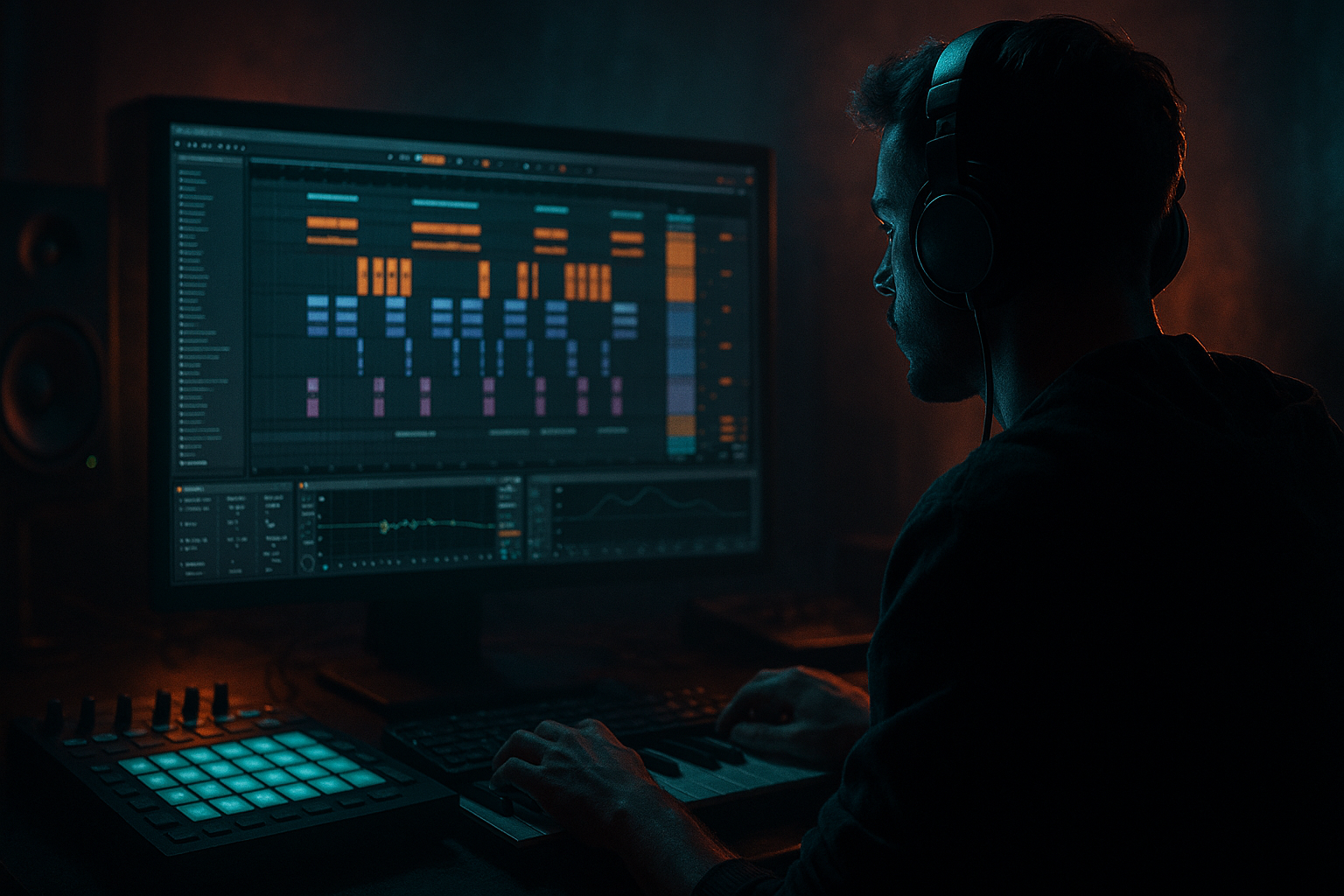
Main tutorial
```markdown
Short Roller Arrangements Masterclass @ 170 BPM (Ableton Live) 🥁⚡️
Level: Intermediate • Category: Arrangement • Genre: Drum & Bass / Jungle / Rollers
---
1) Lesson overview
A “short roller” is a compact DnB idea (typically 16–32 bars) that feels like a full track moment: tight drums, rolling bass, forward momentum, and quick, purposeful transitions. The goal is maximum impact with minimal length—perfect for DJ tools, doubles, edits, TikTok/short content, or building blocks for a full tune.
In this lesson, you’ll learn a repeatable arrangement blueprint for 170 BPM rollers in Ableton Live, focusing on:
- Bar-level tension/release
- Micro-variations (the secret sauce)
- Transitional ear candy (fills, impacts, risers)
- Energy shaping with automation + stock devices
- 8-bar intro switch (DJ-friendly)
- 16-bar main roller drop
- 8-bar exit / turnaround (loops cleanly or sets up a larger arrangement)
- Drum rack: kick, snare, hats, rides, ghost notes, fills
- Rolling bass (reese or wobble) with movement
- Minimal hook (stab/vocal chop/texture)
- 3–5 transition tools: impacts, sweeps, noise, reverse, fill
- Kick: Bar grid in 1/16
- Snare: solid backbeat
- Closed hats: 1/16s or 1/8s depending on vibe
- Ghost snare: subtle hits around `1.2.3` / `1.4.3` (low velocity)
- Amount: `10–25%`
- Apply to hats + ghosts, keep kick/snare mostly straight for power.
- Reese: wide mids + controlled sub
- Wobble/stepper: automated filter/LFO movement
- Jungle subs: clean sine with mid layer
- Instrument: Operator
- EQ Eight: low-pass around `80–120 Hz` (keep it pure)
- Compressor (Sidechain from kick)
- Instrument: Wavetable (or Operator/Simpler)
- Auto Filter
- Saturator
- EQ Eight
- Optional: Chorus-Ensemble (light) or Phaser-Flanger for motion
- A phrase (bars 9–17): establishes groove
- A’ phrase (bars 17–25): same groove, 2–3 changes
- Change the last 1 bar of each 4-bar block (a “turnaround” bar)
- Add a call/response: stab on bar 2, answer on bar 4
- Automate mid-bass filter slightly higher every 8 bars
- Bars 9–13: cutoff ~`200–600 Hz` movement
- Bars 13–17: slightly brighter peaks (~`800–1.2kHz`)
- Bars 17–25: introduce 1–2 “open” moments hitting `1.5–2.5kHz` (briefly)
- Start with hats + texture (noise bed or vinyl crackle)
- Bring in kick/snare by bar 3 or 5
- Tease bass (high-passed) in bars 7–8
- On bass group, automate EQ Eight HPF from `200 Hz → 40 Hz` over bars 7–8.
- Add a reverb throw on a vocal stab at bar 8:
- Full drums + bass
- Add a minimal hook (one stab, one vocal chop, or one texture)
- Make micro-variations every 2 bars so it never loops lazily
- Remove hats for half a bar then slam back
- Add a tiny snare flam (two hits 20–40 ms apart)
- Add a kick ghost very low velocity
- Add a reverse cymbal into snare on bar endings
- Change bass note length on the last 1/4 of bar 4, 8, 12, 16
- DJ tool exit: strip to drums + atmosphere for clean loop-out
- Tease next section: keep bass but filter it down
- Bars 25–29: keep groove, reduce hook elements
- Bars 29–33: automate a low-pass on master music group (not master master) to darken + add an impact at bar 33
- Auto Filter (HP → BP sweep up)
- Redux (very light for grit)
- Hybrid Reverb (small, 10–20% wet)
- Automate volume to peak at drop
- Remove kick
- Add extra snare hits (1/16 ramp)
- Add Reverb (or Hybrid Reverb) just on the fill, then hard cut at drop
- Hat bus EQ Eight: tiny shelf boost `+1–2 dB` at `8–12 kHz` in the second 8 bars
- Drum Buss Drive: up by `1–3%` in bars 17–25
- Bass mid Auto Filter: slightly wider/brighter in bars 17–25
- Reverb send throws: only on specific snare hits (bar 8, 24, 32)
- Put Utility on your hook track; automate Gain to `-inf` for quick dropouts.
- Parallel distortion on drum room:
- Dark atmosphere bed:
- Reese control:
- Aggressive fills:
- Tension with silence:
- Short rollers succeed through phrasing + micro-variation, not constant new parts.
- Use a 32-bar blueprint: Intro (8) → Main (16) → Exit (8).
- Keep hooks minimal, focus on drum authority and bass movement.
- Stock Ableton tools like Drum Buss, Glue Compressor, EQ Eight, Auto Filter, Utility, Hybrid Reverb can get you to a pro result fast.
- Dark/heavy energy comes from controlled distortion, atmospheres, and intentional gaps, not just louder sounds.
---
2) What you will build
A 32-bar short roller at 170 BPM with:
Core elements:
---
3) Step-by-step walkthrough
Step 0 — Session setup (2 minutes)
1. Set tempo: `170 BPM`
2. Time signature: `4/4`
3. In Arrangement View, create markers:
- `1–9` Intro (8 bars)
- `9–25` Main (16 bars)
- `25–33` Exit (8 bars)
Workflow tip: Color-code groups: DRUMS, BASS, MUSIC, FX, MASTER.
---
Step 1 — Build a roller drum foundation (bars 9–25)
You need a drum loop that can stay exciting for 16 bars without “changing the beat” too much.
#### A) Core pattern (classic 2-step roller)
- Put kick on `1.1.1` and a second kick around `1.3.1` (or slightly before with groove).
- `1.2.1` and `1.4.1` (every bar)
#### B) Ableton devices (tight + punchy)
On your Drum Group:
1. Drum Buss
- Drive: `5–15%` (taste)
- Boom: `20–40 Hz` (if kick is light) OR keep off if sub is big
- Transients: `+5 to +20`
2. EQ Eight
- High-pass (gentle) around `20–30 Hz` (clean rumble)
- Dip mud: `200–400 Hz` if boxy
3. Glue Compressor
- Attack: `3–10 ms`
- Release: `Auto`
- Ratio: `2:1`
- Gain reduction: ~`1–2 dB`
DnB rule: If your snare doesn’t feel “locked,” fix it before adding more layers.
---
Step 2 — Add the “rolling” movement with ghost notes + percussion
This is where the loop becomes a roller instead of a basic 2-step.
1. Ghost snare lane (same snare sample or a tighter layer)
- Velocity: `15–45` (keep it quiet)
- Slightly early placement on a few hits (2–8 ms) for pull
2. Ride or shaker layer
- Put a ride on offbeats or a shuffled 1/16 pattern
3. Perc hits (1–2 sounds max)
- Rim / wood / foley tick: place sparingly, e.g. every 2 bars
Ableton trick: Add Groove Pool groove (e.g. MPC swing) lightly:
---
Step 3 — Bass that drives the arrangement (the “engine”) 🔊
For a short roller, bass must provide movement and phrasing.
#### A) Bass sound approach (simple but effective)
Use one of these:
#### B) Stock Ableton chain (solid starting point)
On a Bass Group with two tracks:
Track 1: SUB
- Osc A: Sine
- Envelope: fast attack, medium release (avoid clicks)
- Ratio `4:1`, Attack `1–5 ms`, Release `60–120 ms`
- Aim for `2–4 dB` duck
Track 2: MID BASS
- Start with a saw-ish wavetable
- 12dB or 24dB
- Automate cutoff rhythmically (more below)
- Drive `3–8 dB`, Soft Clip ON
- High-pass around `120 Hz` (leave room for sub)
#### C) Arrangement-minded bass phrasing (16 bars)
Program a bassline that has:
Practical changes that work:
Automation suggestion (MID BASS Auto Filter):
---
Step 4 — Build the short roller arrangement (32 bars) 🎛️
Here’s a clean blueprint that feels “DJ-ready”:
#### Bars 1–9 (8 bars) — Intro switch
Goal: mixable and sets the tone.
Practical Ableton moves:
- Hybrid Reverb (short plate)
- Automate send up just for that hit.
#### Bars 9–25 (16 bars) — Main roller drop
This is your “statement.”
Micro-variation checklist (pick 1–2 every 2 bars):
#### Bars 25–33 (8 bars) — Exit / turnaround
Options:
Practical:
---
Step 5 — Transitions that feel “pro” (without overdoing it) 💥
Use 3–5 FX elements total, placed intentionally.
A) Classic DnB transition toolkit
1. Impact (bar 9 and/or 25)
2. Noise riser (last 1 bar before drop)
3. Reverse cymbal into snare
4. Tape stop or pitch drop (sparingly)
5. Drum fill (last 1/2 bar of every 8)
B) Ableton stock chain for a riser
On an audio track with white noise:
C) Quick fill method (fast + clean)
Duplicate your drum loop for the last 1/2 bar of bar 16 and:
---
Step 6 — Energy shaping with automation (the “arrangement glue”)
Short rollers succeed when they breathe.
Automate these (subtle moves):
Pro workflow: Use Utility for quick “mute automation”:
---
4) Common mistakes
1. No phrasing: A 16-bar loop repeated with zero changes feels amateur. Add planned micro-variations.
2. Overcrowded mids: Reese + wide pads + vocals = muddy. Keep the hook minimal.
3. Sub clashes with kick: If the low end feels unstable, check:
- Sidechain timing (release too long = pumping)
- Kick fundamental vs sub note collisions
4. Too many FX: One good riser + one impact beats 10 random whooshes.
5. Snare not consistent: If your snare changes tone because of processing or layering, the groove loses authority.
---
5) Pro tips for darker/heavier DnB 🕶️
Create a return track with Saturator → EQ Eight (band-limit) → Compressor. Blend in quietly for grit.
Use Granulator III (if available) or Simpler with a field recording, then:
- Auto Filter low-pass
- Hybrid Reverb long/dirty tail
Keep it quiet but constant.
Put Utility on MID BASS and automate Width:
- Verses/intro: `0–30%`
- Drop moments: `60–100%`
(Sub stays mono.)
For the last 1/2 bar before a switch, use Beat Repeat on drums:
- Interval: `1 Bar`
- Grid: `1/16`
- Chance: `10–25%` (or automate On)
Remove the kick for 1/4 bar before a drop hit. That tiny “gap” can feel massive at 170.
---
6) Mini practice exercise (20–30 minutes)
Goal: Make a 16-bar roller that feels “released” and DJ-ready.
1. Create a 16-bar loop (bars 1–17) with drums + bass.
2. Add micro-variation rules:
- Every 2 bars: change one drum element (mute hat for 1/2 bar, add ghost, etc.)
- Every 4 bars: add a bass turnaround note or rhythmic change
3. Add exactly 3 FX:
- 1 riser (bar 16)
- 1 impact (bar 1 or bar 9)
- 1 reverse cymbal (into snare on bar 8 or 16)
4. Bounce a quick export and listen on loop:
- If it gets boring by the 6th repeat, add two more small variations, not a new section.
---
7) Recap ✅
If you want, tell me your sub style (clean sine vs heavy sub) and whether you’re going jungle-leaning or modern neuro-ish, and I’ll give you a tailored 32-bar arrangement template with exact bar-by-bar variation ideas.
```

