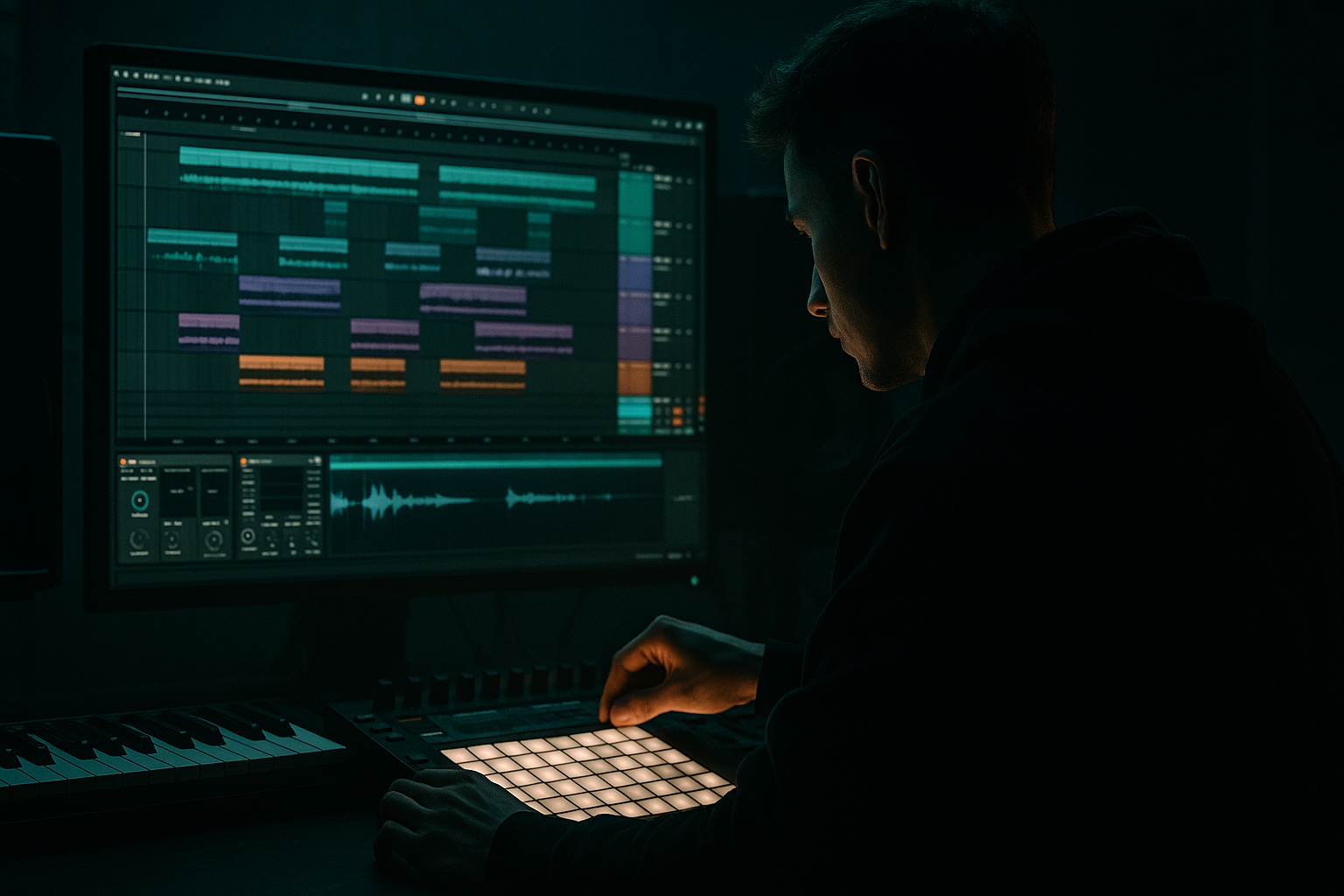
Main tutorial
Short Roller Arrangements Masterclass (DnB) in Ableton Live 12 🥁⚡
Intermediate • Arrangement-focused • Stock-device friendly
---
1. Lesson overview
A short roller is a compact, high-energy DnB arrangement (often 32–96 bars) that’s designed to move fast: quick intro, tight drop, minimal breakdown, and constant micro-variation so it never feels looped.
In this lesson you’ll learn a repeatable arrangement template for rollers in Ableton Live 12, plus the exact automation moves, fill placement, and device chains that make a “16-bar loop” feel like a track.
---
2. What you will build
You’ll build a 64-bar short roller at 174 BPM with:
- A DJ-friendly mini intro (8–16 bars)
- A 32-bar drop that evolves every 4–8 bars
- A micro-break (2–4 bars) to reset energy
- A tight outro (8–16 bars) for mixing
- Rolling drum groove (kick/snare + hats + ghost notes)
- Reese/rolling bass + sub layer
- One main hook (stabs/vox/lead) used sparingly
- Ear candy + transitions (noise, impacts, reverses)
- Arrangement automation (filters, reverb throws, delays)
- Add a Drum Rack in a MIDI track called `DRUMS - Core`.
- Load:
- Pattern:
- Drum Buss
- Glue Compressor
- EQ Eight
- Closed hat 1/16s (but with velocity groove)
- Open hat on the offbeat (every 2 beats or once a bar)
- Ghost snare hits (very low velocity) before/after main snare
- Add a groove like MPC 16 Swing (or any tight shuffle)
- Apply at 10–20% with Timing ~50–80%
- Instrument: Operator
- Add Saturator (Soft Clip ON)
- Bass Mono: ON
- Width: 0%
- Gain: adjust so sub is consistent
- Instrument: Wavetable
- Add Auto Filter (for motion)
- Add Roar (Live 12)
- Add EQ Eight
- Optional: Chorus-Ensemble or Phaser-Flanger lightly for width (keep lows filtered!)
- Sub stays steady (energy anchor)
- Mid bass gets automated (story + evolution)
- Start with:
- Use Auto Filter on the DRUMS group:
- Introduce kick + snare but keep bass teased:
- Return A: Hybrid Reverb (short room)
- Return B: Delay (Ping Pong, 1/8 or 1/4)
- Full drums in
- Sub in
- Mid bass opens up
- Remove most intro reverb (tighter = heavier)
- Bars 9–16: Main groove established
- Bars 17–24: Add a new layer
- Bars 25–32: Add a call/response
- Bars 33–40: Strip + rebuild
- Duplicate your 2-bar drum clip
- On the last 1/2 bar, add:
- Add Beat Repeat on a return or directly:
- Keep a faint top loop running (quiet)
- Kill sub for 1–2 bars
- Add a vocal chop or stab with Hybrid Reverb long tail
- Use Auto Filter sweep up on the master of MUSIC/BASS
- Change snare layer (swap one sample or add a clap quietly)
- Add a new mid bass rhythm on bars 53–60 only
- Add a jungle break layer low in the mix (HP it at ~200 Hz)
- Add a new “hook moment” every 8 bars (stab, vocal, synth shot)
- Use multiple clips per track:
- Arrange like LEGO:
- Remove the hook
- Remove mid bass first, keep sub for a bit
- Then drop to drums only
- End with tops + atmospheric tail
- On snare hit at end of 8/16-bar phrase:
- On `BASS - Mid`:
- On DRUMS group:
- Add a `FX - Noise` track:
- Add reverse cymbal into bar 9 and 45
- Make the drop drier than the intro
- Use parallel distortion on mid bass
- Add a quiet break layer for menace
- Create “fear moments” with half-bar edits
- Control harshness with multiband discipline
- A short roller is about momentum + micro-variation, not big composition changes.
- Use a 64-bar template: Intro → Drop A → Micro-break → Drop A2 → Outro.
- Evolve the groove with an 8-bar variation grid: change one main element + two micro elements.
- Use Ableton stock tools like Drum Buss, Glue, Auto Filter, Hybrid Reverb, Delay, Roar, Utility to create contrast and impact.
- Automate throws, filters, distortion mix, and drum intensity to keep it rolling.
Core elements:
---
3. Step-by-step walkthrough
Step 0 — Project setup (2 minutes)
1. Set Tempo: 174 BPM.
2. In the Arrangement View, set markers:
- `1.1.1 Intro`
- `9.1.1 Drop A`
- `41.1.1 Micro-break`
- `45.1.1 Drop A2 / Variation`
- `61.1.1 Outro`
3. Create groups (Cmd/Ctrl+G) to stay organized:
- DRUMS
- BASS
- MUSIC
- FX/TRANSITIONS
- VOCALS (optional)
Workflow tip: Color-code groups and freeze/flatten resampling lanes later for speed.
---
Step 1 — Build a “roller drum engine” that can evolve
You want drums that feel consistent but never static.
#### 1A) Core kick + snare (minimal, punchy)
- Kick on C1
- Snare on D1 (DnB snare or layered clap+snare)
- Snare on 2 and 4 (standard DnB)
- Kick pattern: keep it simple to leave room for bass (e.g., 1, “and” of 2, 3)
Stock devices (recommended chain on the DRUMS group):
- Drive: ~10–20
- Boom: 0–20 (only if it doesn’t fight sub)
- Transients: +5 to +15 (snap)
- Attack: 3–10 ms
- Release: Auto or ~0.1–0.3s
- GR: 1–3 dB max
- High-pass at 20–30 Hz (clean rumble)
- Small dip around 200–400 Hz if boxy
#### 1B) Ghost notes + hats (movement = arrangement fuel)
Create a second MIDI track: `DRUMS - Tops/Ghosts` with Drum Rack or Simpler.
Add:
Make it roll using Groove Pool:
Arrangement trick: Your hats/ghosts are your variation layer. You’ll mute/unmute, filter, and swap samples every 8 bars.
---
Step 2 — Bass: split sub + mid so arrangement changes stay clean
Rollers live and die by bass control. Make two tracks:
#### 2A) SUB track (mono, stable)
Track: `BASS - Sub`
- Osc A: Sine
- Envelope: short-ish release (100–250 ms) for tightness
- Drive: 2–6 dB (just enough to translate)
Utility
#### 2B) MID/REESE track (movement + aggression)
Track: `BASS - Mid`
Easy stock approach:
- Choose a saw/complex wavetable
- Unison: 2–4 voices, Amount low
- Mode: LP24
- Envelope amount: subtle
- Start with a distortion type like Tube/Drive
- Use Filter inside Roar to control harsh top
- High-pass around 90–130 Hz (let sub own the low)
Key arrangement principle:
---
Step 3 — Create the 64-bar short roller arrangement (template)
Here’s a proven energy curve that works for modern rollers and jungle-influenced minimal DnB.
#### Section A: Intro (Bars 1–8 or 1–16)
Goal: DJ-friendly, no full bass yet, but enough identity.
Bars 1–4
- Tops (hats) + a filtered break texture (optional)
- Atmospheric pad/noise
- HP12 around 200–400 Hz at the start
- Slowly open down to ~80–120 Hz by bar 5
Bars 5–8
- Mid bass filtered (LP at 200–400 Hz)
- One-shot impacts on bar 8
Practical Ableton move:
Use Return tracks:
Then automate send amounts for “throws.”
#### Section B: Drop A (Bars 9–40) 🔥
Goal: full impact, then variations every 4–8 bars.
Bar 9 (impact moment)
Keep the roller evolving: use an 8-bar variation grid
Every 8 bars, change one main thing and two small things.
Example variation plan (Drop A):
- Mid bass pattern A
- Hats steady
- Add ride or shuffled hat loop
- Add a stab on bar 20
- Bass fills at end of phrases (bar 32)
- Reverb throw on snare hit at bar 32
- Remove hats for 2 bars (33–34), bring back with extra swing
- Add crash + noise lift into bar 41
How to do “fills” the Ableton way (fast):
- Snare flam (two hits very close)
- Kick skip (remove one kick)
- Tiny tom/snare roll using Note Repeat feel (manual or draw 1/32s)
- Interval: 1 Bar
- Grid: 1/16 or 1/32
- Chance: 10–25%
- Filter: ON (so repeats don’t get harsh)
Automate Device Activator only on the last beat → instant fill 🎯
#### Section C: Micro-break (Bars 41–44)
Goal: reset without killing energy.
Classic roller move:
At bar 44, add a 1-beat silence (or near-silence) before the drop returns. That “gap” makes the next hit feel huge.
#### Section D: Drop A2 / Variation (Bars 45–60)
Goal: same vibe, fresh details.
Changes you can do without rewriting the track:
Ableton trick: clip-based variation
- `Bass A`, `Bass A fill`, `Bass B`, `Bass B fill`
- Every 8 bars: swap in the “fill” clip for 1 bar
#### Section E: Outro (Bars 61–64 or 61–76)
Goal: DJ-friendly exit.
---
Step 4 — Automation that makes it feel like a track (not a loop)
Here are high-impact automations that work in rollers:
#### 4A) Reverb throws (snare/vocal)
- Automate Send A (Hybrid Reverb) from 0% → 20–40% for one hit
- Immediately back to 0%
#### 4B) Bass “focus” automation
- Automate Auto Filter cutoff slightly over 8 bars (slow creep)
- Automate Roar mix: 30% → 45% in later section for intensity
#### 4C) Drum intensity (clean to savage)
- Automate Drum Buss Drive up by ~2–4 over the second drop
- Automate Utility Gain down slightly if it gets too hot
#### 4D) Transitions
- Use Wavetable noise oscillator or a noise sample
- Filter + volume ramp into drops
---
4. Common mistakes
1. No 4/8/16-bar landmarks
If nothing changes on bar 17/25/33, it feels like copy-paste.
2. Bass fights the kick
Fix with:
- Sub in mono
- EQ split (sub vs mid)
- Sidechain (Ableton Compressor with sidechain from kick)
3. Too many new elements at once
Rollers win by micro-changes, not “new song every 8 bars.”
4. Over-long breakdowns
A short roller thrives on momentum—keep breaks 2–8 bars unless you’re writing a full vocal track.
5. Over-wet mix in the drop
Too much reverb = weak drums. Save long reverb for micro-breaks and throws.
---
5. Pro tips for darker/heavier DnB 😈
Contrast = perceived loudness and aggression.
- Duplicate `BASS - Mid` → call it `BASS - Mid Dirt`
- Add Roar (harder settings) + EQ Eight (band-limit)
- Blend quietly for grit without ruining clarity
- High-pass around 180–300 Hz
- Low in the mix, just for texture and speed
- Remove kick for half a bar
- Leave snare + bass stab
- Then slam back in
- Use Multiband Dynamics gently on the BASS group if needed
- Or use EQ Eight to notch nasty resonances (2–5 kHz is often a culprit)
---
6. Mini practice exercise (20–30 minutes) 🧪
Goal: Turn a 16-bar loop into a 64-bar short roller using the variation grid.
1. Start with your best 16-bar drop loop (drums + bass).
2. Duplicate it to reach bars 9–40 (32-bar drop).
3. Add these changes:
- Bar 17: add a new hat/ride
- Bar 25: add a bass fill clip for 1 bar
- Bar 32: snare reverb throw + mini fill
- Bar 33–34: remove tops (or filter them) then bring back
4. Build:
- 8-bar intro (bars 1–8) using filtered drums + teased bass
- 4-bar micro-break (bars 41–44) with sub muted for 1–2 bars
- 16-bar Drop A2 (bars 45–60) with one new layer and one new fill type
- 4-bar outro (bars 61–64) drums only
Deliverable: Export a quick bounce and listen on headphones + monitors. If you can feel the bar landmarks without looking, you nailed it.
---
7. Recap ✅
If you want, share your current 16-bar loop (or describe your drum/bass setup), and I’ll suggest a concrete 64-bar roller arrangement plan tailored to your sound.

