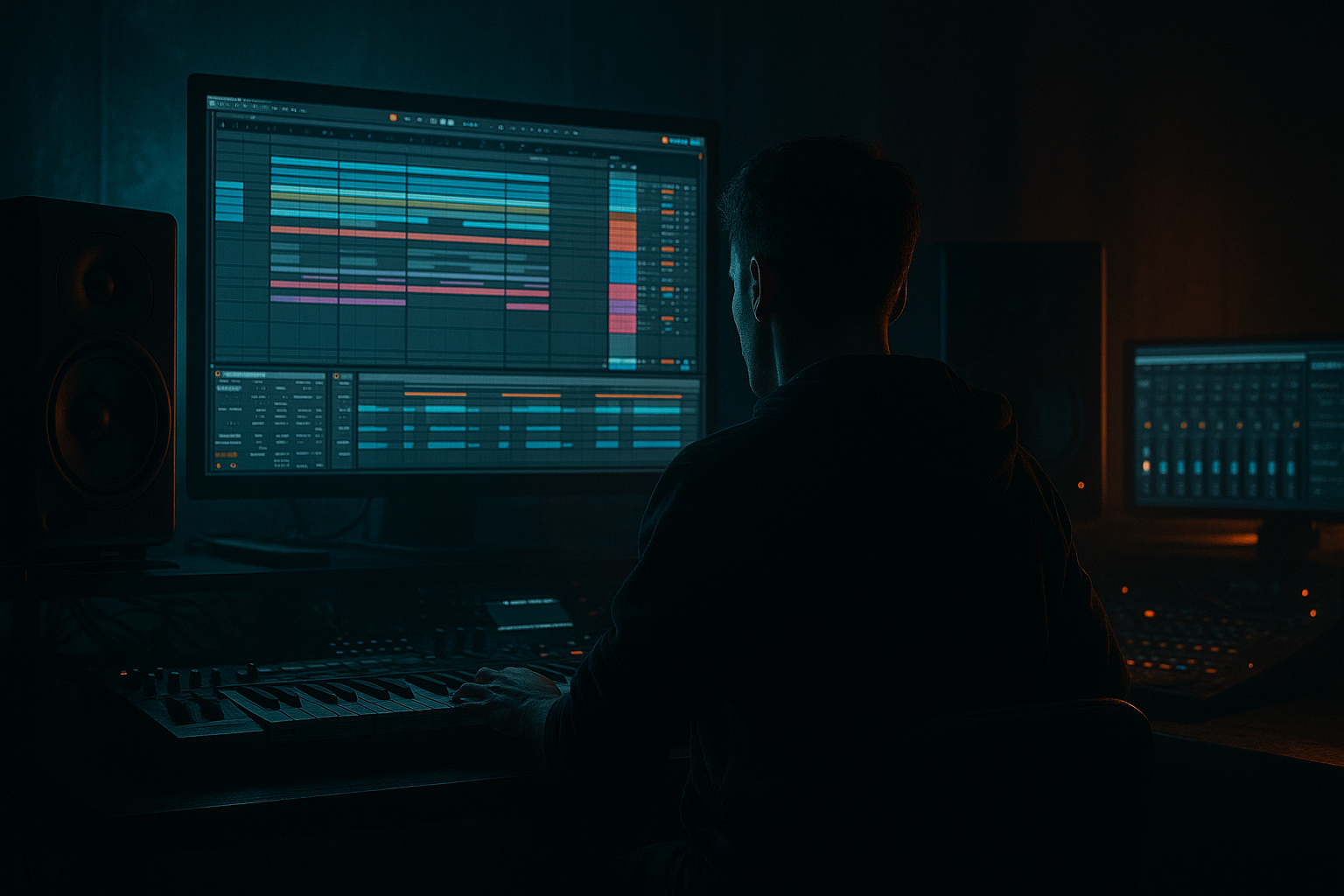
Main tutorial
```markdown
Simple Breakdown Writing in Ableton (Drum & Bass) 🎛️🥁
1. Lesson overview
A breakdown in drum & bass isn’t just “the quiet bit.” It’s a control room for energy: you reset the listener’s ear, create tension, and aim the track like a slingshot back into the drop.
In this lesson you’ll learn a simple, repeatable breakdown formula in Ableton Live using mostly stock devices—perfect for rolling DnB, jungle, and darker dancefloor styles.
Goal: Make a breakdown that:
- clears space after the drop,
- teases the bass/drums without giving away the full groove,
- builds tension with automation and transitions,
- lands cleanly back into the next drop.
- Atmosphere bed (pads/noise/field ambience)
- Filtered break tease (a chopped Amen or drum loop)
- Minimal kick + hat pulse (or ghost percussion)
- Bass hint (sub pulse or reese tail—very subtle)
- Riser + downlifter transitions
- Automation for tension: filter, reverb size, stereo width, and volume
- Drop 1 → Breakdown 16 bars → Build → Drop 2
- On bar 1 of breakdown, hard stop the full drums and bass (a tiny 1/8–1/4 bar silence is powerful).
- Bring in your filtered hats + atmosphere immediately after.
- Add an audio track: Atmos
- Drop in an ambient texture, vinyl noise, rain, rave crowd, jungle FX, etc.
- Create a MIDI track → Wavetable
- Add:
- Add EQ Eight on Atmos:
- Instrument: Operator
- Pattern: 1/2 notes or sparse hits that follow the root note
- Add Auto Filter low-pass around 120–200 Hz if it’s too present
- If your drop bass is heavy, duplicate it and do:
- Kill the breakdown reverb tails (volume automation or reduce send)
- Reset your low-cut automation back to normal
- Bring back:
- Too many elements: breakdown becomes another drop. Strip it back.
- Leaving sub frequencies in atmos/reverbs: makes the drop feel smaller. High-pass your ambience and reverb returns.
- No energy curve: if nothing changes over 16 bars, it feels flat. Add staged entries (bar 1 / 5 / 9 / 13).
- Over-reverb into the drop: huge tail smears the impact. Pull it down right before the drop.
- Risers too loud: transitions should guide, not dominate.
- Use tension chords with dissonance: try minor 2nds or tritones in pads, but keep them low in the mix.
- Texture = menace: layer quiet industrial Foley (chain rattle, metal hits) with heavy high-pass and reverb.
- Distorted atmosphere:
- Pre-drop “sub removal” trick: automate a high-pass on the master up to 120 Hz in the last bar, then drop it back at impact. The bass return feels massive.
- Half-time hint: for 1–2 bars, imply halftime (sparser hits) before returning to full-time at the drop—classic heavy DnB drama.
- Remove the main groove to reset the ear ✅
- Keep vibe with atmos and filtered percussion ✅
- Tease breaks and bass without full power ✅
- Use automation (filter, reverb, width, low-cut) to build tension ✅
- Create a clean pre-drop moment so the drop smacks ✅
---
2. What you will build
You’ll build a 16-bar breakdown (with an optional 8-bar mini-break before it) that includes:
DnB arrangement template (classic):
---
3. Step-by-step walkthrough
Step 0 — Prep your session (2 minutes)
1. Tempo: set around 172–175 BPM.
2. In Arrangement View, mark sections:
- `Drop 1` (whatever you already have)
- `Breakdown` (16 bars)
- `Build` (8 bars)
- `Drop 2`
Workflow tip:
Press `Cmd/Ctrl + I` to insert time for your breakdown and avoid shifting everything manually.
---
Step 1 — Create the “space reset” (bars 1–4 of breakdown) 🌫️
Objective: strip the groove, keep vibe.
1. Duplicate your drop drums to a new track called Drum Tease.
2. On that track, remove the kick and snare hits so you keep only:
- hats
- rides/shakers
- tiny ghost percussion (optional)
3. Add a low-pass filter:
- Device: Auto Filter
- Mode: Low-Pass
- Cutoff: start around 600–1,200 Hz
- Resonance: 10–25%
- Drive (if available): a touch (2–6) for grit
4. Add reverb wash (but keep it controlled):
- Device: Hybrid Reverb (or Reverb)
- Hybrid Reverb preset idea: Dark Hall style
- Decay: 2.5–5.0s
- Low Cut: 250–400 Hz
- High Cut: 6–10 kHz
- Mix: 10–25%
Arrangement move (very DnB):
---
Step 2 — Add an atmosphere bed (bars 1–16) 🎚️
Objective: keep the track alive without drums.
Option A (fast): use a sample
Option B (stock synthesis):
- Osc 1: Sine or basic wave
- Add unison lightly (2–4 voices)
- Filter: low-pass around 2–4 kHz
- Echo (1/8 dotted or 1/4)
- Hybrid Reverb for width
Important DnB rule: clean the low end.
- High-pass at 120–200 Hz (24 dB slope if needed)
- If it’s harsh, dip 3–6 kHz slightly
---
Step 3 — Tease a break loop (bars 5–12) 🥁
Objective: jungle flavor + momentum, but not full energy.
1. Add an audio track: Break Tease
2. Drag in an Amen or classic break.
3. Warp mode: Beats (good for punch) or Complex Pro (for smoother)
4. Slice or simplify:
- Easiest: keep it running but filter it hard
- Better: cut out the snare on 2 and 4 so it feels “held back”
5. Add Auto Filter:
- Low-pass cutoff automate from 500 Hz → 6 kHz over bars 5–12
- Resonance: 15–30%
6. Add Redux very lightly (optional for grit):
- Downsample: 2–8 (subtle)
- Dry/Wet: 5–15%
Arrangement idea:
Bring the break tease in at bar 5 so the breakdown feels like it’s evolving, not looping.
---
Step 4 — Hint the bass without dropping it (bars 9–16) 🔊
Objective: tension via suggestion.
Create a MIDI track: Bass Hint
Option A: Sub pulse (clean, effective)
- Osc A: Sine
- Envelope: short decay (150–300ms), low sustain
Option B: Reese tail (dark tease)
- EQ Eight: high-pass 80–120 Hz (remove sub)
- Auto Filter: low-pass 300–800 Hz
- Reverb: short-ish (1–2s), low cut engaged
- Lower volume so it’s more “ghost” than “bassline”
Key tip:
During breakdown, the bass should feel like a shadow, not the main character.
---
Step 5 — Build tension with automation (the secret sauce) 🧠
You can make a simple breakdown feel pro just by automating 4 things.
#### Automation targets (use Arrangement automation lanes):
1. Master or Group Low Cut (very effective)
- Put EQ Eight on your Drum Group and/or Master
- Automate a gentle high-pass:
- Start: 0–20 Hz
- End (pre-drop): 80–150 Hz
- Then snap it back to 0–20 Hz right on the drop.
2. Reverb size / mix
- On Atmos or Drum Tease reverb:
- increase Decay or Mix gradually into bar 16
- Right before drop: pull reverb mix down fast (clean impact)
3. Filter cutoff rise
- On Break Tease Auto Filter:
- open cutoff gradually
- Optional: quick dip in the last 1/2 bar for a “suck-in” feel
4. Stereo width
- Device: Utility
- On Atmos track: automate Width from 80% → 140%
- Keep sub elements mono (Width 0–50% below ~120 Hz; you can manage this with track design + EQ)
---
Step 6 — Add classic DnB transitions (bars 13–16) 🚀
Objective: tell the listener “drop is coming.”
1. Noise riser (stock):
- MIDI track → Operator
- Use Noise oscillator
- Long note for 4 bars
- Add Auto Filter:
- automate cutoff rising (LP → more open)
- Add Reverb and Echo lightly
2. Pitch riser (simple):
- Use a synth stab or tone
- Automate Transpose (clip or device) up +7 to +12 semitones over 4 bars
3. Downlifter (into bar 1 of drop):
- Reverse a crash or reverb tail:
- Put a crash → Freeze Reverb (or resample a big reverb tail) → reverse it
- Place it so it pulls into the drop
4. The pre-drop gap (don’t fear silence!)
- Last 1/4 or 1/2 bar: cut most elements
- Leave only:
- a tiny vocal chop
- a filtered noise
- or a single snare flam
That micro-silence makes the drop hit harder than any plugin.
---
Step 7 — Make the re-entry clean (Drop 2 impact) ✅
On the exact drop line:
- full drums (kick + snare)
- full bass (sub restored)
- lead elements
Ableton trick:
Group your breakdown-only FX into a group called Break FX and automate the group volume to -inf right on the drop for an instant clean cut.
---
4. Common mistakes
---
5. Pro tips for darker/heavier DnB 🌑
Atmos chain idea:
- EQ Eight (HP 150 Hz) → Saturator (Soft Clip on, Drive 2–6 dB) → Hybrid Reverb (Dark) → Utility (Width 120–150%)
---
6. Mini practice exercise (15 minutes) ⏱️
1. Take any 16 bars of your current drop.
2. Create a 16-bar breakdown:
- Bars 1–4: atmos + filtered hats only
- Bars 5–8: add filtered break tease
- Bars 9–12: add bass hint (sub pulse or reese ghost)
- Bars 13–16: add riser + downlifter + pre-drop gap
3. Automate:
- Break tease filter opening
- Reverb mix increasing then snapping down before drop
- Master/drum group low-cut rising then resetting on drop
4. Bounce a quick audio preview and listen on low volume:
- Does the breakdown progress?
- Does the drop feel bigger after it?
---
7. Recap
A strong DnB breakdown is a planned energy curve:
If you want, tell me your subgenre (liquid, rollers, jump-up, neuro, jungle) and what elements you already have in your drop, and I’ll suggest a breakdown blueprint that fits your track exactly.
```

