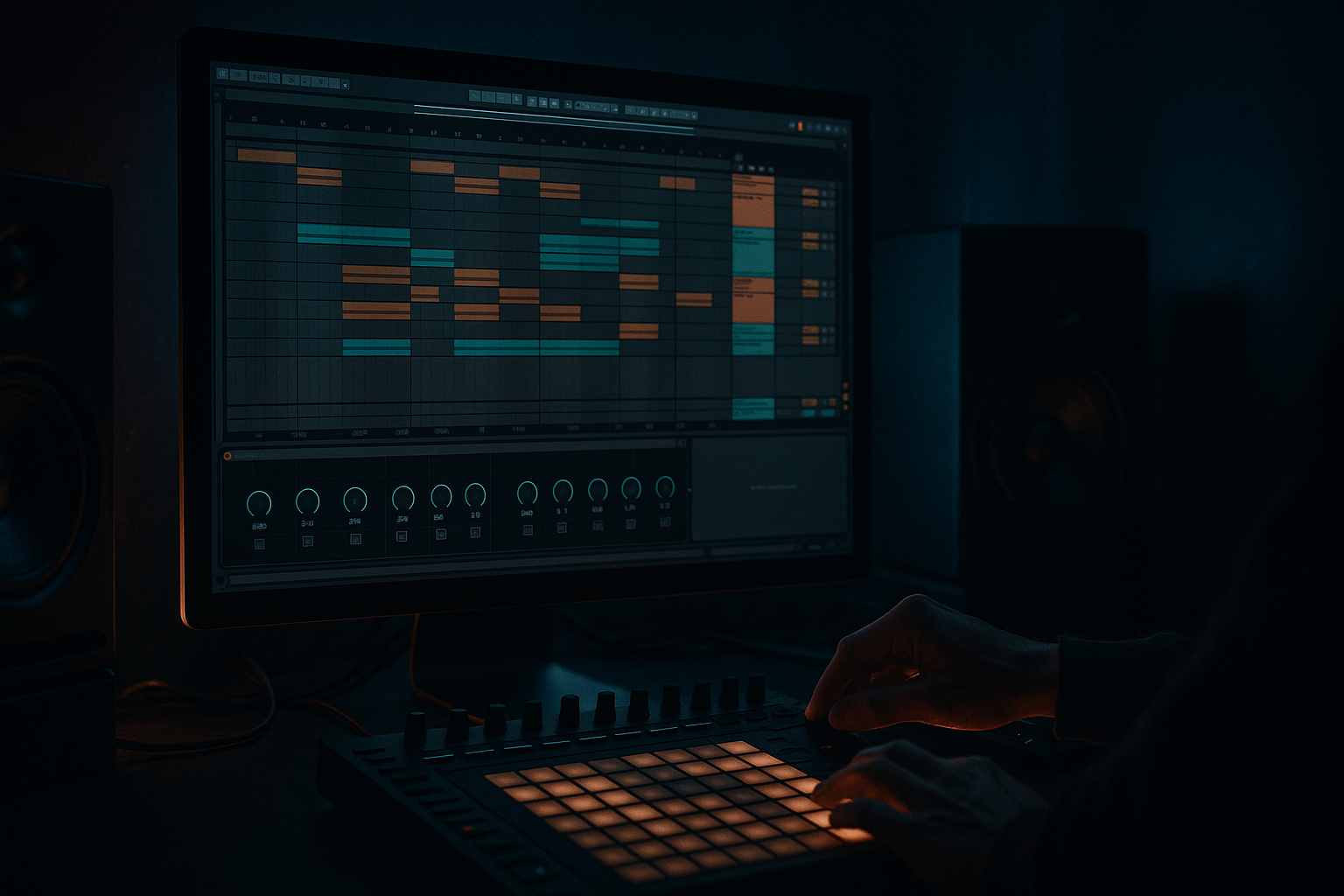
Main tutorial
```markdown
Simple Hook Writing Over Chopped Breaks (Advanced DnB Composition in Ableton Live) 🎛️🥁
1. Lesson overview
This lesson is about writing simple, memorable hooks that sit perfectly over chopped breaks—without overcrowding the groove. You’ll learn how to:
- Build a break-led rhythmic bed (amen / think / funk break style).
- Create a hook that feels DnB/jungle-native: short motifs, call/response, negative space.
- Lock the hook to the break using rhythmic “anchors” and micro-variation.
- Arrange it into a functional 16–32 bar drop idea that rolls hard.
- A chopped break (amen/think-style) with fills and turnarounds.
- A simple 1–2 bar hook motif (synth stab / reese phrase / vocal chop / sampled hit).
- A call-and-response between hook and drums (or hook and bass).
- A tight mix pocket so the hook doesn’t fight the snare or bass.
- The main snare (usually the loudest transient).
- Any signature kick pick-up before the snare.
- Any repeated hat push.
- Anchor A: place hook hits right after the snare (common in rollers).
- Anchor B: place hook hits before the snare as a pick-up (more jungle).
- Anchor C: alternate A and B in a 2-bar phrase.
- Template 1 (post-snare bounce): hits on `2a`, `3`, `4e`
- Template 2 (pre-snare pick-up): hits on `1a`, `2`, `3a`, `4`
- Template 3 (call/response): bar 1 sparse, bar 2 busier (or vice versa)
- last note pitch
- one extra grace note
- replace a hit with a rest
- Osc A: Square or Saw
- Filter: ON, LP24
- Filter Freq: `~1.2–3.5 kHz` (modulate with envelope)
- Amp Env: fast decay (`200–600 ms`), little sustain
- Basic Shapes, slight unison (2–4 voices)
- Keep it mid-focused; avoid wide sub
- Add subtle pitch envelope for bite
- Break is relatively stable
- Add subtle delay throws at bar 4
- Duplicate hook track → “Hook Answer”
- Answer can be:
- That silence creates impact
- Let the break fill do the “talking” then hook returns
- Add a 1/8 or 1/4 bar stop (drum mute) before bar 16
- Add a riser (Noise + Auto Filter) and slam back in
- Mono check: Utility → Width 0% temporarily. If hook vanishes, it’s too phasey.
- Masking: If snare loses crack, carve hook:
- Sidechain: hook ducks to snare or drum bus.
- Chopped breaks already contain tons of info—your hook must be simple, rhythmic, and spaced.
- Use anchors (snare/pickups) + gaps (negative space) to make hooks feel natural over breaks.
- Make hooks 2-bar phrases with tiny variation.
- Use stock tools for control: EQ Eight, Drum Buss, Glue Compressor, Auto Filter, Hybrid Reverb, Echo, Utility.
- Arrange the hook like a DJ-friendly drop: introduce → develop → remove → slam back.
We’re aiming for the classic effect: breaks are doing the talking… but the hook is what people remember. 😈
---
2. What you will build
You’ll end up with a 16-bar drop loop featuring:
Target vibe references (conceptually): jungle-leaning rollers, breaky neuro-ish minimal hooks, 90s-inspired modern DnB.
---
3. Step-by-step walkthrough
Step 0 — Project setup (tight + fast)
1. Tempo: `172–176 BPM` (start at `174`).
2. Groove: keep straight grid first; we’ll add swing later.
3. Return tracks (recommended):
- A – ShortVerb: `Hybrid Reverb` (Algorithm, small room)
- B – LongVerb: `Hybrid Reverb` (Plate/Hall, longer tail)
- C – Delay: `Echo` (ping pong, filtered)
4. Markers: drop locators: `Intro / Drop / Turnaround` so you think arrangement early.
---
Step 1 — Build a chopped break that invites a hook 🥁
Goal: Get a break loop with clear snare identity and controlled chaos.
#### A) Pick a break and warp correctly
1. Drag a break sample (Amen/Think/Funky Drummer style) onto an audio track.
2. In Clip View:
- Warp: ON
- Mode: `Beats`
- Preserve: `Transient`
- Transient Loop Mode: try `Forward` first
- Envelope: `0–20` (lower = cleaner; higher = more crunchy)
3. Set loop to 2 bars (you can go 1 bar, but 2 gives better hook phrasing).
#### B) Slice to MIDI for controlled chops
1. Right-click the clip → Slice to New MIDI Track
2. Slicing preset:
- Slice By: `Transient`
- Create one slice per: transient
- Slicing Preset: `Built-in` → choose “Slice to Drum Rack” (default is fine)
Now you’ve got a Drum Rack full of break slices.
#### C) Create a “rolling but legible” drum pattern
1. In the MIDI clip (2 bars), start with this strategy:
- Keep main snare hits consistent (often on 2 and 4).
- Use kick fragments for forward motion.
- Add ghost notes sparingly (you want room for the hook).
2. Humanize without losing punch:
- Select a few ghost hits → randomize velocity slightly (`±5–12`).
- Micro-nudge some hats/small slices late by 5–15 ms (not snares).
#### D) Control the break with a clean processing chain
On the Break Drum Rack (or the break group), use:
Device Chain (stock)
1. EQ Eight
- HPF at `~30–40 Hz` (24 dB/oct)
- Small dip around `250–400 Hz` if boxy
- Optional gentle shelf +1–2 dB at `8–10 kHz` if dull
2. Drum Buss
- Drive: `5–15%`
- Crunch: `0–10` (taste)
- Boom: OFF or very low for breaks (bass will handle sub)
- Transients: `+5 to +20` if it needs snap
3. Glue Compressor
- Attack: `3–10 ms`
- Release: `Auto` or `0.1–0.3s`
- Ratio: `2:1`
- Aim for `1–3 dB` GR max
4. Saturator (optional)
- Soft Clip: ON
- Drive: `1–4 dB`
Key concept: your break should sound like a finished record loop before the hook enters.
---
Step 2 — Decide your hook “role” (pick one) 🎯
You’ll write a hook that does one job really well:
1. Stab hook (classic jungle): short chord stab rhythm.
2. Single-note synth hook (minimal roller): 1–3 notes, syncopated, repeated.
3. Reese phrase hook (heavier): rhythm-first bass phrase above sub.
4. Vocal chop hook: 2–4 syllables, pitched, rhythmic.
For advanced writing, the trick is: the hook’s rhythm is more important than melody over chopped breaks.
---
Step 3 — Write the hook using “anchors + gaps” 🧠
Goal: Make something catchy that doesn’t fight the snare.
#### A) Find the anchors
Solo the break. Listen for:
Now choose one:
#### B) Build a 1-bar motif, then extend to 2 bars
1. Create a MIDI track: Hook Synth
2. Instrument ideas (stock):
- Wavetable (clean modern hooks)
- Operator (90s stabs / FM bites)
- Simpler (sampled stabs/vocal chops)
3. Start with one note and rhythm first:
- Put 3–6 notes per bar max.
- Leave obvious gaps where the break is busiest (fills/rolls).
DnB rhythm trick: Avoid constant 8ths. Use syncopation: hit on the “e” and “a” of the beat occasionally.
#### C) Practical rhythm templates (drop into a 1-bar grid)
Try these placements (16th grid). Use them as starting points:
Then make it a 2-bar phrase by changing one thing in bar 2:
That tiny variation makes it feel “written,” not looped. ✅
---
Step 4 — Sound design: make it cut through chopped breaks ✂️
Here are two reliable hook chains that work in DnB.
#### Option A: Jungle/roller stab (Operator or Wavetable) 🔥
Instrument: `Operator`
Chain (stock):
1. EQ Eight
- HPF `150–300 Hz` (stabs don’t need sub)
- Dip `2–4 kHz` if harsh
2. Saturator
- Drive `2–6 dB`, Soft Clip ON
3. Auto Filter
- Use envelope amount for “pluck”
4. Hybrid Reverb (Send)
- Short room to glue it to the break
5. Compressor (sidechain from snare OR full drums)
- 2–4 dB duck on snare hits so it never masks the crack
#### Option B: Minimal synth hook (Wavetable) 🧊
Instrument: `Wavetable`
Chain:
1. Utility
- Width `70–110%` (don’t go crazy; breaks need center punch)
2. EQ Eight
- HPF `120–200 Hz`
- Small presence boost `~1.5–3 kHz` if needed
3. Redux (very subtle)
- Downsample a touch for texture (keep it tasteful)
4. Sidechain Compressor from Break Bus
- Fast attack, medium release
- Duck `1–3 dB` just to keep movement
---
Step 5 — Lock hook + break with micro-timing and groove 🎚️
This is where advanced results happen.
1. Groove Pool:
- Add a groove like `MPC 16 Swing 54–58` (start low)
- Apply to hook MIDI only first, not the break
- Commit if it feels right
2. Micro-delay (manual):
- Nudge some hook notes late by 5–12 ms for weight
- Nudge pick-up notes slightly early for urgency
3. Velocity as phrasing:
- Accents on “question” notes (call)
- Softer response notes (response)
Rule: Do not swing the snare. Swing the hook/hats around it.
---
Step 6 — Arrangement: make the hook feel like a “drop moment” 🧱
Build a 16-bar drop with hook evolution:
Bars 1–4: Hook is simple (motif only)
Bars 5–8: Add call/response layer
- a higher octave stab
- a reversed hit
- a filtered copy (Auto Filter LFO)
Bars 9–12: Remove hook for 1 bar → bring it back
Bars 13–16: Turnaround/fill
Ableton tool: automate Auto Filter cutoff on the hook for “phrase arcs.”
---
Step 7 — Mix pocket: hook must not kill the snare 🥊
Quick checks:
- EQ Eight dip `~180–250 Hz` (snare body zone varies)
- Dip `~2–3.5 kHz` if it’s masking snap
- Don’t overduck; we want interaction, not pumping house.
---
4. Common mistakes ❌
1. Hook too busy: If it’s 8th-notes all bar, it will feel cheap over breaks.
2. No negative space: Jungle/DnB hooks often work because they leave room for the breaks.
3. Clashing with snare transients: Big midrange hit exactly on snare = weaker snare.
4. Too many layers too soon: 1 strong hook beats 4 average ones.
5. Over-widening: Breaks want a solid center. Wide hooks can smear the groove.
6. Ignoring 2-bar phrasing: Many hooks feel “amateur looped” because bar 2 is identical.
---
5. Pro tips for darker/heavier DnB 🖤
1. Make the hook rhythmic, not melodic
- Use 1–2 notes, but add distortion movement and filter motion.
2. Parallel distortion for bite
- Create a return track: Roar or Saturator + Overdrive
- Send hook lightly, then EQ the return to focus `~1–5 kHz`
3. Reese-call hook
- Create a mid-reese (no sub) that only plays the hook rhythm
- Sub bass holds steady (or does a simple 2-note pattern)
4. Darker tone shaping
- Low-pass the hook around `6–10 kHz` (depends on brightness)
- Add a tight room verb (short) instead of big shiny reverb
5. Turnaround violence
- At bar 16: Gate the break (fast) + tape stop style pitch drop (clip automation) for a brutal reset
---
6. Mini practice exercise 🎯
Timebox: 25 minutes. No perfection allowed.
1. Load a break and Slice to Drum Rack.
2. Program a 2-bar break chop with:
- consistent snare anchors
- at least 2 ghost hits
3. Create a hook using one note only:
- Make a 1-bar rhythm with max 5 hits
- Copy to bar 2 and change one hit to a rest + add one pickup
4. Add:
- HPF on hook (`150–250 Hz`)
- sidechain from drums (`2 dB` duck)
5. Arrange into 8 bars:
- Bars 1–4 hook plays
- Bar 5 hook drops out
- Bar 6–8 hook returns with a filter automation
Export a quick bounce and listen away from the DAW. If you can hum the rhythm, it’s working.
---
7. Recap ✅
If you want, tell me what type of hook you prefer (stab / vocal / reese / single-note), and I’ll give you a ready-to-program 2-bar MIDI rhythm tailored to your break style.
```

