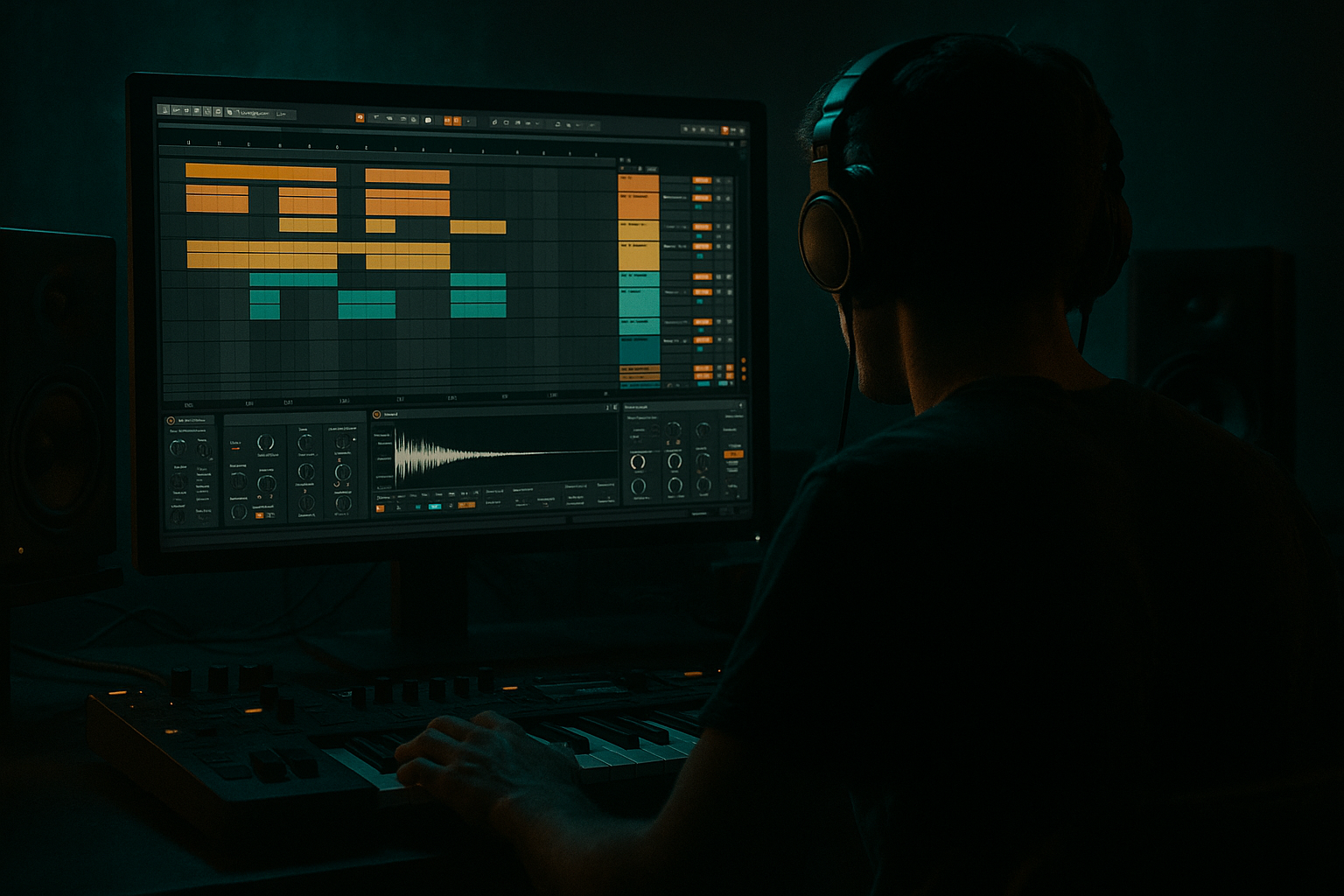
Main tutorial
```markdown
Simple melodic cells with many uses (DnB in Ableton Live) 🎛️⚡
1. Lesson overview
In drum & bass, melodies often need to work like percussion: short, repeatable, and remixable without getting in the way of drums and bass. The fastest way to get there is building simple melodic cells (1–2 bar motifs) that can be re-harmonized, re-timed, resampled, and re-layered across an arrangement.
In this lesson you’ll design a few high-leverage melodic cells and turn them into:
- rolling hooks that don’t fight the bass
- tension builders for breakdowns
- call/response stabs for drops
- resample-ready audio loops for gritty jungle/DnB edits
- syncopation
- repetition with one twist
- a small pitch set (3–5 notes)
- Grid: 1/16
- Turn Groove Pool on later; first get the raw rhythm.
- Step positions: 1.1.1, 1.1.3, 1.2.2, 1.3.1, 1.3.3, 1.4.2
- That’s a 6-hit pattern with offbeats that sit nicely over an Amen-style break or 2-step.
- Use a tight set: F, Ab, C, Eb
- Suggested mapping:
- Change the 1.3.1 note in bar 2 from Eb5 → D5 (a spicy passing tone)
- Or shift last note down: Ab4 → G4 (tension into loop)
- Wavetable (Init preset)
- Filter: LP24
- Amp Env:
- Saturator
- EQ Eight
- Utility
- Delay (not Echo yet)
- Keep Wavetable but make it more “chord stabby”:
- Reverb
- Compressor (optional glue)
- In Wavetable:
- Add Auto Filter after EQ:
- Add Echo
- Add Reverb
- Add EQ Eight at end:
- Duplicate the clip and shift it by 1/16 later (or earlier).
- In Ableton: select notes → nudge (or move start marker / clip start).
- Shape: Square
- Phase: 0°
- Rate: 1/8 or 1/16
- Amount: 100%
- Offset: adjust to hit between kicks/snares
- Replace Ab/C/Eb with G / Bb / Db (neighbor colors)
- Or borrow from Phrygian-ish flavor: use Gb occasionally
- Bars 1–2: CELL riff only (dry, minimal)
- Bars 3–4: add STAB call/response (answer the snare)
- Bars 5–6: introduce displaced clip (variation 1) for energy lift
- Bars 7–8: resample fill (variation 4) + reverb throw → into next phrase
- Keep the same MIDI, but swap to ATMOS sound.
- Automate:
- Then hard-cut back to dry CELL at the drop for impact. 💥
- Use “wrong notes” as momentary tension: add a b2 (Gb in F minor) as a quick 1/16 or 1/8 passing note before resolving.
- Make the cell answer the snare: place key notes right after beat 2 and 4 (post-snare bounce).
- Parallel distortion for aggression:
- Mid/Side cleanup with EQ Eight:
- Use Redux sparingly for grit:
- A melodic cell is a small, repeatable motif designed to behave like a rhythmic layer in DnB.
- Build it with rhythm-first, limited notes, and one controlled twist.
- Get mileage by changing role (riff/stab/atmos) and framing (displacement, gating, resampling), not rewriting.
- Use Ableton stock tools: Wavetable, Chord, Saturator, EQ Eight, Echo, Reverb, Auto Pan, Beat Repeat.
- Arrange with A/A’ logic and phrase evolution every 4–8 bars to keep drops moving.
We’ll stay inside Ableton Live stock devices as much as possible.
---
2. What you will build
You’ll create one core melodic cell and derive 5 usable variations:
1) MIDI cell (1 bar) that grooves at 174 BPM
2) Stab version (chord stab / pluck) for drop punctuation
3) Riff version (monophonic lead) for mid-layer energy
4) Atmos version (pad/texture) for breakdown support
5) Resampled audio version for gritty edits, reverses, and fills
6) Arrangement usage: A/B call-response and “drop evolution” roadmap
---
3. Step-by-step walkthrough
Step 0 — Session setup (DnB-ready)
1. Set tempo to 174 BPM (or 170–176).
2. Create 3 MIDI tracks:
- CELL (MIDI)
- STAB
- ATMOS/RESAMPLE
3. Set global scale reference (optional but helpful):
- Choose a key like F minor (classic for darker DnB) or D minor.
- Drop a MIDI Scale device on CELL with Scale: Minor and Base: F (or your key).
- Keep it subtle: you can still use out-of-scale notes intentionally later.
Workflow tip: DnB is dense; reserve the sub/bass range. Keep melodic cells mostly above ~200 Hz unless it’s a bass-focused riff.
---
Step 1 — Build a core melodic cell (1 bar, high reuse)
We’ll write a cell that feels “rolling” by using:
#### 1A) Create the rhythm first (like drum programming)
On CELL (MIDI), insert a 1-bar MIDI clip.
Place notes (velocity matters):
Now assign pitches (F minor example):
- 1.1.1: F4
- 1.1.3: Ab4
- 1.2.2: C5
- 1.3.1: Eb5
- 1.3.3: C5
- 1.4.2: Ab4
Why this works: it outlines the key but stays compact. It also gives you a “hook contour” without becoming a full melody.
#### 1B) Add micro-variation (the “one twist”)
Duplicate the bar to make 2 bars, then change only one note in bar 2:
Now you have A (bar1) + A’ (bar2). This is gold in DnB: minimal but alive.
---
Step 2 — Pick a sound that behaves like a cell (fast transient, controlled tail)
We’ll create a “cell instrument” that can become stab/lead/atmos with small changes.
#### 2A) Stock device chain (fast + mix-ready)
On CELL (MIDI) load:
- Osc 1: Saw (Position ~20–40%)
- Osc 2: Sine very low level (for body), or leave off
- Unison: 2 voices, Amount 10–20%
- Cutoff: 1.2–3 kHz (adjust to taste)
- Drive: 3–8 dB (for bite)
- Attack 0–5 ms
- Decay 150–300 ms
- Sustain 0–20%
- Release 60–120 ms
After Wavetable:
- Mode: Analog Clip
- Drive: 2–6 dB
- Soft Clip: On
- HPF: 150–250 Hz (24 dB/oct) ✅ (keeps bass space)
- Small dip around 2–4 kHz if harsh (1–3 dB, Q ~1.5)
- Width: 80–120% (careful; keep center solid)
Optional groove:
- Time: 3/16 or 1/8 dotted
- Feedback: 10–20%
- Dry/Wet: 6–12%
- Filter the delay: HP to 500 Hz, LP to 6–8 kHz
DnB mix logic: the cell should “sit” like a percussion layer on top of drums and bass, not dominate.
---
Step 3 — Turn ONE cell into THREE musical roles (without rewriting)
Now we reuse the same MIDI but change the instrument behavior.
#### 3A) Stab version (drop punctuation) 🔪
Duplicate the track to STAB.
On STAB:
- Add Chord MIDI effect
- Shift: +3 (minor third), +7 (fifth)
- Amp Env:
- Decay 80–160 ms
- Release 40–80 ms
- Filter cutoff lower: 600 Hz – 1.5 kHz (darker stab)
Add:
- Size: Small/Medium
- Decay: 0.6–1.2 s
- Pre-delay: 10–25 ms
- Dry/Wet: 8–15%
- HP filter in reverb: 400–800 Hz (keep low-end clean)
- Ratio 2:1
- Attack 10–30 ms
- Release Auto
- Aim: 1–3 dB GR on peaks
Arrangement use: place stabs on bar starts or after snare hits for call/response.
#### 3B) Riff version (monophonic urgency) 🧨
Back on CELL track, keep it mono:
- Voices: Mono
- Glide/Portamento: 20–60 ms
- Mode: LP12
- Env amount: small (5–15)
- LFO: subtle wobble (Rate 1/8 or 1/16, Amount very low)
Now the same notes feel like a rolling riff.
#### 3C) Atmos version (breakdown support) 🌫️
Duplicate to ATMOS/RESAMPLE and make it wide and washed:
- Time: 1/4 (or 3/16)
- Feedback: 35–55%
- Modulation: 2–5
- Noise: tiny (0.5–2) for texture
- Dry/Wet: 20–35%
- Decay: 2.5–5.5 s
- Pre-delay: 20–40 ms
- Dry/Wet: 20–35%
- HPF: 250–400 Hz
- LPF: 8–12 kHz (keeps it dark)
Pro move: automate Echo/Reverb Dry/Wet to increase into transitions.
---
Step 4 — Create “infinite” variations using 4 advanced DnB tricks
You’re not rewriting melodies; you’re reframing the cell.
#### Variation 1: Rhythmic displacement (push/pull)
Result: same pitches, different groove—perfect for drop “B section.”
#### Variation 2: Note gating with a sidechain rhythm
Add Auto Pan (yes, as a gate) on the cell:
This turns sustained tones into rolling 16ths without rewriting MIDI. 🎯
#### Variation 3: Harmonic flip with one “anchor note”
Keep one note constant (e.g., F) and change the others:
DnB-friendly rule: change one tone per bar, not all at once.
#### Variation 4: Resample and mangle (jungle mindset) 🔥
On ATMOS/RESAMPLE:
1. Freeze the track (right-click → Freeze).
2. Flatten (right-click → Flatten).
3. Now slice/edit audio:
- Reverse a tail
- Chop a single transient to create a “plink”
- Add Beat Repeat
- Interval: 1 Bar
- Grid: 1/16
- Chance: 10–25%
- Variation: 5–15%
- Filter: on, keep it dark
Arrangement use: print a 4-bar “edit fill” every 16 bars. Classic.
---
Step 5 — Arrangement ideas (drop evolution without losing the hook)
Use your cell like a DnB “identity tag.”
8-bar drop blueprint:
Breakdown blueprint:
- Filter cutoff down
- Reverb up
- Delay feedback up
---
4. Common mistakes
1. Too many notes (melody becomes a lead song)
DnB wants cells, not long lyrical phrases—let drums and bass lead.
2. Fighting the sub / low mids
If your cell has energy below 150–250 Hz, it’ll clash with Reese/sub. High-pass it.
3. Over-widening
Super wide cells can smear the mix and weaken drop impact. Keep the “hook” mostly center or controlled.
4. No rhythmic intent
If the rhythm doesn’t lock to the drum pocket, no sound design will save it. Build rhythm first.
5. Uncontrolled reverb tails
Reverb buildup kills DnB punch. Filter your reverbs and automate them off in busy sections.
---
5. Pro tips for darker/heavier DnB 🖤
- Create a return track with Saturator (Drive 8–15 dB) → EQ Eight (HP 300 Hz) → Compressor
- Send the cell lightly (5–15%). Keeps weight without mud.
- In EQ Eight, set a band to Side and cut harsh highs if needed; keep the center punchy.
- Downsample a little (e.g., 10–18 kHz) and blend with Dry/Wet 5–12%.
---
6. Mini practice exercise (15–25 minutes) ⏱️
1. Write one 1-bar cell using only 3 notes.
2. Create three versions:
- Dry mono riff
- Chord stab (Chord device)
- Atmos resample (Echo + Reverb)
3. Make two arrangement phrases:
- Phrase A: original
- Phrase B: displaced by 1/16 + Auto Pan gate
4. Export a 16-bar loop and listen:
- Does it still feel like one identity?
- Does each phrase feel different without a new melody?
Bonus: resample the stab and make a reverse swell into bar 1.
---
7. Recap ✅
If you want, tell me your preferred sub style (clean sine, Reese, foghorn, neuro) and I’ll suggest a cell that complements it without masking.
```

