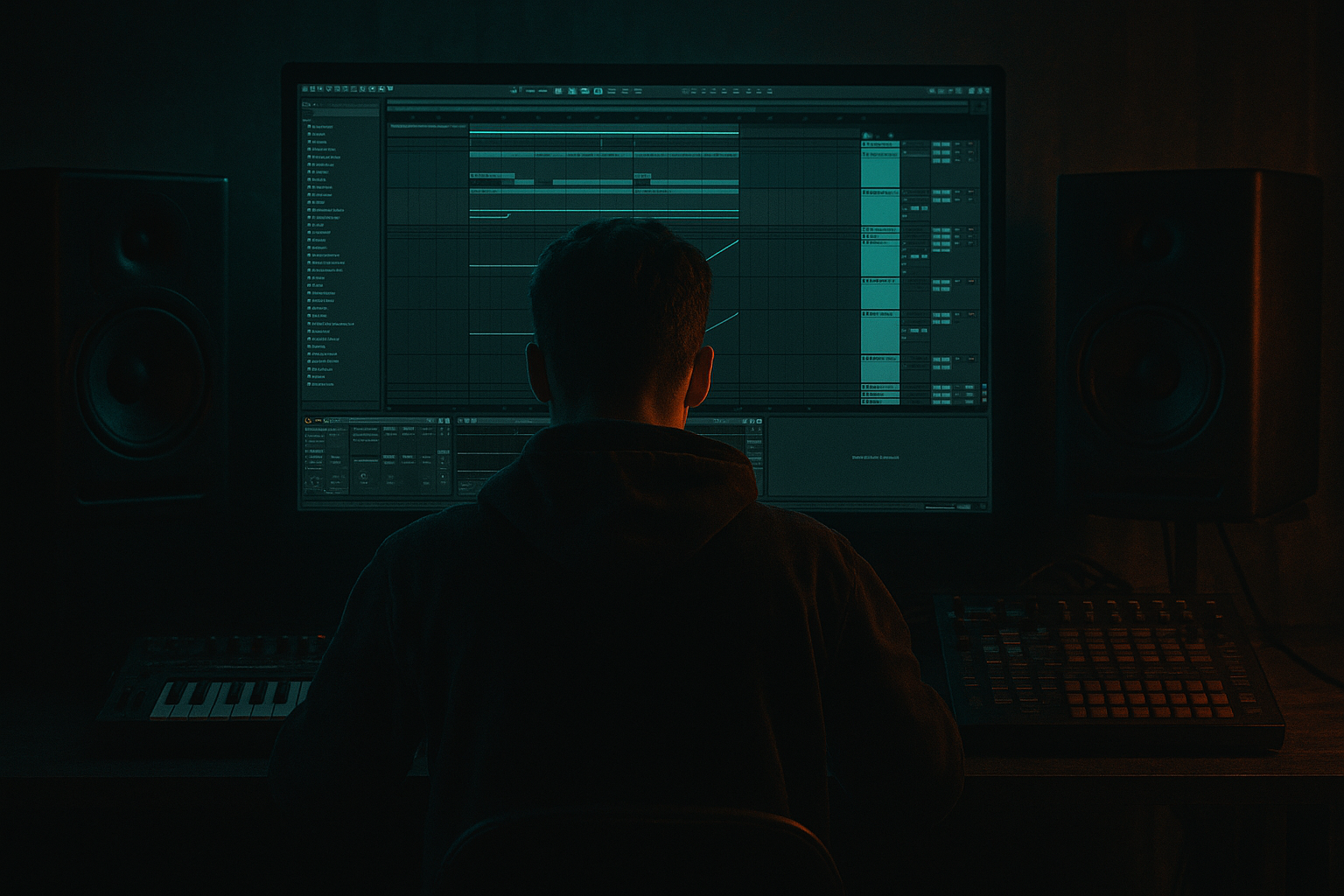
Main tutorial
Simple Panning Movement for Dark Rollers (Ableton Live) 🎛️➡️⬅️
Beginner • Automation • Drum & Bass / Jungle
---
1. Lesson overview
Panning movement is one of the easiest ways to make a dark roller feel wide, alive, and hypnotic—without changing the core groove. In this lesson you’ll learn simple, controlled panning automation in Ableton Live that keeps your mix club-safe (strong mono compatibility) while adding motion to:
- percussion loops and tops
- reverb/delay returns
- texture layers and ear-candy
- occasional bass high layers (carefully!)
- Drum bus stays solid and centered (kick + snare remain mono/center)
- Hats/shakers do subtle left-right drift
- A ghost percussion loop gets auto-pan groove movement
- A reverb return gently moves to add space without smearing the mix
- Optional: a mid/high “bass grit” layer that moves slightly while sub stays dead center
- Bars 1–16: small movement (±8)
- Bars 17–32 (after drop variation): increase slightly (±12) to lift energy without adding new drums.
- Use movement to create tension, not brightness.
- Combine subtle pan with subtle filtering.
- Pan contrast = arrangement energy.
- Mono check (do this every session):
- Keep your “anchor points” stable:
- Dark rollers thrive on subtle movement that supports the groove.
- Manual panning automation = most controlled and beginner-friendly.
- Auto Pan is perfect for rhythmic motion—keep the Amount tasteful.
- Move the space (returns) more than the dry drums for club-safe width.
- Sub stays mono/center, mid layers can move slightly for character.
We’ll stay practical: exact device choices, automation steps, and arrangement ideas for rolling DnB.
---
2. What you will build
A short 16–32 bar dark roller loop with tasteful stereo movement:
Result: more depth and “3D” vibe while keeping that heavy, rolling stability. 🖤
---
3. Step-by-step walkthrough
Step 0 — Prep your session (important for DnB)
1. Set tempo: 172–176 BPM.
2. Create basic tracks:
- Kick (Audio)
- Snare (Audio)
- Hats/Tops (Audio or Drum Rack)
- Perc Loop / Ghosts (Audio)
- Bass Sub (MIDI)
- Bass Mid/Dist (MIDI) (optional but very DnB)
- Return A: Reverb
- Return B: Delay
Rule of thumb: Kick, snare, and sub = centered. Movement mostly lives in tops, rooms, and textures.
---
Step 1 — Add clean, simple panning automation (manual)
This is the most controllable method and perfect for beginners.
Use case: A hat loop that drifts slightly every bar.
1. Click your Hats/Tops track.
2. Press A to show Automation Mode.
3. In the automation chooser, select:
- Mixer → Track Panning
4. Draw automation for a 2-bar phrase:
- Bar 1: pan to +10 (right)
- Bar 2: pan to -10 (left)
5. Keep it subtle: ±5 to ±15 is usually enough for dark rollers.
DnB feel tip: Make it “call and response” with the groove—e.g., hats drift right on bar 1, left on bar 2.
Arrangement idea:
---
Step 2 — Use Auto Pan like a rhythmic tool (but keep it tight) 🔁
Ableton’s Auto Pan is your best stock device for quick stereo motion.
Use case: A ghost percussion loop that pulses left-right in time with the rhythm.
1. On your Perc Loop / Ghosts track, add Auto Pan (Audio Effects).
2. Set these starter settings:
- Amount: 20–35%
- Rate: choose Sync
- Rate: try 1/8 or 1/16 (DnB-friendly)
- Phase: 180° (classic left-right alternation)
- Shape: around 30–50% (more sine-like = smoother; more square = choppier)
3. If it feels too wide or distracting:
- lower Amount first
- then slow the Rate (1/8 instead of 1/16)
Workflow suggestion:
Group your perc layers and put Auto Pan on one layer only (e.g., the “ghosty” loop), not the whole drum bus.
---
Step 3 — Make movement groove with sidechain-style dynamics (optional but powerful) 🥁
If your panning movement fights the snare, you can “breathe” it around the hit.
Use case: Auto-panned tops duck slightly on the snare to keep the punch center-focused.
1. On the moving tops/perc track, add Compressor.
2. Enable Sidechain.
3. Sidechain input: choose your Snare track (or Drum Bus).
4. Settings to start:
- Ratio: 2:1 to 4:1
- Attack: 3–10 ms
- Release: 80–160 ms
- Gain reduction: aim for 1–3 dB on snare hits
This keeps the movement present but stops it from “masking” the snare crack.
---
Step 4 — Put movement on RETURNS (the pro club-safe trick) 🌫️
Moving the reverb/delay is often better than moving the dry signal.
#### A) Reverb return that drifts slowly
1. On Return A, add Hybrid Reverb (or Reverb).
2. Dark roller starter settings:
- Decay: 1.2–2.5 s
- Pre-delay: 10–25 ms
- High Cut: ~6–10 kHz (darker)
- Low Cut: ~150–300 Hz (keep low-end clean)
3. After the reverb, add Auto Pan:
- Amount: 10–20%
- Rate (Sync): 1/2 or 1 bar
- Phase: 180°
- Shape: smoother (20–40%)
Now send snare and tension percussion into this return. Your core drums stay centered, but the space moves. That’s the roller magic.
#### B) Delay return for jungle-style flicker
1. On Return B, add Delay (or Echo).
2. Set:
- Time: 1/8 or 1/16 (sync)
- Feedback: 15–30%
- Filter: roll off lows (HP) and tame highs (LP)
3. Add Utility after delay and automate Width slightly:
- Verse/build: Width 80–100%
- Drop: Width 110–130%
(Keep it subtle—too wide gets messy fast.)
---
Step 5 — Advanced but beginner-safe: split bass into Sub (mono) + Mid (movement) 🧱
Dark rollers often have a stable sub and a gritty moving mid layer.
1. Duplicate your bass track:
- Track 1: Bass Sub
- Track 2: Bass Mid/Dist
2. On Bass Sub, add EQ Eight:
- Low-pass around 80–120 Hz
3. On Bass Mid/Dist, add EQ Eight:
- High-pass around 100–150 Hz
4. On Bass Sub, add Utility:
- Width: 0% (mono sub)
5. On Bass Mid/Dist, you can add subtle movement:
- Option A: Auto Pan (Amount 5–15%, slow rate like 1/2)
- Option B: automate Track Panning ±5 to ±10
Important: Keep movement minimal on bass mid; the bass still needs to feel like it’s “in the middle of your chest.”
---
4. Common mistakes 🚫
1. Panning the kick or snare
- Makes the drop feel weak and unstable in clubs.
2. Too much Auto Pan Amount
- If you notice the effect more than the groove, it’s probably too far.
3. Fast panning on busy hats
- 1/16 Auto Pan on an already-fast hat loop can turn into a blurry mess.
4. Moving low end
- Anything under ~120 Hz should be basically mono/center.
5. No mono check
- Always check mono (see Pro Tips) so your movement doesn’t disappear.
---
5. Pro tips for darker/heavier DnB 🖤
Add Auto Pan after a dark reverb or filtered delay so it feels like shadowy space moving.
Automate Auto Filter cutoff slightly while panning—tiny changes feel “alive” in rollers.
Keep verses narrower (±5–8), drops slightly wider (±10–15). Instant lift without new samples.
Put Utility on the Master temporarily and toggle:
- Width: 0% (mono)
If key percussion disappears, reduce stereo effects or move the movement to returns.
Kick, snare, main ride (if it’s driving), sub bass = stable center.
Ghosts, foley, rooms, delays = movement playground.
---
6. Mini practice exercise 🎯
Goal: Make an 8-bar loop that feels wider and more rolling without adding new samples.
1. Pick one hat loop and one ghost perc loop.
2. Hat loop:
- Automate Track Panning:
Bars 1–2: +8 → 0
Bars 3–4: -8 → 0
Bars 5–8: repeat
3. Ghost perc loop:
- Add Auto Pan: Amount 25%, Rate 1/8, Phase 180°
4. Return A (Reverb):
- Add Auto Pan on the return: Amount 12%, Rate 1 bar
5. Do a mono check and adjust until nothing important vanishes.
If it still feels “flat,” increase movement on the reverb return before touching dry drums.
---
7. Recap ✅
If you want, tell me what elements you’ve got in your loop (hats style, perc type, bass type), and I’ll suggest a specific panning/Auto Pan plan for your exact roller.

