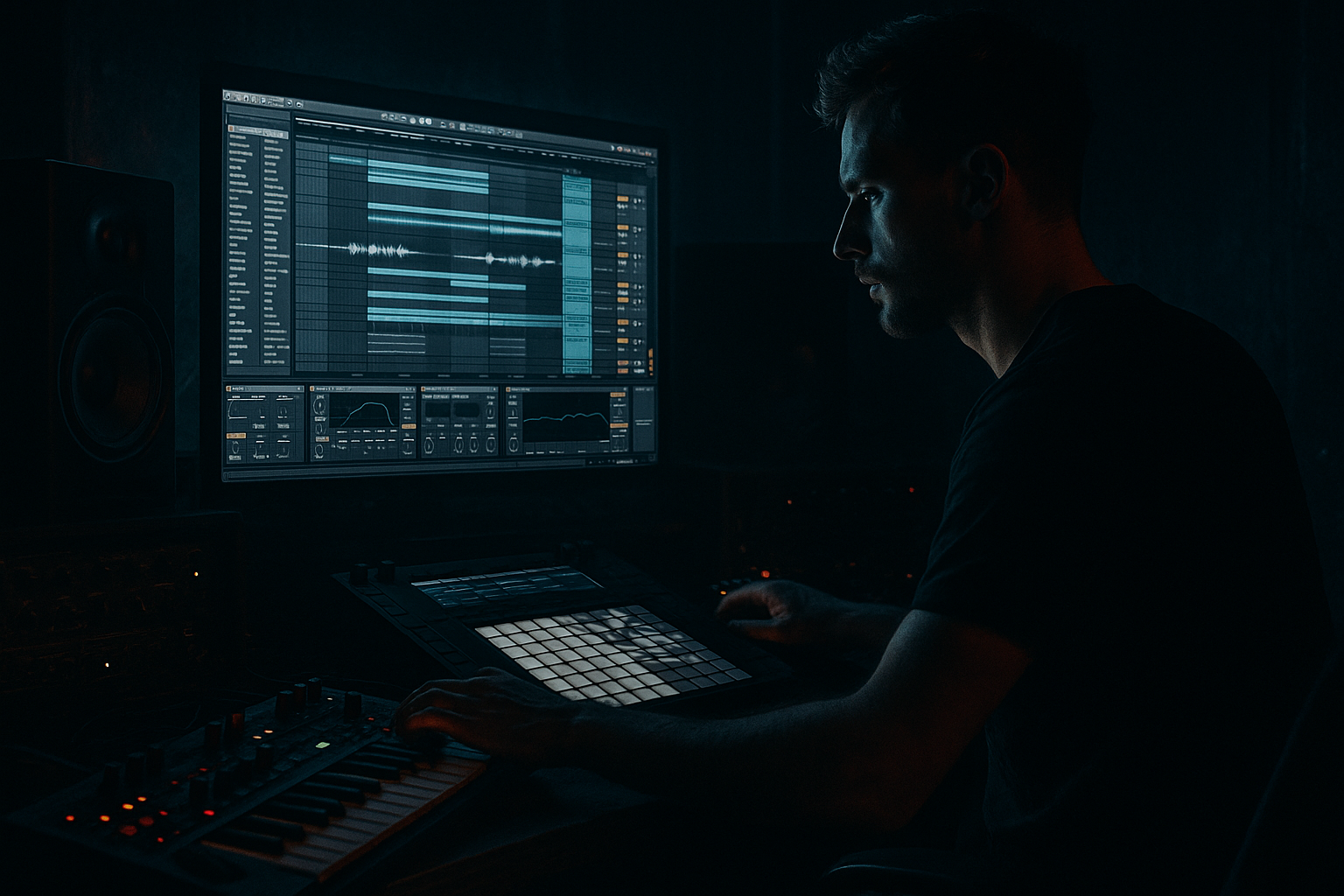
Main tutorial
```markdown
Simple Piano Lines for Jungle Intros (Ableton Live) 🎹⚡
Skill level: Advanced (Composition)
Context: Drum & Bass / Jungle / rolling bass music — intro piano that feels classic, tense, and mix-ready.
---
1. Lesson overview
Jungle intros often rely on simple, loopable piano motifs that create mood fast: nostalgic, eerie, or gritty — while leaving space for break edits, FX, and the drop.
In this lesson you’ll write a few high-impact, low-note-count piano lines and learn to process + arrange them like proper DnB inside Ableton Live using stock devices.
We’re aiming for:
- Strong harmonic implication with minimal notes
- Rhythmic phrasing that locks to jungle drums
- Sound design + processing that sits above breaks without harshness
- Arrangement transitions that scream “jungle intro” 🥁
- A 2-bar piano motif (simple but memorable)
- Velocity + timing humanization (still tight)
- A processed piano chain (grit + width + space)
- An arrangement using drum teaser, FX, and automation into the drop
- One MIDI clip (2 bars) + 3 variations
- A piano processing rack you can reuse
- A structured intro arrangement template
- Return A (Room): Reverb
- Return B (Long): Hybrid Reverb (Hall)
- Return C (Dub): Echo
- Instrument: Grand Piano (Ableton pack) or Electric (MIDI instrument) for a slightly synthetic tine vibe.
- Use Simpler with a sampled piano stab (even a single chord hit), then play it melodically.
- F minor (dark + weighty)
- G minor (common, easy on bass)
- D minor (cinematic)
- Choose Minor (or Dorian)
- In F minor:
- Rhythm: syncopated 2-bar loop
- Bar 1: hit F2 (short) on 1, then Ab3 on 1.2, then F3 on 1.3.3
- Bar 2: similar idea but one note missing (space is vibe)
- Keep it as two-note dyads (e.g., Bb+C, then F+C)
- Target Ab, approach from G, then land Ab
- Send to Return A (Room) for closeness
- Send to Return B (Long) for atmosphere (automate up in the last 4–8 bars)
- Send to Return C (Dub Echo) sparingly (one hit per phrase is enough)
- Put Compressor on the piano, sidechain from your break/kick group.
- Ratio: 2:1–4:1, Attack: 5–15ms, Release: 80–180ms
- Aim for 1–3 dB GR just to make drums feel forward.
- Piano motif (dry-ish)
- Room reverb only
- Sparse atmosphere (noise, vinyl, distant siren)
- Introduce filtered break loop quietly
- Open the piano LP filter slightly
- Add a single dub echo on phrase-ending notes
- Piano variation: remove one key note OR shift up an octave for 1 bar
- Increase long reverb send gradually
- Add a riser made from the piano tail (resample → reverse)
- Break gets louder + less filtered
- Piano gets more narrow (reduce chorus width) to make the drop feel wide later
- Last 1 bar: hard stop or reverb swell (classic)
- Duplicate your 2-bar MIDI clip across the intro.
- Create 3 variations:
- Use harmonic minor for menace:
- Make the piano feel “found footage”:
- Mid/Side control for weight:
- Resample and re-map for texture:
- Tension automation > chord changes:
- Jungle intros thrive on minimal piano motifs with strong rhythmic phrasing.
- Use root/minor-third shapes, sus tension, and chromatic approach notes to create mood fast.
- Make it mix-ready with EQ cleanup, tasteful saturation, controlled width, and send-based space.
- Arrange the intro with automation + variations, not more notes.
- Pair piano with break teasers + FX so it reads unmistakably DnB/jungle.
---
2. What you will build
You’ll produce a 16–32 bar jungle intro with:
Deliverable:
---
3. Step-by-step walkthrough
Step 0 — Session setup (so it feels like jungle immediately)
1. Set tempo: 165–172 BPM (try 170 BPM).
2. Set time signature: 4/4.
3. Create tracks:
- MIDI Track: Piano
- Audio Track: Break Tease (or Drum Rack)
- Return A: Short Room
- Return B: Long Verb
- Return C: Dub Delay
Return defaults (stock):
- Decay: 0.6–1.0s
- Pre-delay: 10–20ms
- Low Cut: 250–400 Hz
- High Cut: 7–10 kHz
- Decay: 2.5–4.5s
- Pre-delay: 25–40ms
- Low Cut: 400–700 Hz
- High Cut: 6–9 kHz
- Time: 1/8 Dotted or 1/4
- Feedback: 25–45%
- Filter: band-limit (e.g. 300 Hz – 6 kHz)
- Ducking: 20–40% (so it stays out of the way)
---
Step 1 — Choose a piano that behaves in a mix
For jungle intros, you want something that can be thin, characterful, and controllable.
Option A (clean/control):
Option B (instant vibe):
Fast Ableton stock chain suggestion (Instrument Rack):
1. Instrument: Grand Piano (or Electric)
2. EQ Eight
3. Saturator
4. Drum Buss (light)
5. Chorus-Ensemble (subtle width)
6. Auto Filter (for intro automation)
7. Utility (mono management)
---
Step 2 — Pick a key/scale that screams jungle
Classic jungle intros often live in minor keys, sometimes with Dorian or harmonic minor spice.
Try one:
Advanced workflow tip:
Drop Ableton’s Scale MIDI effect on the piano track:
This lets you improvise rhythmically without derailing harmony.
---
Step 3 — Write a “simple” motif that’s actually doing a lot
The trick: imply harmony with 1–3 notes, repeat it, and use rhythmic identity more than melodic complexity.
#### Motif Template 1: “Minor 3rd + Root” (classic, ominous)
- Notes: F + Ab (root + minor third)
MIDI programming (2 bars):
Why it works:
Root + b3 instantly says “minor,” and the listener fills in the rest.
#### Motif Template 2: “Sus tension” (90s rave tension)
In F minor, use F + Bb + C (Fsus4-ish color) sparingly:
Rhythm:
Use off-beat stabs on the “&” of 2 and 4 to tease the break.
#### Motif Template 3: “Chromatic approach note” (dark, techy jungle)
Pick a target note and approach from a semitone below:
Example:
G → Ab (short-short), then hold F (long) with reverb tail.
---
Step 4 — Make it feel played (without going sloppy)
Advanced jungle intros benefit from micro-imperfection that still hits tight with drums.
1. Velocity shaping
- Avoid uniform hits.
- Typical range: 55–105
- Accents on syncopations, softer on pickups.
2. Timing
- Turn off heavy groove first: write it tight.
- Then apply Groove Pool lightly:
- Try MPC 16 Swing 55–58 at 10–25%
- Or manual: nudge a few notes late by 5–12 ms (not more unless it’s a deliberate drag).
3. Note length
- Jungle piano likes short stabs with controlled tails.
- Start with lengths around 1/16 to 1/8 and let reverb do the sustain.
---
Step 5 — Processing chain (stock) that sits above breaks
Here’s a practical chain with starting settings.
#### Device chain: “Jungle Piano Intro Rack”
1. EQ Eight (cleanup)
- HP filter: 150–250 Hz (12 or 24 dB/oct)
- Dip mud: 250–450 Hz by -2 to -5 dB (Q ~1.2)
- If harsh: dip 2.5–4.5 kHz slightly
2. Saturator (character)
- Mode: Soft Sine or Analog Clip
- Drive: 2–6 dB
- Output: match level (avoid fooling yourself)
3. Drum Buss (glue + smack, very light)
- Drive: 2–5
- Crunch: 0–10%
- Boom: OFF (usually; keep low end clean)
4. Chorus-Ensemble (width)
- Amount: 10–25%
- Rate: 0.2–0.6 Hz
- Width: 80–120%
- Mix low to avoid washing transients
5. Auto Filter (movement + intro build)
- Mode: LP24
- Frequency: automate from 3–6 kHz opening to 14–18 kHz
- Resonance: 0.8–1.2 (subtle whistle = tension)
6. Utility (mono discipline)
- Bass Mono: ON
- Bass Freq: 120–200 Hz (keeps low mids centered)
#### Sends (important!)
---
Step 6 — Add jungle context: break tease + FX
A piano line alone won’t read “jungle.” Pair it with break fragments and tape-ish transitions.
1. Drag in a break (Amen, Think, Hot Pants, etc.).
2. In the intro:
- Use 2–4 bar filtered break loop (HP around 200–400 Hz, LP around 6–10 kHz)
- Add Vinyl Distortion lightly for grit (or Saturator)
3. Create tension:
- Automate Auto Filter cutoff on break + piano together
- Add Reverb Freeze moments (Hybrid Reverb → Freeze) on a piano hit before a section change
Sidechain (optional but powerful):
---
Step 7 — Arrange like a proper jungle intro (16–32 bars)
Here’s a proven 32-bar blueprint:
Bars 1–8: Establish mood
Bars 9–16: Add movement
Bars 17–24: Tension + variation
Bars 25–32: Pre-drop
- Option: mute piano on beat 4, let a delayed hit ring into drop
Ableton workflow:
1) “Less notes” (space)
2) “Octave lift” (energy)
3) “Turnaround” (last 2 bars: change final note to lead into drop)
---
4. Common mistakes
1. Too many notes = no identity
- Jungle piano works because it’s suggestive, not busy. If it sounds like a full piano etude, it’s not intro material.
2. Uncontrolled low mids
- Piano has tons of 200–500 Hz energy; it’ll fight breaks and bass. HP + dip.
3. Over-reverb
- Long verbs are great, but if your tail masks break transients, it’ll feel amateur. Use pre-delay and low cut on reverb.
4. Swing applied too hard
- Heavy groove can wreck the relationship with chopped breaks. Keep swing subtle and intentional.
5. No arrangement evolution
- A 2-bar loop for 32 bars with no automation/variation feels static. Change sends, filter, octave, density.
---
5. Pro tips for darker/heavier DnB 🕯️🔩
In F harmonic minor, emphasize the E natural leading tone occasionally (sparingly = powerful).
Add Redux (very light) after saturation:
- Bits: 12–14, Sample Rate: reduce slightly
Blend using a Rack so it’s parallel.
Use EQ Eight in M/S mode:
- On Sides, high-pass up to 250–500 Hz
- Keep the center stronger so the intro translates on club systems.
Freeze + Flatten the piano, then drop it into Simpler:
- Use Classic mode
- Add Filter Drive inside Simpler
- Now you can play gritty “piano-stab” versions with consistent tone.
Keep harmony simple, automate:
- Auto Filter cutoff
- Reverb send amount
- Echo feedback (careful: automate down before drop)
- Utility gain dips for “breathing” moments
---
6. Mini practice exercise (15 minutes) ⏱️
1. Choose G minor.
2. Write a 2-bar motif using only these notes: G, Bb, D, F.
3. Rules:
- Max 5 note hits per bar
- At least one rest longer than 1/4 note per 2 bars
- Use one chromatic approach (A → Bb or F# → G) once per 2 bars
4. Process with:
- EQ Eight HP at 180 Hz
- Saturator Drive 4 dB
- Send 10–20% to Room, automate Long Verb from 0% → 25% over 16 bars
5. Arrange 16 bars:
- Bars 1–8: piano only
- Bars 9–16: add filtered break tease + open piano LP cutoff
Export and A/B against a reference jungle intro for space + vibe.
---
7. Recap ✅
If you want, tell me your target vibe (e.g. LTJ Bukem atmospheric, Metalheadz dark, 1994 ragga, modern neo-jungle) and your key, and I’ll give you 3 specific 2-bar MIDI motifs + exact automation moves for a 32-bar intro.
```

