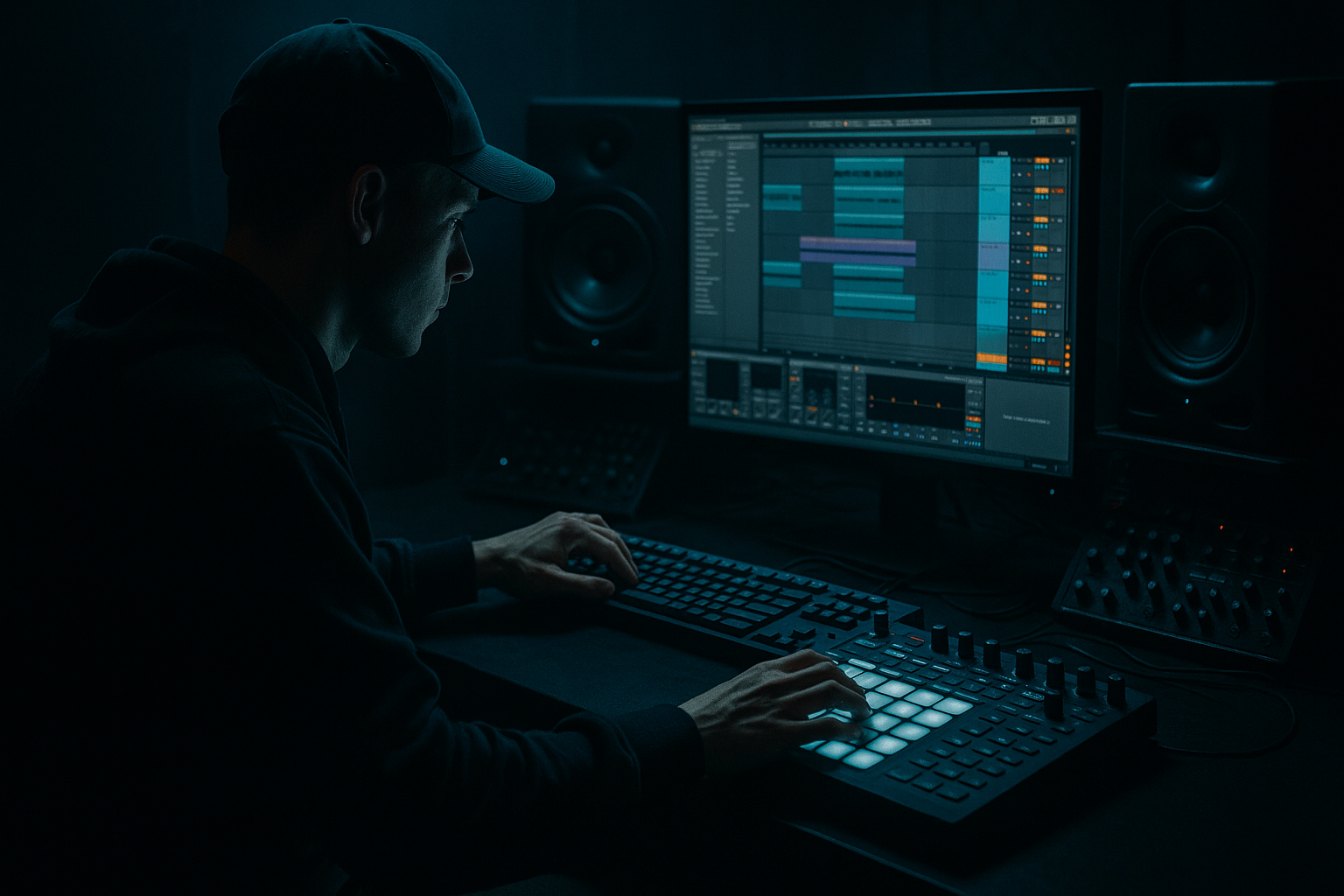
Main tutorial
Snare Flam Programming for Old School Swing (DnB in Ableton Live) 🥁🔥
1. Lesson overview
A classic jungle / early DnB groove often feels like it’s “dragging” and “pushing” at the same time—especially around the snare. One of the easiest ways to get that old-school swing is snare flams: two very close hits that create a human, slightly sloppy (in a good way) impact.
In this lesson you’ll program flams in Ableton Live using Drum Rack/Simpler, MIDI timing, and a little velocity + layering, so your drums roll with that late-90s bounce.
---
2. What you will build
You’ll create a 2‑bar DnB drum loop (think 170–175 BPM) with:
- A tight main snare on beats 2 and 4
- A ghost flam hit just before the main snare for swing
- Subtle velocity and timing variation for that old school feel
- Optional layering for heavier modern weight while keeping vintage groove
- Start with 10–25 ms early (roughly 1/64 to 1/96 note feel at 174 BPM).
- In Live, don’t overthink the math—use your ears and zoom in.
- Set the early flam hit to 30–60 velocity
- Keep the main snare around 90–110 velocity
- Snare 1 (1.2.1): flam early by ~12 ms, velocity 45
- Snare 2 (1.4.1): flam early by ~20 ms, velocity 55
- Snare 3 (2.2.1): flam early by ~8 ms, velocity 35
- Snare 4 (2.4.1): flam early by ~18 ms, velocity 50
- Use a rimshot, tight clap, short snare ghost, or stick click as the flam
- Put it on another Drum Rack pad and program it just before the main snare
- Bars 1–4: no flams (clean intro groove)
- Bars 5–8: add flams on beat 4 only (build tension)
- Bars 9–12: flams on beat 2 + 4 (full energy)
- Bars 13–16: remove one flam and add a fill (variation)
- Add a flam before a snare fill (two quick notes) going into the drop
- Or flam the snare on the last bar to “lift” into the next section 🚀
- Flam too loud → it sounds like a bad double hit. Keep the flam velocity low.
- Flam too late (after the snare) → feels like a delay, not swing. Put it before the main snare.
- Same flam timing every time → robotic. Vary timing/velocity slightly.
- Too much groove quantize → heavy swing on everything can make DnB stumble. Apply groove subtly.
- Over-reverb on snare → flams smear. Keep snare ambience tight.
- Layer the main snare, not the flam:
- Parallel distortion on snare group:
- Add a tiny room ONLY to main snare:
- Breakbeat texture layer:
- A snare flam = a quiet hit just before the main snare.
- Keep flam lower velocity and often shorter than the main snare.
- Vary flam timing slightly across bars for authentic old-school swing.
- Use Groove Pool gently; don’t destroy DnB tightness.
- Shape the snare with EQ Eight + Drum Buss so the flam supports punch, not clutter.
---
3. Step-by-step walkthrough
Step 0 — Set the session like DnB
1. Set tempo to 174 BPM.
2. Create a MIDI Track and load:
- Drum Rack (from Instruments → Drum Rack)
3. Drag in:
- A kick (short, punchy)
- A snare (crispy or 909-ish works great)
- A closed hat (short tick)
> Tip: If you don’t have samples, use Ableton’s packs (e.g., “Core Library” drums) and start simple.
---
Step 1 — Program a basic 2-step backbone (foundation)
1. Create a 2-bar MIDI clip (right-click in an empty slot → Insert MIDI Clip).
2. In the MIDI editor, set grid to 1/16.
3. Place:
- Kick: Bar 1 Beat 1 (1.1.1), and optionally another at 1.3.1 (classic 2-step variations are fine)
- Snare: 1.2.1 and 1.4.1 (beats 2 and 4)
- Copy those snares to bar 2: 2.2.1 and 2.4.1
4. Add hats on 1/8 or 1/16 to taste.
You should now have a clean, rigid “grid DnB” loop.
---
Step 2 — Make your first flam (the classic pre-snare grace note)
A flam is essentially: quiet hit slightly before loud hit.
#### The simplest flam method (MIDI duplicate + nudge)
1. Click the snare at 1.2.1 (the main snare on beat 2).
2. Duplicate it (Ctrl/Cmd + D).
3. Drag the duplicated note slightly earlier.
Timing target:
Velocity target:
4. Repeat for snares on 1.4.1, 2.2.1, 2.4.1.
✅ Result: The snare now “leans” into the beat and feels more human.
---
Step 3 — Add old school swing with uneven flam placement (key move)
If every flam is identical, it starts sounding like a marching band. Jungle swing comes from variation.
Try this pattern over 2 bars:
Keep the main snare hits consistent to anchor the groove.
---
Step 4 — Shape the flam so it doesn’t “double crack” (important)
Two full snare hits can sound like a mistake unless you control them.
#### Option A: Use the same snare sample, but shorten the flam hit
If your snare is in Simpler (inside Drum Rack):
1. Click the snare pad → open Simpler
2. Turn on One-Shot
3. Reduce the flam hit’s length by using note length (in MIDI) and/or:
- Global → Volume Envelope → Shorter Decay
- Or raise Sustain down and adjust Decay depending on Simpler mode
Goal: the flam hit should be more like a tick leading into the main snare, not a full second snare.
#### Option B: Use a different “flam layer” sample (very jungle)
Instead of duplicating the same snare:
This is super effective for that sampled-break vibe. 🎛️
---
Step 5 — Add groove with Ableton’s Groove Pool (subtle!)
Old school swing isn’t only snare timing; hats and ghosts matter too.
1. Open Groove Pool (hotkey depends on version, or click the Groove icon).
2. Try a groove like:
- MPC 16 Swing (start around 55–60%)
3. Drag the groove onto your clip.
4. Set:
- Timing: 20–40%
- Velocity: 0–20% (optional)
- Random: 0–10% (tiny!)
Important: Don’t fully quantize after this or you’ll erase the feel.
---
Step 6 — Control the snare transient so flams hit hard, not messy
Add a simple stock chain on the snare pad (in Drum Rack):
On the snare chain (recommended order):
1. EQ Eight
- HP filter around 100–140 Hz (remove low rumble)
- Small cut if boxy around 300–500 Hz
- Small boost for crack around 2–5 kHz if needed
2. Drum Buss
- Drive: 2–6
- Crunch: 0–15 (tiny)
- Boom: 0–10 (be careful; can muddy flams)
- Damp: adjust to tame harshness
3. Saturator (optional)
- Soft Clip ON
- Drive: 1–4 dB
If the flam makes the snare too long, shorten the tail (Simpler decay) or reduce reverb.
---
Step 7 — Arrangement ideas (where flams shine in DnB)
Use flams like a musical “accent,” not constant spam.
Try this 16-bar idea:
For fills:
---
4. Common mistakes
---
5. Pro tips for darker/heavier DnB 🖤
Keep the flam as a light “tick,” but layer the main snare with a short clap or noise snap for weight.
Group your drums → make a return chain inside the group:
- Return: Saturator (Drive 5–10 dB, Soft Clip ON) → EQ Eight (cut lows) → Compressor
Blend lightly for thickness without killing transients.
Use Hybrid Reverb or Reverb with:
- Decay 0.3–0.7s
- Pre-delay 10–25 ms
- Low cut 200–400 Hz
Keep the flam dry or much drier so the lead hit stays punchy.
Add a very quiet amen/think break layer underneath (high-passed), and let your flams interact with that grit. That’s instant jungle DNA.
---
6. Mini practice exercise (10 minutes) 🎯
1. Make a 2-bar loop at 174 BPM with kick + snare on 2 and 4.
2. Create flams on each snare using:
- Flam timing: 8 ms, 12 ms, 18 ms, 22 ms (different each hit)
- Flam velocity: 35–60
3. A/B test:
- Version A: same flam timing everywhere
- Version B: varied flam timing/velocity
4. Choose the version that feels more “rolled” and less robotic.
5. Export a short audio loop and label it:
“DnB Flam Swing 174bpm – v1/v2”
---
7. Recap ✅
If you tell me what style you’re aiming for (classic jungle, rollers, jump-up, techy), I can suggest exact flam timings and snare layer choices that match that vibe.

