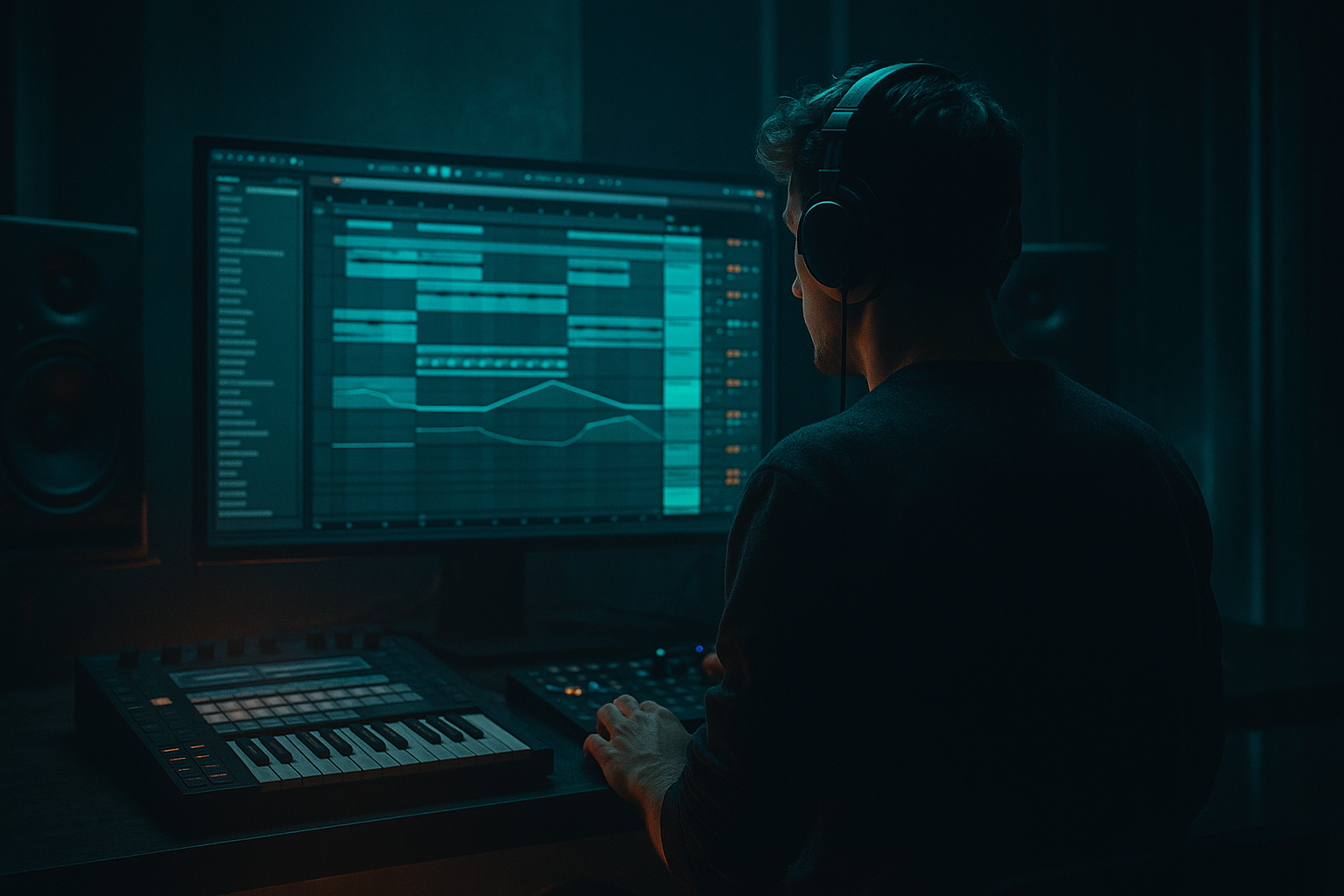
Main tutorial
Snare Flam Timing Masterclass (DnB) — Ableton Live 12 Stock Packs 🥁⚡
1) Lesson overview
A great DnB snare isn’t just a sound—it’s timing, layering, and micro-groove. In rolling drum & bass, the flam (two hits close together) can make your snare feel wider, heavier, and more “alive” without turning it into a messy double-hit.
In this lesson you’ll learn how to build tight, intentional flam patterns using Ableton Live 12 stock packs, and how to control them with Groove Pool, MIDI timing, velocity shaping, Drum Rack, and stock FX.
---
2) What you will build
You’ll create a classic DnB 2 & 4 snare with a controlled flam that:
- feels punchy at 170–175 BPM
- can swing/roll like jungle or modern rollers
- stays consistent in the mix (no random peaks)
- can be pushed darker/heavier with stock devices
- A Drum Rack snare chain (main hit + flam layer)
- A timing method using MIDI notes + Track Delay + Groove
- Two arrangement-ready flam variations:
- Turn Grid off or set it very small.
- Hold Alt/Option while moving notes for fine movement (depending on your settings).
- Or use the Note Position fields in the Clip View (if visible) and aim by ear.
- Main snare: velocity 105–120
- Flam note: velocity 35–70
- If the flam is too loud, it becomes a double snare (unwanted). Keep it as a lead-in.
- Put the flam on its own MIDI note (e.g. MAIN = C1, FLAM = C#1), or
- Keep them on the same note but control offset via Track Delay using two tracks (cleanest), or
- If you keep it inside Drum Rack: route flam to its own chain and use Delay compensation trick (less ideal).
- Use two MIDI notes (C1 + C#1).
- Put MAIN on 2 and 4, then put FLAM hits slightly before.
- Transpose: try -2 to -5 semitones (darker lead-in)
- Length: shorten decay; you want “tick” + little body, not a full tail
- Fade Out: small fade to reduce click if needed
- Add Drum Buss
- Add EQ Eight
- Saturator
- Glue Compressor
- Limiter
- In the last bar before the drop, increase flam timing from 12 ms → 25 ms (automation or manual edits).
- Also raise flam velocity slightly (e.g. +10).
- Bar 1–2: flam only on beat 4
- Bar 3–4: flam on beat 2 and 4
- Add a third super-quiet flam/ghost note after the main snare:
- Pitch the flam down a few semitones and HP it higher.
- Add Roar (Live 12) on the snare bus:
- Use Hybrid Reverb for micro-space:
- Create a snare parallel crush (Return track):
- For neuro/techy rollers: keep flams tight (8–15 ms) and let heaviness come from transient control + distortion, not sloppy timing.
- A DnB snare flam is timing + dynamics, not just two hits.
- Start with 2 & 4, then add a flam 8–35 ms before the main snare.
- Keep the flam quieter and shorter, often slightly darker.
- Use stock tools: Drum Rack, Simpler, EQ Eight, Drum Buss, Saturator, Glue Compressor, Groove Pool, Hybrid Reverb, Roar (Live 12).
- Arrange flams intentionally: build tension, add movement, and keep the drop consistent.
You’ll end with:
- Tight flam (modern rollers)
- Lazy flam (jungle-ish swagger)
---
3) Step-by-step walkthrough
Step 0 — Session setup (don’t skip)
1. Set tempo to 174 BPM.
2. Create a Drum Rack on a MIDI track.
3. Load a stock snare:
- From Packs (stock Ableton packs vary by install), browse a drum pack like:
- Drum Essentials / Core Library / Beat Tools (any clean DnB-ish snare works)
- Drop a snare sample onto a pad (e.g. C1) in Drum Rack.
Goal: Choose a snare with a clean transient. The flam will supply “width” and texture—don’t start too washy.
---
Step 1 — Program the DnB backbone
1. Create a 1-bar MIDI clip.
2. Place snare hits on beat 2 and beat 4 (typical DnB):
- In 4/4 at 174 BPM: place notes at 1.2.1 and 1.4.1.
3. Add a basic kick pattern (optional but helpful for feel):
- Kick at 1.1.1, and a second kick around 1.3.1 or 1.3.3 depending on vibe.
Keep it simple—your ears should focus on snare feel.
---
Step 2 — Create the flam (two practical methods)
#### Method A: MIDI flam (fast + precise)
1. Duplicate each snare note (select note → Ctrl/Cmd + D).
2. Nudge the duplicated note earlier by:
- 8–18 ms for a tight modern flam
- 18–35 ms for a looser jungle flam
How to nudge in Live:
Velocity shaping (crucial):
✅ This method gives you maximum control and is easiest to automate later.
---
#### Method B: Layered flam pad (cleaner mixing + more sound design)
This is the pro workflow when you want consistent tone and easier processing.
1. In Drum Rack, duplicate the snare pad:
- Right-click the snare chain → Duplicate
2. On the duplicated chain, change the sample slightly:
- Use a different snare from a stock pack or reuse the same snare but change pitch/length.
3. Rename chains:
- `Snare MAIN`
- `Snare FLAM`
Now offset timing without messy MIDI edits:
Best simple approach inside one track:
This keeps processing clean: you can EQ and saturate flam differently than main.
---
Step 3 — Shape the flam so it feels like DnB (not a mistake)
#### 3A) Tune + shorten the flam
On `Snare FLAM` chain, add Simpler controls:
This makes the flam read as impact setup, not “two snares”.
#### 3B) Make the main snare punch through
On `Snare MAIN` chain:
- Drive: 3–10
- Crunch: 0–20 (taste)
- Boom: Off or very low for DnB (often kicks own the sub)
- Damp: adjust until tail isn’t fizzy
- High-pass around 80–120 Hz (keep low-end clean)
- If boxy: dip 200–400 Hz
- If harsh: dip 4–7 kHz slightly
---
Step 4 — Groove Pool: add roll without losing punch 🎛️
DnB flam timing gets exciting when you apply controlled swing.
1. Open Groove Pool.
2. Load a groove:
- Try MPC-ish swing or any stock groove with subtle shuffle.
3. Apply it to the snare clip.
4. Suggested groove settings:
- Timing: 10–25%
- Velocity: 0–10% (small)
- Random: 0–5% (keep tight in DnB)
- Base: 1/16
DnB tip:
Let the groove affect the flam more than the main. If groove makes the main snare late, your entire drop can feel sluggish. Keep main hits more “grid-locked,” and let the flam carry the looseness.
Workflow option: Put flam notes on a separate clip/track so you can groove it differently.
---
Step 5 — Control transients and peaks (so the mix doesn’t fight you)
Add these stock devices on the snare group/bus (or on Drum Rack output):
Chain idea (stock-only):
1. EQ Eight (cleanup)
2. Drum Buss (glue + punch)
3. Saturator (density)
4. Glue Compressor (control)
5. Limiter (safety)
Starting settings:
- Mode: Soft Clip
- Drive: 1–4 dB
- Output: match level
- Attack: 3 ms
- Release: Auto or 0.1–0.3 s
- Ratio: 2:1
- Threshold: aim for 1–3 dB GR on snare peaks
- Ceiling: -0.5 dB
- Only catching occasional spikes (not crushing)
Why this matters: flams create quick double transients, which can cause unwanted peak jumps even if it “sounds fine” solo.
---
Step 6 — Arrangement moves (make it feel like a real DnB record)
Here are reliable flam-based arrangement ideas:
#### A) “Drop emphasis” flam
Result: more tension and “human push” into the drop.
#### B) “Call and response” snare
This creates development without changing core drum samples.
#### C) Jungle ghost vibe
- +20 to +40 ms after main
- velocity 15–35
Keep it subtle—this can mimic old break nuance while staying clean.
---
4) Common mistakes
1. Flam too loud → it becomes an accidental double snare.
- Fix: lower flam velocity, shorten flam tail.
2. Flam too late → sounds like a sloppy drummer rather than a controlled flam.
- Fix: keep flam before the main hit most of the time.
3. Groove on everything → whole track feels behind.
- Fix: groove hats/ghosts/flams more than main kick/snare.
4. No EQ separation → flam muddies body frequencies.
- Fix: HP the flam more aggressively (try 150–250 Hz).
5. Over-saturating the bus → flam turns into crunchy click.
- Fix: saturate main more than flam; consider softer saturation or less drive.
---
5) Pro tips for darker/heavier DnB 😈
Sounds weird on paper, works in practice: you get the perception of weight without low-end mess.
- Use subtle distortion + filtering, automate intensity in fills.
- Keep it controlled—DnB needs consistency.
- Very short room (0.2–0.5s), low mix (5–12%)
- High-pass the reverb return (EQ Eight) to keep it dark/clean.
- Return A: Glue Compressor (harder GR), Saturator, EQ Eight
- Send only the main snare body, not the flam transient, if it gets too clicky.
---
6) Mini practice exercise (10 minutes) ⏱️
1. Make a 4-bar loop at 174 BPM with kick + snare on 2/4 + hats.
2. Create three flam variants on bar 4 only:
- Variant 1: 10 ms, flam velocity 50
- Variant 2: 20 ms, flam velocity 55
- Variant 3: 30 ms, flam velocity 60 but shorter decay
3. Bounce (freeze/flatten) a quick audio print of each and level-match.
4. Pick the one that feels:
- tightest in groove
- strongest in the drop
- least annoying after 8 repeats
Bonus: Apply Groove Pool to only the flam notes and compare.
---
7) Recap
If you tell me your sub-genre (liquid, rollers, jungle, neuro, dancefloor) and whether you’re using breaks or one-shots, I can give you a flam timing “recipe” tailored to that exact vibe.

