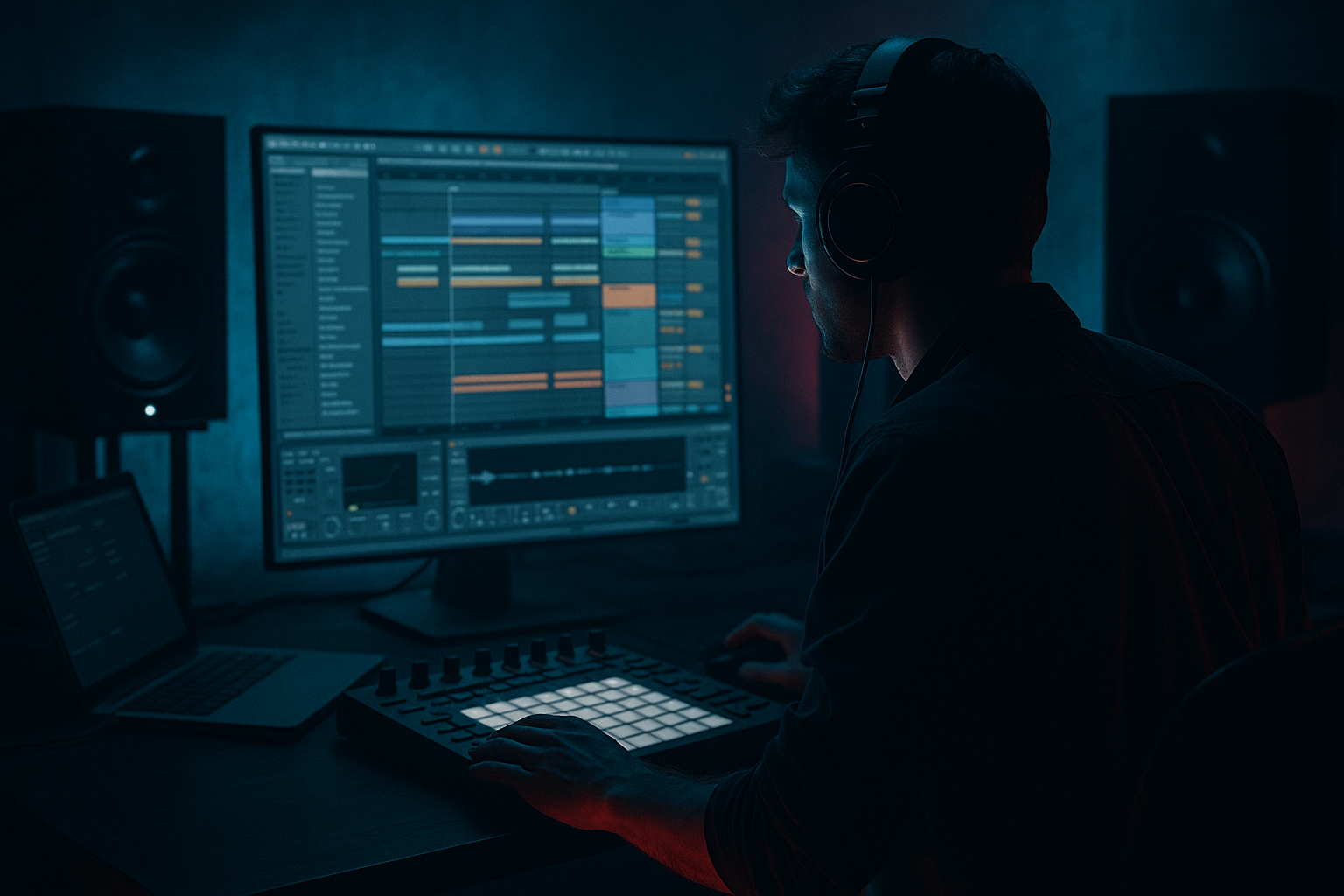
Main tutorial
Snare Flam Timing with Clean Routing (DnB in Ableton Live) 🥁⚡
1. Lesson overview
A snare flam in drum & bass is that tight double-hit that makes your backbeat feel bigger, faster, and more aggressive—without sounding like a messy doubled snare. In rolling DnB/jungle, flams often sit right before or right on the 2 and 4, adding urgency and groove.
In this lesson you’ll learn:
- How to time flams correctly (in milliseconds + groove terms)
- How to keep routing clean and mix-ready (bus structure, return FX, resampling)
- How to create flams using MIDI, audio, and Drum Rack
- How to keep the flam punchy, phase-safe, and controlled in a dense DnB mix
- A main snare (body + crack)
- A ghost/flam hit (shorter, quieter, slightly filtered)
- A Snare Bus for glue + transient control
- A parallel reverb return (tight, gated-ish vibe)
- Optional resampled flam layer for consistency
- Tempo: 172–176 BPM (try 174 BPM)
- Create a basic DnB grid:
- Turn on Metronome and set 1 Bar count-in if recording.
- Duplicate the snare chain inside Drum Rack:
- A tight punchy snare (top end crack)
- A short “papery” layer or rim-like tick for the flam hit
- Disable grid temporarily: Ctrl/Cmd + 4 (turn off Snap)
- Select the flam note → Alt + Arrow keys nudges (or drag carefully)
- You can also use the Note Delay MIDI device (next step) for surgical control.
- Main snare: 100–127
- Flam hit: 35–75 (depends on style)
- If you want “jungle snap,” keep flam velocity lower but make it bright.
- You can change flam timing globally without re-editing MIDI.
- Your groove stays consistent across the track.
- Drum Rack track: `DRUMS (MIDI)`
- Inside Drum Rack:
- Group the snare layers:
- Hybrid Reverb (or Reverb)
- After reverb: Gate
- Optional: EQ Eight after Gate
- Intro → Drop: no flam in intro, add it at drop for instant “bigger drums” 💥
- Every 4 bars: flam only on bar 4 to lead into the next phrase
- Call-and-response: flam on beat 4 only, then switch to beat 2 only in the next section
- Fill moments: add a tighter flam (8–12 ms) before a crash or bass switch
- Automate flam chain Utility Gain:
- Flam too loud: If it’s near the main snare level, it sounds like a double-trigger, not a flam.
- Flam too wide: Wide early transients can smear the center punch. Keep flam mostly mono.
- Timing too long: Above ~25–30 ms it starts to sound like a sloppy delay rather than a flam.
- Too much reverb on the flam: Reverb on the pre-hit can wash the transient and blur the groove.
- Phasey layering: Using the exact same snare twice with no changes can cause comb filtering. Filter/shorten the flam layer.
- Make the flam hit darker: Low-pass the flam around 6–9 kHz so the main snare owns the crack.
- Use distortion in parallel, not on the flam:
- Transient hierarchy:
- Add a tiny pitch offset:
- Dark room verb:
- A great DnB flam is tight (10–18 ms), quieter, and tonally supportive.
- Note Delay gives you clean, global flam control without messy MIDI edits.
- Keep routing professional: Snare layers → Snare Bus → Returns, with short controlled reverb.
- Use flams as an arrangement tool to lift drops and transitions—not necessarily everywhere.
---
2. What you will build
You’ll build a DnB snare group with:
Target vibe: modern roller / jungle-forward, where the snare is wide and heavy but still fast.
---
3. Step-by-step walkthrough
Step 0 — Session setup (quick but important)
- Kick on 1
- Snare on 2 and 4
---
Step 1 — Choose or build a snare that can take a flam
Flams expose weak snares. You want a snare with a clear transient.
Option A: Drum Rack (recommended for routing + layering)
1. Create a MIDI track → drop a Drum Rack.
2. Put your Main Snare sample on D1.
3. Put a Flam/Ghost Snare sample on D#1 (could be the same sample, but we’ll process it differently).
Option B: Same sample, different processing
- Right-click the snare pad → Extract Chains (optional) for advanced routing
- Or simply load the same sample onto two pads.
Good starting samples for DnB:
---
Step 2 — Program the flam timing (MIDI method)
This is the cleanest and most controllable approach.
1. Make a 1-bar MIDI clip with snares on beat 2 and 4.
2. For each snare hit, add a second note just before it (this is the flam note).
3. Set the timing offset:
- Start with 10–18 ms early (common DnB sweet spot).
- In grid terms at 174 BPM:
- Try moving the flam note 1/128 early, then fine-tune by ear with the nudge.
How to nudge precisely in Ableton:
Velocity settings (crucial):
---
Step 3 — Use Note Delay for perfect flam control (clean + repeatable) 🎯
Instead of manually moving MIDI notes, you can keep them on-grid and delay one layer.
1. Put Main Snare on D1 and Flam Snare on D#1.
2. Create two separate chains (inside Drum Rack) or use two pads.
3. On the Flam/Ghost chain, add Note Delay:
- Set Delay to -10 ms to -20 ms (negative makes it earlier)
- Set Random to 0 ms for consistency (or 2–5 ms for human grit)
4. Keep the MIDI notes stacked on the exact same step (same time), and let Note Delay create the flam.
Why this is great:
---
Step 4 — Process the flam hit so it supports, not competes
The flam hit should be shorter, quieter, and often darker than the main snare.
On the Flam/Ghost chain, try this Ableton stock chain:
Device chain (Flam/Ghost):
1. EQ Eight
- High-pass: 200–400 Hz (remove low body)
- Gentle shelf down around 6–10 kHz if it’s too fizzy
2. Transient Shaper (Live 12 stock device) or Drum Buss
- If using Drum Buss:
- Drive: 2–6
- Transients: -5 to +5 (often slightly down for the flam)
- Boom: Off (usually)
3. Utility
- Gain: -6 to -12 dB (set level quickly)
- Width: keep 0–30% (flam is usually more mono so it punches)
Goal: The flam should feel like “extra hand energy,” not like “two snares fighting.”
---
Step 5 — Clean routing: Snare Bus + Returns (mix-ready workflow) 🧼
DnB drums hit hardest when routing is organized.
Recommended routing structure:
- Main Snare chain output → SENDS ONLY (optional advanced) or just keep it internal
- Right-click chains → Extract Chains to separate tracks (optional)
- Or keep in Drum Rack and route to a dedicated Snare Bus using Audio To (if extracted)
Simple and clean approach (works great):
1. Keep both snares inside Drum Rack.
2. Create an Audio Effect Rack on the Drum Rack track called SNARE BUS (this processes combined snare output).
3. Add Return tracks:
- Return A: Short Verb
- Return B: Drum Crush (parallel) (optional)
Return A (Short Verb) stock setup:
- Type: Room / Ambience
- Decay: 0.3–0.7 s
- Pre-delay: 10–25 ms
- High-cut: 7–10 kHz
- Threshold: set so tail cuts quickly
- Return: 50–150 ms vibe (tight)
- Cut lows under 200–300 Hz
- Tame harshness around 3–5 kHz if needed
SNARE BUS chain (stock):
1. EQ Eight
- Tiny cut at harsh zone (often 3–6 kHz, -1 to -3 dB Q medium)
- Optional low cut below 120 Hz (depends on snare)
2. Glue Compressor
- Attack: 3–10 ms
- Release: Auto
- Ratio: 2:1
- Aim for 1–3 dB gain reduction on main hits
3. Saturator
- Mode: Soft Clip
- Drive: 1–4 dB
- Output: trim to match level
This keeps your flam layers together and makes the snare feel like one instrument.
---
Step 6 — Arrangement: where DnB flams actually work
Use flams as energy automation, not constant decoration.
Try these placements:
Automation idea:
- Verse: -12 dB (barely there)
- Drop: -6 dB (present)
- Peak: -3 dB (aggressive)
---
Step 7 — Optional: resample the snare flam for consistency (DnB pro workflow)
Sometimes you want the flam to sound exactly the same every time (especially after heavy bus processing).
1. Create a new audio track: `SNARE RESAMPLE`.
2. Set Audio From: your snare/drum track (or group).
3. Arm and record a few bars.
4. Slice the best hit(s), then use:
- Simpler in One-Shot mode
- Or drop into Drum Rack as a new consolidated snare
This can make your drop drums super stable and easier to mix.
---
4. Common mistakes
---
5. Pro tips for darker/heavier DnB 🖤
- Put Roar or Saturator on a return, send the snare bus lightly.
- Flam transient = small
- Main snare transient = king
- Use Drum Buss or Transient Shaper accordingly.
- In Simpler: transpose flam layer -1 to -3 semitones for weight without clutter.
- Hybrid Reverb with darker filtering + short decay makes the snare feel “in a tunnel” without getting roomy.
---
6. Mini practice exercise (10 minutes) ⏱️
1. Program a 2-step DnB beat (kick on 1, snare on 2 & 4).
2. Add a flam layer using Note Delay at -14 ms.
3. Set flam velocity to 55, main snare to 115.
4. Add Return A “Short Verb” and send:
- Main snare: -18 dB send
- Flam snare: -24 dB send
5. Now make 3 variations:
- A) Flam only on beat 4
- B) Flam on 2 and 4
- C) Flam on 2, but tighten timing to -10 ms
6. Bounce/resample 4 bars and listen: which variation rolls hardest?
---
7. Recap
If you tell me your substyle (liquid roller, neuro, jungle, halftime DnB) and whether you’re using Drum Rack or audio breaks, I can suggest flam timings and bus chains that fit that exact vibe.

