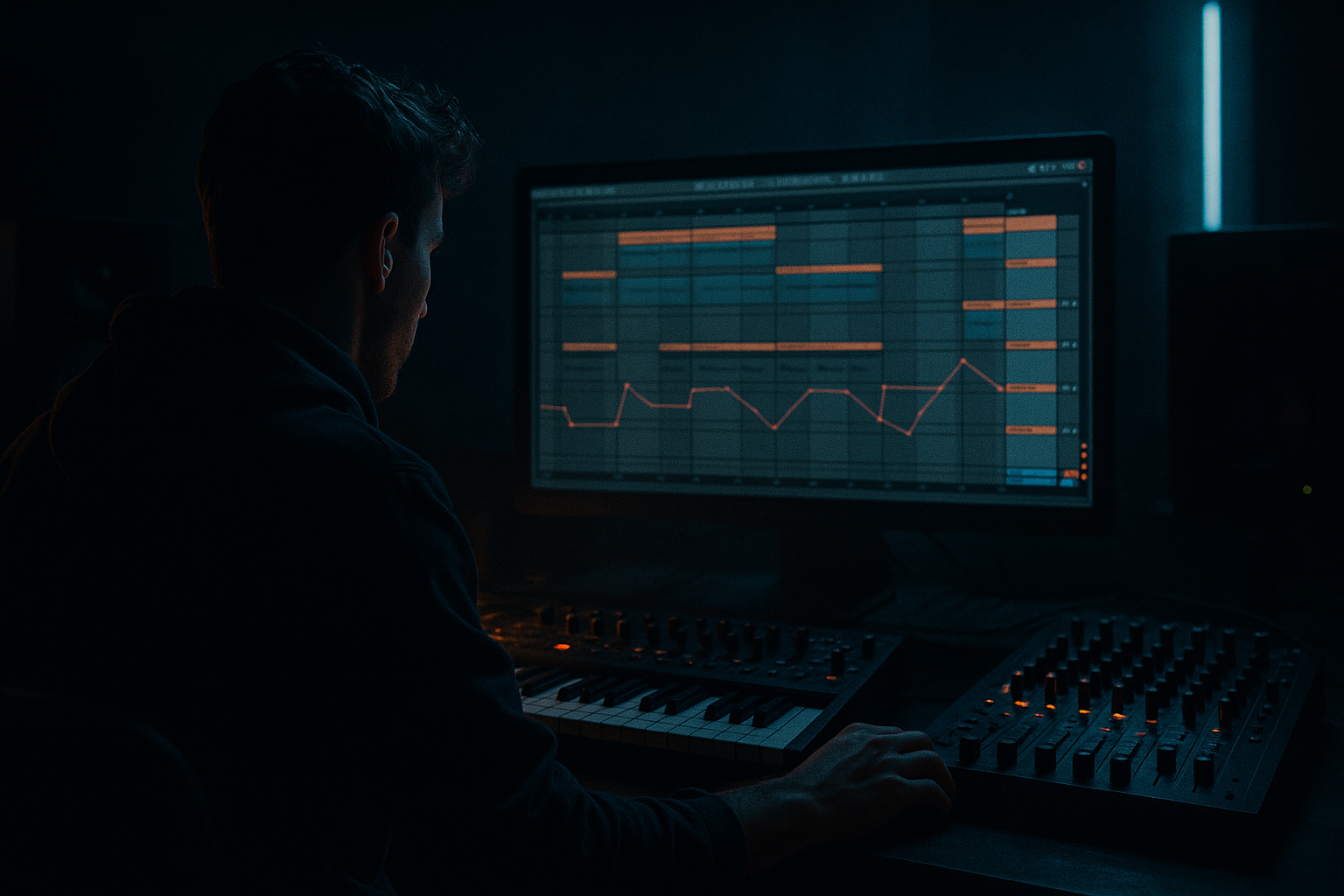
Main tutorial
```markdown
Snare Snap in Ableton Live 12 (Jungle/Oldskool DnB) — Automation‑First Workflow 🥁⚡
Skill level: Advanced
Category: Automation (arrangement + micro‑movement)
---
1. Lesson overview
In jungle/oldskool DnB, the snare “snap” isn’t just a loud transient—it’s a moving target. The classic vibe comes from tiny changes bar-to-bar: pitch drifts, envelope tweaks, saturation “breathing,” and subtle spectral shifts that keep a loop rolling without sounding static.
This lesson teaches an automation‑first workflow in Ableton Live 12 where you:
- Build snap using layering + transient shaping + controlled distortion
- Use automation as the main instrument (macros + arrangement envelopes)
- Keep it oldskool (crunchy, snappy, slightly unstable) but still mix‑ready
- Layer A (Body): punchy mid “thwack” (180–250 Hz + 1–3 kHz)
- Layer B (Snap): bright transient + air (3–10 kHz), short and aggressive
- transient emphasis (attack)
- pitch micro‑movement
- saturation intensity
- dynamic EQ tilt
- micro room/verb flicks
- “fill” intensity on bar 8/16/32
- A snare from a break (e.g., classic Amen/Think-style snare) for authenticity
- A clean one-shot for controllability
- Layer a break snare (grit + vibe) with a clean transient (definition)
- Pad C1: `Snare Body` (break-derived snare or a warm one-shot)
- Pad C#1: `Snare Snap` (short, bright transient—could even be a rim/click/noise burst)
- Mode: One-Shot
- Warp: Off (unless it’s a long break slice you’re shaping)
- Start: trim to remove pre-transient fluff
- Decay: ~180–260 ms (depends on vibe)
- Fade Out: small (3–10 ms) to prevent clicks
- Transpose: start at 0, we’ll automate later
- Decay: 40–110 ms
- Filter: HP or BP if needed
- Fade Out: 2–6 ms
- HP filter at ~90–120 Hz (12 or 24 dB/oct)
- Gentle dip 250–450 Hz if boxy (1–3 dB)
- Small presence bump 2–4 kHz if needed (0.5–2 dB)
- Optional: shelf +1 dB around 8–10 kHz (if you need air)
- Drive: 5–20% (don’t overdo yet)
- Crunch: 0–10% (oldskool grit)
- Damp: 5–30% (tames harshness)
- Transient: +10 to +35 (this is your snap lever)
- Boom: Off or very subtle (snare doesn’t need sub boom)
- Mode: Soft Sine or Analog Clip
- Drive: 1–6 dB
- Output: match level (important for judging snap)
- Soft Clip: On (if you want harder edge)
- Attack: 3 ms (lets transient through; try 1 ms if too spiky)
- Release: Auto or 0.1–0.3 s
- Ratio: 2:1 or 4:1
- Aim for 1–3 dB gain reduction on hits
- Use lightly as a tone shaper, not a destroyer (unless you want techy chaos).
- Start with a mild distortion curve and keep Mix low (10–30%).
- Use for final level trim and mono control.
- Jungle snares are often effectively mono-compatible.
- Select EQ Eight → Utility → Cmd/Ctrl+G
- Name the rack: `SNARE SNAP AUTOPILOT`
- Map to Drum Buss → Transients
- Range: +5 to +45 (tune to taste)
- Map to Saturator → Drive
- Range: 0 to +8 dB
- Also map Output inversely if you want level consistency (advanced but worth it)
- Map to EQ Eight:
- Map to Simpler Transpose (Body and/or Snap layer)
- Range: -2 to +3 semitones
- Map to Glue Compressor → Threshold
- Range: subtle, e.g. -10 to -22 dB depending on input level
- Add Reverb inside the rack (after Glue)
- Map Reverb Dry/Wet to Macro 6
- Range: 0–12% (tiny bursts only)
- Add Multiband Dynamics or use EQ Eight dynamic bands (Live 12 supports dynamic EQ in EQ Eight)
- Target: dynamic control around 6–9 kHz
- Map the dynamic amount/threshold to Macro 7
- Map to multiple things at once for transitions:
- Standard: Beat 2 and 4 (in 4/4)
- Add ghost notes (quiet) before the main snare:
- Macro 1 (Snap): slowly rising from ~20% to ~40%
- Macro 2 (Edge): small rise, 0 → +2 dB
- Macro 6 (Air Pop): keep near 0, then add a tiny flick on bar 8
- Add tiny ramps or step changes on specific hits, especially at the end of phrases:
- Intro (bars 1–16): Macro 1 at 15–25%
- Drop (bar 17): jump Macro 1 to 35–50%
- Keep Macro 7 (Harsh Tamer) ready to prevent brittleness
- Macro 8 (Fill Hype): quick ramp up in last 1–2 beats
- Then hard reset to normal at the downbeat
- On Bass group: Compressor sidechained from Snare Rack
- Fast attack, medium release
- 1–3 dB reduction on snare hits
- On bass: dip ~200 Hz slightly if it masks snare body
- On snare: keep energy focused around 180–250 Hz + 2–5 kHz
- Make snap darker but heavier:
- Use Roar for “metal edge” without fizz:
- Parallel crunch channel (oldskool grit):
- Clipper-style control (stock):
- Break integration:
- Jungle/DnB snare snap is layering + tight envelopes + controlled harmonic edge.
- The pro move is automation-first: macros that perform the snare through the arrangement.
- Use Drum Buss Transients for snap, Saturator/Roar for bite, EQ Eight for focus, Glue for cohesion.
- Write automation in 8/16/32 bar arcs plus micro-changes on key hits for that oldskool “sampler alive” feel.
---
2. What you will build
A two-layer snare designed for jungle/rolling DnB:
Then you’ll create a Macro rack where automation drives:
Result: a snare that hits hard, evolves, and sits inside classic break-driven arrangements. 🔥
---
3. Step-by-step walkthrough
Step 0 — Session setup (fast but important)
1. Set tempo to 165–172 BPM (classic jungle sits nicely at 168).
2. In Arrangement View, create a 32‑bar loop region.
3. Create a Drum Rack track named: `SNARE RACK`.
Why Arrangement View? Because automation is easier to compose like a DJ-friendly progression (8/16/32 bar arcs).
---
Step 1 — Choose source sounds (snap starts at the sample)
You can use:
Practical approach (best of both):
In your Drum Rack:
Tip: Keep each layer short and tight before processing. Snap hates long tails.
---
Step 2 — Tighten each layer with Simpler (classic snap discipline)
On Snare Body (C1) → Simpler:
On Snare Snap (C#1) → Simpler:
- HP around 1.5–3 kHz (remove low junk)
Goal: the Snap layer should sound like a sharp kiss of brightness, not a second snare.
---
Step 3 — Group and build an automation-ready processing chain
Select both pads → right-click → Group to Drum Rack (or just process at the rack level).
On the Drum Rack track (SNARE RACK) add devices in this order:
1) EQ Eight (cleanup + focus)
2) Drum Buss (transient + drive)
3) Saturator (edge + density)
4) Glue Compressor (cohesion)
5) Roar (optional but powerful in Live 12) (character + movement)
6) Utility (final gain + width control)
#### Suggested starting settings
1) EQ Eight
2) Drum Buss
3) Saturator
4) Glue Compressor
5) Roar (optional)
6) Utility
---
Step 4 — Create a Macro Rack for automation (this is the main event) 🎛️
Group the whole chain into an Audio Effect Rack:
Create 8 Macros and map these targets:
Macro 1 — “Snap (Transient)”
Macro 2 — “Edge (Saturation)”
Macro 3 — “Bite (Presence Tilt)”
- a bell boost at 3.2 kHz Gain (range 0 to +3 dB)
- optionally a small dip at 400 Hz (0 to -2 dB)
This creates a “forward snap” macro.
Macro 4 — “Pitch Flick”
Oldskool vibe often has tiny pitch attitude on fills.
Macro 5 — “Clamp (Glue Amount)”
This changes punch perception dramatically.
Macro 6 — “Air Pop (Short Verb)”
- Decay: 0.25–0.6 s
- Pre-delay: 0–10 ms
- HP: 600–1.5 kHz
- LP: 6–10 kHz
Macro 7 — “Harsh Tamer”
This lets you push snap without slicing ears off.
Macro 8 — “Fill Hype”
- Drum Buss Transient (+)
- Saturator Drive (+)
- Reverb Wet (+)
- Pitch Flick (+ small)
Use conservative ranges—this macro is for bar 8/16/32 lift.
---
Step 5 — Program classic jungle placement (so snap reads correctly)
In MIDI, trigger snares in a classic DnB/jungle pattern:
- e.g. a 16th just before beat 2, at very low velocity (10–30)
Ghosts + snap are a signature of rolling breaks. Keep ghosts mostly body, not bright snap.
---
Step 6 — Automation-first: write movement like a DJ-friendly arrangement ✍️
Open Arrangement automation for your rack macros.
#### A) 8-bar arc (repeatable)
Over 8 bars, automate:
This creates progression without rewriting drums.
#### B) Micro-movement on the snare hits (the “alive” trick)
On Macro 4 (Pitch Flick):
- Bars 8, 16, 24, 32: pitch up +1 to +2 semitones briefly then return
This reads like classic sampler behavior and adds urgency.
#### C) Contrast: make drops hit harder
Common jungle trick: reduce snap during intro, then open it at the drop.
#### D) Bar 32 “rinse” moment
On the last bar before a section change:
This is “DJ narrative automation”—simple, readable, effective. 🎚️
---
Step 7 — Make snap cut through a bass-heavy mix (without being too loud)
If your rolling bass eats your snare presence:
Option 1: Sidechain bass to snare (subtle)
Option 2: Frequency slotting
Snap isn’t just treble—it’s contrast.
---
4. Common mistakes
1. Over-bright snap (6–10 kHz) with no mid punch
Result: “tss” instead of “CRACK.” Fix: strengthen 2–4 kHz + body layer.
2. Too much transient shaping (Drum Buss Transients cranked)
You’ll get clicky, fatiguing spikes. Use Macro 7 (tamer) or reduce Transients.
3. Long tails on the snap layer
This smears groove and fights hats. Shorten decay; keep snap super tight.
4. Automation that only increases
If everything ramps up, your ear adapts. Use push/pull: rise → relax → rise.
5. No level matching when adding saturation
Louder sounds “better.” Always compensate output so you judge tone, not volume.
---
5. Pro tips for darker/heavier DnB 🖤
Instead of boosting highs, push 3–5 kHz and control 8–10 kHz dynamically (Macro 7). Dark doesn’t mean dull.
Keep Mix low, drive modest, and tilt tone toward mids. Automate Roar’s character slightly on phrase endings.
Create a Return track with Saturator → EQ Eight (HP 300 Hz, LP 7 kHz) → Glue.
Send snare in small amounts and automate the send at transitions.
Use Saturator Soft Clip or Glue Compressor with a touch of makeup gain—keeps the snare forward in loud mixes.
Layer your snare with a low-level break loop. The break’s ambience glues the snare into the jungle context instantly.
---
6. Mini practice exercise (15–25 minutes) 🎯
1. Build the rack and map 8 macros as above.
2. Write a 32-bar pattern with snares on 2 and 4 + a few ghosts.
3. Automate:
- Macro 1 (Snap): intro low → drop high
- Macro 4 (Pitch Flick): only on bars 8/16/32 final snare
- Macro 6 (Air Pop): tiny verb flick on bar 8 and bar 16
- Macro 8 (Fill Hype): last 1 beat of bar 32 ramp up
4. Bounce a 32-bar audio loop and listen on:
- low volume (does snap still read?)
- louder level (is it harsh/fatiguing?)
If it gets harsh: increase Macro 7 effect or reduce Macro 2 range.
---
7. Recap
If you want, tell me your tempo and whether you’re using a break (Amen/Think/etc.) or clean one-shots, and I’ll suggest exact macro ranges and a snare chain tuned to your mix.
```

