Main tutorial
Soul Pride: Vocal Texture Pitch for Smoky Warehouse Vibes (Ableton Live 12)
Advanced Vocals • Jungle / Oldskool DnB
---
1. Lesson overview
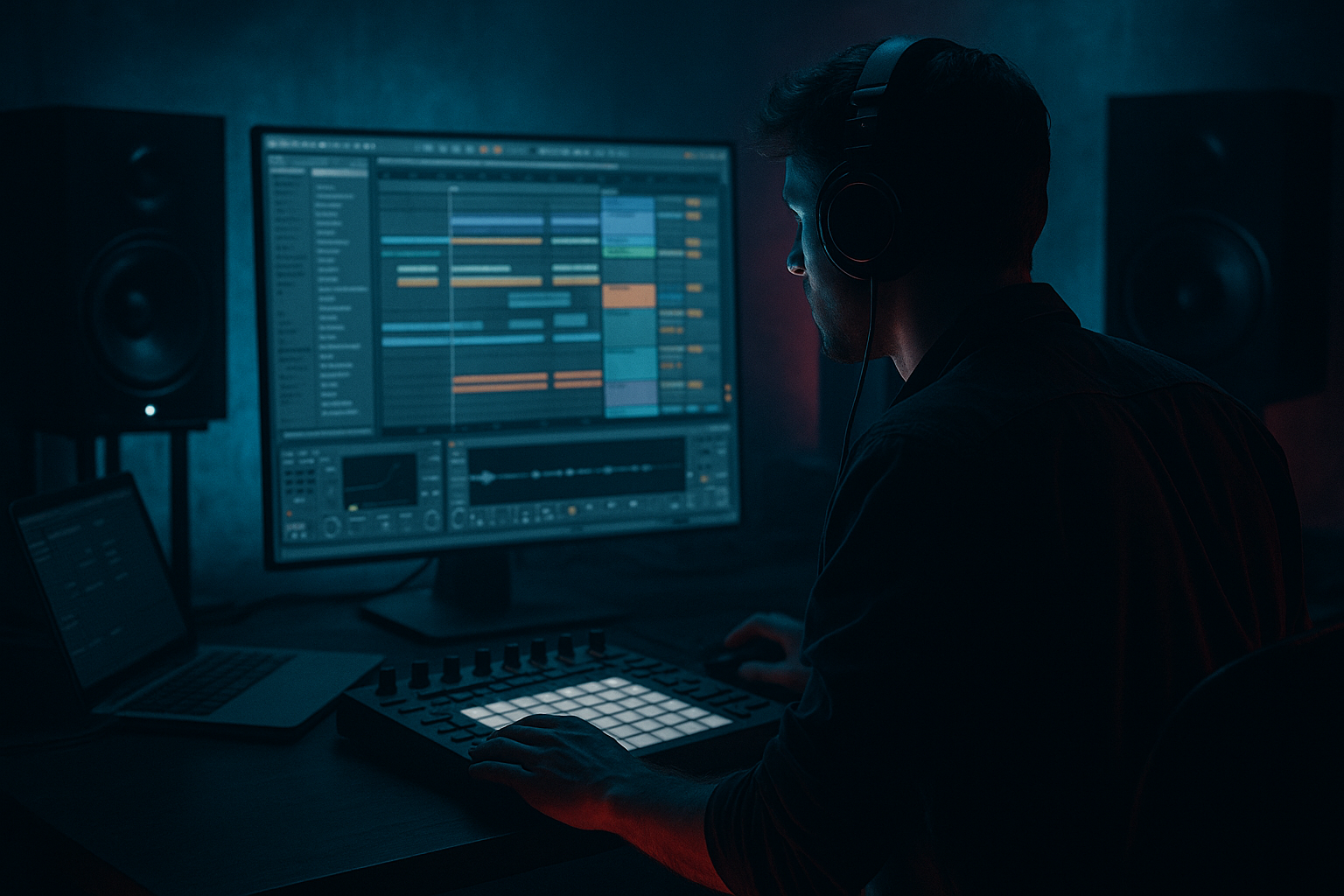
In oldskool jungle and rolling DnB, the vocal isn’t “lead singer up front”—it’s texture, attitude, and ghostly presence. This lesson is about taking a “Soul Pride”-style vocal (short phrase, chant, ad-lib, spoken line, or hook) and turning it into a smoky warehouse element using pitching, formants, resampling, gritty ambience, and tempo-aware slicing—all inside Ableton Live 12 using primarily stock devices. 🔥
We’ll build two complementary vocal layers:
- A pitched, time-stretched main texture (warm, smoky, controlled)
- A chopped “junglist” riff layer (rhythmic, ravey, resampled)
- Layer A: “Warehouse Soul Pad Vocal”
- Layer B: “Jungle Chop Hook”
- Arrangement use-case
- If you want words: Complex Pro
- If you want vibe: Texture
- Duplicate the vocal track: `Cmd/Ctrl + D`
- On the duplicated clip:
- Warp Mode: Texture
- Grain Size: `70–130 ms` (bigger = foggier)
- Flux: `10–25%` (adds movement)
- Great for turning clean soul into a ghost pad.
- Warp Mode: Complex Pro
- Formants: `-30` (start)
- Envelope: `100`
- Great if you still want the line recognizable.
- HP filter at `90–140 Hz` (12 or 24 dB/oct)
- Gentle dip `2–4 kHz` by `-2 to -4 dB` (tames harshness)
- Optional air shelf: OFF (we want dark)
- Mode: Soft Clip or Tube
- Drive: `5–12 dB` (don’t smash; you want saturation, not fuzz)
- Tone/Filter: roll off highs a bit; aim to keep it “brown”
- Mix: `40–70%`
- Filter: LP24
- Freq: `1.2–3.5 kHz`
- Resonance: `0.8–1.4`
- Envelope: subtle (`5–15`)
- Add LFO:
- Algorithm: try Hall or Room, or Convolution “Warehouse-ish” IRs
- Decay: `2.5–6.5s` (intro/breakdown: longer)
- Pre-delay: `10–25 ms`
- Low Cut: `180–300 Hz`
- High Cut: `4–7 kHz`
- Mix: `15–35%` (keep it behind the breaks)
- Width: `120–160%`
- Bass Mono: `120 Hz` (keeps low-end stable)
- Mode: One-Shot (classic stabs)
- Envelope:
- Filter: LP12 on, cutoff around `3–6 kHz` (darken it)
- Pitch/Transpose: use per-slice pitching:
- Apply a groove from Groove Pool:
- Commit lightly (don’t destroy timing): Groove Amount 30–60%
- Drive: `3–8 dB`
- Soft Clip: ON
- HP at `120–200 Hz`
- Notch any nasal tone around `800–1.2 kHz` if needed
- Time: `1/8` or `3/16` (DnB sweet spot)
- Feedback: `20–45%`
- Filter: HP `250 Hz`, LP `5–7 kHz`
- Modulation: subtle
- Tip: automate Dry/Wet to throw only at phrase ends 🎛️
- Decay: `0.6–1.4s`
- Low Cut: `250 Hz`
- Mix: `8–18%`
- Intro (16 bars):
- Pre-drop (8 bars):
- Drop (32 bars):
- Breakdown:
- Put vocals in a group: `VOCALS GRP`
- On the group:
- Over-pitching without formant control → “chipmunk/monster” vibe instead of smoky soul.
- Too much top-end reverb → fights hats and makes the mix hissy.
- Chops too long → they blur with break edits; shorten decay/release.
- Ignoring groove → vocal feels pasted-on instead of “riding” the break.
- No resampling step → sounds clean/digital; resampling is the glue.
- Make the vocal a midrange ghost:
- Parallel dirt:
- Stereo discipline:
- DnB movement automation:
- Break-friendly timing:
- Use warp mode + pitch + formants to shape the vocal’s identity (Complex Pro) or fog (Texture).
- Build two layers: a smoky pad-like vocal (Layer A) and rhythmic jungle chops (Layer B).
- Resample your processing to get that authentic, “printed” warehouse texture.
- Arrange vocals like instruments—call/response with breaks, evolving every 8 bars.
- Keep it dark: filter highs, control width, sidechain to drums, and let the Amen breathe. 🥁
---
2. What you will build
By the end, you’ll have a vocal rack that can sit in a 160–170 BPM jungle/DnB tune:
Long, smeared, pitched down, formant-shaped, saturated, living in the haze.
Slice-to-MIDI chops with tight envelopes, little pitch moves, delays, and dub-style throws.
- Layer A in intros, breakdowns, and as an under-bed during drops
- Layer B responding to the Amen edits (call/response with breaks)
---
3. Step-by-step walkthrough
Step 0 — Prep your source like a pro 🎙️
1. Choose a vocal phrase with character: breath, rasp, grit, or crowd energy. Short is fine (1–4 words).
2. Warp it cleanly:
- Double-click clip → Warp: ON
- Seg. BPM set near the source tempo if known (helps warp quality)
- Pick Warp mode:
- Complex Pro for intelligibility (best for “soul” phrasing)
- Texture for smoky smear and grain (best for warehouse vibe)
Quick rule:
---
Step 1 — Create Layer A (Smoky pitched texture) 🌫️
Goal: pitched down, dark, wide, not overly bright, feels like it’s in a big room.
#### 1A) Duplicate & pitch
- Transpose: `-3` to `-7` semitones (start at `-5`)
- Detune: `-10 to -25 cents` (tiny drift)
- If using Complex Pro:
- Formants: try `-20 to -60` (lower = chestier, darker)
- Envelope: `80–120` (higher can smear transitions)
#### 1B) Warp settings for “warehouse smoke”
Try these two approaches:
Option 1: Texture Warp (more haze)
Option 2: Complex Pro (more phrase identity)
#### 1C) Device chain (Ableton stock)
Put this on Layer A in this order:
1) EQ Eight
2) Roar (for warmth + grit)
3) Auto Filter (movement)
- Rate: `1/8` or `1/4` (sync)
- Amount: tiny (`5–12%`)
- Phase: `180°` (if you also do movement on another layer)
4) Hybrid Reverb (big warehouse)
5) Utility
✅ Checkpoint: You should hear a low, wide, smoky vocal wash that doesn’t fight your snare.
---
Step 2 — Create Layer B (Jungle chop hook) ✂️
Goal: rhythmic vocal stabs/chops that bounce with breaks at 165 BPM.
#### 2A) Slice it to MIDI
1. Right-click the original vocal clip → Slice to New MIDI Track
2. Slice preset:
- Slicing: Transient (or Warp Markers if you placed them)
- Use Built-in slicing preset (fine), we’ll customize afterward
Now you’ve got a Drum Rack with slices.
#### 2B) Tighten the chops for oldskool bounce
Open one slice in Simpler (inside the Drum Rack) and set:
- Attack: `0.0–2.0 ms`
- Decay: `120–250 ms`
- Sustain: `0`
- Release: `30–80 ms`
- Some slices `-2` or `-5` semitones for weight
- Some slices `+7` for hype responses (sparingly)
#### 2C) Groove it like it’s 1994
- Try an MPC swing around `54–58%`
- Or use a groove extracted from your break (Amen/Think)
#### 2D) Device chain on the Drum Rack (or group)
1) Saturator
2) EQ Eight
3) Echo (dub throws)
4) Reverb (short)
✅ Checkpoint: You should have playable vocal hits that sit like an instrument, not a “lead vocal.”
---
Step 3 — “Vocal Texture Pitch” resampling workflow (the secret sauce) 🔁
This is where you get that tape-y, smoked-out warehouse patina.
1. Create an Audio Track called `VOC RESAMPLE`.
2. Set Audio From to your vocal group (Layer A + B), or just Layer A.
3. Set Monitoring to IN.
4. Record 8–16 bars while you tweak:
- Formants
- Grain size (Texture)
- Reverb decay
- Filter cutoff movement
5. Consolidate the best section (`Cmd/Ctrl + J`).
6. Now re-warp the resample:
- Warp mode: Texture
- Grain: `90–160 ms`
- Transpose: `-2` more semitones (optional)
This creates a second-generation vocal texture that sounds “printed,” not plug-in-y.
---
Step 4 — Arrangement ideas (DnB-specific) 🧱
At 165–170 BPM, try this structure:
Layer A only, long reverb tail, slow filter opening. Add distant siren FX or pad.
Bring in Layer B as sparse chops (1–2 hits per bar). Automate Echo throws.
- Layer A: keep low in the mix, sidechained to drums
- Layer B: call/response with breaks; hit after snare or on the “and” of 2/4
- Switch chop pattern every 8 bars (classic jungle variation)
Resampled vocal wash + high-passed break ghost loop.
Sidechain tip: Use Compressor sidechain from your drum bus to tuck the vocal reverb behind the Amen.
---
Step 5 — Mix control: keep it loud but not in the way 🎚️
- EQ Eight: HP `100–150 Hz`
- Glue Compressor:
- Attack: `3–10 ms`
- Release: `Auto`
- GR: `1–2 dB` max (just glue)
- Limiter: only if you’re doing wild resample peaks
---
4. Common mistakes
---
5. Pro tips for darker/heavier DnB 🖤
Low cut up to `200 Hz`, high cut down to `5–7 kHz`. Let drums own the air.
Send vocals to a return with Roar (harder drive) + EQ (band-pass 300–3k) and blend at `5–15%` for grit.
Wide reverb, but keep the core vocal mid-focused. Use Utility:
- Main vocal: Width `90–110%`
- Reverb return: Width `140–170%`
Automate Auto Filter cutoff to open slightly on every 8 bars, and slam shut for fills. Micro-automation = pro energy.
Place vocal chops after the snare (late by 5–15 ms) for that lazy, rolling swagger.
---
6. Mini practice exercise (15–20 minutes) ⏱️
1. Pick a 1–2 bar vocal phrase.
2. Build Layer A:
- Transpose `-5`
- Texture warp, Grain `110 ms`, Flux `18%`
- Roar Drive `8 dB`, Hybrid Reverb Decay `4.5s`, HP `250 Hz`, LP `6 kHz`
3. Build Layer B:
- Slice to MIDI (Transients)
- Set Simpler One-Shot with Decay `180 ms`, Release `50 ms`
- Echo `3/16`, Feedback `30%`, filter it dark
4. Resample 8 bars while automating filter cutoff on Layer A.
5. Drop the resample into the intro and automate a low-pass opening over 16 bars.
Deliverable: a 16-bar intro into an 8-bar pre-drop with vocal chops.
---
7. Recap ✅
If you want, share what kind of vocal you’re starting with (spoken, sung, choir, MC shout) and your target vibe (Metalheadz darkness vs. rave/happy) and I’ll suggest exact warp + rack settings for that flavor.

