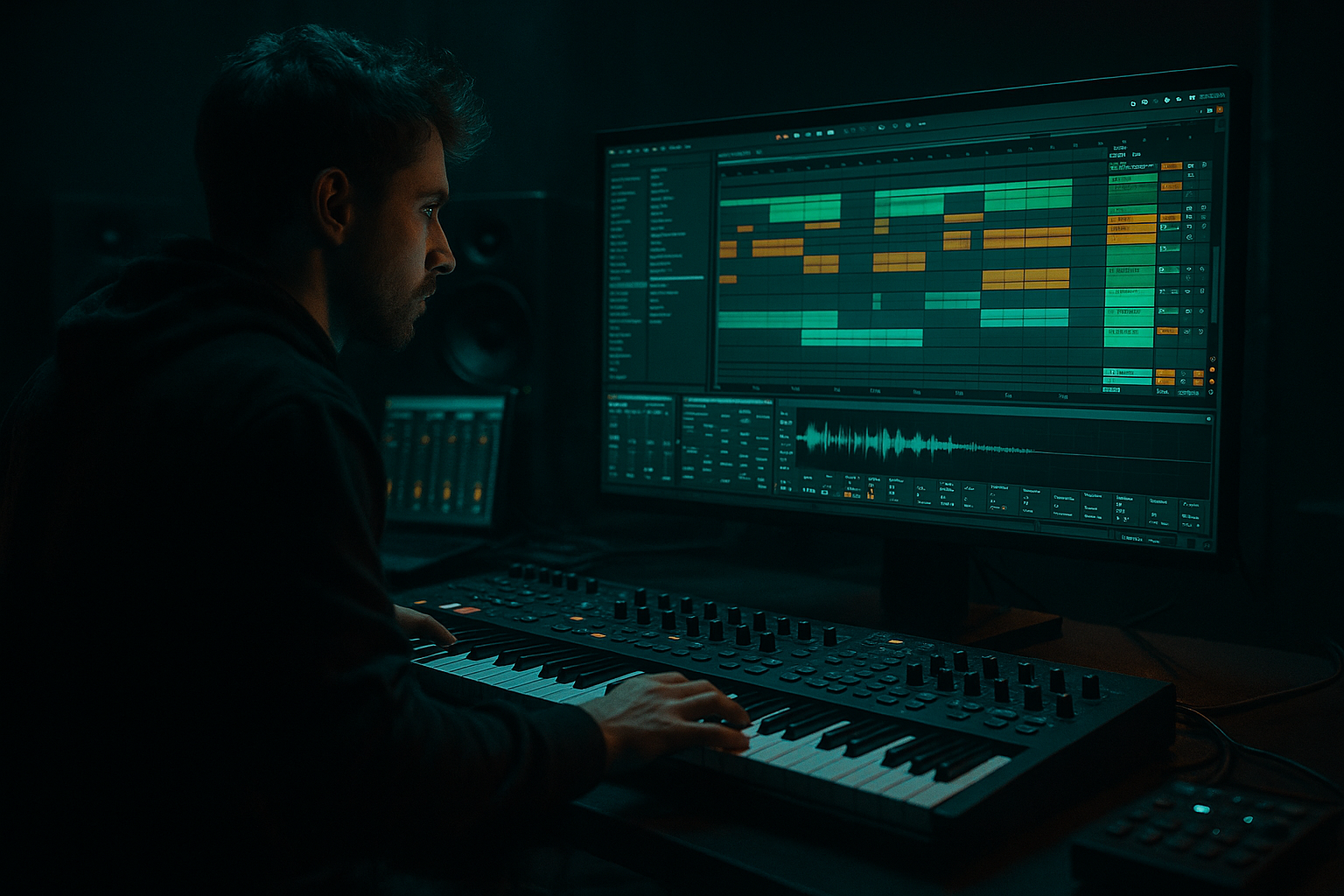
Main tutorial
Spring Reverb Splashes with Stock Devices (Ableton Live) 🌊🌀
Level: Beginner | Category: FX | Context: Drum & Bass / Jungle / Rolling bass music
---
1) Lesson overview
Spring reverb “splashes” are those classic, drippy boing-crash tails you hear on fills, snare hits, vocal chops, and FX in jungle/DnB. They add vibe and motion without washing out your mix—when done right.
In this lesson you’ll learn how to fake convincing spring-style splashes using only stock Ableton devices, and how to trigger them musically in a rolling DnB arrangement.
---
2) What you will build
You’ll create:
1. A Spring Splash Return Track (send effect) using:
- Hybrid Reverb (or Reverb in older Live)
- Saturator
- EQ Eight
- Gate
- Compressor (sidechain option)
- Utility (mono/width control)
2. A one-shot “splash trigger” workflow for:
- snare fills
- vocal stabs
- ride crashes
- impact hits and reverse FX
3. DnB-ready settings: short, bright-but-controlled splashes that cut through a busy break + bass.
---
3) Step-by-step walkthrough
Step A — Pick a good trigger sound (important!) 🎯
Spring splashes sound best when the input has sharp transients and mid/high content.
Great DnB triggers:
- A rimshot/snare layer
- A short perc hit (wood/clave/metal)
- A vocal “ah!” stab
- A crash/ride choke
- A foley click (switch, coin, latch)
- Enable a High-Pass filter:
- Optional: small presence boost
- Algorithmic mode (if available) or a tight algorithm
- Size: 15–25%
- Decay: 0.6–1.2 s
- Pre-Delay: 0–10 ms (keep it snappy)
- Damping/High Cut: 6–10 kHz (don’t let it fizz forever)
- Low Cut: 200–400 Hz
- Wet: 100% (because it’s on a return)
- Increase Early Reflections (or ER level) a bit
- Keep Decay under ~1.2s so it stays splashy, not washy
- Drive: +2 to +8 dB (start at +4 dB)
- Soft Clip: ON
- Optional: Try Analog Clip curve
- Threshold: set so only your accents open it (adjust while playing)
- Attack: 1–5 ms
- Hold: 30–80 ms
- Release: 120–250 ms (shorter = tighter splash)
- Floor: -inf (full cut)
- High-pass again if needed: 300–600 Hz
- Dip harshness: 7–10 kHz, -2 to -5 dB if it’s spitty
- Optional “clang” focus: small boost around 1.5–3 kHz
- Try Width: 80–120%
- If it messes with mono: Bass Mono isn’t in Utility, so instead keep low end removed with EQ and keep width tasteful.
- Main snare: low send (like -20 to -12 dB send amount)
- Fill snare hits: automate send higher (like -8 to 0 dB)
- Last snare before a drop: crank send for a big splash 🌊
- End of every 8 bars: one accent hit with extra splash
- Call-and-response: dry snare → splash snare → dry snare
- Enable Sidechain
- Input: Drum Bus or Snare
- Ratio: 2:1 to 4:1
- Attack: 1–10 ms
- Release: 80–180 ms
- Lower threshold until the splash ducks slightly when the snare hits
- Too long decay → turns into wash and kills groove. Keep it under ~1.2s for classic splash behavior.
- No high-pass filtering → low-mid reverb mud fights the bass and break.
- Sending the whole drum loop → your hats and ghost notes will smear. Send accents only.
- Too wide / phasey → splash disappears in mono and weakens drums.
- Gate set wrong → if threshold is too low, it’s always open; too high, nothing triggers.
- Make it darker, not dull:
- Add metallic bite without harshness:
- Sync splashes to fills:
- Use it on bass stabs sparingly:
- Make it feel “hardware”:
- Spring-style splashes are about short, bright reverb bursts that don’t smear the rhythm.
- Use a Return Track so you can target specific hits (fills/accents).
- Core stock chain: EQ → Hybrid Reverb → Saturator → Gate → EQ → Utility.
- For DnB, keep it tight (short decay), filtered (high-pass), and controlled (gate + optional sidechain).
Tip: Duplicate your snare to a new track and make a “Splash Snare” that’s thinner and brighter (high-passed). This keeps the main snare clean.
---
Step B — Create a Return Track for the splash 🚌
1. Press Cmd/Ctrl + Alt + T to create a Return Track.
2. Name it: SPRING SPLASH.
3. Set the return track to 100% wet effects (we’ll do that inside devices too).
Why a Return?
Because in DnB you’ll want to send only certain hits (fills, accents) while keeping your main drums tight.
---
Step C — Build the stock “spring-ish” chain
Put these devices on the SPRING SPLASH return in this order:
#### 1) EQ Eight (pre-filter the input)
We want the splash to react to highs, not low-end mud.
- Freq: 250–500 Hz
- Slope: 24 or 48 dB/oct
- Bell at 3–6 kHz, +2 to +4 dB (wide Q)
#### 2) Hybrid Reverb (main reverb) 🌀
Hybrid Reverb can do “spring-like” zing if you keep it short and bright.
Suggested starting point:
If you want more “boing”:
> If you don’t have Hybrid Reverb: use Reverb with Decay ~0.8s, Size small, and High Cut ~8k.
#### 3) Saturator (adds spring “twang”) 🔥
Spring tanks distort in a pleasing way. Gentle drive helps it speak.
#### 4) Gate (turn reverb into a “splash”) ✂️
This is the secret: we shape the tail so it “bursts” and gets out of the way.
Goal: You hear a shhk—BOING that dies quickly, leaving space for the groove.
#### 5) EQ Eight (post-shape)
Now carve it to fit DnB.
#### 6) Utility (control width/mono)
DnB drums often like a stable center.
---
Step D — Send only the right hits (classic DnB automation) 🎚️
On your snare track (or your “Splash Snare” track), turn up the send knob to SPRING SPLASH.
Workflow ideas:
Arrangement moves that scream jungle/DnB:
Ableton tip: In Arrangement View, automate the Send level (A/B/C…) for specific hits.
---
Step E — Make it “splash” harder with a dedicated trigger track (advanced beginner, super useful) 🧩
1. Duplicate your snare to a new audio track: SNARE SPLASH TRIG
2. On this track:
- Add EQ Eight: high-pass at 800–1500 Hz (yes, that high!)
- Add Shorter decay sample or transient shaper style trick:
- Use Drum Buss: set Transient +10 to +30, Boom OFF
3. Send this trigger track heavily to the SPRING SPLASH return
4. Keep the trigger track volume low or even muted (you can set Monitor: Off and still send if routing audio properly—if confusing, just keep it very low).
This gives you consistent splash energy without messing your main snare tone.
---
Step F — Optional: Sidechain the splash so it never crowds the drums 🥊
Add a Compressor at the end of the return:
This keeps the splash audible but controlled in a busy 170–175 BPM mix.
---
4) Common mistakes
---
5) Pro tips for darker/heavier DnB 🕯️🔧
Use Hybrid/Reverb High Cut ~6–8 kHz, then add a tiny Saturator drive to keep presence.
Post-EQ: small wide boost around 2 kHz, dip 8–10 kHz if needed.
Put big splash hits at bar 8/16/32 transitions—classic rolling arrangement punctuation.
Send only the top layer (resampled mid bass) to splash—never sub. High-pass the send hard.
Add Redux subtly after Saturator:
- Downsample: 1.2–2.5
- Bit Reduction: very small (0–2)
This can give gritty, old-school jungle energy.
---
6) Mini practice exercise (10 minutes) ⏱️
1. Load or program a simple DnB beat:
- Kick on 1 and 3
- Snare on 2 and 4
- Add ghost snares (very low) and hats
2. Build the SPRING SPLASH return chain from this lesson.
3. Automate send on snare:
- Normal hits: low send
- End of bar 8: one snare hit with high send
4. Bounce a quick 16-bar loop and check:
- Does the groove stay tight?
- Do the splashes pop on transitions?
- Is the low end clean?
Bonus: try sending a vocal chop on the last beat before the drop.
---
7) Recap ✅
If you tell me your Live version (11/12) and whether you prefer more classic dubby spring or metallic jungle splash, I can give you two ready-to-save Audio Effect Rack presets with macros.

