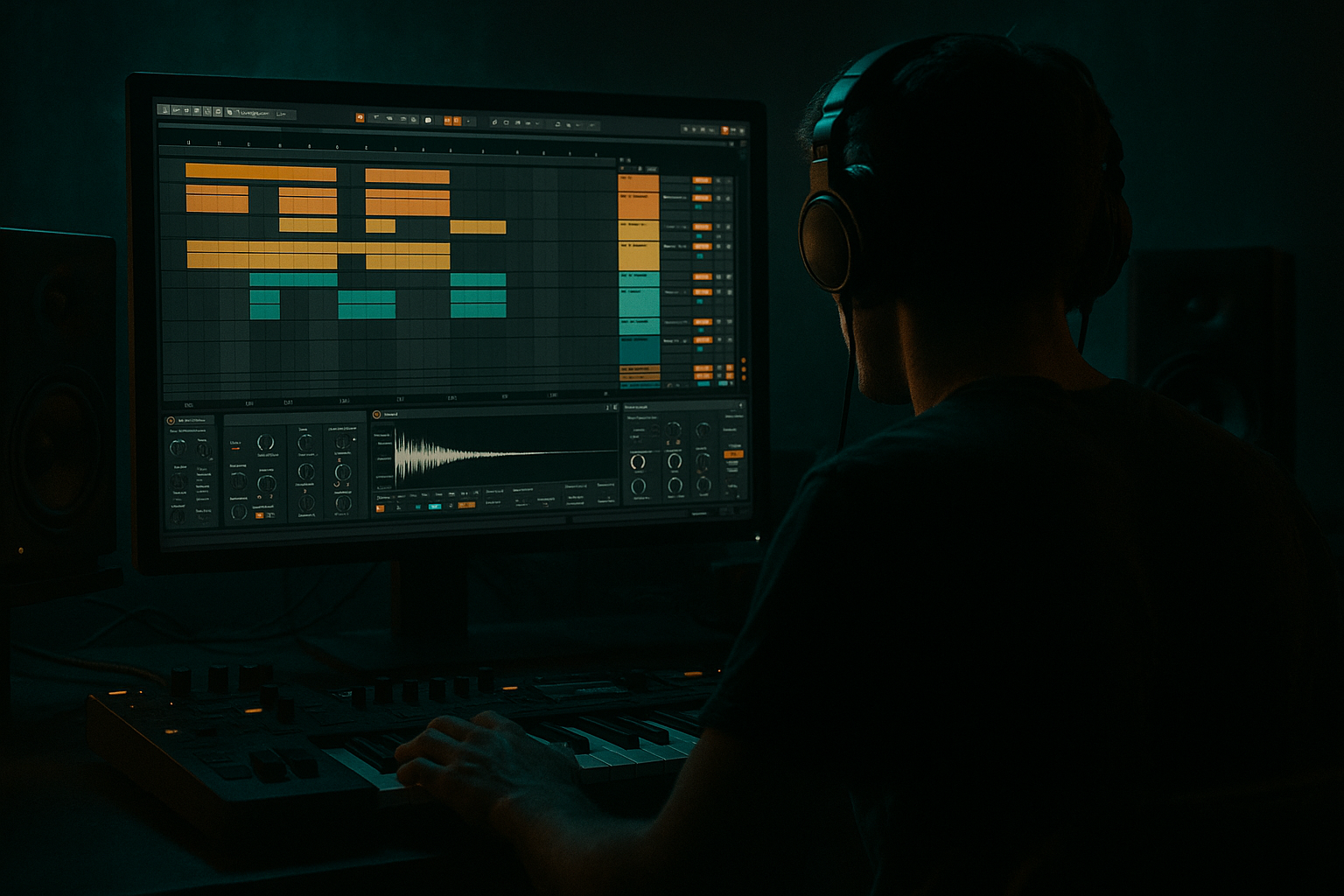
Main tutorial
1. Lesson overview
In this lesson you’ll stack an oldskool DnB/jungle breakbeat using resampling workflows in Ableton Live 12—the same kind of commit-and-build approach that gives classic records that glued, aggressive, “printed” character. We’re going to:
- Build a break stack (clean + crunch + top + ghost layers)
- Shape groove with micro-timing, swing, and velocity
- Resample each stage to audio so you can keep pushing it harder without losing control
- End with a ready-to-arrange 8–16 bar rolling loop that feels authentic and heavy 💥
- a “Main Printed Break” for arrangement (A/B sections)
- alternate “Fill Prints” (1-bar variations, stops, edits)
- the original warped loop (audio authenticity)
- the sliced rack (editability)
- From your original break clip: right-click → Extract Groove
- In Groove Pool:
- Apply to the Top MIDI clip.
- Auto Filter HP around 6–10 kHz if you want only air, or leave fuller if you need energy.
- Saturator 1–3 dB for shine.
- Utility: keep it narrower (Width 80–100%) so highs don’t smear.
- Take 2–5 ghost hits from the break (little snare drags, hat ticks), place them manually around the snare to create forward motion.
- Mute Crunch + Ghost
- Record 8 bars (Session or Arrangement)
- Name clip: `Break_PRINT_Clean_8`
- Unmute Crunch + Ghost + Top
- Record 8 bars
- Name: `Break_PRINT_Full_8`
- Bars 1–8: Clean Print + Top
- Bars 9–16: Full Print + extra ghost edits
- Bar 16: big fill/stutter → drop
- Nudge kicks slightly early (-2 to -8 ms) for urgency.
- Nudge ghost snares slightly late (+5 to +15 ms) for drag.
- Keep main snare consistent (don’t let it wander too much).
- For MIDI: use Track Delay or note nudge.
- For audio: nudge slices or use clip start offsets.
- Over-warping the break: kills the funk. Use minimal warp markers.
- Too much low end in Crunch layer: it fights your sub and makes the mix cloudy.
- Stacking without phase awareness: layered snares can cancel; check polarity with Utility (Phase Invert L/R) on one layer if needed.
- No commit: endless tweaking in device chains instead of printing. Resampling is the point.
- Over-saturating highs: breaks get brittle fast. Use EQ after distortion.
- Make the snare “lead” through density:
- Controlled grit > chaos:
- Mono the break low-mids (cleaner drop):
- Dark room vibe without washing transients:
- Print “Drop” and “Verse” versions:
- You built a layered oldskool break stack (Core/Crunch/Top/Ghost).
- You used Groove extraction to keep hats and extra percussion feeling authentic.
- You resampled multiple stages (clean + full + post-bus) to commit tone and momentum.
- You finished with audio-based edits that feel like real jungle/DnB arrangement moves 🎛️
Skill level is advanced: we’ll move fast, assume you know routing, warping, and basic drum programming.
---
2. What you will build
A 4-layer break system printed through resampling:
1. Core Break (Clean) – transient clarity, tight low end
2. Crunch Break (Smashed) – character, grit, density
3. Top/Hi Layer – consistent hats/air, stable ride energy
4. Ghost/Room Layer – subtle extra hits, movement, human funk
Then we’ll resample the full Drum Bus into:
All inside Live 12 using stock devices.
---
3. Step-by-step walkthrough
Step 0 — Session prep (so the workflow stays surgical)
1. Tempo: 170–176 BPM (start at 174 BPM).
2. Create these tracks:
- Audio Track: `BREAK_Core`
- Audio Track: `BREAK_Crunch`
- MIDI Track: `BREAK_Top` (Drum Rack)
- Audio Track: `BREAK_Ghost`
- Audio Track: `BREAK_PRINT` (for resampling)
- Return A: `PARA_COMP`
- Return B: `ROOM`
3. Group the four break layers into a group: `BREAK_BUS`.
Why: you’ll process per-layer, then glue on the bus, then print.
---
Step 1 — Choose and warp the core break (get it snapping)
1. Drag in a classic break (Amen, Think, Funky Drummer, Hot Pants… anything with real swing).
2. On `BREAK_Core`:
- Warp: ON
- Mode: Complex Pro (if it’s very “musical”) or Beats (for raw drums)
- If using Beats, set:
- Preserve: Transients
- Envelope: 20–40
3. Set 1.1.1 on the downbeat and tighten warp markers only where needed (don’t over-warp; keep natural funk).
4. Consolidate (Cmd/Ctrl+J) a clean 2-bar loop.
DnB note: Oldskool groove comes from imperfect timing. Warp just enough to sit in tempo, not enough to sterilize.
---
Step 2 — Slice to a Drum Rack (but keep your audio workflow)
We want the freedom of MIDI editing, and the sound of printed audio.
1. Right-click the consolidated clip → Slice to New MIDI Track…
2. Settings:
- Slice Preset: Built-in → Slicing
- Slice By: Transient
- Create one slice per: transient
3. This creates a Drum Rack. Name it `BREAK_Core_Rack` (or keep it inside `BREAK_Core` as a separate track if you prefer).
4. Extract the pattern:
- In the sliced MIDI clip, keep the classic 2-step DnB feel (kick on 1, snare on 2 & 4 vibe) but preserve ghost notes.
Advanced move: Keep both:
You’ll resample whichever is winning.
---
Step 3 — Build your Core layer (tight + punchy)
On Core (audio loop or rack output), add:
Device chain (Core):
1. EQ Eight
- HP at 25–35 Hz (12 or 24 dB/oct)
- Gentle dip 250–400 Hz (remove box)
- If hats are harsh: tiny dip 7–10 kHz
2. Drum Buss
- Drive: 5–15%
- Boom: 0–10% (keep subtle; oldskool breaks already have low junk)
- Transient: +5 to +20 (tighten)
3. Saturator
- Mode: Soft Sine or Analog Clip
- Drive: 2–6 dB
- Output: match gain (don’t fool yourself)
Goal: a clean, punchy “spine” that still swings.
---
Step 4 — Duplicate for Crunch layer (destroy it… then control it)
Duplicate Core to `BREAK_Crunch`.
Device chain (Crunch):
1. EQ Eight (pre)
- HP at 120–180 Hz (this layer shouldn’t fight subs)
- Boost a little 2–4 kHz if you want crack
2. Roar (Live 12 stock 🔥)
- Use as distortion + tone shaping.
- Try:
- Style: OD or Distort
- Drive: 20–40%
- Bias: small positive (adds edge)
- Filter: band-pass-ish focus around 200 Hz – 8 kHz
3. Glue Compressor
- Attack: 0.3–1 ms
- Release: Auto or 0.1s
- Ratio: 4:1 or 10:1
- Threshold: aim 5–10 dB GR (yes, heavy)
4. Redux (optional)
- Bit Reduction: 10–14
- Downsample: 1.5–4 (use sparingly)
Blend Crunch under Core until the break feels “printed” and urgent.
---
Step 5 — Create the Top layer (consistent hats/air that follows the groove)
On `BREAK_Top` (Drum Rack):
1. Load:
- tight closed hat
- open hat
- ride (optional)
2. Write a simple pattern locked to the break’s swing:
- 1/16 hats with tiny velocity accents
- occasional open hat before snare or on offbeats
Groove extraction (important):
- Timing: 30–60%
- Velocity: 10–30%
- Random: 2–8%
Top chain:
---
Step 6 — Ghost/Room layer (movement without clutter)
This is where jungle funk comes alive 😈
Option A (from the same break):
1. Duplicate Core to `BREAK_Ghost`.
2. EQ Eight
- HP at 250–400 Hz
- Focus on 1–8 kHz (ghost taps, stick noise)
3. Gate
- Sidechain from Core (if needed) to reduce constant noise
4. Reverb (or send to ROOM return)
- Small room, short decay 0.3–0.6s
- Low cut 500 Hz+ inside reverb
Option B (micro-slices):
---
Step 7 — Route and set up resampling (the heart of the lesson)
Now we print stages like oldskool producers printing to DAT/tape.
1. On each layer track, set Audio To → BREAK_BUS (or group automatically routes).
2. On `BREAK_PRINT`:
- Audio From: `BREAK_BUS`
- Monitor: IN (or Auto + arm)
3. Arm `BREAK_PRINT`.
Print pass #1: “Clean Print”
Print pass #2: “Full Print”
Why print twice: you’ll use Clean for clarity in verses and Full for drops, or blend them for A/B energy.
---
Step 8 — Bus processing (glue it like a record)
On the BREAK_BUS group, use gentle “mix glue,” not rescue processing.
BREAK_BUS chain:
1. EQ Eight
- HP at 25–30 Hz
- Optional small dip at 200–350 Hz
2. Glue Compressor
- Attack 3–10 ms (let transients through)
- Release Auto
- Ratio 2:1
- Aim 1–3 dB GR
3. Drum Buss
- Drive 2–8%
- Transient 0 to +10
4. Limiter (optional, only for printing loud refs)
- Keep it subtle; don’t crush dynamics unless that’s the aesthetic.
Then print again after bus processing if you want a “final committed break” clip.
---
Step 9 — Micro-edit the printed audio (classic jungle surgery ✂️)
Take `Break_PRINT_Full_8` and do the classic edits:
1. Consolidate into 8 bars.
2. Turn warp OFF (or keep Warp on Beats if needed).
3. Make variations:
- Bar 4: remove kick before snare (space → tension)
- Bar 8: 1/8 or 1/16 stutter of a snare slice
- Snare flam: duplicate snare transient, nudge 5–15 ms
4. Use Fade handles to avoid clicks.
5. Optional: Reverse a tiny hat slice into a snare for a pull.
Arrangement idea (16 bars):
---
Step 10 — Lock the groove with subtle timing offsets
Advanced DnB groove isn’t just swing—it’s micro placement:
In Live:
---
4. Common mistakes
---
5. Pro tips for darker/heavier DnB
Add a snare-focused parallel on Return A:
- Glue Compressor (fast attack, heavy GR)
- Roar (midrange bite)
- EQ Eight band-pass ~180 Hz–7 kHz
Blend back at -18 to -10 dB.
Distort, then re-EQ hard. A common chain is:
- Roar/Overdrive → EQ Eight (tame 3–6k harshness) → Glue
On BREAK_BUS add Utility:
- Bass Mono: 120–180 Hz
Use a short room (Return B), but filter it aggressively:
- Reverb decay 0.4s
- Reverb low cut 600–1000 Hz
- Add Gate after reverb keyed by the snare so it “breathes”
Verse: less Crunch, less room
Drop: more Crunch, more parallel, extra top energy
---
6. Mini practice exercise
Goal: Create a 16-bar loop with A/B energy using resampling.
1. Build Core + Crunch + Top + Ghost.
2. Print:
- `PRINT_A` (Clean-ish): Core + Top only
- `PRINT_B` (Drop): all layers + bus glue
3. In Arrangement:
- Bars 1–8: `PRINT_A`
- Bars 9–16: `PRINT_B`
4. Add two edits:
- 1-bar fill at bar 8 (stutter/stop)
- Snare flam somewhere in bars 12–16
5. Export a quick bounce and reference against a classic jungle roller for groove feel.
---
7. Recap
If you want, tell me which break you’re using and whether you’re aiming more 1994 jungle rawness or modern rolling neuro-weight, and I’ll suggest exact warp mode + distortion settings for that direction.

