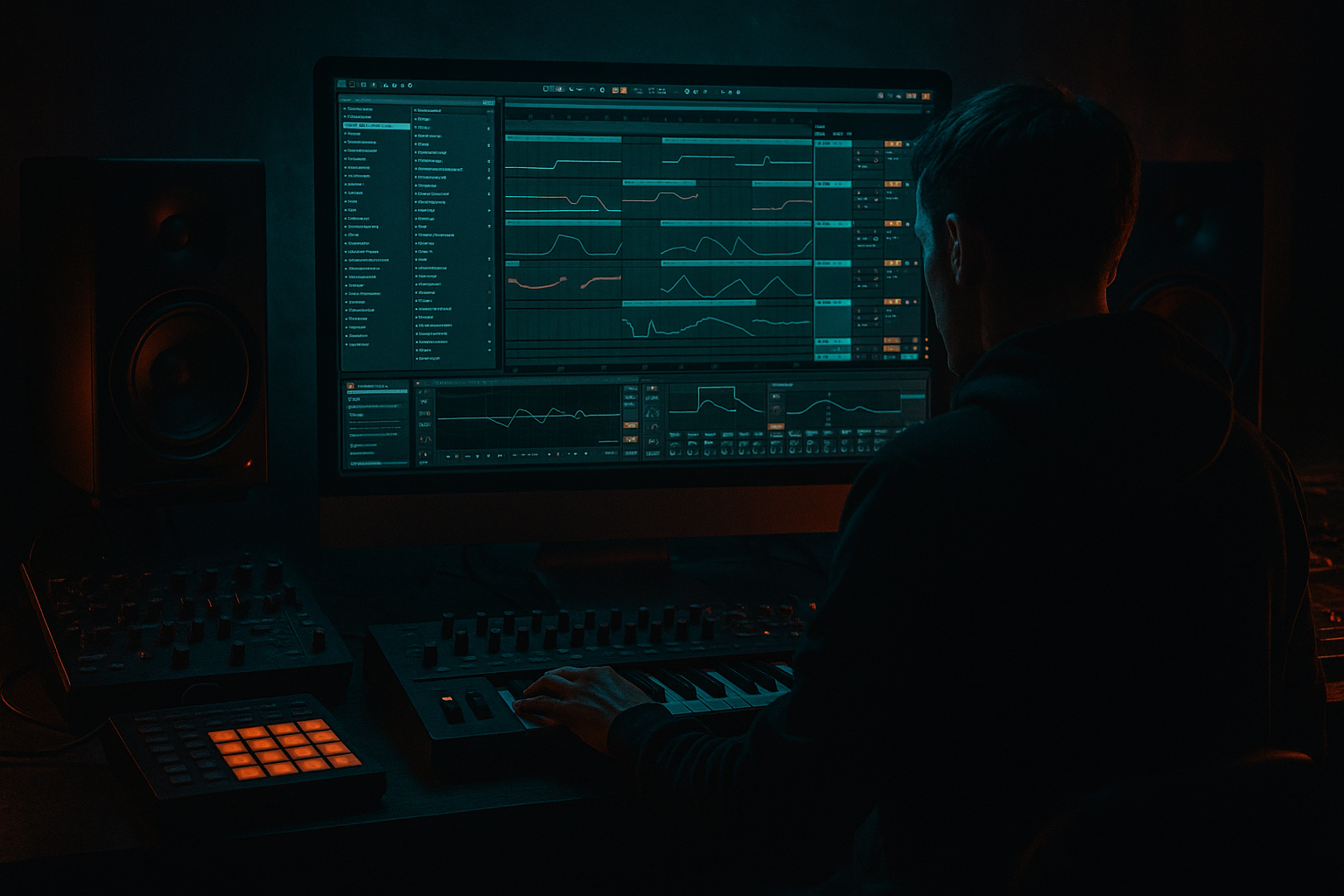
Main tutorial
Stepper Ableton Live 12 Intro Course: Chopped-Vinyl Jungle DnB Character 🎛️🥁
1. Lesson overview
In this lesson, you’ll build a stepper-style drum and bass groove in Ableton Live 12 using sampled vinyl texture, chopped breaks, and oldskool jungle phrasing. The goal is not just to make a loop — it’s to create a rolling, gritty, human-feeling DnB sketch that sounds like it was pulled from a dusty dubplate stack.
We’ll focus on:
- Sampling techniques in Ableton Live 12
- Building a stepper drum pattern
- Creating chopped breakbeats
- Adding vinyl character and age
- Arranging a simple loop into a proper jungle/DnB intro
- A 1–2 bar stepper drum loop
- A chopped break layered with kick/snare support
- Vinyl noise, crackle, and sampled texture
- A bass foundation that sits under the drums
- A short intro arrangement with breakdown-style movement
- classic 90s jungle
- dark roller energy
- slightly lo-fi, chopped, and gritty
- moving forward with a steppy pulse rather than a straight modern half-time feel
- Tempo: `164–172 BPM`
- A strong starting point: 170 BPM
- Time signature: `4/4`
- Track 1: Drums / Break
- Track 2: Extra one-shots
- Track 3: Bass
- Track 4: Vinyl texture / FX
- Track 5: Arrangement FX or reverb throws
- strong transient hits
- room tone
- slightly imperfect timing
- enough midrange to sound lively when chopped
- Amen-style breaks
- Think break-style breaks
- Hot pants / Funky drummer-type material
- Any dusty break recorded from vinyl or a break pack with personality
- For authentic chopped jungle, use Simpler in Slice mode.
- Set slicing to:
- Slice by: Transients
- Playback: Classic
- Voices: 8–12
- Trigger: Gate
- Filter: On, if needed for shaping
- Keep a solid kick on beat 1
- Place your snare on beat 2 and 4
- Add ghosted break slices around the snare
- Use quick hats and percussion to create motion
- Kick: beat 1
- Snare: beat 2
- Ghost snare / break slice: just before beat 2
- Kick or low break hit: around beat 3
- Snare: beat 4
- Small fills: last 1/4 or 1/8 note of the bar
- Shorten the note lengths for chopped slices
- Leave some hits slightly off-grid
- Use velocity variation to make the groove breathe
- a tight kick
- a snappy snare
- a crisp closed hat
- a rim or ghost percussion sound
- Put a kick that has:
- Use a snare with:
- Layer a clap only if it doesn’t make the groove too polished
- Use subtle offbeat hats or shuffled hats
- Keep them low in the mix so the break stays dominant
- Drum Rack
- Simpler
- EQ Eight
- Drum Buss
- Saturator
- Glue Compressor
- sampled records
- imperfect playback
- dusty loop fragments
- analog degradation
- vinyl crackle
- room noise
- needle noise
- low-level record hiss
- short spoken sample or atmospheric stab, if suitable
- during intros
- between drum fills
- just before drop sections
- behind breakdown elements
- Reese bass
- Sub-heavy muted bass
- Reese + sub layer
- Reese with short stabs for movement
- Operator or Wavetable
- Low-pass filter if needed
- Utility to keep it mono
- Optional Saturator for gentle harmonics
- Wavetable or Analog
- Auto Filter
- Saturator
- EQ Eight
- answers the drum pattern
- uses short rhythmic phrases
- avoids stepping on every transient
- Start with small groove amounts
- Don’t over-swing the kick/snare foundation
- Let the break breathe naturally, but keep the main pulse solid
- vinyl crackle
- filtered break ghosting in
- no full bass yet
- main chopped break enters
- kick/snare foundation appears
- bass filtered or very low volume
- bass becomes fuller
- extra percussion added
- occasional fill or reverse FX
- full groove
- add a small variation on the break
- create a pre-drop feel with a snare fill or filter opening
- Auto Filter automation
- Reverb throws on snare hits
- Delay on short vocal chops or FX
- Reverse cymbal or reversed slice
- Drum fills at the end of 8 or 16 bars
- changing velocities
- slightly offsetting ghost notes
- leaving some hits quieter
- varying break chops every 2 or 4 bars
- using small filter changes
- resampling the groove
- Kick and sub should not fight
- Keep bass mono below roughly 120 Hz
- Use Utility to control width
- Needs to cut through
- If too weak, layer a sharper transient
- If too loud, reduce harsh upper mids before boosting volume
- Should sound gritty but not brittle
- If harsh, tame with EQ Eight
- If thin, add Saturator or Drum Buss
- Should support the vibe, not dominate
- If it masks the snare, reduce it or automate it downward during busy sections
- clean sub
- distorted mid bass
- saturated drum bus
- short decay
- dark tone
- low mix
- filtering the break so only the nastiest midrange comes through
- layering a second break with more bite
- pitching a chopped hit down for tension
- filter cutoff on the bass
- break filter opening
- vinyl noise level
- send levels into delay/reverb
- 1 break sample
- 1 kick
- 1 snare
- 1 hat
- 1 bass patch
- 1 vinyl noise track
- Use Simpler slice mode for fast break chopping
- Support the break with a clean stepper drum foundation
- Add vinyl noise and texture for authenticity
- Keep the bass tight, mono, and rhythmic
- Use swing, velocity, and micro-timing for feel
- Arrange in 8- or 16-bar phrases so the track evolves naturally
- a Live 12 rack-building guide
- a sample-chain cheat sheet
- or a full 8-bar MIDI example for drums and bass
This is ideal if you already know the basics of Ableton and want to push into more authentic oldskool DnB / jungle / steppa territory.
---
2. What you will build
By the end, you’ll have:
The final vibe should feel like:
---
3. Step-by-step walkthrough
Step 1: Set the tempo and create the right frame
For this style, start with:
In Ableton:
1. Create a new Live Set.
2. Set the tempo to 170 BPM.
3. Create 3 MIDI tracks and 2 audio tracks.
Suggested track layout:
Why this matters: jungle and DnB are very arrangement-driven. If you organize early, you’ll work faster and make better decisions.
---
Step 2: Find or import a break with character
You want a break that already has:
Good break choices:
In Ableton:
1. Drag the break into Arrangement View or a Simpler on a MIDI track.
2. If you’re using a longer audio break, enable Warp.
3. Try Complex Pro or Beats warp mode:
- Beats: good for preserving drum transients
- Complex Pro: better for full-loop texture, but can soften punch
Best practice:
- Transient
- or 1/16 if you want tighter control
This is one of the fastest ways to turn a break into playable drum parts.
---
Step 3: Chop the break in Simpler
Drag the break into Simpler and choose Slice.
Suggested setup:
Now play the slices like a drum kit.
Build a classic stepper drum phrase
Try this basic logic:
#### Example 1-bar structure:
The key is to avoid making it sound like a plain 2-step loop.
You want micro-shifts, ghost notes, and syncopation.
MIDI editing tip:
In the piano roll:
---
Step 4: Layer in a clean stepper drum foundation
Oldskool DnB often works best when the chopped break is supported by a clean, punchy foundation.
Create a Drum Rack or separate sample chain with:
Suggested drum layering:
#### Kick
- short low end
- a bit of click
- not too much sub if the bass is busy
#### Snare
- body around 180–250 Hz
- crack around 2–5 kHz
#### Hats
Ableton stock devices to use:
Suggested processing chain for the drum bus:
1. EQ Eight
- High-pass unnecessary rumble below 25–30 Hz
- Small cut if the low-mids get muddy around 250–400 Hz
2. Drum Buss
- Drive: light to medium
- Crunch: subtle
- Boom: carefully controlled, or off if the bass will occupy the sub
3. Glue Compressor
- Soft compression, 1–2 dB gain reduction
4. Saturator
- Soft Clip on
- Drive just enough to add edge
---
Step 5: Add vinyl character and chopped texture
This is where the “chopped-vinyl” identity really comes alive.
You want to introduce the sense that the track was built from:
Create a vinyl texture track
Use an audio track with:
Processing chain for vinyl texture:
1. EQ Eight
- High-pass around 150–300 Hz
- Roll off harsh highs if needed
2. Auto Filter
- Gentle movement using envelope or LFO
3. Redux or Saturator
- Very subtle to add grit
4. Utility
- Reduce width if the noise gets too distracting
Pro move:
Automate the vinyl texture so it appears:
Don’t keep it static.
A little movement makes it feel sampled rather than looped from a preset.
---
Step 6: Add a bassline that supports the stepper groove
For jungle and oldskool DnB, the bass should feel like it’s driving under the drums, not fighting them.
Bass style options:
Basic approach:
Create two bass layers:
1. Sub layer
- simple sine or clean sub
- mono
- no distortion if it muddies the mix
2. Mid bass layer
- saw/reese texture
- filtered
- some movement from LFO or automation
Stock device chain for bass:
#### Sub layer
#### Mid layer
Bass arrangement tip:
Write the bass so it leaves room for the snare and break accents.
In oldskool DnB, the bass often:
Quick rule:
If the drums are busy, keep the bass notes shorter and more intentional.
If the drums are sparse, let the bass breathe a little more.
---
Step 7: Use swing and groove properly
A huge part of this style is feel.
If everything is rigid, it will sound modern but not necessarily jungle.
In Ableton:
1. Open the Groove Pool
2. Try using a swing groove lightly
3. Apply it to:
- break slices
- hats
- percussion
- sometimes bass notes
Good practice:
You want a steppy push, not a drunken shuffle.
---
Step 8: Arrange a proper intro
Even for a short lesson track, don’t just loop the bar forever. Build an intro.
Suggested 16-bar intro idea:
#### Bars 1–4
#### Bars 5–8
#### Bars 9–12
#### Bars 13–16
Arrangement devices to use:
---
Step 9: Make it feel sampled, not programmed
This is a big one.
The difference between a “drum loop” and an authentic jungle-inspired sample track is imperfection with intention.
Add human feel by:
Powerful Ableton workflow:
Once your loop works:
1. Bounce or resample the drum section.
2. Re-import the audio.
3. Chop it again.
4. Re-process with saturation, EQ, and filtering.
This gives the track a more “found sample” vibe and less of a clean MIDI-programmed feel.
---
Step 10: Final mix checks
Before moving on, check these things:
Low end
Snare
Break
Vinyl noise
---
4. Common mistakes
1. Over-cleaning the samples
If you remove all noise, wobble, and inconsistencies, you lose the jungle identity.
2. Too much sub in the break
Old breaks often carry low-end junk. High-pass or shape them so they don’t clash with the bass.
3. Making every hit grid-perfect
This kills the human swing. Leave room for micro-timing differences.
4. Overusing reverb
Too much reverb makes the groove blurry and weakens the punch.
5. Bass that is too busy
In stepper DnB, the bass should support the groove, not fill every gap.
6. Too much vinyl noise
Texture is great, but if it competes with the drums, it becomes a distraction.
---
5. Pro tips for darker/heavier DnB
If you want this to lean darker and heavier, try these moves:
Use distortion in layers
Instead of smashing everything, split the sound:
This keeps the low end controlled while making the track sound aggressive.
Use short, dark ambiences
Add a very low reverb send with:
This can make snares and stabs feel like they’re in a warehouse without washing them out.
Make the break more threatening
Try:
Add ghost hits before the snare
Small pre-snare percussion hits can create the classic “rolling forward” feel.
Use automation for pressure
Automate:
That movement is crucial in heavy DnB. Static loops feel weak fast.
---
6. Mini practice exercise
Try this exercise in Ableton:
Goal
Build a 4-bar jungle stepper loop using only:
Steps
1. Import one break into Simpler and slice it.
2. Create a 4-bar drum phrase with:
- kick on 1
- snare on 2 and 4
- 2–4 chopped break accents per bar
3. Add a simple mono bassline that answers the snare.
4. Layer vinyl noise quietly underneath.
5. Add one fill at the end of bar 4.
6. Resample the whole loop and re-chop one section for variation.
Challenge
Make bar 4 feel like it’s about to drop into a bigger section, even though it’s only 4 bars long.
---
7. Recap
You’ve just built the foundation of a stepper Ableton Live 12 jungle/DnB intro with chopped-vinyl character.
Key takeaways:
If you do this well, your loop will already sound like the start of a serious oldskool DnB tune — not just a beat exercise. And that’s the difference between making a loop and making jungle with identity 🔥
If you want, I can also turn this into:

