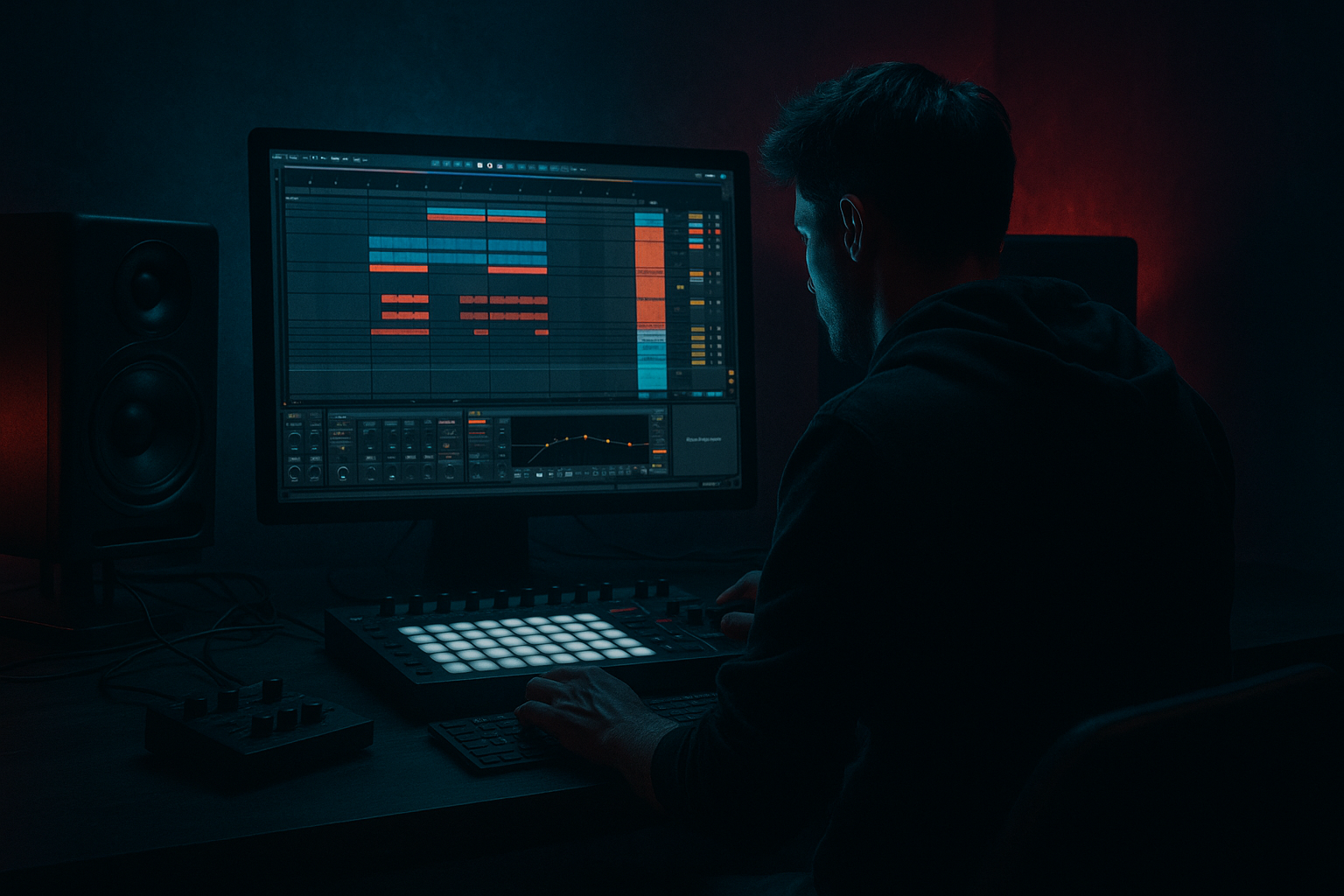
Main tutorial
```markdown
Stepper Ableton Live 12 Transition Masterclass
Sunrise-set emotion for jungle / oldskool DnB vibes (Beginner • Sampling) 🌅🥁
---
1) Lesson overview
This lesson is about building DJ-style but fully produced transitions inside Ableton Live 12 for a stepper DnB track that leans oldskool jungle—think: crisp breaks, warm pads, emotional melodies, and that “sunrise” lift.
You’ll learn how to:
- Use sampling workflows (breaks, vocals, atmospheres, FX)
- Create classic DnB transition moves: bass drop-out, filter rides, tape stops, risers, impacts, break edits
- Arrange a 16–32 bar transition that feels intentional, musical, and club-ready
- Bars 1–16: Rolling stepper groove → gradual tension (filters + drum edits)
- Bars 17–24: Breakdown lift → pads, vocal stab, filtered break tease
- Bars 25–32: Pre-drop → snare roll + riser + impact → drop hits clean
- A drum rack for break slicing
- A bus chain for cohesive transition FX
- A few automation lanes that do 80% of the emotional work 🎛️
- 1–16: Tension
- 17–24: Lift
- 25–32: Pre-drop
- 33: Drop
- On the BASS group, automate Utility Gain down:
- On DRUMS group, add Auto Filter:
- Automate cutoff:
- Automate the pad’s Auto Filter cutoff gradually up:
- Add an impact sample on the very first beat of the drop (bar 33).
- On the bar right before the drop (last 1/4 or 1/2 bar), do a micro-silence:
- Reset filters (drum group Auto Filter back to fully open)
- Bring bass back to full level instantly
- Ensure kick + snare are dry compared to the lift
- Drum Buss
- Glue Compressor
- Over-filtering everything: if pads, breaks, and drums are all filtered, the mix feels thin. Choose one main filter move.
- No low-end plan: sunrise emotion still needs controlled subs. High-pass your FX/atmos heavily.
- Risers too loud: they should guide energy, not become the track.
- Transition is busy but not musical: add one emotional anchor (pad chord, vocal, or melody) and let it breathe.
- Drop doesn’t “reset”: if reverb tails and delays are still huge at the drop, it won’t slap. Automate return sends down right before impact.
- Swap the uplifting pad for a minor 2-note drone and automate frequency shifter subtly:
- Use Redux lightly on break teases for grit:
- Add Roar (Ableton Live 12) on a drum parallel chain:
- Make the “air pocket” longer:
- For heavier tension, automate Utility Width:
- Slice breaks → build a clean stepper pattern with jungle swing
- Use group automation (filters, utility gain, width) for DJ-like tension
- Create lift with pads + vocal stabs + break teases
- Deliver impact with snare rolls, risers, and a controlled air pocket
- Glue everything using stock returns (Hybrid Reverb + Echo + Auto Filter)
We’ll stick mainly to stock Ableton devices so you can do this immediately.
---
2) What you will build
A 32-bar transition section that takes you from a rolling stepper groove into an emotional sunrise “lift” and back into a proper jungle-flavoured drop:
You’ll end with:
---
3) Step-by-step walkthrough
Step 0 — Session setup (DnB-ready)
1. Set tempo to 172 BPM (classic range: 170–174).
2. Create groups:
- DRUMS
- BASS
- MUSIC (pads/melody)
- FX / ATMOS
- MASTER (no limiter yet while building)
Why: transitions are easiest when you can automate groups, not 20 tracks.
---
Step 1 — Get the “stepper + jungle” drum foundation (sampling)
#### A) Load a break and slice it
1. Drag a classic-style break (or any break sample) onto an Audio Track.
2. In Clip View:
- Turn Warp ON
- Set Warp Mode: Beats
- Preserve: 1/16
- Check it loops tightly at 1 bar or 2 bars (adjust start marker)
3. Right-click the clip → Slice to New MIDI Track
- Slicing preset: Built-in (or “Slice by Transients”)
- This creates a Drum Rack with break hits.
#### B) Build a stepper pattern (simple but rolling)
1. Create a new MIDI clip (1 bar) on the Drum Rack track.
2. Program:
- Kick: on 1 and 3
- Snare: on 2 and 4
- Add ghost notes from the sliced break (quiet snare/kick hits) between beats.
3. Groove:
- Use Groove Pool → try MPC 16 Swing 55–58
- Apply at 30–50%.
✅ Goal: clean stepper backbone + jungle swing texture.
---
Step 2 — Make a sunrise emotional bed (simple sampling layer)
We’ll use a sampled texture + a pad so the transition feels “wide” and uplifting.
#### A) Atmosphere sample
1. Drag an ambient field recording / vinyl noise / jungle intro texture onto an Audio Track.
2. Warp Mode: Complex (or Complex Pro if it’s tonal).
3. Low cut it with EQ Eight:
- HP filter at 120–200 Hz (so it doesn’t fight bass/kick)
#### B) Warm pad (stock instrument + simple harmony)
1. Add Wavetable or Analog on a MIDI Track.
2. Choose a warm pad preset (or init + lowpass).
3. Add Reverb:
- Decay: 4–7s
- Pre-delay: 20–35ms
- Dry/Wet: 15–25%
4. Add Auto Filter after Reverb:
- Filter: Lowpass
- Freq start around 700–1.5kHz (we’ll automate later)
Keep chords simple: i–VI–VII style progressions work well for emotional DnB.
---
Step 3 — Build the transition spine (32-bar arrangement)
Create a 32-bar region in Arrangement View and label markers:
#### A) Bars 1–16: Tension (subtract bass, add movement)
1. Keep full drums + bass for bars 1–8.
2. From bars 9–16, begin transition moves:
Move 1: Bass “air gap”
- Bar 13: -2 dB
- Bar 15: -6 dB
- Bar 16 (last beat): -inf for 1/4 or 1/2 bar
This creates anticipation without killing momentum.
Move 2: Filter ride on drums
- Type: Lowpass
- Drive: 2–6%
- Resonance: 10–20%
- Bar 9: ~18 kHz
- Bar 16: ~1.5–3 kHz
This “DJ filter” scream is a classic transition cue.
#### B) Bars 17–24: Lift (break tease + pad opens)
Move 3: Break tease
1. Duplicate a clean break loop to a new track (Audio Track).
2. Put Auto Filter on it (Bandpass is great here):
- Bandpass Freq: 1–2.5 kHz
- Resonance: 20–35%
3. Bring it in quietly around bar 17, rising in volume to bar 24.
Move 4: Open the pad filter
- Bar 17: ~800 Hz
- Bar 24: ~4–8 kHz
Move 5: Emotional vocal stab (sampled)
1. Take a short vocal phrase (“ah”, “yeah”, “ready”, “one time”) and drop it into Simpler.
2. In Simpler:
- Mode: One-Shot
- Enable Snap
- Add Fade Out a touch (avoids clicks)
3. Add Delay (stock):
- Ping Pong
- Time: 1/8 or 1/4
- Feedback: 20–35%
- Filter: roll off lows < 200 Hz
Place the vocal stab on bar 20 and 23 to punctuate the lift.
#### C) Bars 25–32: Pre-drop (snare roll + riser + impact)
Move 6: Snare roll (classic jungle energy)
1. Create a MIDI track with a snare sample (or a sliced snare from the break).
2. Program a roll that increases density:
- Bar 25: 1/8
- Bar 27: 1/16
- Bar 31: 1/32 (last bar only)
3. Automate velocity rising slightly (don’t max it).
4. Add Saturator on the snare roll track:
- Drive: 2–6 dB
- Soft Clip: ON
Move 7: White noise riser (stock)
1. Create MIDI track with Wavetable (noise oscillator) or use a noise sample in Simpler.
2. Add Auto Filter (highpass):
- Start: 150 Hz
- End: 6–10 kHz
3. Add Reverb (bigger than pad):
- Decay: 8–12s
- Dry/Wet: 20–35%
4. Automate volume up into bar 32.
Move 8: Impact + sub drop control
- Mute drums for 1/8–1/4 bar
- Keep only a reverb tail or vocal delay tail
This “air pocket” makes the drop feel huge.
---
Step 4 — Glue it together with a Transition FX Bus (super useful)
Create a Return track called “TRANS FX”:
1. Hybrid Reverb
- Algorithm: Hall
- Decay: 6–10s
- Low Cut: 200 Hz
2. Echo
- Time: 1/4 Dotted or 1/8
- Feedback: 25–45%
- Mod: small (2–6)
3. Auto Filter
- Highpass around 150 Hz (keep return clean)
Now send your vocal stab, break tease, and pad hits into this return during the lift.
Automate send amounts to build space without drowning the mix.
---
Step 5 — Make the drop hit like a record (basic mix moves)
Right at the drop (bar 33):
On DRUMS group add:
- Drive: 5–15
- Boom: 20–40 Hz (careful—DnB subs can overload)
- Damp: taste
- Attack: 3 ms
- Release: Auto
- Ratio: 2:1
- Aim: 1–2 dB gain reduction max
This keeps it punchy without flattening it.
---
4) Common mistakes
---
5) Pro tips for darker/heavier DnB (same technique, different mood) 🕶️
- Frequency Shifter: 10–30 Hz with small Dry/Wet for unease.
- Downsample a bit (don’t destroy transients).
- Keep it subtle, automate Drive up into the pre-drop.
- Try 1/2 bar silence before the drop for savage impact.
- Narrow to 0–30% in the build, then snap back to 100% on the drop.
---
6) Mini practice exercise (15 minutes)
1. Choose one break and slice it to Drum Rack.
2. Program a 1-bar stepper loop + ghosts, add Groove at 40%.
3. Build an 8-bar transition only (short version):
- Bars 1–4: filter drums down to ~3k
- Bar 5–7: add break tease + vocal stab with Echo
- Bar 8: snare roll + micro-silence (1/8)
4. Drop back into the full loop on bar 9.
Goal: make the drop feel bigger than the loop, using only automation and sampling moves.
---
7) Recap
You now have a repeatable Ableton Live 12 workflow for stepper DnB transitions with jungle/oldskool flavour and sunrise emotion:
If you want, tell me your current vibe (more Bukem-style sunrise vs Metalheadz dark sunrise) and I’ll suggest a specific 32-bar transition blueprint and a starter Ableton device chain for your drums and FX.
```

