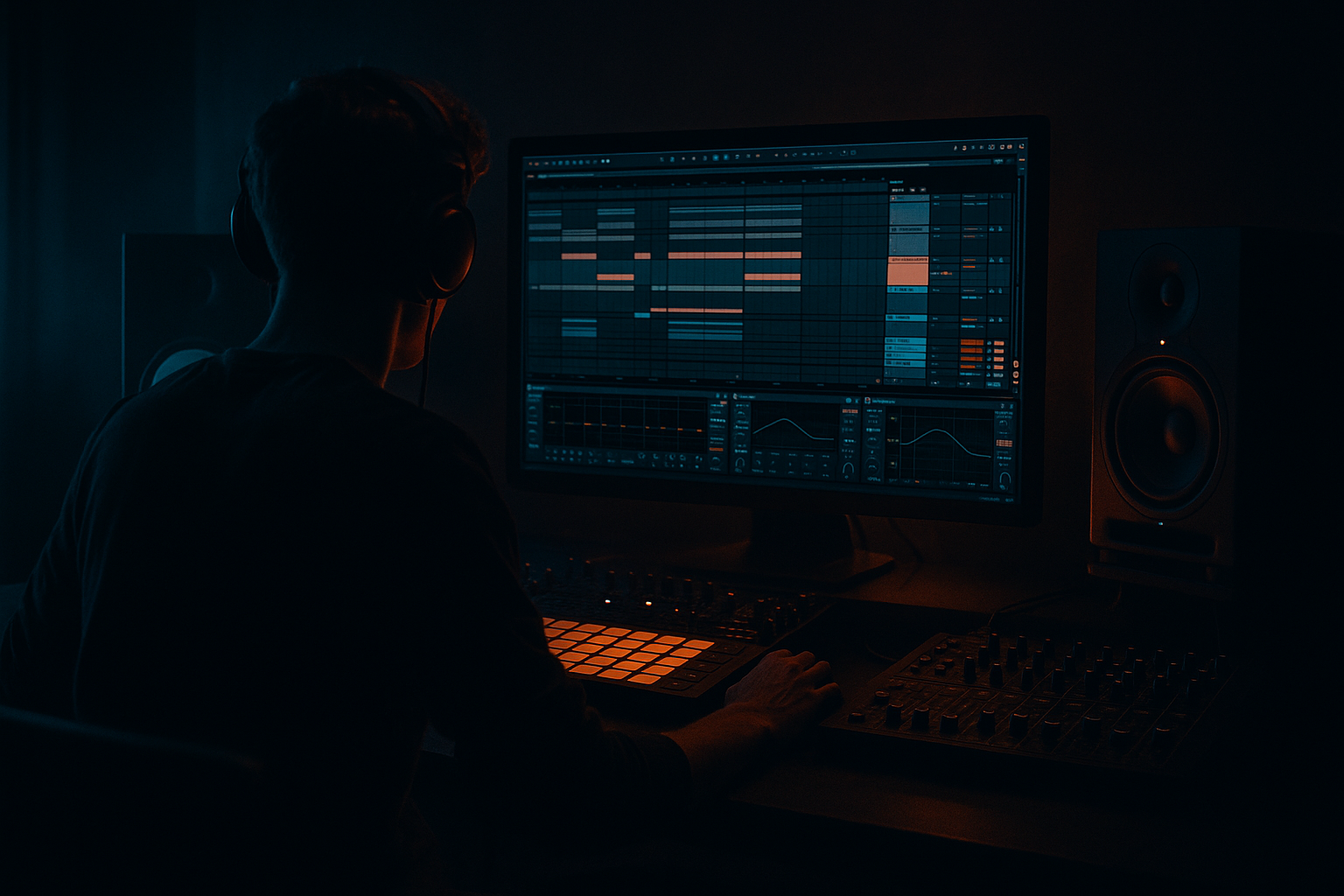
Main tutorial
Stepper Approach: Chop + Blend in Ableton Live 12 (Oldskool Jungle / DnB Vibes) 🔥🥁
1. Lesson overview
This lesson is about building classic stepper jungle/DnB drums by chopping a break, then blending it with clean one-shots for punch and control—without losing that oldskool swing and grit.
You’ll learn a practical Ableton Live 12 workflow using stock devices:
- Simpler (Slice Mode) for fast chop mapping
- Drum Rack for layering and routing
- EQ Eight, Saturator, Drum Buss, Glue Compressor for weight + glue
- Auto Filter + Redux for jungle grit
- Groove Pool and timing tricks for that shuffly stepper feel
- A 16–32 bar stepper drum loop built from a classic break (Amen/Funky Drummer/Think-type)
- Chop-controlled variation (fills, ghost notes, edits)
- A layered kick + snare that hits like modern DnB but keeps break character
- A simple arrangement structure: Intro → Drop → Mid variation → Outro
- Playback: `Trigger` (classic quick chop behavior)
- Voices: 8–16 (prevents cut-offs when layering)
- Fade: 2–8 ms (reduces clicks on tight edits)
- Kick on 1
- Snare on 2 & 4 (backbeat)
- Optional kick on the “and” before 3 (varies by vibe)
- Kick: 1.1.1
- Snare: 1.2.1 and 1.4.1
- Add a second kick (optional): 1.3.3 (this often gives that rolling “push”)
- Add low-velocity snare slices around:
- Ghosts: 20–50
- Main snares: 90–110
- Example: 1.4.3.3 and 1.4.3.4 (depending on grid)
- Don’t shift main snares too much.
- Nudge ghosts slightly late (a few ms) using:
- Zoom in and listen for flamming between break snare and layered snare.
- Nudge the one-shot track using Track Delay:
- Break provides: top movement + grit + ghosts
- One-shots provide: low-end punch + stable backbeat
- Saturator (Drive 8–15 dB, Soft Clip ON)
- EQ Eight (band-limit: HP ~200 Hz, LP ~8 kHz)
- Compressor (heavy: Ratio 6:1+, fast attack)
- Filtered break (Auto Filter low-pass around 6–10 kHz)
- Sparse hats, maybe rim/perc hits
- Tease fills at bar 8
- Full stepper loop + layers
- Every 4 or 8 bars: one micro-edit (stutter, reverse slice, quick fill)
- Switch to alternate snare slice or add a different ghost pattern
- Drop hats for 1 bar to create impact
- Reverse a snare slice into bar 9
- Tape-stop style: use Repitch warp on a short audio resample (optional)
- One-bar break “mute” before a drop (classic)
- Over-chopping: too many slices firing = messy groove. Keep the stepper backbone stable.
- Flamming layers: kick/snare layers slightly off timing. Fix with Track Delay or note nudges.
- Too much low-end in the break: if you don’t high-pass the break layer, your kick gets cloudy fast.
- Over-swinging the snare: stepper needs the 2 & 4 to feel confident.
- Over-crushing on the master: jungle needs grit, but not at the cost of transient definition.
- Make the break a “top loop”: high-pass higher (120–180 Hz), then let your kick + sub own the lows.
- Snare weight trick: layer a short, low “thud” under the snare (a tom or synth hit), low-passed around 200–500 Hz.
- Pitch the break down slightly: in Simpler, try -1 to -3 semitones for darker tone (watch timing/feel).
- Gated room vibe (oldskool darkness): send snare to a short reverb (0.4–0.8s), then Gate it (or use tight decay and EQ).
- Controlled distortion: use Roar (Ableton Live 12) subtly on the break bus:
- Slice the break (Simpler → Slice to Drum Rack) and program a stepper skeleton.
- Add ghost notes and micro-edits for jungle character.
- Blend with clean one-shot kick/snare layers for modern punch.
- Use EQ separation: break = texture, one-shots = weight.
- Glue on a Drum Bus, add parallel crush, and apply Groove Pool for swing.
- Arrange in 8–16 bar blocks with small, intentional variations.
Target vibe: rolling stepper (think 2-step DnB with jungle spice), tight but still “alive”.
---
2. What you will build
By the end, you’ll have:
---
3. Step-by-step walkthrough
Step 0 — Session setup (fast + correct)
1. Set tempo to 170–174 BPM (start at 172).
2. Create tracks:
- Audio Track: `BREAK RAW`
- MIDI Track: `BREAK CHOPS`
- MIDI Track: `DRUM RACK (Layers)`
- (Optional) Return Tracks: `A Reverb`, `B Delay`, `C Parallel Crush`
3. Choose a breakbeat audio file (any classic break works). Drag it to `BREAK RAW`.
---
Step 1 — Warp the break properly (this matters!)
1. Double-click the break to open Clip View.
2. Turn Warp ON.
3. Warp Mode:
- Start with Beats
- Preserve: Transient
- If it gets too “clicky,” try Preserve 1/16.
4. Set the Start exactly on the first transient (first kick).
5. Right-click → Warp From Here (Straight) to align to the grid.
6. Check feel: if it’s too stiff, you’ll re-introduce swing later via Groove and micro-timing.
✅ Goal: tight alignment, but not “dead.”
---
Step 2 — Slice the break into playable chops (Simpler Slice Mode)
1. Drag the warped break from the Audio Track into Simpler on `BREAK CHOPS`.
2. In Simpler, select Slice mode.
3. Slicing method:
- Choose Transient (best for breaks), or
- Choose 1/16 for strict stepper programming.
Recommended starting settings:
4. Click “Slice to Drum Rack” (top-right in Simpler).
- This creates a Drum Rack with each slice on its own pad.
Now you have break chops mapped across pads—perfect for “chop + blend.”
---
Step 3 — Program a stepper skeleton (kick/snare anchor)
A classic stepper backbone (in 4/4 at 172 BPM):
#### Do this:
1. Create a 1-bar MIDI clip on the sliced Drum Rack track.
2. Find the pads that contain:
- A clean kick slice
- A clean snare slice
- A hat/ride slice
3. Put notes:
🎯 Don’t worry if the break kick/snare aren’t perfect yet—we’ll blend with one-shots next.
---
Step 4 — Chop variation: ghost notes + little edits (the jungle sauce) 🌪️
Now add the “break intelligence” without making it chaotic.
#### A) Ghost snares
- 1.2.3 or 1.2.4
- 1.4.3 (lead-in ghost)
Velocities:
#### B) Quick stutters / pulls
Pick one small slice (a hat/snare bit) and drop two 1/32 notes right before a main snare.
Use Note Length short (or Trigger playback handles it).
#### C) Micro-swing without destroying the grid
- Track Delay (bottom of mixer) OR
- Clip note nudge (Alt/Option + arrow in some workflows)
- Or apply a Groove (next step)
---
Step 5 — Blend with clean one-shots (modern punch, oldskool vibe)
This is the “blend” part: keep break texture, but layer a solid kick/snare underneath.
#### Create a Drum Rack for one-shots
1. On `DRUM RACK (Layers)`, load a Drum Rack.
2. Add:
- A punchy kick (short, controlled)
- A snare with body (200 Hz-ish) + crack (2–6 kHz)
- Optional: hat/ride one-shots
#### Pattern match
Copy the stepper MIDI skeleton (kick/snare placement) to this Drum Rack track.
#### Tighten phase + timing
- Try -5 ms to -15 ms if the one-shot feels late
- Try +5 ms if it feels too “ahead”
✅ You want the layer to feel like one drum, not two.
---
Step 6 — Make the break fit the layers (EQ + dynamics split)
Now we shape roles:
#### On the BREAK CHOPS Drum Rack (break layer), add:
Device Chain (stock):
1. EQ Eight
- High-pass at 90–140 Hz (12 or 24 dB/oct)
- Small dip if boxy: 250–400 Hz (optional)
- If harsh: gentle dip 6–10 kHz
2. Saturator
- Mode: Analog Clip
- Drive: 2–6 dB
- Soft Clip: ON
3. Drum Buss
- Drive: 5–15
- Crunch: 0–20 (use taste)
- Boom: 0–20 (but careful; you already high-passed)
- Transients: slightly up if needed (+5 to +15)
#### On the DRUM RACK (Layers) one-shot track:
1. EQ Eight
- Kick: ensure sub is clean (often fundamental 45–60 Hz)
- Snare: control mud 180–300 Hz if needed
2. Glue Compressor
- Attack: 3 ms
- Release: Auto
- Ratio: 2:1
- Aim for 1–3 dB gain reduction on peaks
3. Optional Drum Buss (light)
- Drive 2–5 just to unify
---
Step 7 — Glue both together (bus processing + parallel)
Route both drum tracks to a Drum Bus Group:
1. Select both drum tracks → Cmd/Ctrl + G to Group → name it `DRUM BUS`.
On `DRUM BUS`, add:
1. EQ Eight
- Tiny low shelf trim if too heavy (<100 Hz)
- Gentle presence boost around 3–5 kHz if dull
2. Glue Compressor
- Ratio 2:1
- Attack 10 ms
- Release 0.1–0.3 s or Auto
- GR target: 1–4 dB (DnB likes a bit of clamp)
3. Limiter (optional for safety)
- Ceiling: -0.3 dB
- Don’t smash it—just catch stray peaks.
#### Parallel crush (Return track)
Create Return `C Parallel Crush` with:
Send the DRUM BUS into it around 5–20%.
This adds that “ripped speaker” intensity without ruining transients.
---
Step 8 — Groove Pool: get that stepper swing 🕺
1. Open Groove Pool.
2. Load a groove:
- Start with something like MPC 16 Swing 54–60 (or similar)
3. Apply groove to BOTH:
- Break chops clip
- One-shot clip
4. Set:
- Timing: 20–40%
- Velocity: 0–20% (subtle)
- Random: 0–10%
🎯 Keep it controlled: too much groove makes stepper lose its “drive.”
---
Step 9 — Arrangement: oldskool structure that works
Build a quick 32-bar idea:
Bars 1–8 (Intro)
Bars 9–24 (Drop / Main)
Bars 25–32 (Variation / Call & response)
Transition tricks:
---
4. Common mistakes
---
5. Pro tips for darker/heavier DnB 😈
- Start with a mild curve, mix low (10–30%), filter the distortion band to mids/highs.
---
6. Mini practice exercise (20–30 minutes) 🎯
1. Pick one break and build:
- A: clean stepper (minimal ghosts)
- B: heavier chop version (extra ghosts + one stutter per bar)
2. Create a 16-bar arrangement:
- Bars 1–8: A (filtered intro)
- Bars 9–16: B (full drop)
3. Export both versions and A/B:
- Which hits harder?
- Which grooves better?
- Did the snare feel consistent on 2 & 4?
Bonus: resample your Drum Bus to audio and do one manual edit (reverse, stutter, or single fill) for that authentic jungle hand-crafted feel.
---
7. Recap ✅
If you want, tell me what break you’re using (or upload a screenshot of your Drum Rack pads), and I’ll suggest a tight pad mapping + a couple of proven stepper patterns for that exact material.

