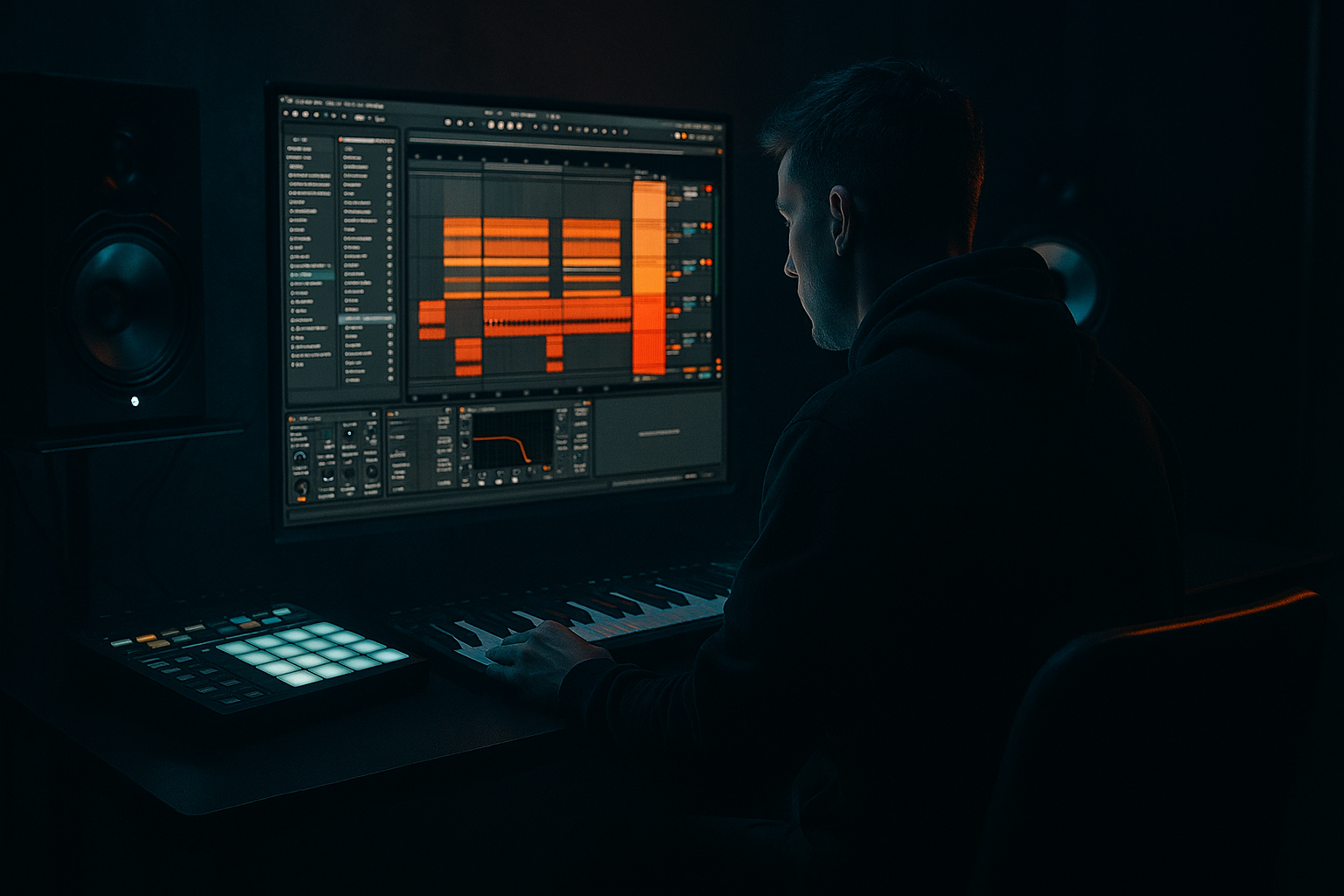
Main tutorial
Lesson Overview
The stepper call-and-response riff flip system is a fast, CPU-light way to build dark, forward-driving DnB edits in Ableton Live 12 without overcomplicating the session. The idea is simple but powerful: you create a main stepper bass riff that “calls,” then answer it with a second phrase, a reversed variation, or a rhythmic interruption that flips the energy every 1–2 bars. This keeps the groove moving while preserving space for the drums, which is exactly what oldskool jungle, dark rollers, and modern stepper DnB all rely on.
In a real track, this technique usually lives in the main drop, but it also works brilliantly in the last 8 bars of a breakdown, a DJ-friendly intro edit, or a switch-up before the second drop. For edits, it’s especially valuable because you can generate variation from a single bass patch and a small set of bounced audio clips instead of building a heavy layered synth rack that drains CPU and muddies the low end.
Why it matters: in DnB, repetition is essential for hypnosis, but identical loops get stale fast. A call-and-response system gives you phrasing, tension, and identity while keeping the arrangement tight and mixable. You get the oldskool “riff energy” of jungle and early techstep, but with modern control over impact, stereo discipline, and low-end clarity.
---
What You Will Build
By the end of this lesson, you’ll have a minimal-CPU Ableton Live edit system built around:
- A stepper bass call phrase: 1-bar or 2-bar riff with strong root/sub movement
- A response phrase: a flipped, delayed, reversed, or rhythmically displaced answer
- A drum edit rack with break chops, ghost hits, and fill variations
- A resampled audio loop so the whole system is light on CPU
- A simple arrangement structure for:
- Making the response too different
- Over-layering bass synths
- Ignoring the drums during the bass edit
- Too much stereo spread in the low end
- Using long reverbs on bass
- Letting every bar hit the same way
- Distort the response, not the sub
- Use filter automation as phrasing
- Layer a reverse drum ghost under the switch
- Carve space around the snare
- Use clip gain for phrase balance
- Push atmosphere only at phrase ends
- Keep the drop DJ-readable
- Build a simple call phrase and a different response, but keep the motif recognizable.
- In DnB, the best variation often comes from rhythm, space, and tone, not bigger melodies.
- Use Ableton stock devices like Operator, Wavetable, Auto Filter, Saturator, Drum Buss, Echo, and Utility.
- Resample early to keep CPU low and turn the idea into an editable audio system.
- Let the drums answer the bass with fills, ghost notes, and break chops.
- Keep the sub mono, FX short, and arrangement phrases clear for DJ-friendly movement.
- intro tension
- drop statement
- call-response variation
- breakdown reset
- second-drop switch-up
Musically, think of something like:
bar 1–2: stripped break + sub stab call
bar 3–4: response with a reese tail or pitch dip
bar 5–6: break flip and fill
bar 7–8: return to the call with automation lift
The result should feel like a classic stepper loop with a jungle brain and a modern DnB spine: dark, syncopated, efficient, and ready for arrangement edits.
---
Step-by-Step Walkthrough
1. Build the foundation with one drum break and one sub source
Start with a single drum break and one bass sound. For the break, use a stock Drum Rack or a simple audio track with chopped break slices. Keep it authentic: Amen, Think-style energy, or a break with a strong snare on 2 and 4. If you’re working from audio, warp the break in Complex Pro only if necessary; for oldskool edits, Beat mode often preserves punch better for chopped drums.
On the bass side, create a Wavetable, Operator, or Analog patch that can do both sub and mid movement without stacking devices. For CPU efficiency, a clean stock choice is:
- Operator for sub/body
- Saturator after it for harmonics
- Optional Auto Filter for movement
Practical settings:
- Operator sine for the sub oscillator
- Filter off or minimal filtering
- Saturator Drive: 1.5–5 dB
- Soft Clip: On
- Keep bass mono from the start
Why this matters: the call-and-response system only works if the foundation is clear. If your break and sub are already crowded, the riff flip will sound messy instead of intentional.
2. Write a 1-bar stepper call with strong rhythmic gaps
Program a short bass riff in MIDI. Don’t overplay it. The call phrase should leave air for the drums and create a question. In oldskool/jungle DnB, the tension often comes from what you leave out.
Try this structure:
- Hit on beat 1
- Another note on the “&” of 1 or beat 2
- A shorter pickup on 3 or the “a” of 3
- Rest into beat 4
Practical MIDI and device ideas:
- Notes around D#1–G1 or whatever fits your track key
- Note lengths: 1/16 to 1/8 for stabs, 1/4 for sub holds
- Use Velocity for contour: first hit around 110–127, later hits around 70–95
- In MIDI Note Editor, add subtle timing nudges of 5–15 ms off-grid on some notes for a human, stepped feel
If you’re using Operator, map subtle expression using:
- Pitch envelope very lightly for attack
- Short amplitude decay for punchier stabs
- No wide stereo tricks yet
This is the “call.” It should feel like a riff that asks the listener to lean in.
3. Create the response by flipping rhythm, not just pitch
The response should answer the call, but it should not be a copy-paste. Advanced edits work best when the second phrase changes rhythmic placement, note length, or filter tone more than raw melody. That’s how you get variation without losing identity.
Make a second MIDI clip or duplicate the first and edit it:
- Shift one note late by 1/16
- Remove the opening hit
- Extend the final note into the next bar
- Add a lower octave answer on the last beat
Great stock-device approach:
- Duplicate the bass track
- On the duplicate, insert Auto Filter
- Use a darker cutoff for the response, around 180 Hz to 600 Hz depending on tone
- Automate resonance subtly, around 0.20–0.45, to make the answer speak more
If the call is punchy and dry, the response can be:
- more filtered
- slightly more distorted
- a semitone bend down
- a reverse of the last stab tail
Why this works in DnB: the brain perceives the second phrase as a continuation, but the rhythmic reversal keeps the groove alive. In a fast 170–175 BPM context, tiny changes matter more than big melodic leaps.
4. Use resampling to keep CPU low and commit the groove
Once the call and response are working, resample them to audio. This is the key to the “minimal CPU load” part. In Ableton Live 12, route the bass track to a new audio track and record the phrase. Then edit the recorded audio into separate clips for the call and response.
Workflow:
- Create a new audio track
- Set Audio From to the bass track or Resampling
- Record 2–4 bars
- Consolidate the best sections
- Chop the response into its own clip if needed
Audio editing moves:
- Use Warp Markers only if the phrase needs alignment
- Fade clip edges to avoid clicks
- Reverse one or two tail segments for a flip effect
- Use Clip Gain for micro-level balance between call and response
This is the edit mindset: instead of building a huge live synth performance, you commit the groove and then shape it like an arrangement tool. That keeps the session light and lets you focus on the musical decision-making.
5. Add the drum edit layer: ghost notes, break slices, and fills
The bass riff becomes much more effective when the drums also “speak” in a call-and-response pattern. Use a Drum Rack with break slices, or edit audio slices manually. A classic DnB edit often has the main break supporting the call, then a fill or turnaround answering the bass response.
Recommended stock workflow:
- Put the break on an audio track
- Slice to new MIDI track if you want granular control
- Or use Simpler in Slice mode for fast triggering
- Add a separate snare layer with Drum Rack if the break lacks impact
Practical drum shaping:
- Snare layer: Transient emphasis via Drum Buss or Saturator
- Drum Buss Drive: around 5–15%
- Transient: +10 to +30
- Boom: very careful in DnB; often low or off unless the kick is too thin
- Use ghost snare hits at very low velocity between main accents
For the response bar, add:
- a quick break fill
- a reversed snare
- a 1/8 hat burst
- a snare flam leading into the next phrase
This is where the edit feels “alive.” In jungle and darker rollers, the drums aren’t just support—they’re part of the conversation.
6. Shape the call-and-response with effects sends, not heavy inserts
To preserve CPU and clarity, use return tracks for shared FX instead of stacking heavy devices on every channel. Create two return tracks:
- Return A: short room / dub space
- Return B: delay / throw
Good stock choices:
- Reverb
- Echo
- Hybrid Reverb if you want a slightly deeper space, but keep it controlled
- Filter Delay for gritty movement
Practical settings:
- Short reverb decay: 0.4–1.1 s
- Pre-delay: 5–20 ms
- Delay feedback: 15–35%
- High-pass the reverb return above 200–400 Hz
- Low-pass the delay return around 4–8 kHz if the top end gets harsh
Automate send levels so only the end of the call or first note of the response gets splashed. That creates the sensation of space without washing the groove. In DnB, this is crucial: too much FX smears the kick/snare relationship and weakens the drive.
7. Build the flip system with scene-based or clip-based variation
Now organize the riff into a proper edit system. In Session View or Arrangement View, create versions:
- A1: dry call
- A2: call with filter movement
- B1: response with reverse tail
- B2: response with octave drop or added delay
Advanced workflow:
- Duplicate the bass clip 3–4 times
- Vary one musical parameter per clip:
- clip 1: dry
- clip 2: slightly filtered
- clip 3: reversed tail
- clip 4: fill ending
- Use Clip Envelopes to automate filter cutoff or volume per clip
Arrangement suggestion:
- 8 bars intro
- 16 bars main drop
- alternate every 2 bars between call and response
- use a 1-bar fill at bar 8 or 16
- remove the sub for the final half-bar before the switch-up
This gives you a DJ-friendly structure with enough repetition to mix, but enough variation to stop the loop from feeling static.
8. Use group processing to glue the edit without killing dynamics
Group your drums and bass separately, then apply light bus shaping. This helps the system feel like one record instead of disconnected parts.
Drum bus ideas:
- Drum Buss for punch and density
- Glue Compressor with very mild settings
- Ratio: 2:1
- Attack: 10–30 ms
- Release: Auto or around 0.1–0.3 s
- Only 1–2 dB of gain reduction
Bass bus ideas:
- Utility to keep mono control
- Saturator very lightly
- EQ Eight to carve a small dip around 200–350 Hz if the edit clouds the low mids
Keep the sub centered and the drums punchy. If you need more movement, automate tonal changes in the mid bass rather than widening the low end. For darker DnB, width should live above the fundamental, not inside it.
9. Refine the edit with micro-automation and tension cues
This is where the advanced polish happens. Instead of adding more notes, add more intention. Automate small changes around the phrase boundary:
- bass filter cutoff opening over 1–2 bars
- slightly more saturation on the response
- reduced kick transient on the call, then restored on the response
- short reverb throw on the final stab
- delay feedback ramp for the last hit of the phrase
Useful musical move:
- On the final 1/4 bar before the response, mute the bass for a beat and leave only the break fill and atmosphere. Then slam the answer back in on the next downbeat.
This creates the kind of tension/release that makes oldskool DnB edits hit hard without relying on giant risers or modern festival-style build-ups.
10. Print, audition, and trim for mix-ready edit behavior
Once the riff works, print a version of the whole section to audio and audition it like a DJ edit. Ask:
- Does the loop still drive after 8 bars?
- Is the call recognizable after the response?
- Does the sub stay stable in mono?
- Does the break breathe around the bass?
Final cleanup:
- remove excess tail reverb
- tighten any clips that push the groove late
- check on a mono utility
- ensure headroom on the master, ideally leaving around -6 dB peak space while arranging
If it works as an audio edit, it’ll translate better in a live DJ context and be easier to arrange into a full track.
---
Common Mistakes
- Fix: keep the same motif, but change rhythm, note length, or filter tone instead of rewriting the whole idea.
- Fix: commit to one core bass source and resample. In DnB edits, clarity beats complexity.
- Fix: make sure the break chops and ghost notes answer the bass phrases too.
- Fix: keep sub mono with Utility and use stereo width only on the upper harmonics.
- Fix: use short returns and filter them aggressively. Long tails can smear the groove and hide the kick.
- Fix: alternate call, response, fill, and reset. Even a tiny one-beat change can make the loop feel alive.
---
Pro Tips for Darker / Heavier DnB
- Keep the sub clean and add more edge to the mid-bass answer using Saturator or Pedal lightly. That gives aggression without low-end collapse.
- A bass riff can “speak” through cutoff movement alone. Try automating Auto Filter from around 200 Hz to 1.2 kHz on the response phrase for a darker talking effect.
- Reverse a snare tail or break hit into the start of the response. It adds underground tension with almost no CPU cost.
- If the bass hits fight the snare, try delaying the bass response by a tiny amount or removing the bass note on the snare backbeat. This preserves impact.
- Don’t rely only on automation. Often the cleanest fix is turning one response clip down by 1–2 dB so the arrangement feels intentional.
- A short noise wash or vinyl texture can live behind the final hit of the call. That nods to oldskool jungle without cluttering the whole drop.
- If the bass pattern is too busy, simplify the first 8 bars. Many of the best rollers and jungle edits work because the first statement is strong and the variations come later.
---
Mini Practice Exercise
Spend 10–20 minutes building a two-bar call-and-response edit from scratch:
1. Choose one break and one bass sound.
2. Write a 1-bar call phrase with 3–4 notes max.
3. Duplicate it and make a response by changing only rhythm and filter tone.
4. Resample both phrases to audio.
5. Add one reversed tail or one ghost snare fill into the response.
6. Automate a return send only on the last hit of each phrase.
7. Loop the result for 16 bars and make one small variation every 4 bars.
Goal: by the end, you should have a working loop that feels like a real DnB edit, not just a static bassline.
---
Recap
If you can make one bass riff feel like a conversation, you can make the whole track feel alive.

