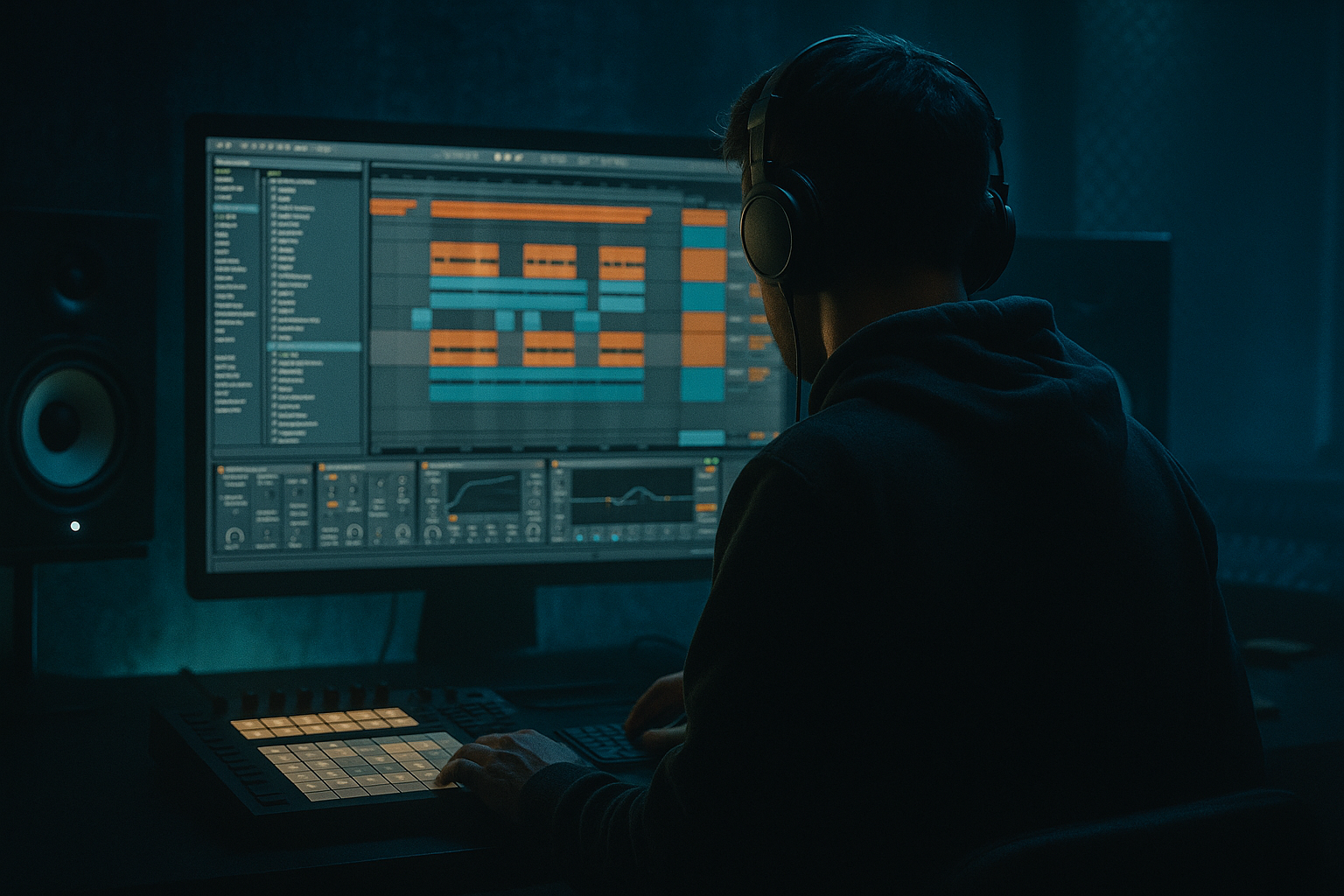
Main tutorial
Stepper Jungle Air Horn Hit: Color and Arrange in Ableton Live 12
1. Lesson overview
In this lesson you’ll build a hard-hitting stepper jungle air horn hit that sits properly in a drum and bass / jungle arrangement—not just as a one-shot, but as a musical impact event with color, movement, and placement.
We’re going to treat the air horn like a rhythmic punctuation mark: part rave siren, part tension spike, part transition tool. In DnB, this kind of hit works best when it has:
- Strong midrange presence
- Controlled low-end
- Aggressive stereo character without phase problems
- Arrangement logic that complements breaks, bass drops, and phrase changes
- A snappy, colored horn hit
- A darkened, heavier version for steppy jungle sections
- A layered arrangement with automation, returns, and drum/break interplay
- A hit that can function as:
- Sample trimming and transient control
- EQ shaping
- Saturation / distortion
- Drum Buss or Glue-style punch
- Reverb/delay for space and depth
- Optional pitch/filter automation for movement
- Bright enough to cut through breaks
- Midrange-focused
- Short transient or at least editable
- Not too much sub already baked in
- Turn on Warp only if needed
- Trim the start tightly so the transient hits immediately
- Remove dead air before the impact
- If the sample has a long tail, decide whether you want:
- Keep the sample peaking around -12 to -6 dB before processing
- You want headroom for saturation and parallel processing
- High-pass around 80–120 Hz
- Cut muddy buildup around 250–500 Hz
- Presence boost around 1.5–4 kHz
- Tame harshness around 6–8 kHz
- Drive: +3 to +8 dB
- Soft Clip: ON
- Curve: Default is fine to start
- Output: trim so you don’t clip downstream devices
- more forward
- more dense
- more harmonically rich
- raising Drive
- then reducing Output
- then re-checking the EQ after saturation
- Drive: 5–15%
- Crunch: low to moderate
- Transients: slightly positive if you want more attack
- Boom: usually off or very subtle for horn hits
- Damp: adjust to reduce harsh fizz if needed
- Pull back Crunch
- Lower Drive
- Use EQ after it to control the extra top-end fizz
- Low-pass sweep into the hit for tension
- Band-pass for a more “telephone/rave siren” character
- Envelope follower style movement using automation
- Filter type: Low-Pass or Band-Pass
- Resonance: moderate
- Cutoff: automate from darker to brighter over 1/2 to 1 bar
- Delay Time: 1/8, 1/8D, or 1/4 depending on tempo
- Feedback: 10–30%
- Filter: roll off low end and harsh highs
- Dry/Wet: keep modest if inline
- Modulation: subtle for movement
- call-and-response moments
- pre-drop horn throws
- jungle transition bars
- Decay: 0.8–2.0 s
- Size: medium
- Pre-delay: 10–25 ms
- Low Cut: at least 200 Hz
- High Cut: 6–10 kHz depending on brightness
- Mono compatibility
- Width control
- Gain trim
- Keep the dry hit fairly centered
- If using stereo effects, check mono collapse
- If the horn disappears in mono, reduce widening and rely more on harmonic density
- High-pass the low end
- Add saturation
- Mild band-pass filtering
- Short reverb tail
- Slightly reduced highs
- Brighter EQ around 2–5 kHz
- More Echo
- Slight stereo width
- Short pre-drop automation sweep
- Bars 1–4: drums + bass foundation
- Bar 5: horn answer or tension hit
- Bar 7 or 8: horn on the downbeat into a phrase change
- Bar 9: variation with filtered horn or reversed tail
- On the 1 for a strong section marker
- On beat 3 as a syncopated stepper stab
- Before the snare as a pickup
- After a snare fill to punctuate the break edit
- At the top of every 8 bars to reinforce arrangement structure
- Horn answers the break
- Horn answers the bass drop
- Horn fills space between snare accents
- Horn creates a “warning siren” before a drop or switch
- Filter cutoff
- Reverb send
- Echo feedback
- Transpose if using Simpler or a sample chain
- Volume for accented hits
- First hit = dry and punchy
- Second hit = filtered with delay
- Third hit = octave-down layer or lower-pitched stab
- Fourth hit = reversed horn into the downbeat
- Does it clash with the snare crack?
- Is it masking the kick transient?
- Is it stepping on the bass movement?
- Is it too long and filling every gap?
- Shorten the decay
- Sidechain lightly to the kick/snare if needed
- Cut low mids around 300–500 Hz
- Use automation so the horn answers the drums, not competes with them
- a short reese stab
- filtered noise
- a brass hit
- a pitched-down vocal exclamation
- Saturator
- EQ Eight
- Drum Buss
- cut it tighter
- reverse parts of the tail
- chop it rhythmically
- re-import and re-process
- Ratio: 2:1 to 4:1
- Attack: fast
- Release: short to medium
- Gain reduction: just a few dB
- filter open/close
- saturation amount
- echo feedback
- reverb send
- Start with a strong horn source
- Trim and tighten the sample
- Use EQ Eight to clear space
- Add Saturator and Drum Buss for grit and density
- Control movement with Auto Filter
- Add space with Echo or Reverb
- Keep the low end out of the way
- Arrange the hit around 8-bar and 16-bar phrasing
- Automate variations so it stays exciting
- a device-chain preset recipe
- a MIDI/arrangement template
- or a step-by-step rack for a more modern neuro jungle horn
We’ll use Ableton Live 12 stock devices to shape the source, add weight and movement, and then place it in a stepper-style jungle arrangement so it feels intentional and powerful. ⚡
---
2. What you will build
You’ll create a single air horn hit chain and then arrange it into a short 8- or 16-bar DnB phrase.
Final result:
- downbeat emphasis
- pre-drop tension
- call-and-response with the snare
- transition marker between 8-bar sections
Core sound design elements:
---
3. Step-by-step walkthrough
Step 1: Load or choose the right horn source
Start by importing an air horn sample or a rave horn / synth stab / brass hit into an Audio Track.
Good source characteristics:
If your sample is too clean or weak, don’t worry—we’ll brutalize it tastefully. 😈
#### Quick sample prep
In the Clip View:
- a short punchy one-shot
- or a longer rave tail for transition use
#### Recommended starting level
---
Step 2: Build a practical device chain
Here’s a strong starting chain using stock Ableton devices:
1. EQ Eight
2. Saturator
3. Drum Buss or Glue Compressor
4. Auto Filter
5. Echo or Delay
6. Reverb on a send or lightly inline
7. Optional: Utility for mono/stereo control
---
Step 3: Shape the tone with EQ Eight
Insert EQ Eight first.
#### Suggested EQ moves
- Keep the horn out of the sub range
- Important in DnB where the kick and bass need room
- Use a broad bell cut if the horn sounds boxy
- This is where the horn cuts through busy breaks
- Especially if the source is screechy or metallic
#### Pro approach
Use audition mode and sweep with a narrow band to find ugly resonances, then reduce them.
A jungle horn should feel aggressive, not painful.
---
Step 4: Add weight and attitude with Saturator
Add Saturator next.
#### Starting settings
#### Why this matters
In DnB, horns often need to sound:
Saturator helps the horn stay audible even when the break and bass are going full tilt.
#### Optional trick
If the horn is too polite, try:
Often saturation changes the tone enough that you’ll want to re-EQ after drive.
---
Step 5: Add punch with Drum Buss
Now insert Drum Buss after Saturator.
Yes, Drum Buss on an air horn can work brilliantly in DnB if used carefully.
#### Good starting settings
#### Use case
This gives the horn a more physical, speaker-rattling punch—perfect for steppy jungle intros or drop accents.
#### If Drum Buss gets too dirty
---
Step 6: Control movement with Auto Filter
Add Auto Filter to make the hit feel like part of an arrangement rather than a static sample.
#### Suggested uses
#### Starting settings
#### Practical DnB move
Automate the horn to open slightly just before the downbeat, then hit full brightness on the one.
That makes the event feel like it’s inhaling before impact.
---
Step 7: Add space with Echo or Reverb
For stepper jungle, the horn can feel huge without cluttering the mix if the space is controlled.
#### Option A: Echo
Use Echo for a dubby/rave tail.
Suggested settings:
This is great for:
#### Option B: Reverb
Use Reverb for a short, dense space.
Suggested settings:
#### Better workflow
Put Reverb on a Return Track so you can send the horn into space only when needed.
That keeps your main horn hit punchy and clean.
---
Step 8: Tighten the dynamics with Utility and gain staging
Add Utility at the end.
#### Use it for:
#### Starting ideas
#### Gain target
Aim for the processed horn to peak around -10 to -6 dB if it’s a one-shot element.
You want it strong, but not fighting the master.
---
Step 9: Color the hit for a jungle aesthetic
To make it feel like it belongs in stepper jungle, give it a slightly raw, rugged identity.
#### Two strong directions
##### A. Dark warehouse horn
This works in darker rollers and steppers.
##### B. Rave alarm horn
This works in classic jungle energy and amen breaks with attitude.
---
Step 10: Build the arrangement in context
Now place the horn in an actual DnB phrase.
#### A solid arrangement template
Try an 8-bar or 16-bar loop with:
#### Placement ideas
#### Jungle-specific phrasing
Classic jungle and modern steppers both love call-and-response:
---
Step 11: Use clip envelopes or automation for variation
Don’t repeat the same horn hit identically every time.
#### Automate:
#### Great variation tricks
This keeps the arrangement alive without adding too many new sounds.
---
Step 12: Layer with the break and kick/snare
Your horn must cooperate with the drum pattern.
#### In stepper jungle, check:
#### Practical fixes
If your drums are aggressive, the horn should feel like a feature accent, not a permanent fixture.
---
4. Common mistakes
1. Letting the horn own the sub range
Air horns often carry unnecessary low-end energy.
In DnB, that will instantly fight the kick and bass.
Fix: high-pass aggressively, usually somewhere between 80–120 Hz.
---
2. Over-widening the sound
Stereo spread can feel exciting, but too much width makes the horn unstable and weak in mono.
Fix: keep the core hit centered, use stereo effects lightly, and check mono.
---
3. Too much reverb
A huge tail may sound epic solo, but in a fast DnB mix it turns into mud.
Fix: use short decay, low-cut the reverb, or move it to a return.
---
4. Harsh upper mids
Air horns can become piercing fast, especially after saturation.
Fix: tame 6–8 kHz and use gentle saturation rather than harsh clipping.
---
5. Random placement
If the horn is dropped randomly, it sounds gimmicky instead of powerful.
Fix: place it at phrase boundaries, pickup moments, or response slots in the drum pattern.
---
6. No variation
Repeating the same exact horn hit every 2 bars gets old fast.
Fix: automate filter, reverb, and level; create 2–4 versions.
---
5. Pro tips for darker/heavier DnB
Tip 1: Darken the horn with band-pass treatment
For a heavier rolling vibe, use Auto Filter in Band-Pass mode and narrow the resonance slightly.
This gives a more hostile, tunnel-like character—great for neuro-leaning steppers and dark jungle. 🕶️
---
Tip 2: Layer with a reese stab or metallic noise
Duplicate the horn or layer it with:
Then group them and process together with:
This makes the impact feel larger and more custom.
---
Tip 3: Use resampling for character
Resample your processed horn back into audio and then:
This is very useful in jungle because it creates a more organic, broken-up texture.
---
Tip 4: Sidechain the horn to the kick slightly
If the horn lands on top of a kick or bass hit, use Compressor with sidechain from the kick.
#### Subtle settings
This keeps the hit powerful but lets the drum transient breathe.
---
Tip 5: Use a short reverse pre-hit
Reverse a chopped version of the horn and place it just before the main hit.
That adds tension and helps the horn slam into the downbeat. Perfect for jungle drop energy.
---
Tip 6: Automate density, not just volume
Instead of only turning the horn up and down, automate:
That creates the feeling of movement and impact without wrecking headroom.
---
6. Mini practice exercise
Build a 16-bar jungle stepper phrase using one horn hit and two variations.
Requirements
Create:
1. Main horn hit
2. Filtered/darker horn variation
3. Reverse pickup into a downbeat
Exercise steps
1. Load one air horn sample into Audio Track 1.
2. Process it with:
- EQ Eight
- Saturator
- Drum Buss
- Auto Filter
- Echo or Reverb
3. Duplicate the track twice:
- Variation A: darker band-pass version
- Variation B: longer delay tail version
4. Arrange them like this:
- Bar 5: main horn
- Bar 7: filtered variation
- Bar 8 last beat: reverse pickup into bar 9
5. Add automation:
- filter cutoff rise before the main hit
- reverb send increase on the variation
- echo feedback on the transition hit
6. Check the groove against:
- breakbeat
- snare placement
- bassline movement
Goal
Make the horn feel like it is directing the arrangement, not randomly decorating it.
---
7. Recap
A strong stepper jungle air horn hit in Ableton Live 12 is about more than grabbing a loud sample. It’s about shaping the horn so it works with the drums, bass, and phrase structure.
Remember the core workflow:
If you do it right, the horn becomes a signature DnB impact element—dark, rude, and perfectly placed in the mix. 🔥
If you want, I can also turn this into:

