Main tutorial
Lesson Overview
This lesson is about turning a plain warehouse intro into a proper jungle/oldskool DnB opening: roomy, dusty, slightly dangerous, but still controlled enough to sit in a real arrangement. You’re building an intro that stretches tension without feeling empty, with crisp transients up top and gritty midrange texture underneath. In other words: the kind of opening that makes a DJ or listener lean in before the drums fully arrive.
This technique lives in the first 8 to 16 bars of a track, or in a pre-drop section before the main groove locks in. In jungle and oldskool-inspired DnB, the intro is not just “atmosphere”; it has to suggest the breakbeat energy, hint at the bass character, and leave enough room for the drop to land hard. Musically, that means using short transient events, filtered dust, and rhythmic spacing. Technically, it means shaping transients cleanly, keeping the low end under control, and making the midrange feel worn-in without getting muddy or harsh.
This works best for jungle, oldskool DnB, rollers with a retro edge, darker breakbeat tracks, and any intro that needs warehouse scale without sounding modern-polished in the wrong way. By the end, you should be able to hear a stretched intro that feels like an abandoned space with sparks of motion: crisp hits, ghostly tails, a rough mid texture, and enough rhythm to imply the track before the full drums arrive.
What You Will Build
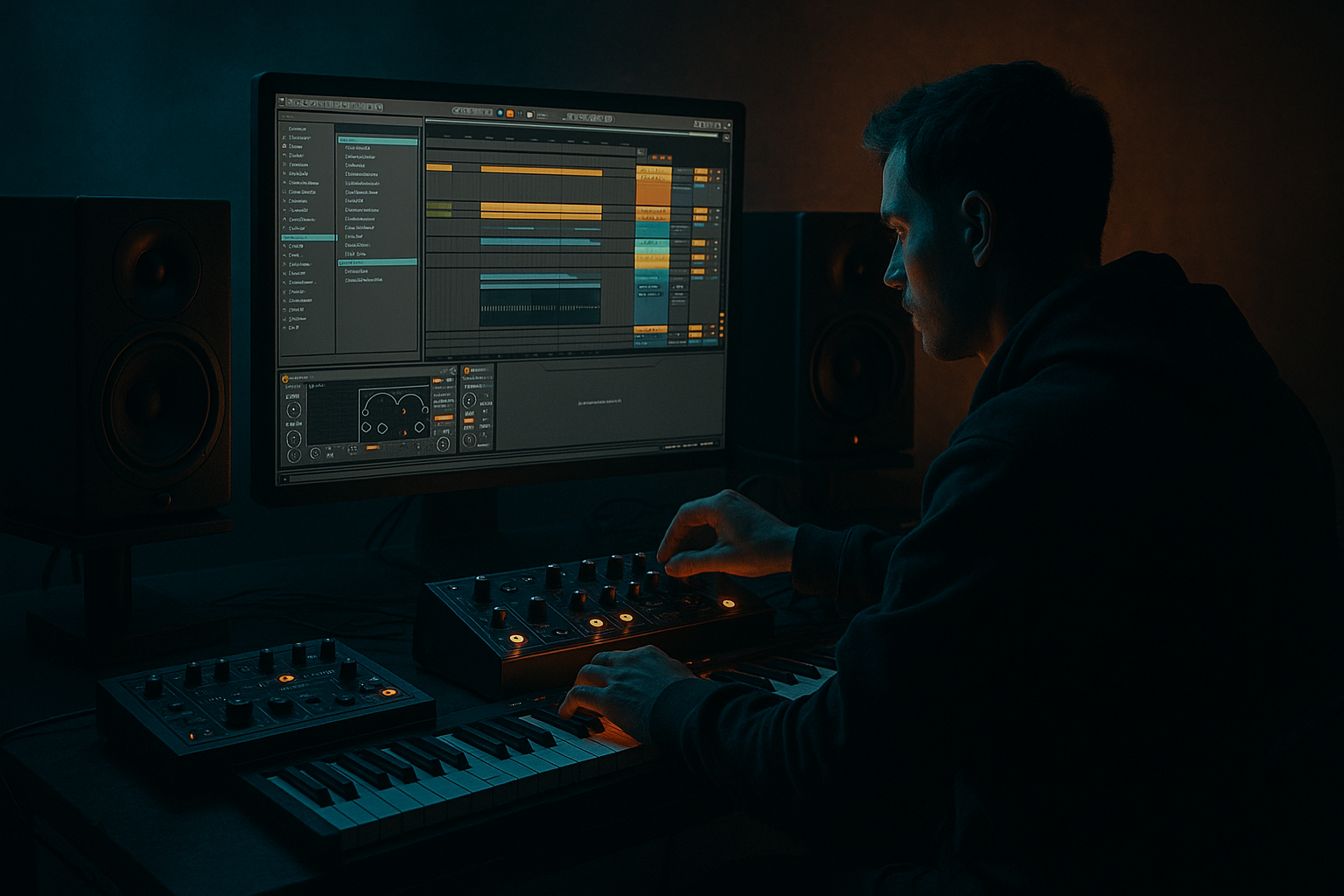
You will build a DJ-friendly intro scene in Ableton Live 12: a dusty warehouse atmosphere made from short transients, filtered break fragments, and a controlled midrange bed. The sound should feel like a concrete room with moving air, not a washed-out ambient pad.
The finished result should have:
- a crisp transient layer that cuts through without sounding clicky or brittle
- a dusty midrange texture that gives the intro age, grit, and movement
- a sense of space that suggests a warehouse or industrial room
- a rhythmic pulse that locks to 170-ish DnB energy without needing full drums yet
- enough polish to sit against a kick, snare, or break when the track opens up
- Treat the transient layer like a warning light, not a drum loop. A few sharp hits spaced across the intro often feel heavier than constant activity because the silence around them creates dread.
- Let the dusty mid layer carry the “age” of the track. Mild Saturator drive into a filtered room sound can evoke old tape, worn vinyl, or concrete reflections without needing an obvious lo-fi effect.
- If the intro needs more menace, automate the filter downward over the last 2 bars instead of upward. Closing the spectrum before the drop can feel more threatening than opening it.
- For a more ruthless, underground feel, use shorter reverbs with darker tone and keep the room more centered. Excess stereo beauty can soften the edge of a jungle intro.
- Resample a version with slightly different edits on the second pass of the intro. That small variation stops the track from feeling copy-pasted and makes the DJ mix more interesting.
- Use break fragments as atmosphere. A chopped ghost of a break, processed into the background, often feels more authentic than a synthetic pad trying to imitate grime.
- Check mono compatibility on the atmosphere bus. If the intro disappears or gets hollow in mono, reduce stereo widening and simplify the mid texture. DnB clubs punish weak mono decisions fast.
- use only Ableton stock devices
- use one source sample and duplicate it into two layers
- no more than one reverb device total
- the intro must leave clear space for a kick/snare drop
- 12 bars of intro audio with a transient layer, a dusty mid layer, and one automation move across the section
- mute the layers one at a time: can you hear what each one contributes?
- play it with a drum loop: does the atmosphere support the groove instead of masking it?
- collapse to mono: does the intro still feel solid and intentional?
Success sounds like this: when you mute the bass and main drums, the intro still feels like a real part of the track, not a placeholder. When you unmute the drums, the atmosphere should support them, not smear over them. If you can nod to the groove before the drop even lands, you’ve nailed it.
Step-by-Step Walkthrough
1. Start with a tight source, not a giant pad
In Ableton, begin with a short audio source or a simple sample that has some transient detail: a clipped room hit, a metal tap, a reversed break slice, a shuffled vinyl crackle burst, or a one-shot from a breakbeat. Drag it into an audio track and trim it so the useful transient sits right at the start.
Why this matters: oldskool/jungle intros work because the ear catches on small rhythmic events. If you start with something overly smooth, you’ll spend forever trying to manufacture character later. A source with a defined attack gives you something to stretch, carve, and dust up.
Keep the clip short enough that it doesn’t already feel like the full atmosphere. You want a seed, not the finished bed.
2. Stretch it into a warehouse-sized bed
Use Warp on the clip and stretch it until it sits in the intro at a slower, spacious pace. For a jungle-feeling texture, try a warp mode that preserves transients clearly enough to keep the attack readable. If the source is percussive, you’ll usually get a better starting point from a transient-friendly mode than something overly smudgy.
A useful move is to create a 1-bar or 2-bar loop and let the tail breathe across the bar line. Then duplicate it across 8 bars, but vary the end of each 2-bar phrase with tiny edits so it doesn’t loop like wallpaper.
Listen for two things:
- the attack should still be obvious even when slowed down
- the sustained part should feel like room tone, not a digital smear
If the transient disappears completely, shorten the warp distance or choose a different source. If the tail sounds plasticky, reduce the amount of stretching and move more of the “space” into reverb and filtering instead.
3. Build two layers: one transient, one dusty midrange
Now create two separate audio tracks or duplicate the clip into two lanes:
- Layer A: transient layer
- Layer B: dusty midrange layer
For Layer A, keep the clip high-passed aggressively with EQ Eight, usually somewhere around 200–400 Hz depending on the source, so it behaves like a crisp punctuation layer.
For Layer B, low-pass it and shape the mids so the body becomes dusty and worn. A good starting point is a low-pass around 6–10 kHz, then a gentle notch if there’s a harsh resonance around 2–4 kHz. You’re trying to keep the “room grime” while removing glossy top-end.
Why this works in DnB: the transient layer gives the intro definition for the drums to later cut against, while the dusty mid layer makes the sound feel like a physical space. Jungle and oldskool moods are often carried by the midrange, not by huge modern sheen.
4. Shape the transient layer with a short, controlled chain
On the transient layer, add these stock devices in this order:
- EQ Eight
- Drum Buss or Saturator
- Utility
EQ Eight: high-pass low enough to avoid thinning the vibe too much, but high enough to remove body. Often 200–300 Hz is enough. If the attack is too sharp, cut a little around 3–5 kHz instead of just turning it down globally.
Saturator: use gentle drive, roughly 2–5 dB, to make the transient feel denser and more audible on smaller systems. Keep the Soft Clip on if needed, but don’t crush the attack into a square edge.
Drum Buss: use very lightly if the source needs extra bite. A small amount of Drive and Transients can help, but avoid overdoing it. You want the transient to feel like a strike in a big room, not a modern kick sample.
Utility: if the source has stereo wobble that distracts from the punch, reduce width here or set it narrower. For intro punctuation, a more centered hit often reads better once the main drums arrive.
What to listen for:
- the transient should speak quickly and then get out of the way
- the hit should feel like it belongs to the room, not sit on top of it
5. Build the dusty midrange bed with movement, not wash
On the dusty midrange layer, use this chain:
- Auto Filter
- Saturator
- Hybrid Reverb or Reverb
- EQ Eight
Auto Filter: set a band-pass or low-pass style movement and automate the cutoff slowly across 4 or 8 bars. If you want a more haunted warehouse feel, let the cutoff drift down and back up over the intro. Keep the movement subtle; the goal is motion, not a wobble effect.
Saturator: add a little drive, often around 3–8 dB depending on the source. This brings forward the dusty harmonics in the mids so the layer feels like it has age and compression.
Reverb: use a medium or large room feel with a fairly short to medium decay, around 1.2–2.5 seconds as a starting point, and keep low frequencies out of the tail. You want a sense of concrete space, not a washed cloud.
EQ Eight after reverb: trim any boxy buildup around 250–500 Hz if the room starts to cloud the intro. If the reverb gets too shiny, tame 6–10 kHz.
Decision point — A versus B:
- A: darker and tighter. Use a shorter reverb and stronger low-pass. This suits stripped-back jungle intros and DJ tools.
- B: wider and more cinematic. Use a longer room and slightly less filtering. This works when the intro needs to feel like a scene before a breakdown.
Choose A if the drop is already dense. Choose B if the intro needs to sell scale before the drums hit.
6. Add rhythm by editing the clip like a break, not a pad
Duplicate the audio and chop it rhythmically so the atmosphere behaves like a fractured break element. In the clip view, use slices that create little call-and-response gaps: one hit, a gap, a softer hit, a longer tail, then silence. A useful phrase length is 2 bars, with an evolving variation every 4 bars.
Try placing the main transient on beat 1, then a quieter pickup just before beat 3 or the “and” of 4. That gives the intro a hint of breakbeat motion without fully turning it into drums.
If you want an oldskool jungle lean, let some edits feel slightly offset rather than perfectly grid-snapped. A tiny timing nudge can make the loop breathe. Keep the nudge subtle; you want human drift, not sloppy timing.
Stop here if the intro already feels like it’s moving with intent. If the room, transients, and gaps are speaking clearly, commit the edited audio to a new track and continue with processing from there. Printing it keeps you from endlessly second-guessing the loop.
7. Check it against a ghost drum groove or a muted bass idea
Before polishing further, place your intro in context with a basic kick/snare or a stripped break, and if possible, a placeholder bass note or sub pulse. This is the crucial reality check: atmospheres in DnB only work if they leave space for the groove.
Listen for whether the transient layer masks the snare crack or whether the dusty mids sit on top of the break’s midrange. If so, carve space with EQ Eight:
- cut a little around 180–250 Hz if the intro fights the kick body
- trim 2–4 kHz if it interferes with snare presence
- remove excess low end below about 120–150 Hz from the atmosphere tracks
What to listen for:
- the drums should feel clearer, not thinner, when the intro plays
- the intro should still be audible in the gaps between hits
This check matters because a warehouse intro that sounds huge solo can collapse the whole drop if it lives in the same frequency pocket as the drums.
8. Automate tension across the bar phrases
Use automation to make the intro evolve in clear DnB phrases, not random motion. A strong structure is 8 bars of development with a small change every 2 bars:
- bars 1–2: dry and distant, more low-passed
- bars 3–4: introduce brighter transient detail
- bars 5–6: open the filter slightly and add a bit more reverb send or wet level
- bars 7–8: thin the atmosphere again or add a reverse swell leading into the drop
A very effective move is to automate Auto Filter cutoff and reverb wet amount in opposite directions: as the filter opens, reduce the reverb slightly, so the intro gains clarity without turning into a haze.
For a drop lead-in, mute the dusty mid layer for the final half-bar and let only the transient or reverse tail survive. That negative space makes the drop feel bigger.
9. Use sidechain only if it serves the intro, not if it flattens it
If the intro sits over a light kick pulse or a ghost sub, use Compression with sidechain gently on the atmosphere bus. Keep the action subtle: enough to clear space when the kick or snare hits, not enough to make the intro pump like a house track.
A modest attack and release can help the warehouse bed duck out of the way and then bloom back in. If the sidechain is too obvious, the intro loses its mystery and starts sounding like filler.
Trade-off: sidechain can create cleaner drum visibility, but it also reduces the feeling of suspended space. Use it when the intro is competing with early groove elements; skip it when the intro needs to remain static and cinematic.
10. Final polish: commit the role, not just the sound
Once the idea is working, decide what each layer is doing in the arrangement:
- transient layer = cue, punctuation, anticipation
- dusty mid layer = atmosphere, room identity, tension
- reverse or filtered tail = transition into the drop
Bounce or resample the intro into audio if you’ve reached the point where the balance and phrasing are right. This is a workflow efficiency move: committed audio is faster to arrange, easier to automate, and less likely to drift into endless tweaking.
Put the full intro next to the first drum entry and the bass drop. If the intro still feels like it belongs when the track opens up, you’re done. A successful result should feel like a worn industrial space that is alive with motion but never muddy, with transients sharp enough to imply the beat and mids dusty enough to sell the scene.
Common Mistakes
1. Making the intro too wide too early
Why it hurts: wide low-mid atmospheres can smear the central groove and weaken the drop impact.
Fix: use Utility to narrow the atmosphere tracks, or keep anything below roughly 150–200 Hz effectively mono by cutting it out of the stereo layer with EQ Eight.
2. Leaving too much low end in the atmosphere
Why it hurts: the intro may sound huge solo, but it will fight the kick and sub once the track enters.
Fix: high-pass the atmosphere more aggressively, often somewhere between 120–250 Hz depending on the source and the arrangement.
3. Over-warping until the transient turns plasticky
Why it hurts: jungle energy depends on transient identity. If the attack gets smeared, the intro loses its rhythmic cue.
Fix: use a more transient-friendly warp mode, shorten the stretch amount, or choose a source with stronger attack before processing.
4. Using reverb as the main character
Why it hurts: a wash with no rhythmic detail becomes mood wallpaper, not a DnB intro.
Fix: reduce decay, add a clearer transient layer, and automate the filter so the space feels like it’s breathing rather than just lingering.
5. Letting dusty mids build up around 300–500 Hz
Why it hurts: that range can turn the intro boxy and mask snare and break body.
Fix: use EQ Eight to cut gently in that zone, then check again in context with drums.
6. Making every bar identical
Why it hurts: DnB intros need forward motion and DJ usability. Static loops feel like placeholders.
Fix: change something every 2 or 4 bars: a filter move, a chopped gap, a reverse tail, or a transient accent.
7. Over-compressing the atmosphere bus
Why it hurts: too much compression flattens the room and can exaggerate noise in an ugly way.
Fix: back off the compression threshold, use less gain reduction, or split the transient and dusty layers so each can be treated differently.
Pro Tips for Darker / Heavier DnB
Mini Practice Exercise
Goal: build a 12-bar warehouse intro that feels like an authentic jungle/DnB opening.
Time box: 15 minutes.
Constraints:
Deliverable:
Quick self-check:
Recap
A strong warehouse intro in Ableton Live 12 is built from contrast: crisp transient cues, dusty midrange texture, and controlled space. Keep the low end out of the atmosphere, edit the phrasing like a break, and automate the intro in clear DnB-sized chunks. Most importantly, check it against drums and bass early. If the intro feels like a real room with rhythmic intent and leaves the drop room to hit, you’ve got the right result.

