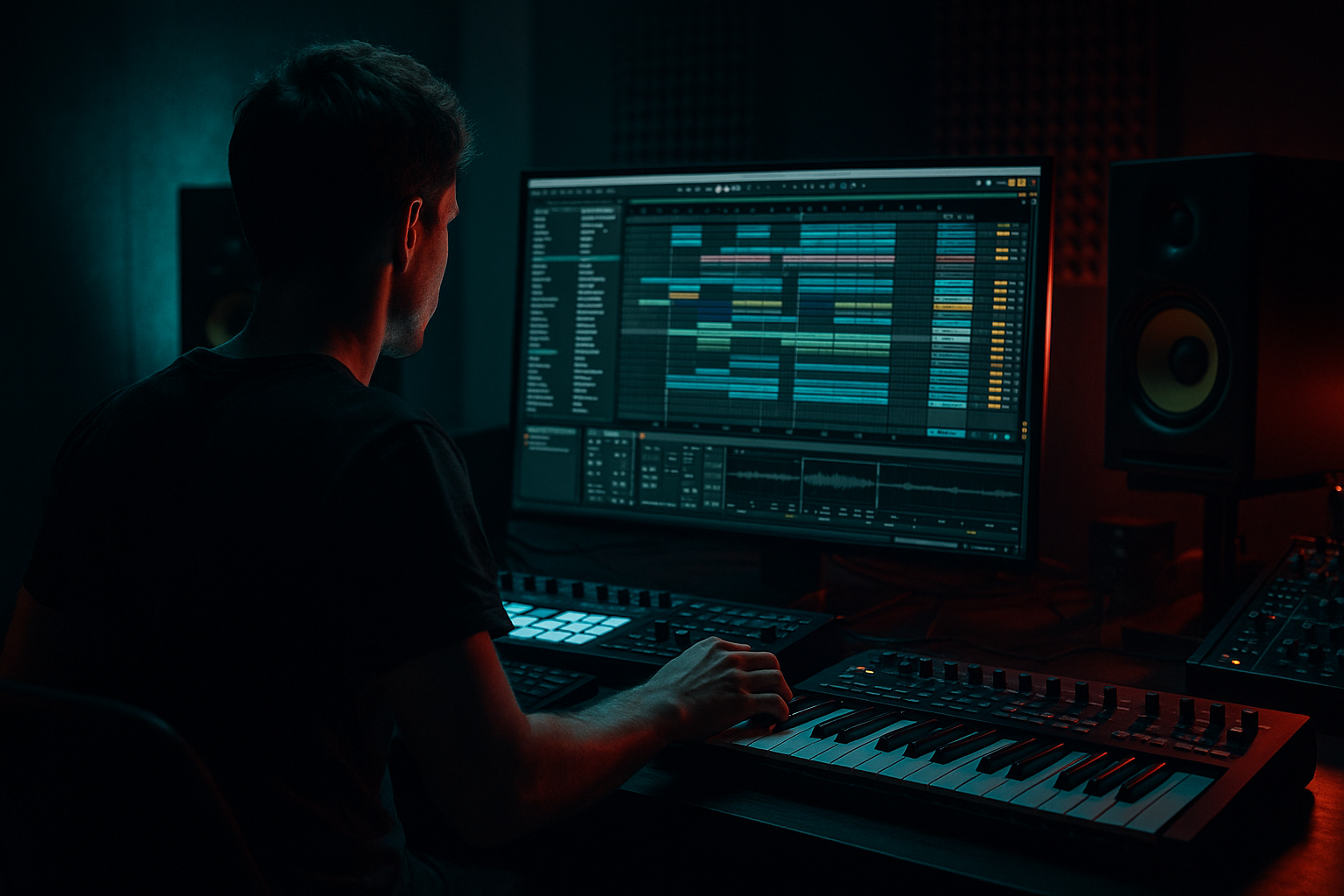
Main tutorial
Stretch Oldskool DnB Ride Groove for Pirate‑Radio Energy in Ableton Live 12 (Beginner) 🏴☠️🔊
1. Lesson overview
Oldschool jungle/DnB rides have that pirate‑radio urgency: slightly rushed, gritty, and “pulled” by swing and time‑stretch artifacts. In this lesson you’ll take a classic ride groove (from a break, a sample pack, or your own loop) and stretch + reshape it in Ableton Live 12 so it feels faster, dirtier, and more rolling—without losing vibe.
You’ll learn:
- How to time‑stretch rides without killing character
- How to extract groove and apply it to other drums
- How to create controlled “radio” grit using stock devices
- A practical arrangement trick to make it feel like a late‑night FM broadcast
- A stretched, shuffled ride groove that drives the track
- Tight kick/snare backbone
- Ghost notes + hats that inherit the ride’s swing
- “Pirate radio” processing chain (saturation, band‑limiting, wow/flutter vibe)
- Drop a breakbeat loop (e.g., old Amen‑style or a dusty ride loop) onto `Ride Loop`.
- We’re focusing on the ride layer (top end rhythm), not necessarily the whole break.
- Use any 1–2 bar ride/percussion loop with swing and texture.
- Temporarily set project tempo to 160 BPM
- Warp the clip so it plays tight at 160
- Now return project tempo to 172 BPM
- In the clip, drag the end warp marker so your 2‑bar loop becomes 2 bars + a tiny bit (like 2.1 bars)
- Then add warp markers to force downbeats back to the grid
- Bar 1: Kick on 1, then another around 1.3 (or 1.2 depending on swing)
- Bar 2: Kick on 1, then a pickup kick near 1.4
- Snare on 2 and 4 (standard DnB backbeat)
- Add Drum Buss on Kick and Snare tracks:
- Hybrid Reverb
- EQ Eight: band-limit
- Saturator: Drive 5–10 dB
- Compressor: Ratio 4:1, fast attack, medium release, push it
- Optional Vinyl Distortion:
- Bars 1–4: Ride band‑limited (Auto Filter freq lower), minimal reverb
- Bars 5–8: Open the filter a bit, add Return B (Radio) more
- Bars 9–12: Drop ride for 1 bar, let hats + ghosts roll (tension)
- Bars 13–16: Bring ride back louder + a touch more saturation; add a short fill (snare flam or quick amen chop)
- Return B send (Radio) up into transitions
- Filter frequency to “open the station”
- Over-warping until it’s sterile: If every transient is perfectly pinned, you lose swagger. Keep some drift.
- Using Complex/Complex Pro on drums: Often makes rides smeary. Start with Beats or Texture.
- Too much top-end boosting: Oldskool rides are bright, but harshness kills the vibe fast—use EQ dips, not endless shelves.
- No groove transfer: If only the ride swings, the rest feels pasted on.
- Overdoing bitcrush: A little radio grit is great; too much turns into fizzy sand.
- Parallel crush the ride, not the whole drum bus: Keep kicks/snares punching clean while the ride carries grime.
- Sidechain the ride to the snare (subtle):
- Add controlled metallic edge:
- Short slap delay for “warehouse tape” vibe:
- With groove extraction vs without
- With Radio return vs dry
- You created pirate‑radio energy by stretching a ride groove and embracing controlled warp artifacts.
- You extracted groove to make the whole kit roll together.
- You built a practical stock-device chain for gritty broadcast texture.
- You added tiny arrangement variations to avoid “2‑bar loop fatigue.”
---
2. What you will build
A 16‑bar rolling DnB drum loop at ~170–175 BPM featuring:
End result: a loop that feels like oldskool rave tape energy, but clean enough to sit in a modern mix. ⚡
---
3. Step-by-step walkthrough
Step 0 — Session setup (fast + clean)
1. Set tempo to 172 BPM (good middle ground for jungle/DnB).
2. Create tracks:
- Audio: `Ride Loop`
- MIDI: `Kick`, `Snare`, `Hats/Ghosts`
- Return: `A = Room`, `B = Radio`
Why: You’ll stretch/warp the ride in audio, but build the backbone in MIDI for control.
---
Step 1 — Get a ride groove source (2 options)
Option A: From a break sample
Option B: From a ride loop sample pack
Tip: Choose something with dynamic hits (not perfectly even)—that’s where the pirate‑radio feel comes from. 🎛️
---
Step 2 — Warp it like a DnB producer (don’t over-polish)
1. Click the clip on `Ride Loop`.
2. Enable Warp.
3. Set Seg. BPM roughly correct (don’t stress perfection yet).
4. Choose Warp Mode:
- Start with Beats mode
- Preserve: `1/16` (for fast ride patterns)
- Turn Transient Loop off initially
- If it gets too “clicky,” try Texture mode:
- Grain Size: `15–25 ms`
- Flux: `10–20%`
Goal: keep some artifacts. Slight roughness = vibe.
---
Step 3 — Stretch it to create urgency (the key move)
Here’s the pirate trick: stretch the ride slightly longer/shorter than the grid, then force it back with warping.
1. Decide your loop length (start with 2 bars).
2. In Clip View, set the Loop Length to 2 bars.
3. Now do one of these:
Method A (classic): slow the loop down then warp it back up
This makes the ride feel like it’s being dragged forward—a classic tension.
Method B (direct stretch):
Listen for: the ride slightly “leans” and sprays energy into the bar. That’s the FM‑tape push. 📻
---
Step 4 — Extract the groove from the ride (so the whole kit rolls)
1. Right‑click the warped clip → Extract Groove.
2. Open the Groove Pool (hotkey: open from left panel if hidden).
3. Find the extracted groove (it’ll be named after the clip).
4. Set:
- Timing: `40–70%` (start at 55%)
- Random: `5–15%`
- Velocity: `0–20%` (small is good)
5. Drag that groove onto:
- Your `Hats/Ghosts` MIDI clip
- (Optionally) the `Snare` for subtle push/pull (keep low timing like 20–35%)
Why: oldskool DnB feels glued because everything “inherits” the break’s micro-timing.
---
Step 5 — Build the backbone (kick + snare that doesn’t fight the ride)
Use a Drum Rack or Simpler on MIDI tracks.
Kick pattern (DnB basic):
Snare pattern:
Ableton devices:
- Drive: `5–15%`
- Boom: `0–20%` (keep low; DnB subs usually come from bass)
- Transient: `+5 to +20` on snare if needed
Important: Keep the snare consistent; let the ride do the chaos. 🥁
---
Step 6 — Make the ride sit like pirate radio (stock chain)
On `Ride Loop`, add this chain in order:
#### Device Chain (Ride Loop)
1. EQ Eight
- High‑pass: 200–350 Hz (12 or 24 dB/oct)
- Gentle dip: 3–6 kHz if harsh (small, -2 to -4 dB)
- Optional shelf up: 8–12 kHz for air (+1 to +3 dB)
2. Saturator
- Mode: Analog Clip
- Drive: 2–6 dB
- Turn Soft Clip ON
- Output: adjust so level matches before/after (avoid tricking your ears)
3. Redux (light touch!)
- Downsample: 2.0–4.0
- Bit Reduction: 0–2 (keep subtle)
- Mix: 20–40% (or use Dry/Wet)
4. Auto Filter (for “radio” movement)
- Filter type: Band‑Pass
- Freq: 1.5–4 kHz
- Resonance: 0.7–1.2
- Add LFO:
- Rate: 1/8 or 1/4
- Amount: small (just a wobble)
Result: gritty midrange chatter + motion, like a stressed transmitter. 📡
---
Step 7 — Add “broadcast space” and dirt (Returns)
#### Return A — Room (glue + rave haze)
- Algorithm: Room or Hall (small)
- Decay: 0.6–1.2s
- Pre‑delay: 10–25 ms
- High‑cut: 6–9 kHz
Send ride and hats lightly (10–25%).
#### Return B — Radio (parallel destruction)
- HP: 300 Hz
- LP: 6–8 kHz
- Drive low, add a touch of crackle if you want texture (keep it subtle)
Send your ride more than anything else (20–40%). This is your “broadcast layer.”
---
Step 8 — Micro-edit for roll (make it feel alive)
This is where beginner loops become real.
1. Duplicate your 2‑bar loop to 8 bars.
2. In bar 4 and bar 8, do a tiny variation:
- Mute 1–2 ride hits
- Or nudge a single warp marker to make a “rush” into the snare
- Or automate Auto Filter frequency slightly upward
Classic jungle move: make bar 8 slightly more hyped than bar 1. 🔥
---
Step 9 — Arrangement idea (16 bars of pirate pressure)
Try this structure:
Automate:
---
4. Common mistakes
---
5. Pro tips for darker/heavier DnB 🌑
- Add Compressor on `Ride Loop`
- Sidechain input: `Snare`
- Ratio: `2:1`, small gain reduction (1–3 dB)
- This makes the snare slap through like proper rollers.
- Try Resonators very quietly (Dry/Wet 5–15%) tuned to a dark note (F, F#, G).
- Echo: 1/32 or 1/16, very low feedback, high‑cut around 5–7 kHz, mix 5–12%.
---
6. Mini practice exercise (10–15 minutes)
1. Import any ride/break loop.
2. Warp in Beats (1/16).
3. Do Method A stretching: tempo 160 → warp tight → back to 172.
4. Extract Groove → apply to a hi-hat MIDI clip.
5. Add the Ride Loop chain (EQ Eight → Saturator → Redux → Auto Filter).
6. Arrange 8 bars and automate Return B (Radio) rising into bar 8.
Export a quick 8‑bar audio bounce and compare:
---
7. Recap ✅
If you tell me what kind of source you’re using (Amen break? ride loop? full breakbeat?), I can suggest the best warp mode + exact groove/timing ranges for that material.

