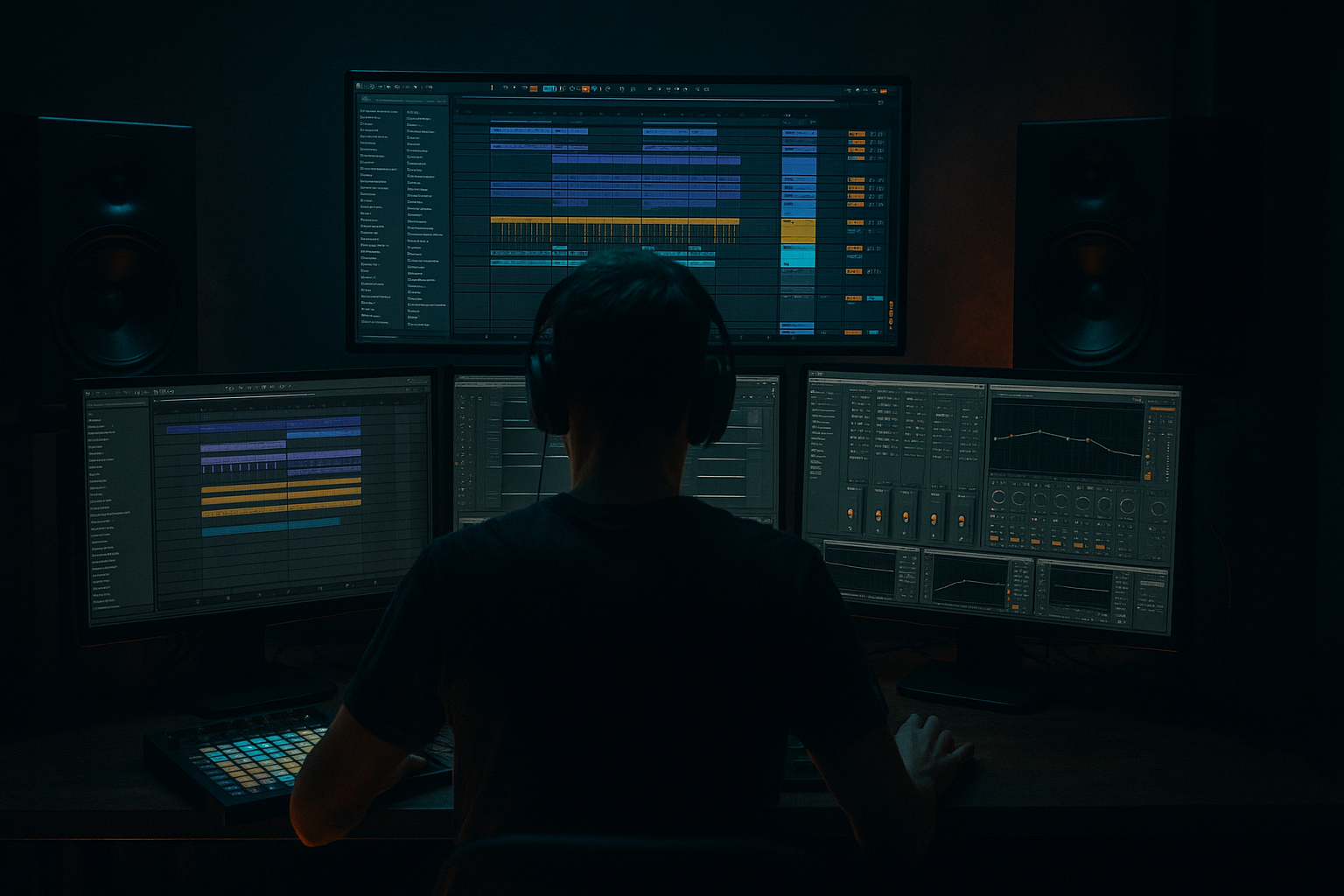
Main tutorial
Stretching Pads From One‑Shots Masterclass (DJ‑Friendly DnB Sets) 🎛️🌌
1) Lesson overview
In drum & bass, pads aren’t just “pretty background.” In DJ-friendly productions, they’re mixing glue: they create long, stable harmonic beds that make intros/outros feel professional, help DJs blend keys, and keep energy rolling while drums drop in/out.
This masterclass shows how to take tiny one-shot samples (vox hits, foley, chord stabs, synth plucks, reese resamples) and stretch them into lush, evolving pads in Ableton Live, while keeping them tempo-locked, key-aware, and mix-ready for DnB arrangement norms (16/32-bar phrases).
You’ll do this with stock tools: Sampler/Simpler, Warp modes, Granulator III (if you have it), Wavetable, Hybrid Reverb, Echo, Auto Filter, Chorus-Ensemble, Utility, Saturator, Glue Compressor, and Resampling.
---
2) What you will build
By the end, you’ll have:
- A pad instrument rack built from one-shot(s) that can generate:
- A DJ-friendly arrangement template:
- A repeatable workflow: stretch → stabilize pitch → add motion → mix carve → print stems.
- Short chord stab, string hit, vocal tone, analog synth pluck, frozen reverb tail, reese note, metallic foley
- Avoid super transient-only hits (unless you want noisy pads)
- In Simpler, adjust Transpose until the pad feels in key.
- If you know the note: tune so your played C sounds like your project key root (or vice versa).
- Mode: Lowpass 24 dB
- Cutoff: start around 300–800 Hz
- Resonance: 5–15%
- Enable LFO:
- Bar 1–16: slowly open
- Bar 17–32: either open more or pull back before drop
- Mode: Ensemble
- Amount: 10–30%
- Rate: 0.05–0.20 Hz
- Width: 80–120% (watch mono compatibility)
- Start with Convolution + Algorithm (best of both worlds)
- Decay: 4–10 s
- Predelay: 10–30 ms (keeps clarity)
- High Cut: 6–10 kHz (darker DnB-friendly)
- Mix: 10–25% (or use a Return track)
- Time: 1/4 or 3/8 (DnB loves 3/16, 3/8 feels spacious)
- Feedback: 10–25%
- Filter: HP 200–400 Hz, LP 4–8 kHz
- Mod: a touch (but keep it classy)
- Right-click pad track → Freeze Track
- Right-click → Flatten
- Bars 1–8: pad + noise bed (LP filtered, darker)
- Bars 9–16: bring in hats/shaker loop, subtle uplifter
- Bars 17–24: add break ghost layer or rim ticks
- Bars 25–32: automate filter open + tension FX → drop
- Pad printed from a stab + huge verb tail
- Layer with a filtered Amen at low volume
- Add vinyl noise and dub delay throws (Echo) at phrase ends
- Pad is very low in level, mostly mid/high texture
- Sidechain stronger
- Use it to fill gaps when bass is sparse, keeping energy consistent
- Warp mode mismatch: Using Beats mode on tonal material = warbly/phasey nonsense.
- Loop clicks: No crossfade or loop too short without fades.
- Pads fighting the bass: Not high-passing enough (pads do not need sub).
- Too wide too low: Huge stereo width below ~200 Hz = mono problems in clubs.
- No sidechain: Pads blur transients; DnB needs punch.
- Over-reverb: Long decay + bright top end = harsh wash that kills drums.
- Untuned source: If your pad is “between notes,” your whole track feels amateur.
- Make pads “smoke,” not “shine”:
- Resample through saturation for grit:
- Pitch down for menace (carefully):
- Add subtle dissonance:
- Mid/Side EQ discipline:
- Reese-compatible space:
- Stretching pads from one-shots is about warp choice + loop technique + fades.
- Make it DJ-friendly by thinking in 32-bar phrases, key stability, and printed stems.
- Make it DnB-ready with HP filtering, sidechain, controlled width, and dark, intentional space.
- Resampling is your friend: commit the vibe, reduce CPU, and keep consistency across the set.
- 16–32 bar intros/outros for DJs 🧩
- breakdown beds behind atmos and FX
- “rolling fog” pads that sit behind reese + drums without masking
- 32-bar intro (pads + atmos)
- 16-bar “tease” (pads + perc)
- drop, breakdown, 32-bar outro
---
3) Step-by-step walkthrough
Step 0 — Choose the right one-shot (this matters)
Pick one-shots with harmonic information or rich texture:
DnB vibe tip: Jungle-era pads often come from resampled stabs + reverb tails, stretched and filtered.
---
Step 1 — Set project foundations for DJ-friendly behavior
1. Set tempo: 172–176 BPM.
2. Decide your key early (e.g., F minor / G minor / D minor are common for heavier DnB).
3. Turn on Loop brace to 32 bars and start thinking in phrases:
- intros/outros usually 32 bars (sometimes 16).
---
Step 2 — Stretch in Simpler (fastest “pad from one-shot” method) ⚡
1. Drag your one-shot into Simpler (not Sampler yet).
2. Go to Classic mode.
3. Enable Warp inside Simpler.
4. Choose a warp mode:
- Complex Pro for tonal/musical content (chords, vox, synth)
- Set Formants around 0–30 (avoid chipmunking when pitching)
- Set Envelope around 64–128 for stability
- Texture for noisy/foley/atmos
- Set Grain Size ~ 80–200 ms
- Flux ~ 10–25% for motion without chaos
5. Turn on Loop:
- Find a section of the sample that sounds “steady” (even if tiny).
- Set Loop Length typically 50–400 ms.
- Add a Fade (crossfade) to kill clicks:
- Fade around 20–80 ms depending on loop length.
6. Shape amplitude:
- Attack: 50–300 ms (pads don’t “tick”)
- Release: 1–6 s (long tail for DJ blends)
- Enable Voices: 6–12 if you plan to play chords.
Checkpoint: Hold a note for 8 bars. It should sound continuous, not clicky, and not wildly pitch-wobbling.
---
Step 3 — Get it in key (advanced but essential)
Pads that aren’t in key = DJs hate you (and your drop won’t feel “intentional”).
Method A: Use Simpler’s Transpose
Method B: Use Ableton Tuner + resample
1. Drop Tuner after Simpler.
2. Play a single note (e.g., C3) and watch the reading.
3. Adjust Transpose until stable.
4. Optional: Freeze + Flatten to print it clean.
Pro approach: once tuned, consider printing a single sustained note and re-importing it. That locks it down for consistent DJ intros/outros.
---
Step 4 — Add movement like a pro (without overcomplicating) 🌫️
A pad that’s static for 32 bars will feel lifeless. Add slow motion.
#### A) Filter movement (classic DnB intro vibe)
Add Auto Filter after Simpler:
- Rate: 0.03–0.10 Hz (very slow)
- Amount: small, 5–15%
Automate the cutoff across phrases:
#### B) Width & haze (make it “cinematic” but controlled)
Add Chorus-Ensemble:
Add Hybrid Reverb:
#### C) Tempo-synced “air” pulses (subtle DJ glue)
Add Echo:
---
Step 5 — Make it sit in a rolling DnB mix (serious mix carving) 🥁
Pads can ruin your drop if you don’t carve.
Device chain (recommended):
1. EQ Eight
- HP filter: 24 dB @ 120–250 Hz
(higher if your bass is huge)
- Dip: 200–500 Hz if boxy (2–4 dB)
- Dip: 1–3 kHz if it fights snares/vocals
2. Utility
- Bass Mono: set 120–200 Hz (keep low end centered)
- Width: 80–110% depending on the pad
3. Glue Compressor (gentle)
- Ratio: 2:1
- Attack: 10–30 ms
- Release: Auto
- GR: aim 1–2 dB
4. Sidechain compression (mandatory for DnB)
- Use Compressor with Sidechain from your Kick+Snare group (or whole Drum Buss)
- Ratio: 4:1
- Attack: 1–5 ms
- Release: 80–160 ms (tune to groove)
- GR: 2–6 dB depending on density
DnB arrangement note: In intros/outros, you can reduce sidechain to keep it lush. During drops, increase it for punch.
---
Step 6 — “Print it” for DJ-friendly reliability (resampling workflow) ✅
Once your pad sounds good, print stems so it’s consistent and CPU-light.
Option A: Freeze/Flatten
Option B: Resample to audio (my go-to)
1. Create a new Audio track named `PAD_PRINT`.
2. Set its input to Resampling.
3. Arm and record 32 bars of your pad performance (intro length).
4. Consolidate (Cmd/Ctrl + J) into a single clip.
5. Warp mode for the printed audio:
- Usually Complex (or Complex Pro if needed)
6. Add tiny clip fades to eliminate any start clicks.
Now you have a DJ-ready pad stem you can drop into any arrangement.
---
Step 7 — DJ-friendly arrangement ideas (DnB/Jungle rooted)
Here are three proven ways to use the pad:
#### Template A: “Classic 32-bar blend intro”
#### Template B: “Jungle throwback”
#### Template C: “Minimal roller tool”
---
4) Common mistakes
---
5) Pro tips for darker/heavier DnB 🖤
Use Hybrid Reverb High Cut (6–8 kHz) + Auto Filter to keep it moody.
Add Saturator (Soft Clip on, Drive 2–6 dB) before reverb, then print.
Pitch -3 to -12 semitones + Complex Pro with modest formant settings.
Duplicate pad track, detune +7 cents, low volume, more reverb. Instant tension.
With EQ Eight in M/S mode:
- Cut some Side around 200–600 Hz
- Let Side live more above 2–5 kHz (but keep it dark overall)
If your reese owns 200–1k, carve the pad there and let pad focus on 1–4k air (quietly) + stereo tails.
---
6) Mini practice exercise (20 minutes) ⏱️
1. Pick one one-shot (vocal “ah,” synth stab, or foley tone).
2. Build a Simpler pad:
- Warp: Complex Pro (tonal) or Texture (noisy)
- Loop: 100–250 ms + Fade 30–60 ms
- ADSR: A 150 ms, R 3 s
3. Add chain:
- Auto Filter (LP24, slow LFO)
- Hybrid Reverb (Decay 7 s, Predelay 20 ms, High Cut 7 kHz)
- EQ Eight (HP @ 180 Hz, small dip at 300 Hz)
- Sidechain Compressor from drums
4. Record/print 32 bars as audio.
5. Arrange a DJ intro:
- Bars 1–16: pad only + subtle noise
- Bars 17–32: hats + filtered break
- Automate filter open into bar 33 (drop point)
Export a quick bounce and listen like a DJ: does it blend smoothly for 30–60 seconds without getting annoying?
---
7) Recap
If you tell me what kind of one-shot you want to use (vocal, stab, reese, foley) and your target subgenre (liquid, neuro, jungle, minimal roller), I can suggest exact warp/loop ranges and a rack preset structure tailored to it.

