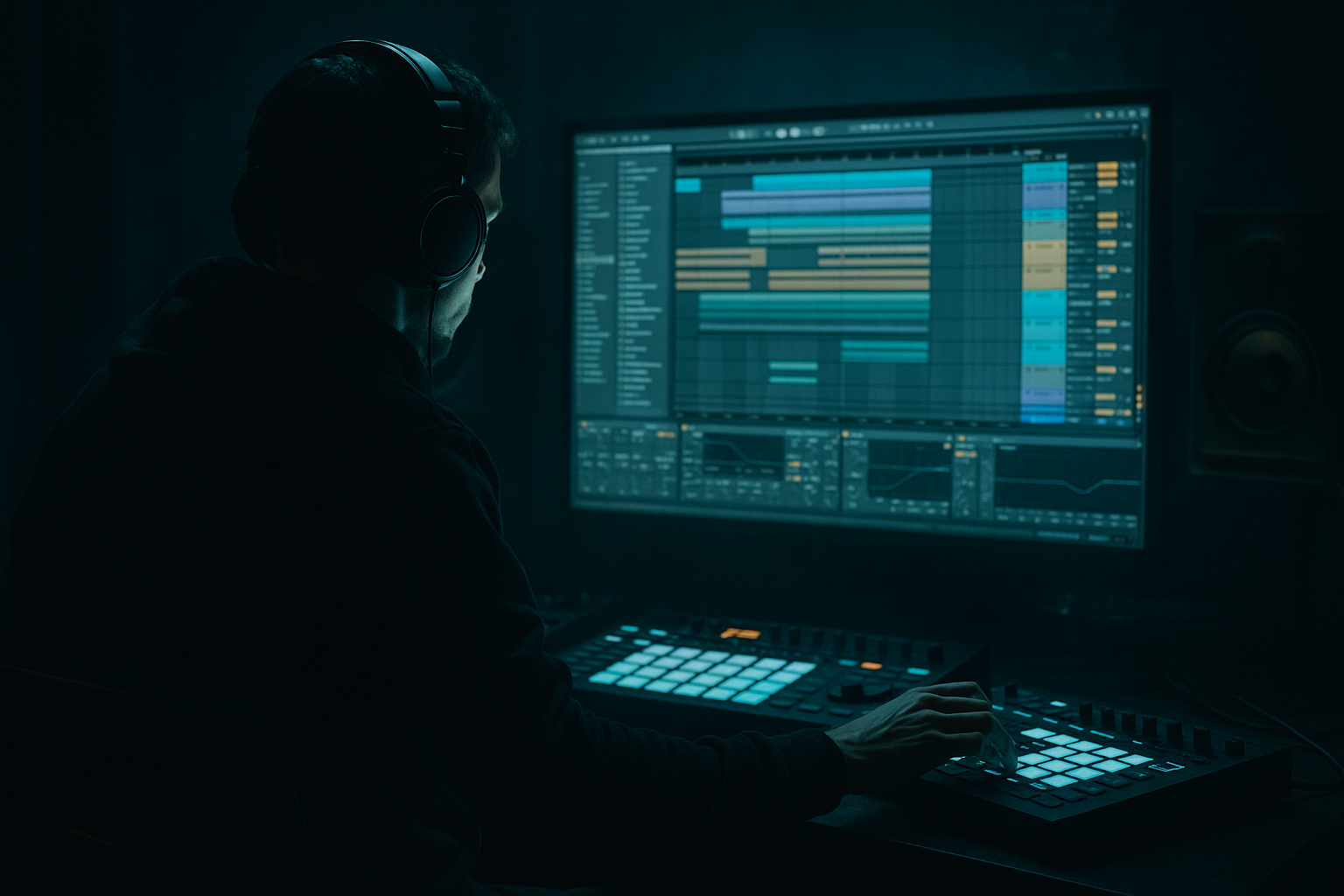
Main tutorial
```markdown
Sub grooves that swing behind the drums (DnB in Ableton Live) 🔊🥁
1) Lesson overview
In rolling drum & bass, the sub doesn’t always hit exactly with the kick. A lot of that “pull” and forward drum energy comes from the bass landing a few milliseconds late, or being slightly delayed/offset so the drums feel like they’re leading.
In this lesson you’ll learn multiple beginner-friendly ways in Ableton Live to make a sub groove that swings behind the drums while staying tight and club-safe.
---
2) What you will build
You’ll create a 16-bar rolling DnB loop with:
- A kick + snare pattern (standard DnB placement)
- A 2-step or shuffled hat groove
- A clean sub bass that:
- 1 bar in 4/4, 16th grid.
- Kick: on 1
- Snare: on 2 and 4
- Closed hat on 8ths or 16ths.
- Add a bit of shuffle by moving a few hat hits slightly later (we’ll do the sub swing more deliberately, but hats help the feel).
- Drum Buss:
- EQ Eight:
- Instrument: Operator
- Oscillator A: Sine
- Envelope:
- Oscillator 1: Basic Shapes → Sine
- Unison: Off
- Filter: low-pass if needed
- Hit root on 1
- Another hit on “and” of 1 (offbeat)
- A hit just before the snare (a little pickup)
- Space around snare hits to keep impact
- Beat 1: note
- 1.3 (16th-ish area): note
- Beat 3 (after snare): note
- Beat 3.3: note
- Use mostly root notes.
- Optional: add 5th or octave for a bar variation later.
- 5–12 ms = subtle pocket
- 12–25 ms = noticeable late sub (common in rolling styles)
- Above 30 ms can feel disconnected unless the pattern is very sparse
- Add Utility
- EQ Eight
- Use a Spectrum device to visualize and ensure your fundamental is stable.
- Sub pattern repeats
- Small velocity variations (tiny)
- Drums steady
- Remove one sub note before snare for extra snap, OR
- Add an octave jump on the last beat of bar 12
- Increase hat energy (extra 16ths)
- Add a short sub “fill” at the end of bar 16 (but keep it low and clean)
- Add controlled harmonics so the sub reads on small systems:
- Split sub + reese/mid bass (later step, but huge in dark DnB):
- Use subtle note slides for menace (careful):
- Let the drums lead:
- Check in mono + low volume:
- “Swing behind the drums” in DnB often means micro-late sub timing, not messy playing.
- Best beginner method: Track Delay +10 to +20 ms on the sub.
- Add sidechain compression so the kick stays punchy.
- Keep the sub mono, clean, and stable with Utility + EQ Eight + gentle saturation.
- Build small arrangement variations to make it feel like real rolling music.
- Follows the harmony simply
- Grooves behind the drums
- Stays mono, controlled, and consistent for loud playback
Target vibe: rolling / jungle-leaning with that “late sub” movement 😈
---
3) Step-by-step walkthrough
Step 0 — Session setup (fast + correct)
1. Set tempo: 172–175 BPM (try 174 BPM).
2. Create tracks:
- Drums (or a Drum Rack)
- Sub Bass (MIDI)
- (Optional) Reference track (drag in a pro DnB tune, turn it down)
Ableton tip: Turn on Warp for audio samples, but for one-shots keep them Warp Off if they’re short drum hits.
---
Step 1 — Build a basic DnB drum anchor 🥁
Kick + Snare (classic):
(In DnB, that means snare hits halfway through each bar and at the end: beats 2 and 4.)
Hats:
Stock device suggestion (on Drum Bus):
- Drive: 3–8%
- Boom: 0–10% (careful—sub already exists)
- Transients: +5 to +15
- High-pass the drum group at 25–35 Hz (gentle) to leave room for sub.
---
Step 2 — Create a clean sub instrument (beginner-proof) 🔊
On the Sub Bass MIDI track, load:
#### Option A: Operator (recommended)
- Attack: 0–5 ms
- Decay: 200–600 ms (depends on pattern)
- Sustain: -inf (or very low)
- Release: 50–120 ms (avoid clicks, keep it tight)
Add devices after Operator:
1. EQ Eight
- Low-pass around 120–180 Hz (keep it sub-only for now)
- Optional small cut if it’s boxy: 200–300 Hz (but you might not even reach that if you LP)
2. Saturator
- Type: Soft Sine or Analog Clip
- Drive: 1–4 dB
- Output: adjust so level stays controlled
This helps sub translate on smaller speakers without turning into mid-bass.
#### Option B: Wavetable (also solid)
Keep it mono.
---
Step 3 — Program a simple rolling sub pattern (the “engine”) 🏁
Start with something that works in most rolling DnB:
Key idea: The sub should feel like a conversation with the kick, not a clone of it.
In 1 bar, try this MIDI pattern (notes are examples—choose a root like F or G):
A classic beginner-friendly rhythm:
Don’t overcomplicate pitch yet:
---
Step 4 — Make the sub sit behind the drums (3 practical methods)
You only need one method, but I’m giving you options so you can choose what feels best.
#### Method 1: Track Delay (quickest + cleanest) ✅
1. Click the “D” button (bottom right) to show Track Delays.
2. On the Sub Bass track, set Track Delay to:
- Start with +10 ms
- Push to +15–25 ms if you want more “late” feel
3. Loop your 1–2 bar groove and adjust until:
- Kick feels like it leads
- Sub feels like it “leans back” without sounding sloppy
Rule of thumb:
---
#### Method 2: Groove Pool (musical swing that can lag) 🎛️
This adds swing/shuffle in a more “human” way than Track Delay.
1. Open Groove Pool (left browser → Grooves).
2. Try grooves like:
- Swing 16-XX
- MPC-style swing (if available)
3. Drag a groove onto the Sub Bass MIDI clip.
4. In the Groove Pool settings, tweak:
- Timing: 30–70%
- Random: 0–10% (keep low for sub)
- Velocity: 0–20% (sub velocity variation is subtle)
5. Hit Commit only when you’re happy (optional).
DnB note: A tiny amount of groove goes a long way on sub. Too much swing can make it feel drunk.
---
#### Method 3: Nudge MIDI notes late (surgical + pattern-specific) ✂️
If only certain hits should lag:
1. Open the MIDI clip.
2. Select the notes you want behind (often offbeats or pickups).
3. Nudge them right by 5–20 ms:
- Use Ctrl/Cmd + Arrow (depending on your settings) or just drag with grid off.
4. Keep the main downbeat more solid, and make the in-between notes late.
This is great for jungle-ish rolling bass where the groove has a “skip.”
---
Step 5 — Lock the sub to the kick with sidechain (so it’s still punchy) 🎚️
Late sub is great… but the kick and snare still need space.
1. On Sub Bass, add Compressor (Ableton stock).
2. Turn on Sidechain.
3. Sidechain input: Kick (or the full Drum group, but kick-only is a clean start).
4. Starting settings:
- Ratio: 4:1
- Attack: 1–5 ms
- Release: 60–120 ms (tempo-dependent; adjust so it breathes)
- Threshold: lower until you get about 2–5 dB gain reduction on kick hits
Pro feel: If your sub is delayed, you may need slightly different release timing so the pump feels smooth and rolling.
---
Step 6 — Keep it mono and clean (club rules) 🧼
On the Sub Bass track (or Bass Group):
- Width: 0% (mono)
- Gain: set level properly
Optional cleanup:
- Cut subsonic rumble below 25–30 Hz (gentle)
---
Step 7 — Arrangement idea (16 bars that feel like real DnB) 🧩
Make it musical fast:
Bars 1–8: Main groove
Bars 9–12: Add a variation
Bars 13–16: Tension + release
Classic trick: In bar 16, mute the sub on the last half-beat before the drop/loop point to make the next bar feel huge.
---
4) Common mistakes (and fixes)
1. Too much delay = sloppy groove
- Fix: keep Track Delay around 10–20 ms, and check against the snare.
2. Sub clashes with kick (mud / no punch)
- Fix: sidechain properly, and leave space in the pattern on kick-heavy moments.
3. Stereo sub = weak low end
- Fix: Utility Width 0%.
4. Clicks at note starts/ends
- Fix: add a tiny Attack (2–5 ms) and Release (50–120 ms).
5. Swing applied to everything
- Fix: swing the sub and hats, keep kick/snare more locked.
---
5) Pro tips for darker/heavier DnB 😈
- Saturator Drive 2–6 dB, but keep peaks controlled.
- Keep your Sub clean (below ~120 Hz)
- Put gritty bass above it (Band-pass / distort)
- Operator: enable Portamento (Glide)
- Very short glide time: 30–80 ms
- Use only on select transitions.
- The whole point is: drums feel aggressive, sub feels like it’s dragging the pocket.
- If it still grooves quietly, it’ll roll loud.
---
6) Mini practice exercise (10 minutes) ⏱️
1. Make a 1-bar drum loop at 174 BPM (kick on 1, snare on 2 & 4).
2. Create a sine sub with Operator.
3. Program a 1-bar sub groove with 4–6 notes, mostly root.
4. Try three versions:
- A) Track Delay +0 ms
- B) Track Delay +12 ms
- C) Track Delay +20 ms
5. Bounce/record 8 bars of each and ask:
- Which version makes the drums feel like they’re “pulling” the track?
- Which version still feels tight?
---
7) Recap ✅
If you tell me your drum pattern style (2-step, steppers, or jungle break-led) and your key (e.g., F minor), I can suggest a few sub note patterns that naturally “sit late” without fighting the kick.
```

