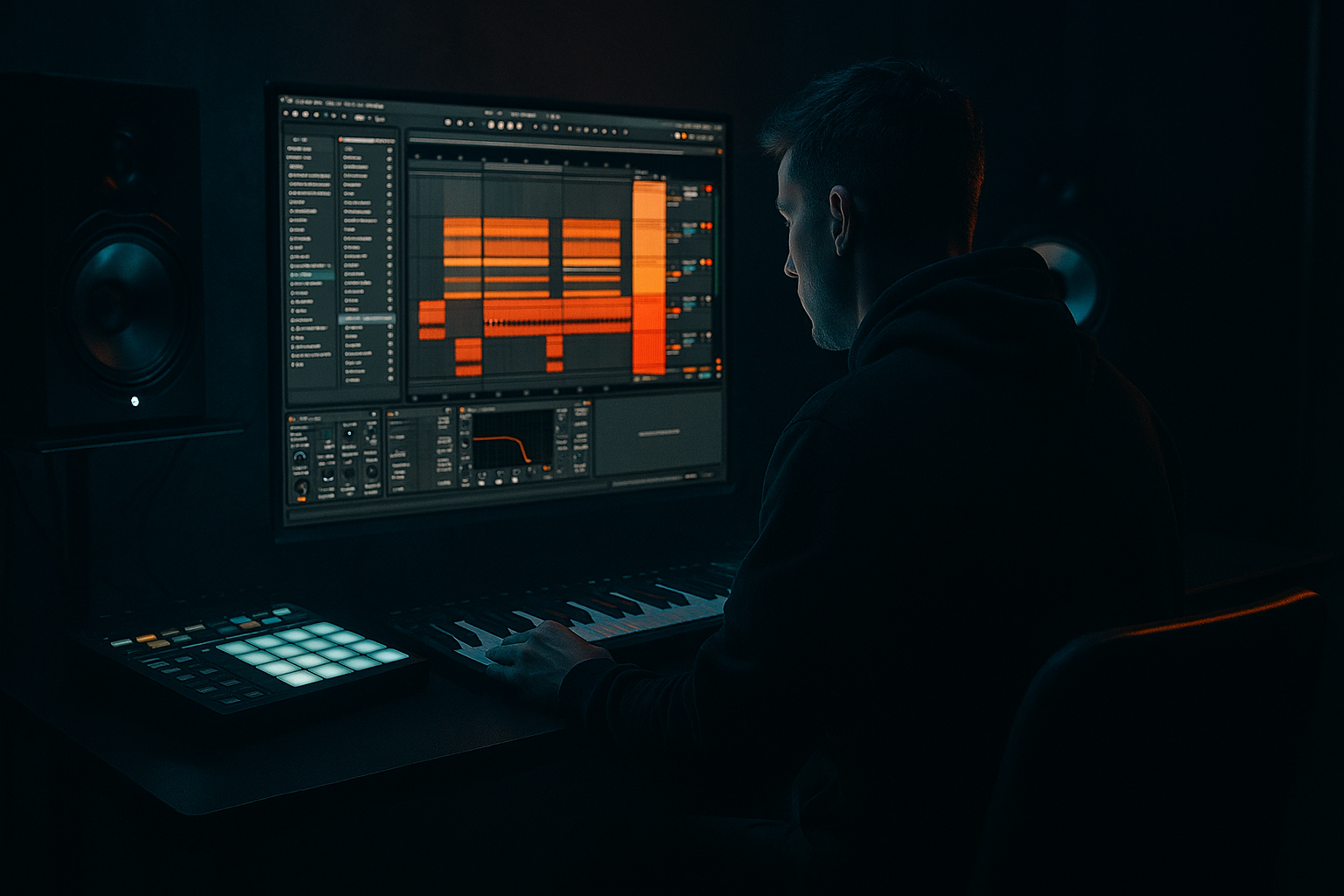
Main tutorial
Lesson Overview
This lesson is about building sub pressure in Ableton Live 12 for a rewind-worthy DnB drop with that jungle / oldskool / dark roller energy. The goal is not just “make the bass louder” — it’s to create a low-end system that feels heavy, controlled, and dangerous when the drop hits.
In Drum & Bass, the intro matters because it sets up the emotional and physical impact of the drop. If your intro is too busy, the drop loses weight. If it is too empty, the tune can feel weak or unfinished. For rewind-worthy moments, you want an intro that hides the full weight of the bassline, teases a sub pressure hint, and leaves room for the drop to feel like the floor shifts under the listener.
This workflow fits especially well in:
- Oldskool jungle-inspired intros with break edits, tape-style tension, and short bass teases
- Rollers where sub movement is the main event
- Darker DnB / neuro-adjacent rollers where pressure and precision matter more than melodic movement
- DJ-friendly arrangements where the intro must mix cleanly, but still create anticipation
- A controlled mono sub foundation that enters the track as a tease before the drop
- A call-and-response bassline with oldskool jungle flavor
- A breakbeat-driven intro using stock Ableton tools
- A drop arrangement where the bass opens up from restrained pressure into full impact
- A mix that leaves headroom, low-end separation, and enough space for kick/snare impact
- A reusable template approach for future DnB tracks
- Intro: filtered break, distant atmosphere, short sub hints, tension risers
- Pre-drop: bass phrase repeats with increasing energy, drum fills tighten, sub becomes clearer
- Drop: full-weight sub and reese layer slam in with an oldskool jungle urgency
- Set the tempo between 170–174 BPM for a classic DnB feel.
- Create three core groups:
- On the master, keep plenty of headroom. Aim for your rough mix to peak around -6 dB or lower before mastering.
- Load a breakbeat into a Simpler or Drum Rack lane.
- Use Simpler in Slice mode if you want oldskool chop flexibility.
- Keep a separate lane for kick and snare reinforcement if your break needs more punch.
- Create one MIDI track for the sub.
- Create a second track for mid-bass/reese movement.
- Route both to a bass bus so you can process them together later.
- Oscillator A: Sine wave
- Turn off extra oscillators at first
- Envelope:
- Add Pitch Envelope only if you want a small initial thump, but keep it subtle
- Keep the sub mono
- Use Utility after the instrument and set Width = 0%
- Filter out unnecessary lows on any non-sub bass layer, not on the sub itself
- Keep the line simple and rooted in the key center
- Use notes that sit well with the kick, often root, fifth, octave, and minor 7th for darker DnB tension
- Avoid overcomplicated motion in the sub layer
- In Operator, keep the main oscillator level around -12 to -6 dB before processing
- In Utility, use Bass Mono only if needed, but ensure the sub itself stays centered
- Start with two detuned saws or a thick wavetable
- Detune modestly — enough to create width and motion, not a trance pad
- Put a Filter on it, often a Low-Pass 24 dB or Band-Pass depending on the vibe
- Oscillator 1: Saw-like wavetable
- Oscillator 2: Another saw or slightly different harmonically rich table
- Detune: small amounts, roughly 5–20 cents between oscillators
- Filter cutoff: start around 120–400 Hz and automate it later
- Resonance: 10–25% for character, but don’t exaggerate
- Use LFO gently to modulate filter cutoff or wavetable position
- Rate: sync to 1/4, 1/8, or 1/2 depending on the groove
- Keep depth subtle so it feels alive, not wobbling like a dubstep patch
- Saturator with Soft Clip on
- EQ Eight to cut unnecessary low bass under the sub, often below 80–120 Hz
- Utility to narrow the stereo image below the crossover area if needed
- A strong root note on the downbeat
- A short response note or offbeat stab
- One or two syncopated hits before the phrase resolves
- Bar 1: root note long
- Bar 2: shorter note on the “and” of beat 2 or 3
- Bar 3: variation with a lower octave hit
- Bar 4: pickup note or silence into the next phrase
- Long notes for sub pressure
- Short notes for groove punctuation
- Rests for tension
- In the intro, the bass only hints at the full phrase every 8 bars.
- In the pre-drop, the same phrase appears with more of the reese layer exposed.
- At the drop, the full phrase returns with drums hitting harder and the sub fully open.
- Simpler in Slice mode for break chopping
- Warp with care if the break needs locking to tempo
- Drum Buss for transient control and weight
- EQ Eight for cleanup
- High-pass the break only as much as needed to avoid fighting the sub
- Add a little Drum Buss Drive for density, but keep the low end clean
- Use ghost notes and edits to create forward motion into the drop
- On break bus: Drum Buss
- Follow with EQ Eight
- Keep one break slightly looser and another tighter
- Layer a clean snare on 2 and 4 or use break-derived snare ghosts
- Use tiny timing offsets to make the groove breathe
- 8 bars atmosphere only
- 8 bars break with filtered bass hints
- 8 bars breakdown of the break with fills
- 8 bars pre-drop tension
- Drop
- Auto Filter to slowly open drums, noise, or bass layers
- Reverb on small send amounts for atmosphere
- Echo for short delays on selective hits
- Utility to automate width changes on FX only, not on the sub
- Start with atmospheric vinyl noise or field texture
- Add a filtered break loop
- Introduce a low bass note or two every 4 or 8 bars
- Use a snare fill or reverse hit before the drop
- Automate Auto Filter cutoff from around 200 Hz up to 1–2 kHz over 8 bars on a bass tease layer
- Automate reverb send on a snare stab from low to moderate just before the drop
- Automate Utility gain for a quick bass mute or lift to shape the final bar
- Route the bass bus to a new audio track
- Record 4–8 bars of the bass phrase
- Also consider resampling a processed break or bass reese texture
- You can commit to a sound and stop endlessly tweaking
- Audio lets you cut, reverse, stretch, and rearrange with more character
- It makes oldskool-style edits and fills faster
- Slice the audio into a new Simpler rack
- Rearrange one or two hits for call-and-response
- Reverse a note tail into the drop
- Add a tiny audio pause before the full bass returns
- Put Utility on your sub and confirm it is mono
- On the bass bus, compare in mono and stereo
- Make sure the kick and sub are not occupying the exact same transient space
- If the kick is weak, don’t just boost it — carve space in the bass with EQ
- If the sub disappears, check note lengths and sidechain timing
- If the reese dominates, high-pass it a bit more or reduce its low-mid saturation
- Sub layer: avoid unnecessary processing
- Reese layer: remove low-end mud below the crossover point
- Drum bus: trim build-up where it masks the bass body
- Use Compressor or Glue Compressor on the bass bus
- Sidechain from kick or kick-snare group
- Keep it musical, not pumping excessively unless that is the style
- Attack: 1–10 ms
- Release: 50–120 ms
- Ratio: moderate, enough to let the kick speak
- Reduce bass content right before the drop
- Strip the drums briefly
- Let the first hit hit almost naked, then bring the full groove back in
- One-beat or half-bar silence before impact
- First bar: main bass phrase with minimal extra movement
- Second bar: add reese movement, fill, or harmony layer
- Fourth bar: variation or switch-up to keep the crowd engaged
- Open a filter
- Increase drive on a bass layer
- Bring in a parallel distortion return for the drop only
- Add a short pitch rise or noise burst into the first hit
- Too much sub movement
- Stereo bass below the crossover
- Overwritten intros
- Breaks masking the bass
- Bass notes too long or too dense
- Too much distortion on the sub
- Drop has no contrast
- Use parallel saturation on the bass bus
- Split sub and harmonic bass with intention
- Automate filter movement in phrases
- Create call-and-response between bass and drums
- Use short, nasty fills
- Keep the low end emotionally simple
- Test on low volume
- Build sub pressure by separating clean sub from audible mid-bass movement.
- Keep the sub mono, simple, and disciplined.
- Use breaks, filtering, and small automation moves to create intro tension.
- Write basslines with space, phrasing, and contrast, not constant motion.
- Mix for headroom, low-end separation, and mono compatibility.
- The drop hits hardest when the intro withholds the full bass energy until the right moment.
Why this matters: in DnB, the low end is the emotional engine. The track doesn’t just need bass — it needs sub discipline, phrasing, and arrangement control so the drop lands with authority. That’s what makes people rewind 🔁
---
What You Will Build
You will build a sub-pressure intro workflow in Ableton Live 12 that leads into a hard drop. The result will be:
Musically, think of it like this:
The finished idea should feel like a tune that could sit between a classic jungle roller and a darker modern DnB drop.
---
Step-by-Step Walkthrough
1. Set the project up for bass-first arrangement
Start by building the project around the low end, not the synth lead.
In Ableton Live:
- DRUMS
- BASS
- FX / ATMOS
In the DRUMS group:
In the BASS group:
Why this works in DnB: the genre depends on low-end hierarchy. If the session is organised around drums and bass from the start, every arrangement decision becomes easier and the drop keeps its weight.
---
2. Build a mono sub that behaves like pressure, not melody
Create your sub track with a simple instrument. Use Operator or Wavetable.
Recommended starting point in Operator:
- Attack: 0–5 ms
- Decay: 120–250 ms
- Sustain: -inf to low sustain depending on note length
- Release: 50–120 ms
Important:
MIDI note choice:
Concrete parameter ideas:
If the sub feels too polite, don’t just turn it up. Add slight harmonic content later. The fundamental should stay clean.
---
3. Add a reese or mid-bass layer for audible movement
Now create the layer that gives the sub pressure its identity in the room.
Use Wavetable or Analog for a reese-style layer:
Suggested starting settings in Wavetable:
Add movement:
Then process the layer:
Why this works in DnB: the sub gives you chest impact, but the reese layer gives the listener something to lock onto on small speakers. That combination is what creates “pressure” across systems.
---
4. Write a bassline that uses space, not constant motion
This is where the tune starts feeling like DnB instead of generic bass music.
Program a simple 2-bar or 4-bar phrase with:
A good oldskool / rollers approach:
Use note lengths deliberately:
Try this mindset: the bassline should feel like it’s speaking in sentences, not vomiting notes.
Arrangement context example:
This is the classic “tease then detonate” DnB structure.
---
5. Shape the drum break so the bass has room to hit
Your breakbeat is not just rhythm; it is the frame around the bass.
Use stock Ableton tools:
Practical drum guidance:
Suggested processing:
- Drive: 5–20%
- Crunch: very light, if needed
- Boom: only if it doesn’t interfere with sub
- Cut muddy buildup around 200–400 Hz if the loop feels cloudy
- Notch harshness around 3–6 kHz if the hats get brittle
If you’re going for jungle oldskool flavour:
The bass will feel heavier when the drums are organised around it.
---
6. Build the intro as a tension container, not a full statement
Now arrange the intro so it sets up the drop with restraint.
A strong DnB intro might be:
Tools to use:
Intro recipe:
Concrete automation ideas:
This creates anticipation without giving away the full drop weight too early.
---
7. Use resampling to lock in grime, grit, and character
Once the bass and break are working, resample parts of them into audio.
In Ableton:
Why resample:
After resampling:
This is especially useful for darker DnB because gritty audio edits often feel more authentic than perfectly quantized MIDI.
---
8. Balance sub, kick, and bass with mono discipline
Now check the low end in context.
Key moves:
Practical balancing:
Use EQ Eight carefully:
Sidechain approach:
Suggested starting point:
---
9. Design the drop reveal so the bass feels bigger than expected
The drop should feel like the intro was holding back a monster.
Use contrast:
Drop design idea:
Use Clip Automation in Ableton to:
A rewind-worthy drop usually has one thing in common: the listener understands exactly what was withheld, so when it lands, it lands hard.
---
Common Mistakes
- Fix: keep the sub mostly simple and let the mid-bass move instead.
- Fix: mono the sub and keep widening effects above the low-end region only.
- Fix: leave more space. In DnB, restraint increases impact.
- Fix: carve muddy mids out of the break and reduce low-end clutter.
- Fix: shorten note lengths and use rests. Groove needs air.
- Fix: distort the reese layer instead, and keep the fundamental clean.
- Fix: remove elements before the drop so the first hit feels bigger.
---
Pro Tips for Darker / Heavier DnB
- Duplicate the bass bus or use a return, then add Saturator or Overdrive lightly to a parallel chain. Blend in only enough for grit.
- Keep the sub clean, and let the reese carry the danger. This is the best way to stay heavy without losing translation.
- Open the filter slightly every 4 bars during the intro or pre-drop. Small changes feel huge in DnB when repeated with discipline.
- Let one bar be bass-heavy, the next bar more drum-heavy. This is especially effective in jungle and rollers.
- A tiny snare flam, reversed break slice, or sub pickup note before the drop can make the whole section feel more alive.
- Darker DnB often works best when the bassline has a strong identity but limited note count. Less can feel much heavier.
- If the bassline still feels present quietly, the harmonics are working. If it vanishes, add upper harmonics, not just more sub.
---
Mini Practice Exercise
Spend 15 minutes building a quick sub-pressure intro for a DnB drop.
1. Set the project to 172 BPM.
2. Create a mono sub in Operator with a sine wave.
3. Write a 2-bar bass phrase using only 3 notes: root, fifth, and octave.
4. Add a reese layer in Wavetable with light detune and low-pass filtering.
5. Chop a breakbeat in Simpler and build an 8-bar intro with a filtered loop.
6. Automate the reese filter opening over the last 4 bars before the drop.
7. Add a short snare fill or reverse hit into the drop.
8. Check the low end in mono and adjust the bass so the kick still punches through.
9. Resample one bass phrase and move one slice a little early or late for groove.
10. Export a rough 16-bar loop and listen at low volume.
Goal: by the end, you should have a basic intro-to-drop structure that already feels like a DnB tune, even if it’s not fully finished.
---
Recap
If the listener feels the floor shift at the drop, you’ve done it right 🔥

