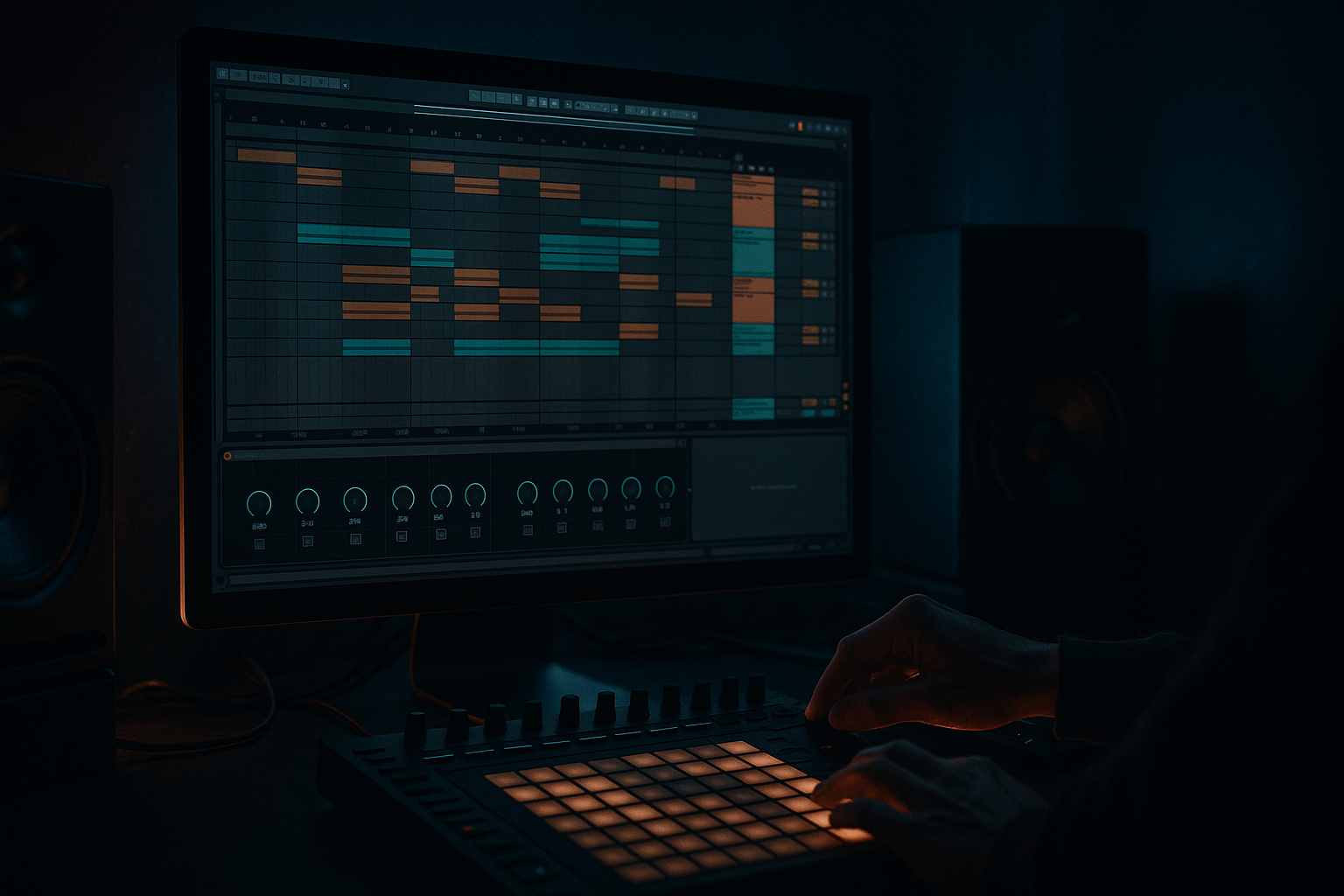
Main tutorial
Sub Pressure Jungle Switch-Up: Polish and Arrange in Ableton Live 12
Advanced DnB Automation Tutorial
1. Lesson overview
In this lesson, you’ll turn a sub-heavy jungle switch-up into a finished, arrangement-ready section using automation in Ableton Live 12. The focus is not just on making the drop hit hard, but on polishing transitions, controlling low-end energy, and creating movement without losing sub impact.
This is especially relevant for drum and bass, jungle, and rolling bass music, where the arrangement often depends on:
- abrupt groove changes,
- tension/release through filter and reverb automation,
- sub/bass weight management,
- and fast, musical edits that still feel clean and intentional.
- keep the sub focused and mono,
- automate bass tone and density in layers,
- use drum fills and FX automation to signal the switch-up,
- and finish with balance, contrast, and impact control.
- a main rolling section,
- a breakdown into tension,
- a switch into a sub-pressure halftime/jungle variation,
- automated filters, sends, EQ, utility, reverb, delay, and bass movement,
- and a more polished arrangement that feels like a real DnB tune rather than a loop.
- Bars 1–8: rolling groove, full energy
- Bars 9–12: tension build, bass thins out, drums get more exposed
- Bars 13–16: switch-up lands with a heavier sub-led jungle variation
- Drums: kick, snare, hats, breaks
- Bass/Sub
- Music/Atmosphere
- FX
- Returns: reverb, delay, parallel dirt if needed
- Utility
- EQ Eight
- Auto Filter
- Saturator
- Drum Buss
- Compressor
- Glue Compressor
- Hybrid Reverb
- Echo
- Limiter
- Sub layer = simple sine/clean low end
- Mid-bass layer = movement, wobble, reese texture, FM grit
- Auto Filter cutoff
- Saturator drive
- Instrument macro for wavetable position/FM amount if applicable
- Utility gain for slight pre-drop pullback
- At bar 9, start closing the filter slowly:
- Reduce bass layer volume by 1–2 dB
- Add a tiny bit more drive or distortion on the last 1–2 beats before the switch
- Then cut the bass abruptly or nearly abruptly on the final beat before the drop
- movement
- restriction
- release
- Cutoff automation: 18 kHz → 500 Hz
- Resonance: 10–20%
- Envelope amount: subtle, unless you want extra bite
- less straightforward rolling hat energy,
- more break edits,
- snappier snare phrasing,
- maybe a halftime-feeling kick/snare emphasis with jungle break fills.
- Drum Buss drive on a drum rack or break track
- EQ Eight on breaks for tonal shifts
- Send automation to reverb/delay on fill hits
- Filter automation on a break layer or top loop
- Automate Auto Filter to band-limit the break during the build
- Then open it hard on the switch
- Add a little Drum Buss Crunch during the transition
- Reduce it again once the new groove lands if the drum bus is getting too aggressive
- Break A: full loop
- Break B: edited fill/variation
- reverse cymbals
- noise risers
- sub drops
- pitch-down impacts
- short delay throws
- reverb blooms on snares or vocal chops
- Hybrid Reverb
- Echo
- Reverb if you want a simpler sound
- Auto Filter
- Utility for mono control if needed
- Increase Echo feedback on the final snare hit before the switch
- Automate Reverb dry/wet up briefly on a fill snare, then snap it back to dry
- Use Auto Filter to sweep a noise riser upward
- Automate Utility gain on a crash or impact for controlled emphasis
- remove kick for a beat or two,
- thin the hats,
- mute the top bass layer,
- leave the sub implied rather than fully exposed.
- Bar 9: start reducing musical density
- Bar 10: let the drums breathe; bass tone narrows
- Bar 11: last tension hit, maybe a fill
- Bar 12: near-silence or stripped-down pre-drop
- Bar 13: switch-up lands with sub and break impact
- not just “more energy,”
- but managed absence before impact.
- lower the bass bus by 1–1.5 dB during the build
- lower the music bus by 0.5–1 dB if needed
- restore full level at the switch-up
- Use slow curves for filter closes
- Use steeper ramps for last-beat drops
- Make reverb throws short and deliberate
- Avoid perfectly linear movement on every automation lane
- Cutoff automation: gentle downward curve
- Echo feedback: quick rise, then fast release
- Bass gain drop: short dip right before the switch
- Drum bus drive: slightly increased energy leading into the fill, then reset
- Is the sub still mono and centered?
- Does the bass disappear too much during the build?
- Are the fills too loud compared to the drop?
- Is the reverb masking the kick/snare impact?
- Does the switch-up feel like a new phrase, not just a loop variation?
- automate filter resonance for sharper tension
- use tiny level rides on bass hits to emphasize phrasing
- add distortion only at transition points for contrast
- mute the top layer for one or two beats before the drop
- EQ Eight
- Saturator
- Auto Filter
- Compressor sidechained lightly to kick if needed
- Utility for mono management
- Drum Buss
- Glue Compressor
- EQ Eight
- very subtle Saturator
- chopped, filtered break
- open, crunchy break
- tight halftime snare emphasis
- fast fill with a sudden full-frequency reveal
- 1 bass track
- 1 breakbeat track
- 1 FX track
- 1 return reverb
- 1 return delay
- Automate Auto Filter cutoff on the bass.
- Automate Utility gain on the bass or music bus.
- Automate Echo feedback on one final fill hit.
- Use one Drum Buss automation move on the break.
- Pull the mix down briefly before the drop, then bring it back.
- Did the sub stay authoritative?
- Did the contrast feel strong enough?
- Did the fill lead the ear clearly into the new section?
- keeping the sub stable and mono,
- using automation on the bass texture, not just the low end,
- shaping tension with filters, utility gain, reverb throws, and delay feedback,
- making the drum edit feel deliberate with break variation and Drum Buss movement,
- and using contrast to make the drop hit harder.
We’ll work like a proper DnB session:
2. What you will build
By the end, you’ll have a 16-bar jungle switch-up with:
The core idea:
3. Step-by-step walkthrough
Step 1: Set up the arrangement like a DnB producer
Start in Arrangement View.
Create or confirm these tracks:
If your session started in Session View, record a rough 16-bar performance first. For jungle switch-ups, an arrangement that feels “played” often works better than a fully static loop.
#### Recommended stock devices:
---
Step 2: Lock the sub first
The sub is the foundation of this lesson. In DnB, if the sub doesn’t survive the arrangement, the switch-up loses authority.
On your sub or bass bus, use:
#### Suggested chain:
1. Utility
- Width: 0% on the sub layer
- If your bass has a separate upper layer, keep the sub separate and mono
2. EQ Eight
- High-pass only if needed, usually gentle at 20–30 Hz
- Check for muddiness around 80–150 Hz if other elements are crowding it
3. Saturator
- Drive: 1–4 dB
- Use Soft Clip ON
- This helps the sub read on smaller systems without overblowing the mix
#### Automation target:
Automate the bass harmonic layer, not the pure sub, during the switch-up.
The pure sub should stay stable unless you’re intentionally creating a drop-out.
Pro move:
If your bass patch has movement, split it into:
Then automate the mid layer heavily while keeping the sub mostly consistent.
---
Step 3: Build the tension with bass filtering and space control
For bars 9–12, you want the mix to feel like it’s inhaling before the switch.
#### Automate these bass parameters:
##### Example automation moves:
- Low-pass cutoff from full open down to 300–600 Hz
This creates a classic DnB pressure effect:
#### Stock device suggestion:
Use Auto Filter in Low-Pass 24 dB mode on the bass layer.
Map cutoff and resonance to a Macro if you’re using an Instrument Rack.
Good starting point:
---
Step 4: Shape the drums so the switch-up feels intentional
A jungle switch-up lives or dies on the drum edit.
For bars 13–16, you want the drums to feel like they’ve “changed language”:
#### Use these automation moves:
##### Example:
On the break track:
#### Practical jungle trick:
Duplicate your break track and create:
Use clip gain and automation to reveal Break B only at the switch point.
This makes the transition sound composed rather than repetitive.
---
Step 5: Automate the FX like a mix engineer, not just a producer
Now add the ear candy that tells the listener, “the drop is coming.”
#### Good DnB switch-up FX:
#### Stock device chain for FX:
##### Automation ideas:
Important:
Keep FX automation tasteful. In DnB, too much wash can blur the low-end impact. Let the FX guide the switch, not smear it.
---
Step 6: Use arrangement contrast to make the sub hit harder
A heavy switch-up works because of contrast.
If the full section is already too busy, the drop won’t feel bigger. So in bars 9–12, pull out elements strategically:
#### A strong arrangement pattern:
This is classic DnB pacing:
---
Step 7: Automate gain staging for the drop
Advanced arrangement is not only about tone—it’s about level psychology.
Use Utility or clip gain to create a subtle pre-drop pullback:
This prevents the arrangement from feeling static and gives the drop more apparent punch without needing extra processing.
#### On the master?
Be careful.
You can use global automation sparingly, but it’s better to automate bus elements, not the master, unless you know exactly why you’re doing it.
---
Step 8: Polish the transition with automation curves
Ableton Live 12 lets you draw very precise automation shapes. Use that.
#### Tips for cleaner automation:
#### Suggested curve logic:
This keeps the transition musical instead of robotic.
---
Step 9: Finalize with mix checks
Before you call the section done, audition it at two volumes:
1. Low volume — can you still hear the sub pressure and arrangement shape?
2. Moderate volume — does the switch-up feel exciting, not messy?
Check:
Use EQ Eight and Utility to tighten anything that’s wandering.
---
4. Common mistakes
1. Over-automating the sub itself
The sub should usually stay stable. If you automate it too much, the drop loses foundation.
2. Making the build too busy
If every lane is moving, the switch-up has no contrast. Pull elements out.
3. Letting reverb wash out the low end
Reverb on snares and FX is great, but too much wet signal can blur the whole drop.
4. Not separating sub and bass character
If your bass movement and sub are fused into one patch, automation becomes messy fast.
5. Weak fill writing
A switch-up needs a clear signpost. If the fill is weak, the transition feels accidental.
6. Over-compressing the drum bus
DnB needs punch and transient definition. Too much compression can flatten the groove.
---
5. Pro tips for darker/heavier DnB
Use automation to imply menace, not just movement 😈
For darker jungle or heavy neuro-leaning DnB:
Great heavy-chain ideas:
#### Bass bus
#### Drum bus
Dark arrangement trick:
Automate a high-pass on atmospheric pads during the build, then remove it on the switch.
That creates a sensation of the room opening up again when the drop lands.
Jungle-specific move:
Use breakbeat automation to alternate between:
That combination gives you the classic “old-school jungle pressure” with modern polish.
---
6. Mini practice exercise
Try this in a new 16-bar loop:
Task
Build a jungle switch-up using only:
Rules
Goal
Make the switch-up feel like:
1. full rolling pressure,
2. controlled tension,
3. unmistakable new groove on the re-entry.
Record or bounce it, then listen back and ask:
---
7. Recap
To polish and arrange a Sub Pressure jungle switch-up in Ableton Live 12, focus on:
In DnB, the strongest arrangements are not just loud—they’re well-controlled, rhythmically smart, and automation-driven.
If you can make the listener feel the pressure building before the switch, the drop will land with much more authority. 🔥
If you want, I can turn this into a project template walkthrough with exact Ableton automation lanes and a mock 16-bar arrangement map.

