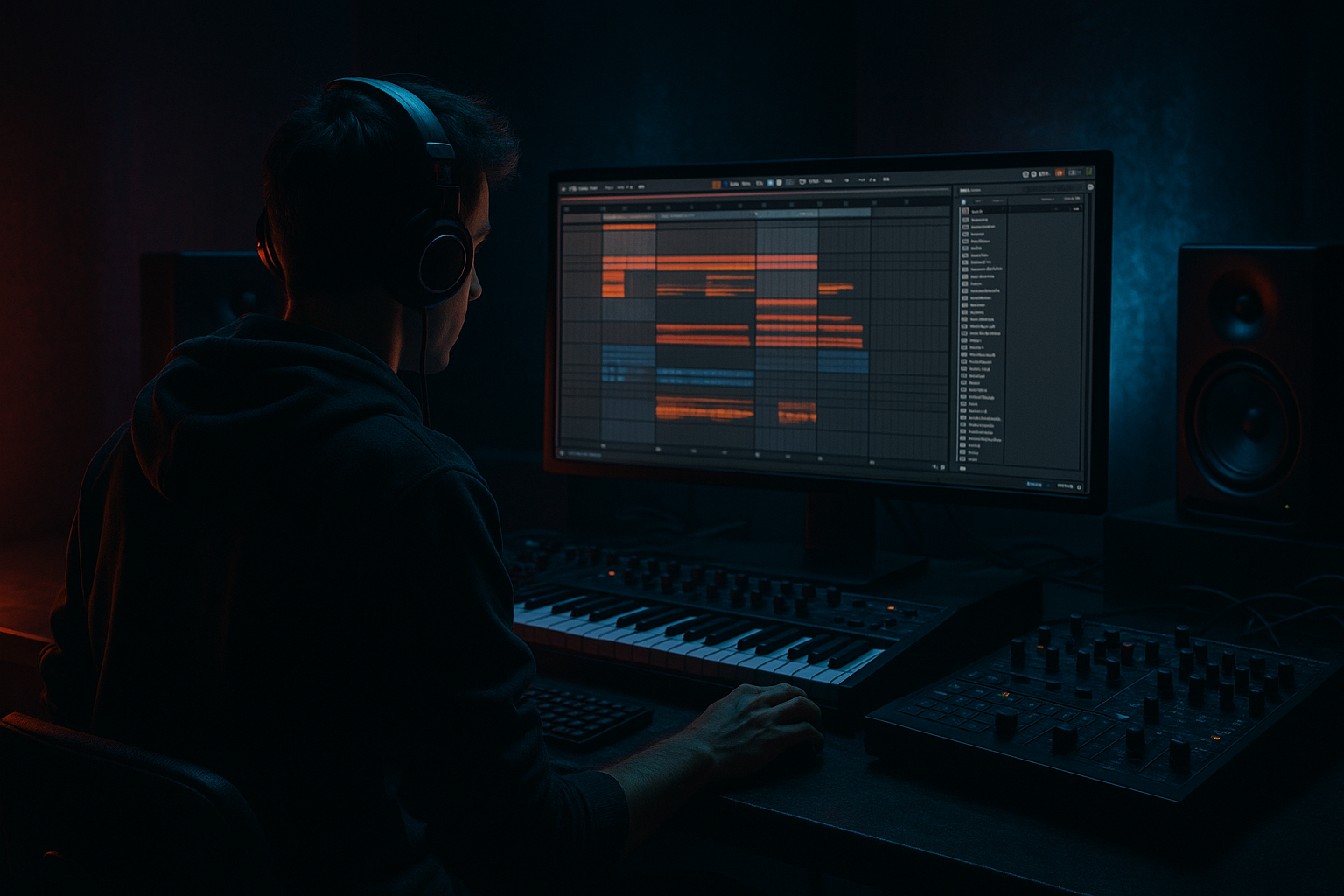
Main tutorial
```markdown
Sub Sustain by Note Length Logic (DnB in Ableton Live) 🎛️🔊
1. Lesson overview
In rolling drum & bass, the sub has two main jobs:
1) Hit cleanly with the kick, and
2) Fill the gaps with controlled sustain so the groove feels glued together.
This lesson shows you a logical way to set sub sustain based on MIDI note length—so short notes punch, long notes hold, and everything stays tight at 170–176 BPM. We’ll do it using Ableton Live stock devices and a few reliable workflows.
---
2. What you will build
You’ll build a DnB sub-bass instrument and a MIDI workflow where:
- Short notes = stabby sub (quick decay, minimal tail)
- Long notes = sustained sub (controlled hold/release)
- The sub stays mono, centered, and consistent across the pattern
- You can write jungle/rolling patterns fast without fighting envelope settings 🎯
- A Sub track (clean sine/triangle)
- A MIDI clip that “tells” the sub how long to sustain (via note lengths)
- Optional: sidechain + saturation + safety limiting
- Oscillator A: Sine
- Level: around -12 dB to start (leave headroom)
- Voices: 1 (mono by design)
- Pitch Envelope: off (for now)
- Attack: 0.0–2.0 ms
- Decay: ~200 ms (we’ll refine)
- Sustain: -inf dB or low (see explanation below)
- Release: 60–120 ms
- Set Sustain to about -6 to -12 dB (not full, not off).
- Short notes on offbeats + a longer note before the snare.
- Put 1/8 notes on: 1.2, 1.4, 2.2, 2.4, 3.2, 3.4, 4.2, 4.4
- Then add a longer note (1/4 or dotted 1/8) leading into the snare hit.
- Make the offbeat notes short (e.g., 1/16 to 1/8 length).
- Make select notes long (e.g., 1/4 length) where you want sustain.
- Short notes should feel like tight punches.
- Long notes should feel like controlled glue—not a wobbly, boomy blur.
- Attack: 0 ms
- Decay: 120–220 ms
- Sustain: -9 dB
- Release: 80 ms
- If short notes still feel too long → lower Release (and/or reduce Sustain).
- If long notes don’t “hold” enough → raise Sustain slightly (or lengthen notes).
- Ratio: 4:1
- Attack: 1–5 ms
- Release: 60–120 ms (sync to groove)
- Threshold: lower until you get 2–6 dB of gain reduction on kick hits
- Use mostly short notes for bounce.
- Add long notes at phrase ends (every 4 or 8 bars) to “lean” into transitions.
- Use a long sustain under a drum fill to keep weight while drums get busy.
- Use longer notes but reduce saturation/level for tension.
- You can create continuous sustain sections quickly
- Then shorten specific notes to reintroduce bounce
- Use a triangle instead of pure sine (Operator Osc A: Triangle)
- Add a tiny pitch drop for aggression (carefully)
- Ghost sustain
- Control 40–80 Hz buildup
- Phrase-end “sub holds”
- Note length is your sustain control when your amp envelope uses a sustain stage.
- For DnB, combine:
- Use a clean chain:
- Always check:
You’ll end up with:
---
3. Step-by-step walkthrough
Step 0 — Session setup (DnB defaults)
1. Set tempo to 174 BPM.
2. Make sure you have a basic drum loop (kick + snare) so you can hear how the sub sits.
3. Turn on View → In/Out to route sidechain later.
---
Step 1 — Create a clean sub instrument (stock devices only)
1. Create a new MIDI Track: name it SUB.
2. Add Operator (or Wavetable—Operator is perfect for clean subs).
Operator settings (simple + reliable):
Amp Envelope (this matters for note-length logic):
✅ Key concept:
If your amp envelope uses a sustain stage, note length controls how long the sound holds. That’s the core of “sub sustain by note length logic.”
Recommended envelope approach for DnB:
This gives a punchy start but still allows holding for long notes.
---
Step 2 — Make the sub react clearly to note length
Create a 1-bar MIDI clip on SUB (Ctrl/Cmd + Shift + M to insert MIDI clip quickly on the grid).
#### Write a classic rolling pattern (example)
In F (or any key), try:
At 174 BPM, 1 bar = 4 beats:
Now the logic:
🎚️ What to listen for:
---
Step 3 — Tighten the envelope to match DnB transients
Now fine-tune Operator’s Amp envelope while looping your drums + sub:
Try this baseline:
Adjust by ear using this rule:
🧠 DnB-friendly guideline:
At fast tempos, your sub should often stop just before the next kick/snare impact—unless you intentionally want overlap.
---
Step 4 — Make it mono, centered, and safe
Add these stock devices after Operator:
#### Device chain (recommended)
1) Utility
- Bass Mono: On (if available in your version)
- If not: set Width = 0%
- Gain: adjust so peaks are sensible
2) EQ Eight
- HP filter? Usually don’t HP a true sub heavily, but you can do:
- Low-cut at 20–30 Hz (gentle 12 dB/Oct) to remove rumble
- Optional: tiny dip where kick fundamentals clash (depends on your kick)
3) Saturator (light!)
- Drive: 1–4 dB
- Soft Clip: On
- Output: reduce to match level
Purpose: adds harmonics so sub translates on smaller systems 🔥
4) Limiter (as a safety, not loudness)
- Ceiling: -0.5 dB
- Gain: 0
This is just to catch accidental spikes while learning.
---
Step 5 — Sidechain the sub to the kick (classic DnB control)
1. Add Compressor after Saturator (or before—both can work).
2. Turn on Sidechain.
3. Input: Kick track.
Starter settings:
🎯 Goal: the kick gets the first word, the sub fills the space after.
---
Step 6 — Arrangement logic: where to use short vs long notes
To make a rolling DnB track feel intentional, use note length like an arranger:
In the drop:
In fills:
In breakdowns:
---
Step 7 — Optional “Note-length = sustain” quick workflow tricks
These are workflow tools (not magic) that make the logic faster.
#### Trick A: Duplicate clip and edit only note lengths
1. Duplicate your 1-bar clip across 16 bars.
2. Only change note lengths every 4 bars:
- Bars 1–4: short/tight
- Bars 5–8: slightly longer
- Bars 9–12: add a few long holds
- Bars 13–16: tighten again for energy
You get variation without changing notes—super DnB-friendly. ✅
#### Trick B: Use Legato intentionally
In the MIDI editor, if you use Legato on selected notes:
---
4. Common mistakes 🚫
1. All notes the same length
→ Results in a flat groove. DnB needs contrast.
2. Release too long
→ Sub overlaps everything and masks kick/snare. Tighten release.
3. Too much saturation on pure sub
→ You’ll lose clean low-end and it may distort the master. Keep it subtle.
4. Stereo sub
→ Phase issues + weak mono playback. Keep sub centered (Utility width 0%).
5. Ignoring gain staging
→ If the sub is too loud, you’ll chase problems elsewhere. Start quieter.
---
5. Pro tips for darker/heavier DnB 🖤
Darker weight + slightly more harmonics, still clean.
Operator Pitch Env:
- Amount: very small (like 5–15 cents)
- Decay: 30–80 ms
Makes the front edge hit harder without turning into a dubstep “pew.”
Write long notes but lower their MIDI velocity (if your patch maps velocity to volume).
If not, use MIDI Velocity device to scale dynamics.
Use EQ Eight to gently shape around where your room lies to you.
Dark DnB often sounds huge because the low end is controlled, not because it’s loud.
At the end of 8 or 16 bars, add a longer sustain note while drums do a micro-fill.
That “hang” feels menacing and intentional.
---
6. Mini practice exercise 🧩
Goal: Make the same bassline feel tighter or heavier only by changing note lengths.
1. Create a 2-bar sub MIDI clip with a simple pattern (8–12 notes total).
2. Make Version A:
- All notes short: 1/16–1/8
- Release: 60 ms
3. Duplicate to Version B:
- Keep the same notes and timing
- Make every 4th note long: 1/4
- Increase Sustain slightly: from -12 dB → -6 dB
4. A/B both versions with drums:
- Which one rolls more?
- Which one hits harder?
- Does the kick stay clear?
Write down one sentence: “Long notes work best when ___.”
---
7. Recap ✅
- Short notes (bounce + punch)
- Occasional long notes (glue + menace)
Operator → Utility (mono) → EQ Eight → Saturator (light) → Compressor (SC)
release time, overlap, kick relationship, and mono compatibility.
If you tell me your target vibe (liquid roller, jungle steppers, neuro-ish, jump-up), I can suggest a specific 1–2 bar MIDI pattern and exact envelope/sidechain timings for that style. 🎚️
```

