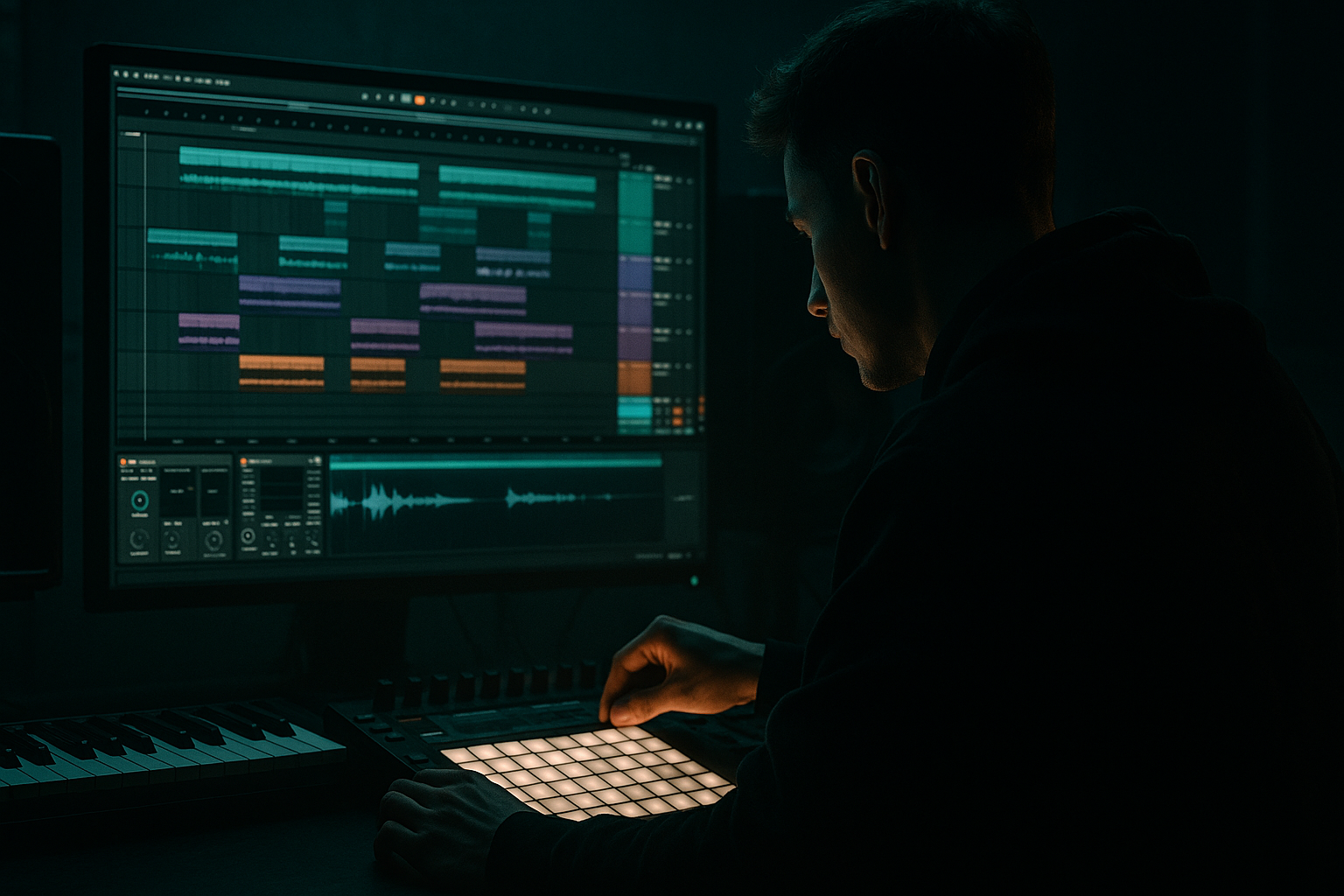
Main tutorial
```markdown
Subsine Clean Course: Timeless Roller Momentum (Ableton Live 12) 🥁🔊
Skill level: Intermediate
Category: Drums (with sub integration for roller feel)
Vibe: Jungle / oldskool DnB roller energy—clean subs, tight drums, relentless momentum
---
1. Lesson overview
This lesson is about building roller momentum the oldskool/jungle way:
- Clean subsine that locks with the kick without fighting it
- Drum programming that creates motion (ghosts, pushes, shuffles)
- Mix control so your groove stays loud, punchy, and timeless 🎯
- A clean sub sine (stable, mono, controlled sustain)
- A classic 2-step-ish roller drum groove with amen-style energy (ghost notes + hats)
- A drum bus chain that glues without killing transients
- Basic arrangement movement (fills, hat variations, short breaks)
- Attack: 0.0–1.0 ms
- Decay: ~250–450 ms (depends on pattern)
- Sustain: -inf to -6 dB (roller subs often “pluck” a bit rather than hold forever)
- Release: 60–120 ms (avoid sub clicking; keep tail controlled)
- Bar 1: 1.1 (long), 1.3 (short), 1.4.2 (short)
- Bar 2: 2.1 (long), 2.2.3 (short), 2.4 (short)
- Sidechain: ON
- Audio From: Kick track (we’ll build next; for now route later)
- Ratio: 2:1 to 4:1
- Attack: 2–10 ms (let the sub speak a hair; don’t erase it)
- Release: 60–140 ms (time it to groove—too long kills momentum)
- Aim for 2–5 dB gain reduction on kick hits.
- Kick: on 1.1 and 1.3 (classic 2-step anchor)
- Snare: on 1.2 and 1.4
- Closed hats: 1/8 notes (or 1/16 if you want busier energy)
- Open hat: try 1.3.3 or just after 1.3 (tiny push)
- Ghost snare very low velocity at 1.1.3, 1.2.3, 1.3.3, 1.4.3 (pick 1–2 to start)
- Main snare: 105–127
- Ghosts: 20–55
- Hats: vary 45–90, avoid machine-gun consistency
- HP at 150–250 Hz (keep sub clean)
- Slight dip around 3–5 kHz if it fights snare crack
- Select DRUMS + BREAK → Group → name it DRUM BUS
- Mute BREAK for 1 bar
- Add a reverb throw on snare hit at bar 16 (use Send)
- Sub too long: sustained sub notes smear the groove and reduce punch. Leave gaps.
- Over-swinging the snare: keep main snares steady; swing hats/ghosts instead.
- Break loop too loud: if you can clearly “hear the Amen,” it’s probably not tucked enough (unless that’s the point).
- Too much Drum Buss Boom: Boom can fight the sub fundamental and wreck clarity fast.
- Sidechain too extreme: pumping is cool in some styles, but classic rollers often want tight, not “EDM duck.”
- Parallel distortion on drums:
- Sub harmonics without losing clean:
- Snare weight in the 180–240 Hz zone (carefully):
- Darker roll from hats:
- Roller momentum comes from tight anchors (kick/snare) + controlled chaos (ghosts, hats, break texture).
- A clean subsine is about envelope discipline, mono control, and gentle harmonics—not excessive distortion.
- Use Ableton stock tools: Operator, EQ Eight, Saturator, Utility, Compressor, Drum Buss, Glue Compressor to get pro results fast.
- Arrange in 4-bar blocks with small changes to keep the loop alive.
We’ll focus on Ableton Live 12 stock tools and a workflow you can repeat fast.
---
2. What you will build
By the end you’ll have a working 16-bar loop that feels like a proper roller:
---
3. Step-by-step walkthrough
Step 0 — Session setup (tempo + grid)
1. Set tempo to 170–174 BPM (start at 172).
2. In the top bar, set Global Quantization: 1 Bar.
3. Turn on Groove Pool view (we’ll use it later for swing).
DnB note: “Roller momentum” usually lives in the micro-timing and ghost velocity more than in fancy sound design.
---
Step 1 — Build the clean sub sine (the “Subsine clean course”) 🔊
We’re making a sub that is pure, stable, and mix-safe.
#### 1A) Create the sub instrument
1. Create a new MIDI track: SUB
2. Drop Operator (stock Ableton).
3. In Operator:
- Algorithm: set to A only (just one oscillator)
- Oscillator A:
- Wave: Sine
- Level: 0 dB (adjust later)
#### 1B) Shape the sub envelope (clean but rhythmic)
In Operator → Amp Envelope:
✅ If you want longer notes (more “held” roller), increase Sustain and shorten Release slightly.
#### 1C) Add a safety chain (Ableton stock device chain)
On the SUB track, add:
1. EQ Eight
- Enable HP filter at 20–30 Hz, 24 or 48 dB/oct (tighten rumble)
- Optional: tiny dip around 120–200 Hz if it overlaps with kick “thump” area
2. Saturator (for audibility on smaller speakers)
- Drive: 1.5–4 dB
- Soft Clip: ON
- Output: reduce so level matches before/after
- Keep it subtle—this is “clean course,” not reese territory.
3. Utility
- Width: 0% (mono)
- Optional: Bass Mono (if using Live’s bass mono feature) set around 120 Hz
- Gain staging: aim your SUB to peak around -10 to -6 dB before the master.
#### 1D) Program the sub pattern (roller momentum)
Create a 2-bar MIDI clip. Use a key like F or G (common for DnB subs).
Example pattern (F1-ish range; choose what fits your track):
Important: Leave small gaps. Continuous sub = no punch. Gaps create perceived loudness and groove.
#### 1E) Sidechain the sub to the kick (transparent)
On SUB, add Compressor:
---
Step 2 — Build the roller drums (core groove first) 🥁
We’ll use a Drum Rack to keep it organized.
#### 2A) Drum Rack setup
1. Create a MIDI track: DRUMS
2. Drop Drum Rack.
3. Load:
- Kick: tight DnB kick (short tail)
- Snare: jungle/snappy snare (or snare+clap layer)
- Closed hat: crisp 909-ish or break hat
- Open hat: short, bright
- Ghost snare: lighter snare or rim
Ableton workflow tip: Put Simpler on each pad (default in Drum Rack), and use One-Shot mode.
#### 2B) Program the foundational “roller” placement
In a 1-bar clip (repeat later):
Now add ghost notes (this is where the roll comes from):
Velocity targets:
#### 2C) Make it feel jungle: micro-timing + groove pool
1. Select the hat notes and some ghosts.
2. Nudge timing slightly:
- Push some hats +5 to +12 ms late for swingy roll
- Pull a few ghosts -5 ms early for urgency
3. Add a Groove:
- Open Groove Pool, choose something like MPC 16 Swing or SP-style groove
- Apply Groove Amount: 10–25% (subtle)
Rule: Don’t swing the main snare hits heavily—keep them as your “pillars.”
---
Step 3 — Breakbeat texture layer (oldskool glue) 🧨
Rollers often feel “alive” because a break is quietly driving the air.
#### 3A) Add a break loop track
1. Create audio track: BREAK
2. Drop in an Amen-style or classic break (legal sample, of course).
3. Warp mode:
- Beats mode
- Preserve: Transients
- Envelope: 20–40 (keeps some natural variation)
#### 3B) High-pass and tuck it in
On BREAK add EQ Eight:
Set BREAK level low: it should be felt, not obviously heard.
---
Step 4 — Drum bus processing chain (punch + glue without flattening) 🔥
Group your drum tracks:
Add these devices in order:
1. EQ Eight
- HP at 25–35 Hz (remove nonsense)
- Optional: gentle shelf +1 dB around 8–10 kHz if dull
2. Drum Buss
- Drive: 5–15% (light)
- Boom: OFF or very low (Boom can mess with sub clarity)
- Transient: +5 to +20 (if you need punch)
- Crunch: 0–10 (tiny)
- Keep it “feel-good,” not crunchy distortion.
3. Glue Compressor
- Attack: 3 ms or 10 ms (10ms preserves transients more)
- Release: Auto or 0.1–0.3s
- Ratio: 2:1
- Aim for 1–3 dB GR on peaks
4. Soft Clip (optional)
- Use Saturator with Soft Clip ON, Drive 1–3 dB
- This can make drums louder without sounding squashed.
---
Step 5 — Kick/Sub relationship: lock it tight ✅
Now that drums and sub exist, do a quick relationship check:
1. Tune the kick (if needed)
- If your kick has tonal tail, tune it near the sub note (e.g., F) or shorten its tail in Simpler.
2. Check phase
- Add Utility on SUB
- Try Phase Invert L/R (or just invert if available) and pick the setting with more low-end impact (trust ears + meter)
3. Sidechain re-check
- Make sure the sub ducks cleanly on kick hits
- If the groove feels like it “breathes” too much, reduce ratio or shorten release.
---
Step 6 — Arrangement ideas for timeless roller momentum (16 bars) 🧱
Make a 16-bar section and add movement every 4 bars:
Bars 1–4: Core groove (no fills, just establish)
Bars 5–8: Add hat variation (extra 1/16 hats very low velocity)
Bars 9–12: Add a tiny snare fill (1/32 roll or ghost triplet just before bar 9)
Bars 13–16: Mini drop-out:
Ableton trick: Automate Drum Buss Transients up slightly in bars 9–16 for rising energy.
---
4. Common mistakes 🚫
---
5. Pro tips for darker/heavier DnB 🕶️
- Create a return track with Saturator (Drive 6–12 dB) + EQ Eight HP 200 Hz
- Send snare/hats lightly to it for grit without mud.
- Duplicate SUB → high-pass the duplicate at 120 Hz
- Add heavier Saturator on the duplicate only
- Blend quietly to make the bass “read” on phones while keeping true sub pure.
- Tiny bell boost +1 to +2 dB on snare channel if it’s thin
- But re-check with sub and kick so it doesn’t cloud the low mids.
- Low-pass hats slightly (Auto Filter or EQ Eight) around 10–14 kHz
- Less “sparkle,” more menace.
---
6. Mini practice exercise 🎯
Do this in 20 minutes:
1. Build a 1-bar roller groove (kick/snare/hats/ghosts).
2. Create two sub clips:
- Clip A: more sustained notes
- Clip B: shorter notes with more gaps
3. A/B them with the same drums and choose which feels more “rolling.”
4. Add a break layer and mix it so you only notice it when it’s muted.
5. Export an 8-bar loop and listen on:
- headphones
- small speaker/phone
Check: does the groove still feel like it’s “moving forward”?
---
7. Recap ✅
If you want, tell me what style you’re aiming for (more 94 jungle, early RAM roller, or modern minimal roller) and I’ll give you a specific 16-bar MIDI drum + sub pattern blueprint.
```

